

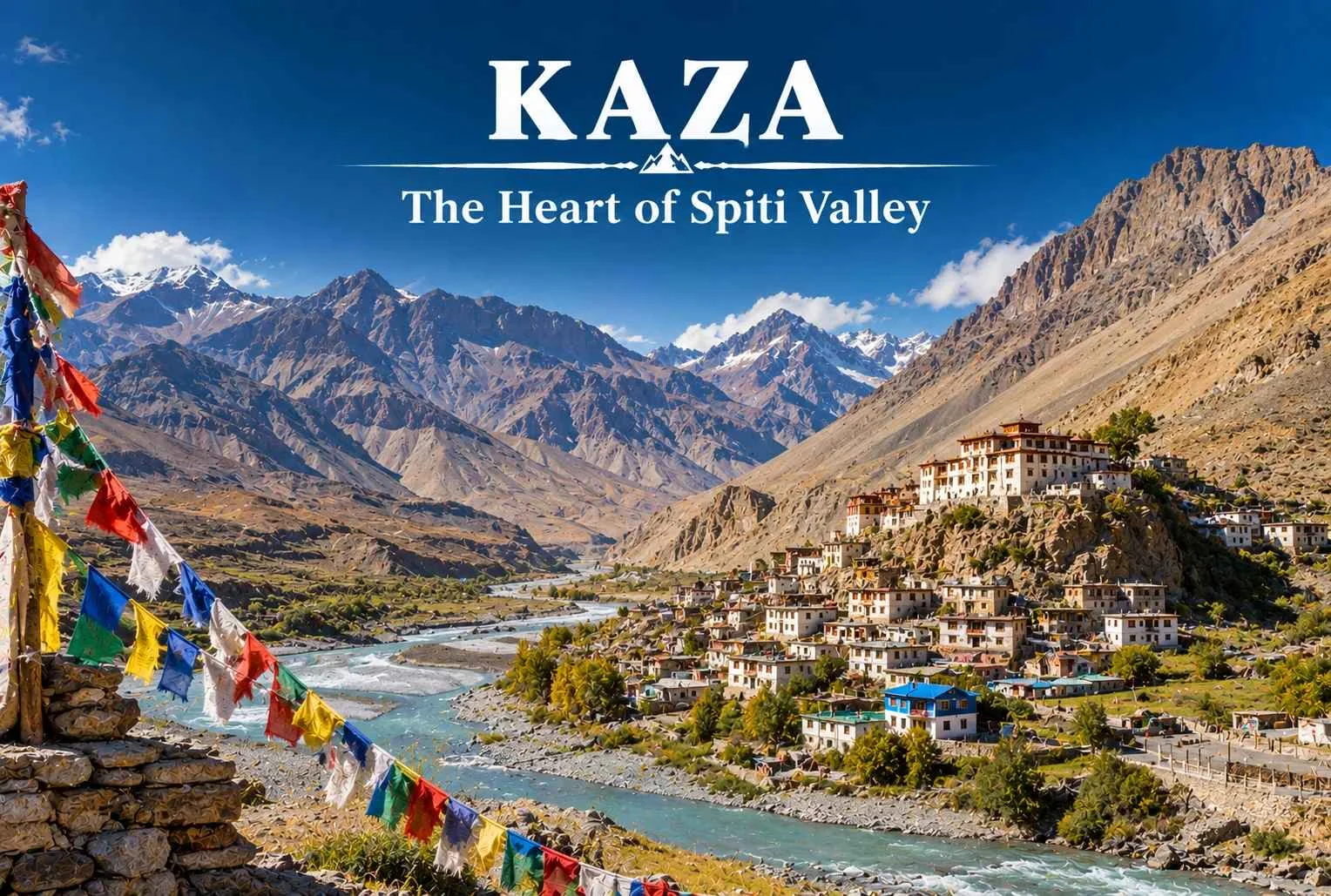
Kaza sits at the center of Spiti Valley, and if you’re planning a trip to this cold desert region of Himachal Pradesh, you’ll likely pass through it more than once. It’s the administrative headquarters of Lahaul and Spiti district, the largest town in the valley, and the natural base for exploring monasteries, villages, and high-altitude landscapes that surround it on every side.
Table of Contents
This guide covers what you need to know before you go: Kaza’s altitude, how to get there, the best time to visit, where to stay busy once you arrive, and what to pack for a region where the weather can shift fast and facilities are limited.
Kaza Quick Facts
| Information | Details |
| Location | Spiti Valley, Lahaul and Spiti district, Himachal Pradesh |
| Altitude | Approximately 3,800 m / 12,500 ft above sea level |
| Best Time to Visit | Mid-May to early October |
| Nearest Airport | Bhuntar Airport (Kullu-Manali), approximately 200 km away |
| Nearest Railway Station | Joginder Nagar or Shimla (both several hours away by road) |
| Starting Points | Manali or Shimla |
| Language | Hindi, Spiti dialect, English understood in tourist areas |
| Connectivity | Limited mobile network; BSNL works best |
Kaza Himachal: Location and Overview
Kaza sits along the Spiti River, roughly midway between the valley’s northern and southern stretches, which is why most itineraries use it as a base for day trips. The town itself is compact, split into Old Kaza and New Kaza, with markets, guesthouses, and a few cafes catering to travelers.
The region falls within a cold desert zone, so vegetation is sparse and the landscape leans toward bare mountains, deep river gorges, and scattered patches of green wherever irrigation reaches the fields. Barley and pea are common crops here, and you’ll notice traditional mud-brick houses built to handle the extreme temperature swings between day and night.
Culturally, Kaza and the wider Spiti Valley carry strong Tibetan Buddhist influence. Monasteries dot nearly every ridge, and local festivals often follow the Tibetan calendar. If you’re interested in Himalayan Buddhist culture, this is one of the more accessible regions in India to experience it firsthand.
Kaza Height From Sea Level and Climate
Kaza’s height from sea level — approximately 3,800 meters or 12,500 feet — places it in a range where altitude sickness is a genuine consideration, especially if you’re arriving directly from lower elevations like Manali or Delhi without acclimatization. Days can feel warm under direct sun even in summer, but temperatures drop sharply after sunset year-round. Winters bring heavy snowfall and can isolate the town for weeks at a time when roads become impassable.
How to Reach Kaza
There are two primary road routes into Kaza, and choosing between them depends on the season and how much time you have.
From Manali
The Manali to Kaza route via Kunzum Pass covers roughly 200 km and typically takes 8 to 10 hours, depending on road conditions. This route stays closed for most of the winter due to snow at Kunzum Pass and generally opens by late May or June. It’s a scenic drive, but it’s also physically demanding given the altitude gain, so many travelers break the journey with a stop in Chandratal or Losar.
From Shimla
The Shimla to Kaza route runs via Kinnaur and Reckong Peo, covering approximately 412 km over 2 to 3 days of travel with overnight stops. This road stays open longer into the year than the Manali route and is generally considered safer during shoulder seasons, though it’s a longer journey overall.
Transportation Options
- Private vehicle: Gives you flexibility to stop at viewpoints and villages along the way, and is the preferred choice for most travelers given the limited public transport frequency.
- HRTC buses: Himachal Road Transport Corporation runs buses connecting Kaza with Shimla and Manali during the operational season, though schedules can be irregular and subject to weather.
- Shared taxis: Available from Manali and Reckong Peo, especially during peak season.
Road conditions in this region change quickly with weather, so it’s worth confirming current status with local authorities or the Himachal Pradesh Tourism department before you set out.
Best Time to Visit Kaza
Timing your trip well matters more here than in most Himalayan destinations, since road access is seasonal and weather conditions vary dramatically.
| Season | Weather | Crowd Level | Experience | Recommended For |
| Summer (June–August) | Mild days, cold nights | High | Full road access, monastery festivals, green patches in fields | First-time visitors, families |
| Monsoon (July–August) | Generally drier than rest of Himachal, occasional landslides on approach roads | Moderate | Spiti sits in a rain shadow, so this can be a good window, but access roads outside the valley may see disruption | Travelers avoiding peak monsoon elsewhere |
| Autumn (September–October) | Clear skies, cooler temperatures | Moderate | Good visibility, harvested fields, fewer crowds | Photographers, peaceful travel |
| Winter (November–April) | Extreme cold, heavy snow, roads often closed | Very low | Frozen Spiti River, “Spiti in winter” specialty trips for the adventurous | Experienced high-altitude travelers only |
May to early October remains the practical window for most visitors, since both the Manali and Shimla routes are typically functional during this stretch. Winter travel to Kaza is possible but requires specialized planning, warmer gear, and flexibility around road closures.
Places to Visit in Kaza
Kaza works well as a base because so many notable sites sit within an hour or two of the town.
Key Monastery
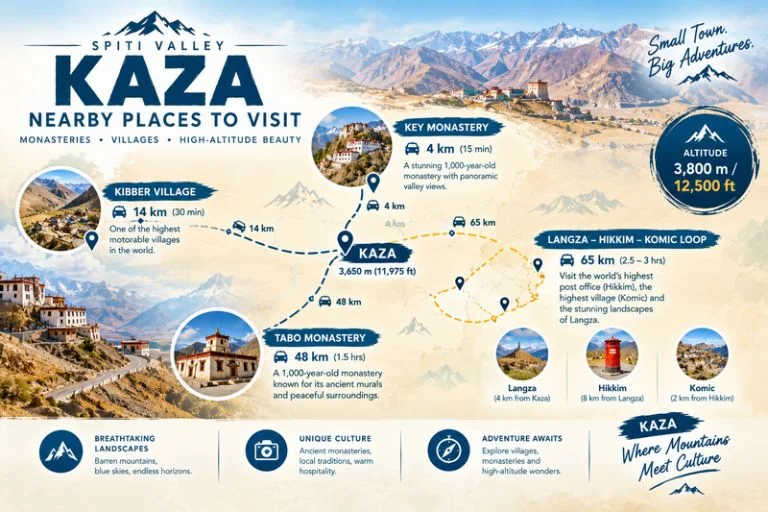
Key Monastery, also spelled Ki Gompa, sits around 12 km from Kaza and is one of the largest and oldest monasteries in Spiti Valley. Built into the hillside in a series of stacked structures, it houses a community of monks and a collection of murals, thangkas, and manuscripts. It’s one of the most recognizable places to visit in Kaza and a fixture on nearly every Spiti itinerary.
Kibber Village
Kibber sits close to Key Monastery at a higher elevation and was historically known as one of the highest motorable villages in the region. It’s a good stop for those interested in traditional Spitian architecture and rural life, and it also serves as a gateway for wildlife spotting, including occasional snow leopard sightings in winter.
Tabo Monastery
Located about 47 km from Kaza, Tabo Monastery is often called the “Ajanta of the Himalayas” for its centuries-old wall paintings. It’s one of the oldest continuously functioning Buddhist monasteries in India and the Himalayan region, and its mud-brick structures contrast with the more elevated, cliffside style of Key Monastery.
Langza, Hikkim, and Komic
These three villages sit close together and make for a natural day-trip loop from Kaza. Langza is known for its large Buddha statue overlooking the valley and for fossil hunting in the surrounding hills. Hikkim is home to what’s often cited as the world’s highest post office. Komic ranks among the highest villages connected by motorable road in the region.
Pin Valley
South of Kaza, Pin Valley opens into a National Park known for its stark, dramatic terrain and as habitat for species like the ibex and snow leopard. It’s also home to Kungri Monastery, one of the older gompas in the valley.
If you’d rather explore this entire region as part of a structured itinerary with local support, Explore Hills’ Spiti Valley tour covers Kaza alongside these surrounding villages and monasteries.
Things to Do in Kaza
Beyond sightseeing, Kaza and its surroundings offer a range of activities depending on your interests and fitness level.
- Trekking: The region around Kaza connects to several high-altitude trekking routes, and travelers who enjoy Himalayan treks elsewhere in Himachal often extend their trip to include a route through this belt.
- Village walks: Walking through Old Kaza or nearby villages like Kibber gives you a closer look at everyday Spitian life, mud-brick construction, and local farming practices.
- Photography: The combination of stark mountains, monasteries, and clear high-altitude light makes this one of the more rewarding regions in India for landscape photography.
- Monastery visits: Beyond sightseeing, many monasteries welcome visitors during prayer sessions, offering a genuine window into daily monastic routine if approached respectfully.
- Fossil hunting near Langza: The area around Langza is known for marine fossils, a reminder that this entire region was once part of the ancient Tethys Sea.
- Stargazing: With minimal light pollution and high altitude, clear nights around Kaza offer some of the best stargazing conditions in Himachal Pradesh.
If high-altitude trekking is part of your plan, it’s worth looking at Explore Hills’ broader Himachal treks lineup, including routes like the Pin Bhaba Pass Trek, which connects the Pin Valley near Kaza with the Bhaba Valley in Kinnaur.
Packing List for Kaza
Given the altitude and remoteness, packing thoughtfully matters more here than for a typical hill station trip.
- Warm layers, including a down jacket even in summer, since nights stay cold
- Windproof and waterproof outer shell
- Sturdy walking shoes or trekking boots
- Sunscreen and sunglasses, since UV exposure is stronger at altitude
- Lip balm and moisturizer for the dry climate
- A reusable water bottle and water purification tablets
- Personal medications, along with basic medicine for altitude-related discomfort
- Power bank, since charging points can be unreliable
- Cash, as ATMs are limited and unreliable across the valley
- Valid ID, since some stretches near the Indo-Tibetan border may require identification checks
Acclimatization matters as much as any item on this list. Spend a day resting in Kaza before attempting nearby high-altitude villages like Komic or Kibber, and pay attention to symptoms like persistent headache, nausea, or breathlessness.
Responsible Tourism in Kaza
Spiti Valley’s ecosystem is fragile, and the local communities that live here depend on tourism behaving responsibly.
- Carry your waste back out, especially plastic, since there’s no organized waste management system in most villages.
- Respect monastery etiquette by dressing modestly, removing footwear where required, and asking before photographing monks or religious ceremonies.
- Support local homestays and family-run guesthouses rather than defaulting only to larger hotels, since tourism income directly benefits Spitian households.
- Stick to established roads and paths, since off-roading damages the sparse vegetation that takes years to recover in this cold desert environment.
- Avoid disturbing wildlife, particularly in Pin Valley National Park, where species like the snow leopard are sensitive to human presence.
Planning Your Spiti Trip Around Kaza
Kaza works best as a hub rather than a single stop. Once you’re acclimatized, the surrounding villages, monasteries, and valleys are all within reach for day trips, and the town itself has enough guesthouses and cafes to make a multi-day stay comfortable.
If you’d rather travel through this stretch of Himachal with a fixed itinerary and local support, Explore Hills’ Himachal trips include options covering Spiti Valley and neighboring regions like Kinnaur, including the Shimla Kalpa Sangla Chitkul trip for those who want to combine both areas in a single journey.
Freuently Asked Question’s
What is Kaza’s altitude?
Kaza sits at approximately 3,800 meters (12,500 feet) above sea level, making acclimatization an important part of trip planning.
How do I reach Kaza from Manali?
The Manali to Kaza route via Kunzum Pass covers about 200 km and takes roughly 8 to 10 hours, but it’s only open during the summer and early autumn months.
Is Kaza safe for first-time high-altitude travelers?
Kaza is a reasonable introduction to high-altitude travel since it has basic infrastructure, but you should still rest for a day to acclimatize before heading to higher villages nearby.
What is the best time to visit Kaza?
Mid-May to early October is generally the most reliable window, when both major access roads are typically open and weather is more predictable.
Are there ATMs in Kaza?
Kaza has limited ATM access, and machines can run out of cash or face connectivity issues, so it’s best to carry sufficient cash from Manali or Shimla.
Can I visit Kaza in winter?
Winter visits are possible but challenging, since heavy snow often closes access roads for extended periods, and temperatures drop well below freezing.
How many days do I need in Kaza?
Three to four days is enough to cover Kaza itself along with nearby sites like Key Monastery, Kibber, Langza, Hikkim, and Komic.
Is mobile network available in Kaza?
Network coverage is limited, and BSNL tends to work more reliably than other carriers, though connectivity can still be patchy throughout the valley.