

Table of Contents
Four hours south of Mumbai, where the Konkan coastline folds around a cluster of forested hills, sits a town small enough to walk across in twenty minutes yet layered enough in history to fill an entire day. Harihareshwar has been called Dev-Ghar, the “House of God,” for centuries, and it’s also known locally as Dakshin Kashi, the Kashi of the south. Rather than list Harihareshwar’s attractions in the usual order, let’s walk through them the way a visitor actually would — from the temple at sunrise to the fort at sunset.
Morning: The Temple That Named the Town
Most visits begin the same way locals have begun theirs for generations — at the Harihareshwar Temple, perched on a hill directly above the sea. The complex is actually two adjoining shrines. Tradition insists you visit the smaller Kalbhairav temple first, dedicated to Shiva’s fierce guardian form, before entering the main sanctum. Inside the principal shrine sit idols of Shiva, Parvati, Vishnu, and Brahma together, which is part of why the site carries such unusual religious weight — most temples honour one primary deity, but this one gathers several.
The temple’s origins trace to the late medieval period, and it holds a particular significance for the Peshwas, the hereditary prime ministers of the Maratha Empire, who regarded the presiding deity as their family god. Chhatrapati Shivaji Maharaj is recorded as having visited in 1674. Decades later, a fire severely damaged the structure, and Peshwa Bajirao I financed its restoration in 1723. A circumambulatory path, the Pradakshina Marg, runs around the temple along the seashore, built under the patronage of Chandrarao More — though it’s worth avoiding during high tide, when the sea reclaims parts of the walkway.
Just behind the temple stands a large boulder, split cleanly into two. Local legend attributes this to Bhima, the second of the five Pandava brothers, who is said to have broken the rock apart with his bare hands because it blocked the path to the shrine.
Midday: Two Beaches, One Coastline
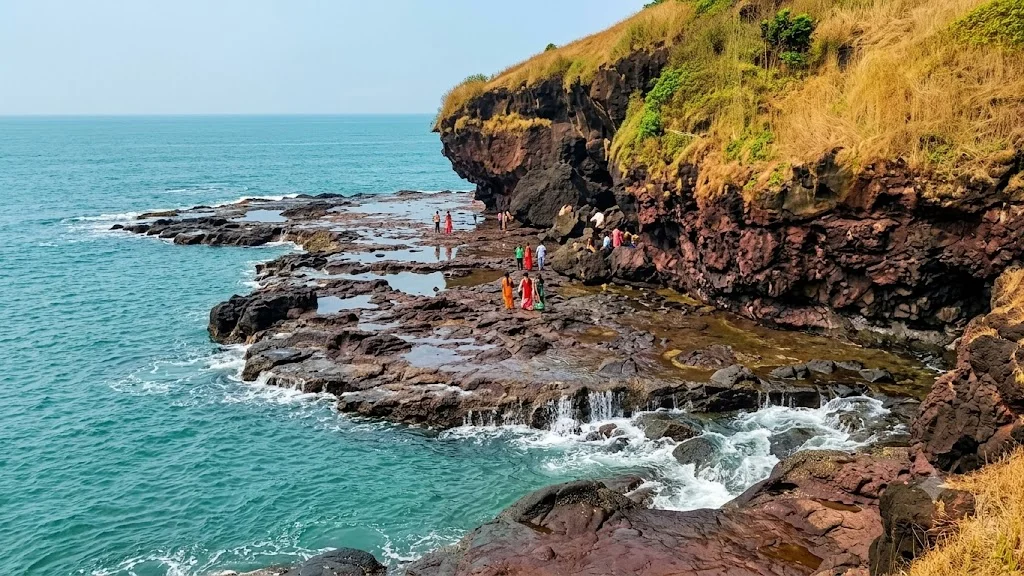
By midday, most visitors make their way down to the Harihareshwar Beach, and there’s genuine choice involved, since the town actually has two. One stretches roughly 2.4 km directly in front of the temple, while a second, L-shaped beach lies near the MTDC resort to the south. Both are framed by the same dramatic backdrop — four hills known locally as Harihareshwar, Harshinachal, Brahmadri, and Pushpadri, rising just behind the sand.
Unlike some of Maharashtra’s more commercialised coastal towns, the beaches here retain a quieter, more contemplative character, shaped in part by the town’s pilgrimage identity. Alongside the shoreline, visitors can also explore the Kalbhairav Cave, a rock-cut space near the temple containing carvings and imagery associated with the deity, adding another layer to an already temple-dense stretch of coast.
Afternoon: Crossing to the Fort
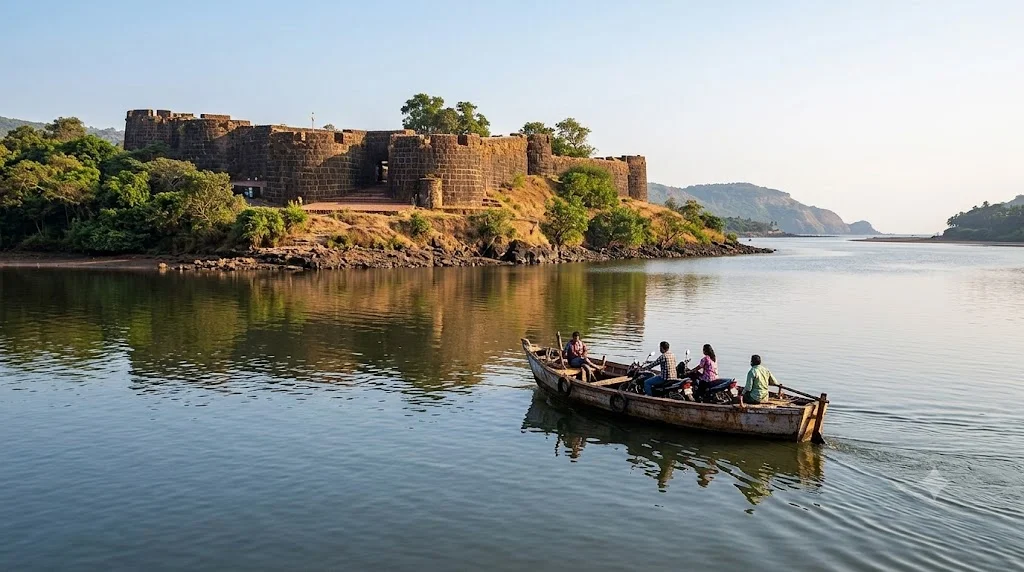
For travellers with a little more time, the afternoon is best spent on a short but memorable detour: a visit to what’s often loosely referred to as the Harihareshwar Fort. Strictly speaking, there’s no fort within Harihareshwar itself — the actual fortification, Bankot Fort, also known as Himmatgad or Fort Victoria, sits roughly 10 km away, across the mouth of the Savitri River.
Getting there is part of the experience. Visitors typically take a ferry from Bagmandala across the creek, a short but scenic crossing that adds genuine adventure to the trip. Built from red laterite stone and shaped roughly like a square, Bankot Fort has passed through an unusually long list of hands — local rulers, the Siddis, the Marathas under Kanhoji Angre, and eventually the British, who renamed it Fort Victoria after capturing it. A secret bastion entrance, added by the Siddis to strengthen its defences, still survives today, along with sweeping views over the Bankot creek where the Savitri meets the Arabian Sea.
Legends Carved Into the Landscape
Beyond the Bhima legend, another story explains the sacred status of the main temple itself. According to local tradition, Sage Agastya performed intense penance here, and Lord Shiva appeared in lingam form as a boon for his devotion — an origin story that ties the temple’s spiritual power directly to the landscape rather than to any single dynasty or ruler.
This layering of myth and documented history is part of what makes Harihareshwar stand out. It isn’t simply an old temple with a nice beach attached; it’s a place where legend, Maratha-era politics, and geography all intersect on the same short stretch of coastline.
Why Locals Call It Dev-Ghar
The nickname “House of God” isn’t just poetic flourish for Harihareshwar. Harihareshwar is counted among the Pancha Kashi, a group of five sites in Maharashtra considered especially sacred to Shiva devotees, alongside Shingnapur, Ozar, Lenyadri, and Nashik. Its connection to the Peshwas adds a second layer of significance — the very institution of the Peshwa prime-ministership is said to have originated nearby in Shrivardhan, just a short drive away, where Balaji Vishwanath, the first Peshwa, was born.
Taken together, these threads explain why a town this small draws pilgrims, historians, and beach-goers in equal measure.
Planning Your Trip
- Location: Raigad district, Maharashtra, on the Konkan coast
- Distance from Mumbai: Approximately 210 km, around 4 to 5 hours by road
- Distance from Pune: Approximately 190 km
- Temple timings: Generally 6:00 AM to 8:00 PM, with no entrance fee
- Best time to visit: October to March, avoiding the monsoon months when sea conditions and ferry access can be unpredictable
- Nearby stops: Shrivardhan Beach, Diveagar Beach, and Bagmandala village
For a broader weekend escape that pairs coastal calm with cultural depth, our Weekend Packages collection covers similar short getaways for travellers short on time but not on curiosity.
For verified travel details and heritage information, you can refer to Maharashtra Tourism (MTDC), the state’s official tourism portal.
Frequently Asked Question’s
What is Harihareshwar famous for?
Harihareshwar is famous for its ancient hilltop temple dedicated to Shiva, Vishnu, and Brahma together, its twin beaches, and its historical connection to the Peshwas of the Maratha Empire.
Is there really a fort in Harihareshwar?
Not within the town itself. The nearest fort, commonly associated with a Harihareshwar trip, is Bankot Fort, located about 10 km away and reachable by a short ferry ride across the Savitri River.
How far is Harihareshwar from Mumbai and Pune?
It’s approximately 210 km from Mumbai and 190 km from Pune, both roughly a 4 to 5-hour drive.
What are the temple timings and is there an entry fee?
The temple is generally open from 6:00 AM to 8:00 PM daily, and there is no entrance fee.
What is the best time to visit?
October to March offers the most pleasant weather and stable sea conditions, making it ideal for both temple visits and beach activities.