

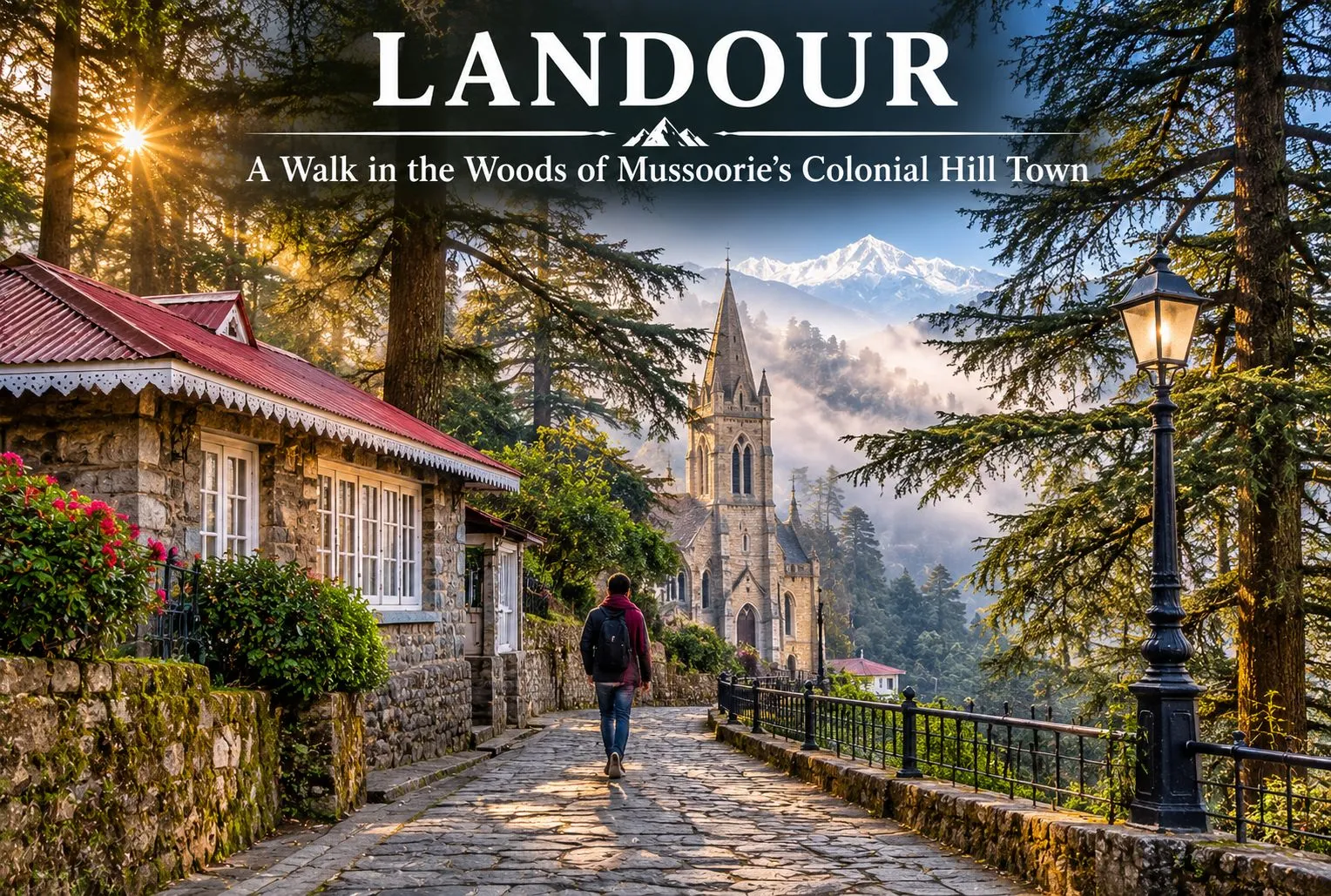
Where the honking starts to fade, and time seems to stand still in the 1820s, begin quiet deodar- and oak-lined walking trails. In the hills of Uttarakhand, known for its misty forests, lies Landour, a peaceful mountain destination known for its British Raj cantonment at an elevation of 7,500 ft. Landour, being so scenic and majestic, has been protected by cantonment regulations, first under the Cantonments Act of 1924 and now the Cantonments Act of 2006, which tightly restrict new commercial buildings and massive developments.
This makes Landour feel stuck in the 1820s, giving it an old-world charm that contrasts with Mussoorie. The colonial settlement is situated above Mussoorie in the Garhwal Himalayan region of the Dehradun district in Uttarakhand, a state in northern India.
For official information on how the area is administered, you can refer to the Landour Cantonment Board, the Ministry of Defence body that manages the cantonment.
Table of Contents
The Story of a Colonial Hill Station Set in the Himalayas
Landour is a beautiful hill station surrounded by natural beauty, colonial flair, and a welcoming atmosphere. Dating back to the early nineteenth century, Landour is home to some of the earliest examples of British hill stations. Its origins lie in the colonial era, when the British wanted to escape the heat of inland India. The region that would become the colonial-era settlement was a sparsely populated area of Garhwal. However, after the Anglo-Nepalese War (1814-1816), British authorities determined that the territory would be beneficial as a place for troops to rest and recover. Thus, the first British settlers arrived in the region.
Among them was Captain Frederick Young, a member of the Gurkha Infantry, who in 1825 built Mullingar, the first permanent house in the Mussoorie-Landour area. In 1827, a military hospital was founded on the territory of modern-day Landour. British soldiers wounded in action were sent to this sanatorium on high ground to take advantage of the cool climate. Subsequently, hotels, houses, and churches were built within the settlement.
Today, Landour is home to several colonial-era buildings and two notable churches: St. Paul’s and the Kellogg Memorial Church. Even after India’s independence in 1947, the place retained its status as a center of military significance while also becoming a popular tourist destination. To this day, the legacy of the colonial era lives on in the local architecture. Besides being a haunt of writers and nature lovers, Landour offers a pleasant stay for those who enjoy road trips, as well as hiking and exploring.
Why Landour Is Famous
Landour is a land of peace, which makes it a great alternative for nature lovers who want to enjoy the beauty of the region away from the busy roads and much of the crowd of Mussoorie. That said, summer weekends in May and June can bring heavy traffic and limited parking to Landour as well, so weekdays and early mornings are the calmest times to visit. Landour is famous for its handmade artisanal items, food products, old-fashioned Bakehouse, and leather goods. The most famous author, Ruskin Bond, is a resident of the area, which makes the place even more special. There are several famous spots near Landour as well.
- Lal Tibba: Lal Tibba is a scenic point and a must-visit for all photography enthusiasts, as well as for sightseeing.
- Char Dukan: Char Dukan is a popular hub for foodies, offering tasty pancakes, omelettes, sandwiches, Maggi, and tea. It is a good place to relax and have a hearty breakfast while exploring local cuisine.
- The Landour Bakehouse: The Landour Bakehouse is a bakery and cafe in the heart of Sisters’ Bazaar, famous for its cosy interior, desserts, and coffee. It is a perfect spot to relax and enjoy a piece of cake or some coffee after a day of exploring the Himalayas.
Significant Buildings of Landour
Captain Frederick Young, a member of the Gurkha Infantry, built Mullingar, the first permanent house in the Mussoorie-Landour area, in 1825. It became an important landmark that other British residents followed. Landour’s weather was one of the most important reasons for settlement in the area. Its cool climate helped injured soldiers recover and rest from the war.
- St. Paul’s Church: St. Paul’s Church is a historic building located near Char Dukan. The area is ideal for taking a short break, enjoying the scenery, and soaking in the peace and tranquillity of the atmosphere.
- Kellogg Memorial Church: Kellogg Memorial Church is another notable landmark that serves as a reminder of the area’s colonial history and of the missionary educational institutions around it. Because of its close ties with the Language School, it is considered one of the most interesting landmarks in the area.
- Cafe Ivy: Cafe Ivy is a good choice for those who want to explore the local scene, offering upscale dining and a chance to enjoy the ambiance of the region and the mountain air. It is advisable to call ahead to confirm that it is open.
In addition to scenic views and opportunities to experience local culture, Landour offers quiet deodar- and oak-lined walks, quaint cottage neighbourhoods, road travel, and immersion in the legacy of the famous writer Ruskin Bond.
Altogether, these factors make Landour a fascinating destination full of opportunities for nature lovers, gourmets, adventure travellers, and history buffs. The Clock Tower is a good place to ask for directions, as it serves as a reliable guide to the region’s roads and heritage.
For a proper trek close to Mussoorie after a few relaxed days here, Explore Hills’ Nag Tibba Trek is a popular weekend option.
Journey from Mall Road to the Colonial-Era Settlement
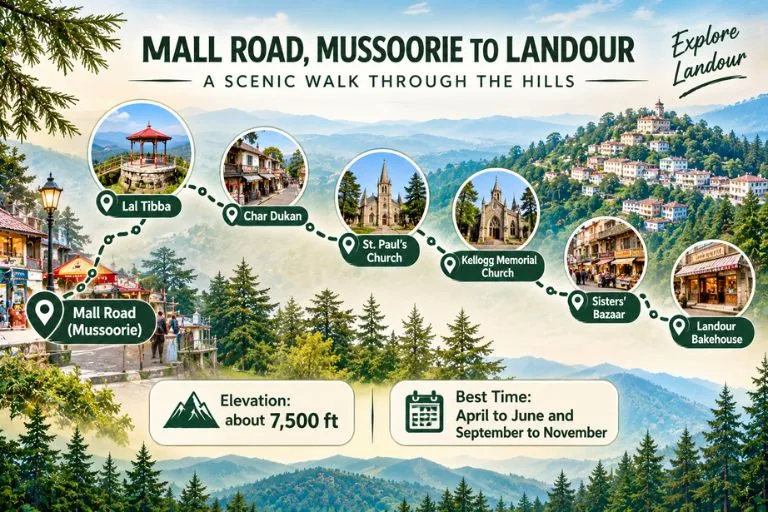
A trip from Mall Road, Mussoorie, to Landour is a short getaway that starts from the busy streets of the hill station and heads up the mountain roads to a more serene escape. Starting your journey on Mall Road, which is full of shops, bars, and restaurants, head to Landour via the mountain pass. On the way, you may want to stop at Lal Tibba, one of the best viewpoints in Mussoorie. From there, you can see the distant Himalayas on a clear day. Further ahead, you will find the local favourite diner, Char Dukan, where you can have pancakes, sandwiches, and tea. Stop at Sisters’ Bazaar and the famous Bakehouse to try their treats.
If you are interested in the history of the region, St. Paul’s Church and Kellogg Memorial Church are worth seeing. Landour is different from Mussoorie because it offers a more relaxed atmosphere, an opportunity to enjoy the natural beauty of the region, and mountain air. A trip from Mall Road in Mussoorie to Landour is an adventure that takes you away from the chaos of the city and into the peaceful woods and up the Himalayas.
Travellers who want to see more of the area around Mussoorie can also explore Explore Hills’ Mussoorie-Rishikesh-Haridwar Trip, which pairs the hill station with two more popular stops.
Conclusion
Landour is a real hidden gem, offering views over the Himalayas and an unforgettable wilderness experience in a magnificent mountain landscape. Landour is ideal for nature lovers, adventure enthusiasts, and those seeking to escape the hectic rhythm of city life. If you are searching for a complete escape from the mundane hustle and bustle of modern society, this is the retreat for you. Landour has plenty to offer in terms of excursions, hikes, and cultural tourism activities, as well as cafes where you can enjoy a good coffee while taking in the spectacular views.
Frequently Asked Questions
Which famous person lives in Landour, Mussoorie?
Some visit for the old charm of Landour, while others come to see the beloved author Ruskin Bond. Ruskin Bond is the most famous resident of the area, living there since 1963. He has traditionally met his fans on Saturday afternoons at the Cambridge Book Depot on Mussoorie’s Mall Road, but he is now in his 90s and does not appear every week, so it is best to check with the bookshop before planning your visit around it.
What to buy from Landour?
Landour is famous for its food, homemade peanut butter, jams, and artisanal cheese. You can buy cakes and cookies from the famous Landour Bakehouse.
What is the distance from Dehradun to Landour?
The distance from Dehradun to Landour is about 35 to 40 km by road, usually 1.5 to 2 hours depending on traffic. The nearest airport is Jolly Grant in Dehradun, and the nearest railway station is Dehradun railway station. You need to travel by road from the airport or railway station to reach Landour.
Can I walk from Mussoorie to the Bakehouse?
The Landour Bakehouse is about 4 to 5 km from Mussoorie’s Mall Road. The walk takes roughly 1 to 1.5 hours uphill and 30 to 40 minutes downhill. Distances vary by route, so it is worth checking a live map.
Which is the best month to visit Landour?
The best time to visit Landour is April to June and September to November. April to June brings pleasant weather, while September to November offers clear, green scenic views and mild temperatures.