

Table of Contents
At about 2,205 metres, Shimla is where colonial Britain went to escape the plains and where modern Himachal now governs itself. The hill town stretches along a ridge of deodar forest, with Gothic spires, old tea rooms and a toy train that arrives from the plains after a four-to-five hour climb. It is easy to reach, easy to walk and rewarding if you know where to start.
This article works as a planning sheet. It covers the road and rail routes, the landmarks worth your time, the weather and snow you can expect, and a one-day route that links the sights together.
Shimla at a Glance
| Detail | What to know |
|---|---|
| Altitude | About 2,205 metres (7,234 feet), per the India Meteorological Department |
| Role | Capital of Himachal Pradesh; once the British summer capital |
| Coldest month | January, with mean temperatures from about 2.5 to 10.3 °C |
| Snowiest months | January and February |
| Gateway | Chandigarh by road, Kalka by rail |
| Airport | Jubbarhatti, about 23 km from the town |
Chandigarh to Shimla Distance and the Road In
The usual published road distance is about 110 to 120 kilometres, and the drive takes roughly three to four hours in normal traffic. The route follows NH5 through the Parwanoo and Kalka side, then climbs past Dharampur, Solan and Kandaghat before reaching the hill town. Weekends and rain can add an hour.
State and private buses run from Chandigarh and usually terminate at the ISBT at Tutikandi, about 4 km from the centre, so budget for a local taxi or city bus for the last stretch. There is no direct train from Chandigarh. You go to Kalka first and change to the narrow-gauge line.
The Toy Train: Kalka to the Hills
The toy train Shimla route is the most romantic way up. The Kalka–Shimla Railway runs for about 96.5 km and climbs from roughly 656 metres to about 2,076 metres. It has 102 tunnels still in use (107 were built) and 864 bridges, opened in 1903 and entered the UNESCO list of Mountain Railways of India in 2008. A full run takes roughly four to five and a half hours.
Fares in March 2026 ranged from about 65 to 630 rupees by class, but several trains were suspended in August 2026 because of rain and landslide risk, so check live status on IRCTC before you book.
Places to Visit in Shimla: The Heritage Core
Most of the central sights lie within walking distance of each other, so you can cover them on foot.
The Ridge and Mall Road
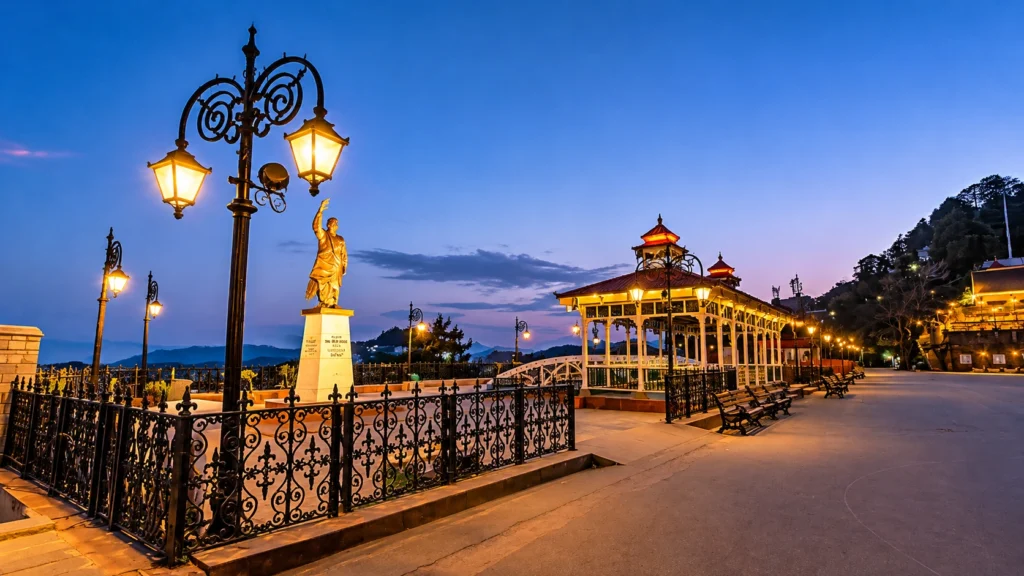
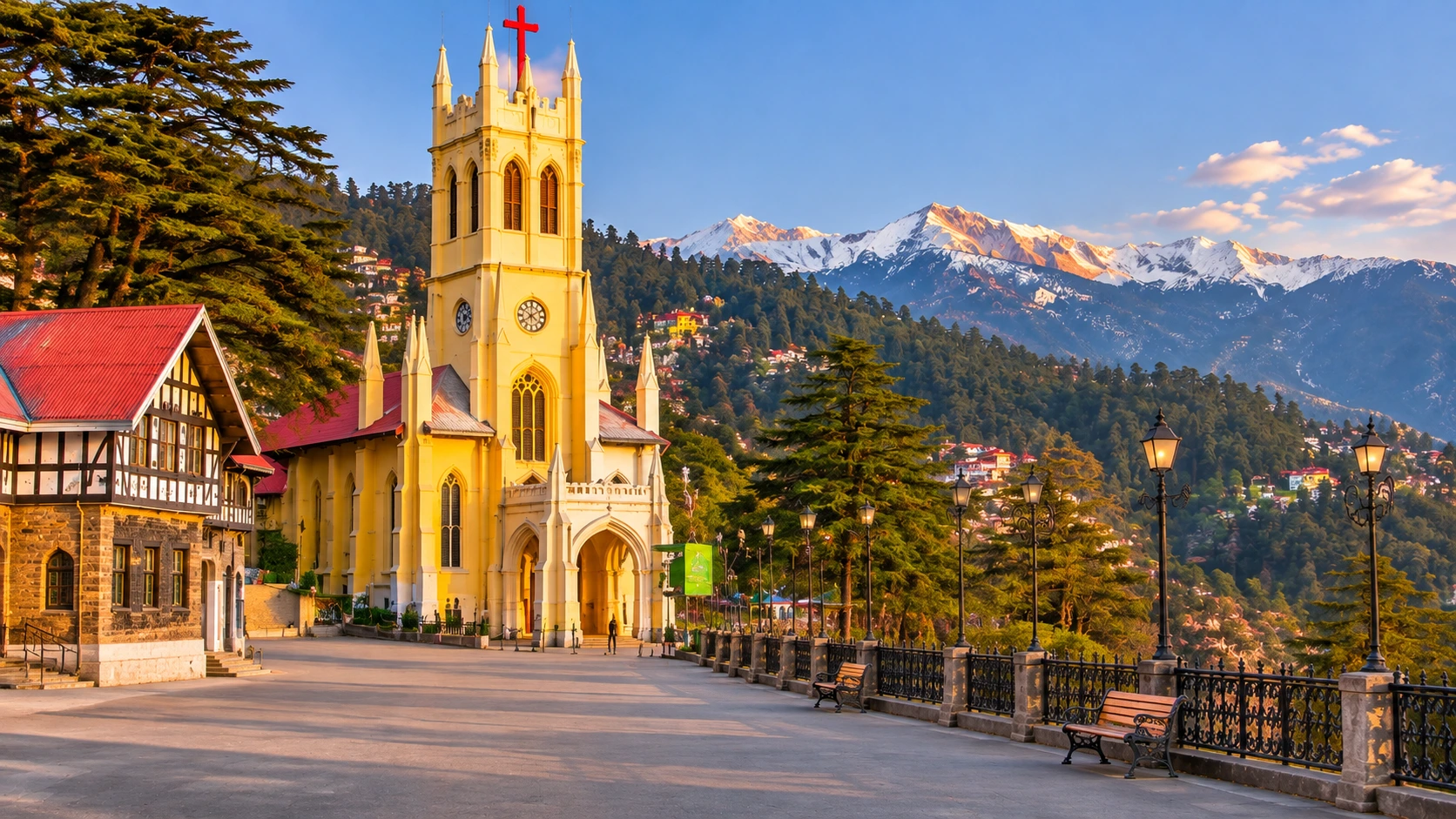
The Ridge Shimla is a broad open space that runs east to west and serves as the town’s cultural hub. On clear days it opens to views of the northern snow peaks. Around it stand Christ Church, the State Library, the Town Hall, the Gaiety Theatre and a Gandhi statue, and under it lies a reservoir built in the 1880s that still supplies the daily water. Scandal Point, where the Ridge meets the Mall, is the classic meeting spot.
Mall Road Shimla is the main commercial street, lined with showrooms, department stores and restaurants. Himachal Emporium is a good place to buy handicrafts and handloom, and the pedestrian stretch is at its best in the early evening.
Christ Church
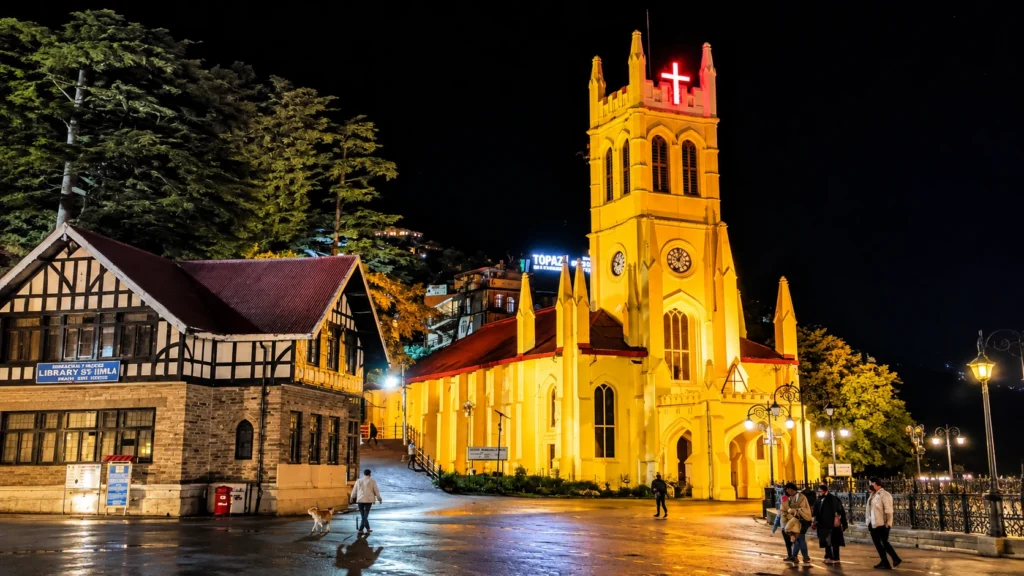
Christ Church Shimla is a neo-Gothic landmark on the Ridge. Its cornerstone was laid on 9 September 1844 by the Bishop of Calcutta, Daniel Wilson, and it was consecrated on 10 January 1857 to a design by Colonel J. T. Boileau. One heritage site calls it the second-oldest church in North India, and its stained-glass windows each represent a Christian virtue such as faith, hope and charity. The clock was donated in 1860.
Jakhu Temple
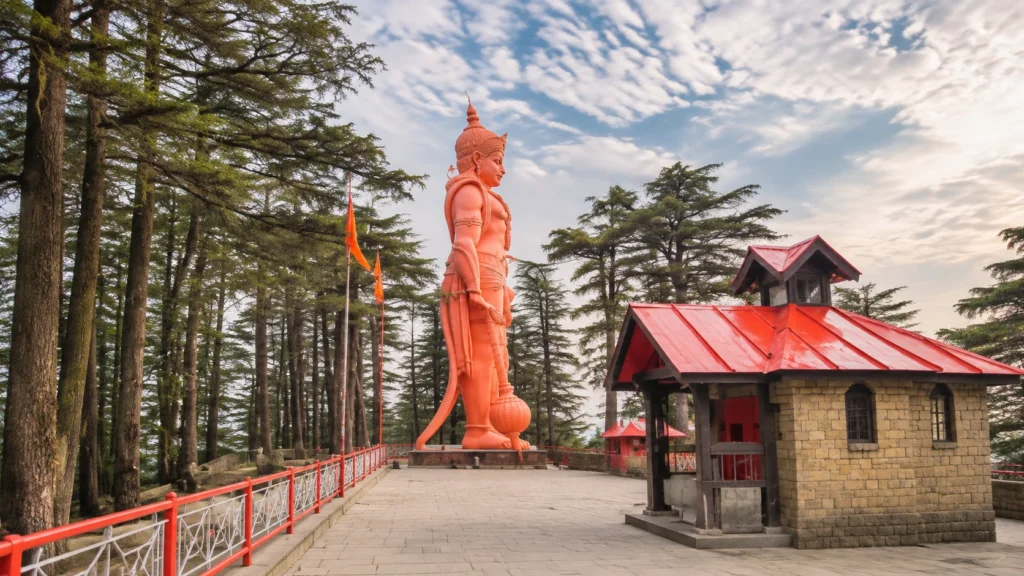
The shrine stands on Jakhu Hill at about 2,445 to 2,455 metres, with sources differing by a few metres. It is dedicated to Hanuman. According to the legend repeated here, Hanuman rested on this hill while carrying the Sanjeevani herb for the wounded Lakshmana, and the temple is built around footprints attributed to him. A 108-foot Hanuman statue, built in 2010, is the best-known landmark nearby, though the “world’s tallest” claim attached to it is not sourced.
The walk is about 2.5 km with long flights of steps, and a ropeway takes about five minutes. A recent listing gives fares of 250 rupees one way and 470 rupees return for adults, so check at the counter. Keep your belongings secure, since monkeys around the temple are bold.
Kali Bari Temple
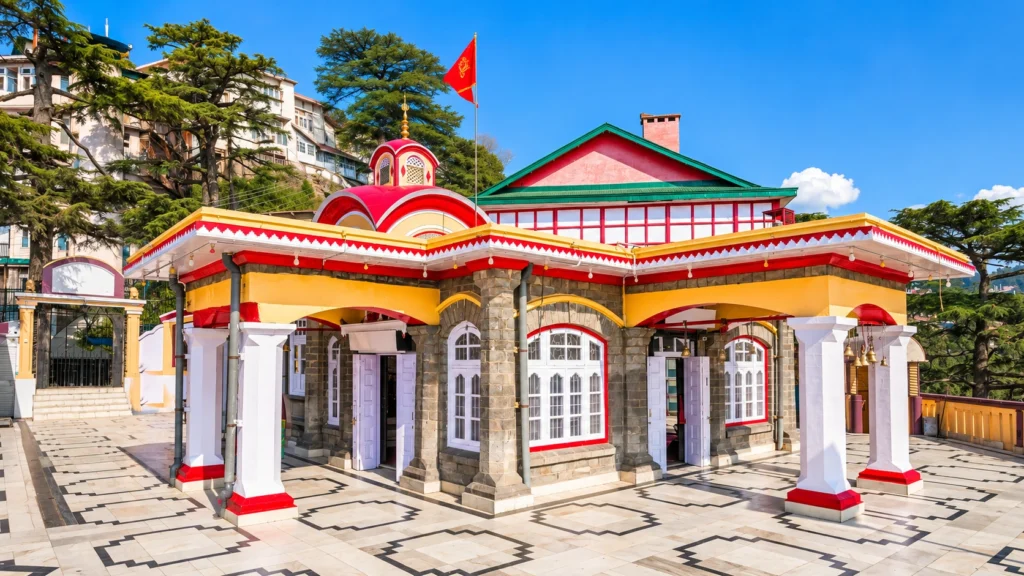
The Kali Bari Temple Shimla was built in 1845 by a Bengali Brahmin and is within walking distance of the Mall. It is a quieter stop than Jakhu and a good break during an evening stroll.
High Court and Colonial Landmarks
The High Court of Himachal Pradesh Shimla was established in 1971, when the state was created, and first worked from the old Ravenswood building. It is a working court, so treat it as a landmark to see from outside rather than a sightseeing stop. Other colonial buildings include the Viceregal Lodge, completed in 1888 and now the Indian Institute of Advanced Study, and Gorton Castle, built in 1901 to 1904.
Beyond the Centre
Among the best-known Shimla tourist places outside the Mall are the Viceregal Lodge on Observatory Hill and the hill temple at Tara Devi, about 11 km away. Chotta Shimla is the neighbourhood just outside the centre. It holds the Himachal Secretariat at Knollswood and offers many hotels, though listings differ on how close it is to the Mall, so check distances before you book.
Further out are Mashobra (12 km), Chadwick Falls (7 km), Kufri (16 km) and Naldehra (23 km). Narkanda, about 65 km away, is the usual base for winter snow.
Things to Do in Shimla: A One-Day Route
The best things to do here are walking ones. This route stitches them together:
- Morning: Climb to Jakhu Hill on foot or by ropeway, before the crowds and the heat.
- Late morning: Walk down to the Ridge and visit Christ Church.
- Afternoon: Lunch on the Mall, then browse the Himachal Emporium and see the Gaiety Theatre.
- Evening: Walk to Kali Bari, then return to the Ridge at dusk when the lamps come on.
Shimla Weather and Snowfall Through the Year
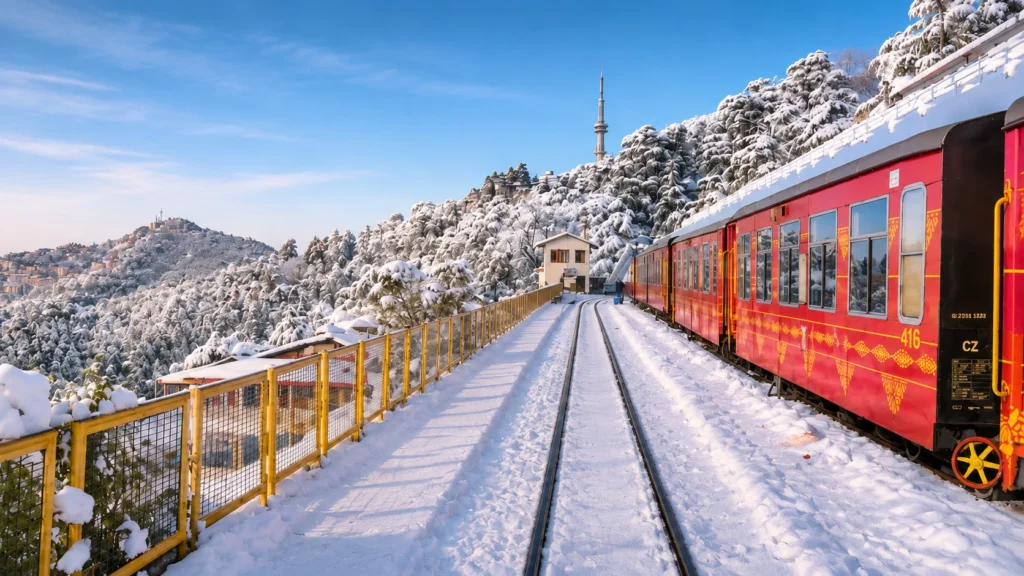
The weather is mild for much of the year and cold in winter. India Meteorological Department data show January as the coldest month, with mean temperatures of about 2.5 to 10.3 °C, and June as the warmest, at about 16 to 24 °C. The monsoon brings heavy rain, with July averaging about 346 mm and August about 314 mm, plus landslides and fog.
Snowfall in Shimla is concentrated in midwinter. IMD records for 1990 to 2010 give normal totals of about 7 cm in December, 42 cm in January, 43 cm in February and 7 cm in March, so mid-January to mid-February is the best window. Snow in the town itself is never guaranteed. If you want it for sure, go higher, to Kufri, Narkanda or Hatu Peak, though roads can close after fresh falls.
Light woollens suit April to October, and heavy jackets suit November to March.
Turn Your Stay into a Himalayan Journey
The hill town is also the first stop on the road to Kinnaur. Our Shimla Kalpa Sangla Chitkul trip is a six-day journey that starts with an overnight drive to the capital, then continues via Narkanda and Rampur to Kalpa, Sangla and Chitkul, the last inhabited village near the Indo-Tibetan border. If you want a high-altitude walk, our Buran Ghati trek crosses a pass in the hills around Rohru.
For official visitor information, see the Himachal Pradesh Department of Tourism page on Shimla, published by the Government of Himachal Pradesh.
Quick Tips Before You Go
- Book rooms early for New Year and the summer holidays, when the town fills quickly.
- Wear shoes with grip, since the lanes around the Ridge are steep and can be icy in winter.
- Carry some cash for ropeway tickets and small shops.
- Reach the Ridge early for the clearest Himalayan views, before the haze builds.
Frequently Asked Question’s
How far is Shimla from Chandigarh?
It is about 110 to 120 km by road, and the drive takes roughly three to four hours.
How long does the Kalka toy train take?
The 96-km journey takes about four to five and a half hours and passes through 102 tunnels still in use.
When does it snow in Shimla?
Snow is most likely from mid-January to mid-February, and normal totals peak in those two months.
What is the best time to visit Shimla?
Spring and early summer are comfortable, and midwinter suits those who want snow, but the monsoon is wet and landslide-prone.
What is the Ridge famous for?
It is the open cultural heart of the town, with Christ Church, the library, the Town Hall and Himalayan views on clear days.
How old is Christ Church?
Its cornerstone was laid in 1844 and it was consecrated in January 1857.
The town has changed a great deal since the British left, yet its best moments are still the old ones: a cup of tea on the Mall, a bell ringing across the Ridge and a train whistle somewhere far below in the valley.