

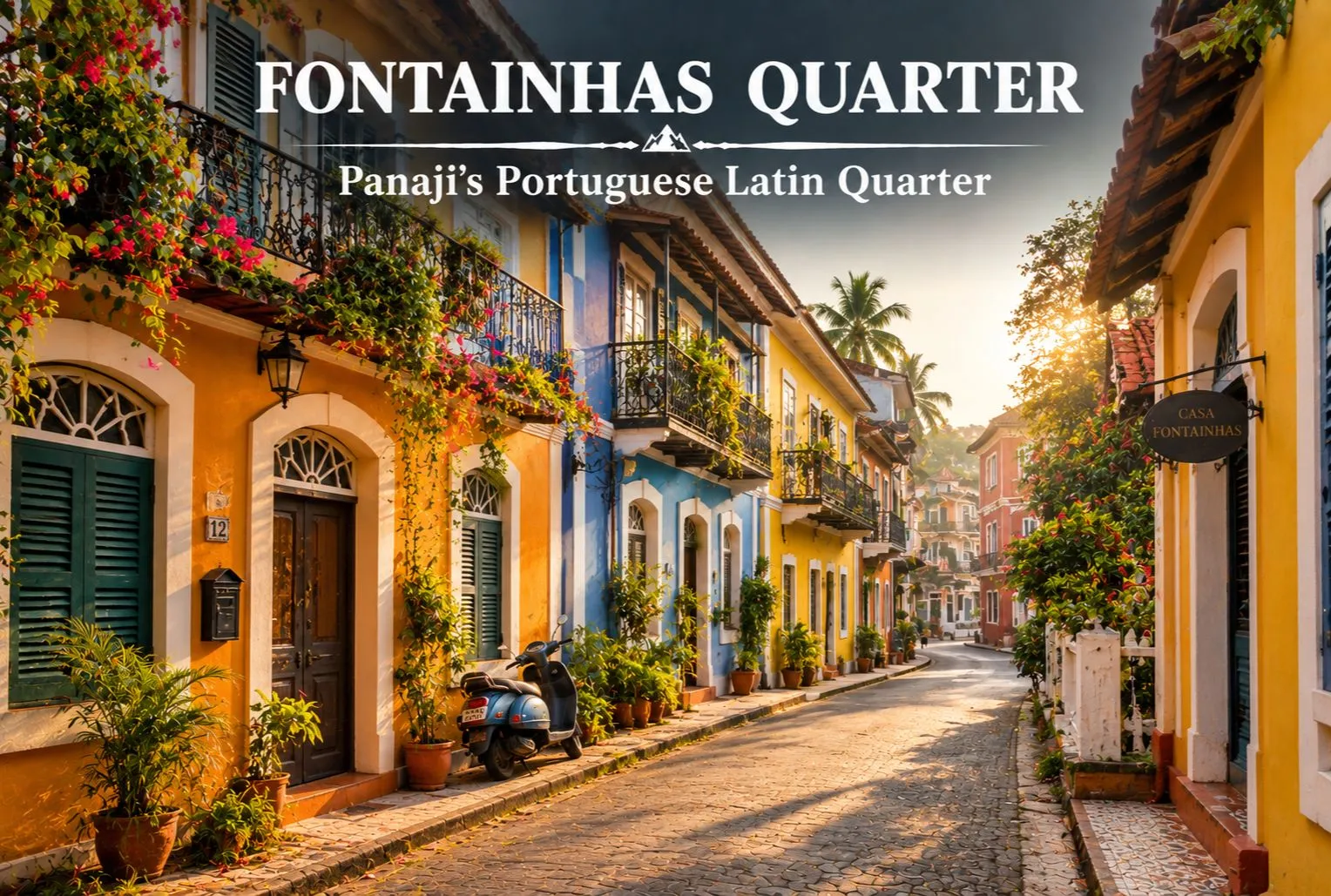
Tucked into the heart of Panaji, Fontainhas Quarter is a cluster of narrow lanes lined with ochre, blue, and mustard-yellow houses that still carry the imprint of nearly four centuries of Portuguese rule. It’s one of the few urban neighborhoods in India where the streetscape hasn’t been swallowed by modern construction, and that’s largely why it draws photographers, architecture enthusiasts, and travelers looking for a slower side of Goa. This guide covers the fontainhas quarter’s location, how to get there, what to see once you arrive, and when to plan your visit.
Table of Contents
Unlike Goa’s beach towns, Fontainhas rewards a slow walk rather than a checklist. There isn’t a single blockbuster monument here — the neighborhood itself is the attraction. Give yourself two to three hours to wander without a fixed plan, and you’ll likely stumble onto more than any itinerary could promise.
Where Is Fontainhas Quarter Located?
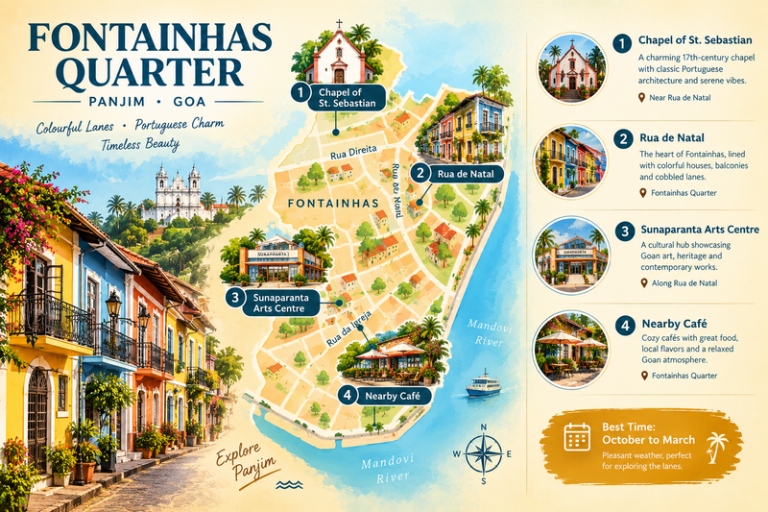
Fontainhas quarter’s location sits on the eastern edge of Panaji (also called Panjim), the capital city of Goa, bordered by the Ourem Creek. The area was developed in the late 18th and early 19th centuries after a landslide from the nearby Altinho hill created fresh ground for settlement, and Portuguese residents moved in soon after, building homes in a distinctly Iberian style.
The quarter takes its name from the Fonte Phoenix, a natural spring that once supplied water to the area (Fontainhas roughly translates to “little fountains”). Today, it’s recognized as a protected heritage zone by INTACH (Indian National Trust for Art and Cultural Heritage), one of the reasons the original architecture has survived largely intact.
Fontainhas is compact — you can walk from one end to the other in about 15 minutes — but the density of old houses, chapels, and art spaces packed into that small footprint is what makes it worth the visit.
Quick Facts: Fontainhas Quarter
| Information | Details |
| Location | Panaji (Panjim), North Goa district |
| Also known as | Latin Quarter of Panaji |
| Developed | Late 18th to early 19th century, Portuguese colonial era |
| Recognized by | INTACH, as a protected heritage precinct |
| Nearest Airport | Manohar International Airport, Mopa (approx. 35 km); Goa International Airport, Dabolim (approx. 30 km) |
| Nearest Railway Station | Karmali Railway Station (approx. 12 km) |
| Best Known For | Portuguese-era houses, narrow lanes, art galleries, Chapel of St. Sebastian |
| Best Time to Visit | October to March |
Fontainhas Goa Directions: How to Reach the Quarter
Reaching Fontainhas is straightforward since it sits inside Panaji, Goa’s capital and a well-connected transport hub.
By Air
Goa is served by two airports. Manohar International Airport at Mopa, which opened in 2023, is the newer of the two and lies roughly 35 km from Panaji. Goa International Airport at Dabolim, the older and more established airport, is around 30 km away. Prepaid taxis and app-based cabs run from both airports into the city.
By Train
If you’re looking for the nearest Goa station to Fontainhas, Karmali Railway Station is your best option — it’s about 12 km from Panaji and handles regular Konkan Railway services. Madgaon (Margao) Railway Station, roughly 33 km away, is the larger junction with wider connectivity across India and is worth checking if Karmali doesn’t have a convenient train for your route.
By Road
Once you’re in Panaji, Fontainhas is a short local ride away — most parts of the city center are within 10 to 15 minutes by auto-rickshaw or taxi. Since the quarter’s lanes are narrow and largely pedestrian-friendly, it’s best to park at the edge of the neighborhood (near the Panaji Municipal Garden or the Secretariat area) and explore on foot from there.
If you’re driving in from other parts of Goa, following fontainhas goa directions is easiest with a map app — search for “Fontainhas, Panaji” rather than a specific street, since the quarter itself is the landmark.
Things to Do in Fontainhas Quarter
Walk the Heritage Lanes
The main appeal of Fontainhas is simply walking its streets — Rua de Natal, Rua 31 de Janeiro, and the lanes around Emidio Gracia Road are lined with two-story houses featuring oyster-shell windows, wrought-iron balconies, and tiled roofs. Morning light works best for photography, before the streets fill up with parked scooters.
Visit the Chapel of St. Sebastian
The Capela de São Sebastião is Fontainhas’ most recognizable landmark. According to local tradition, the crucifix inside originally stood in the Palace of the Inquisition in Old Goa and was moved here after the Inquisition ended — with its eyes reportedly kept open, unlike most crucifixes of the period. This detail is part of local lore rather than a verified historical record, but it’s one of the stories guides commonly share on walking tours.
Explore Art Galleries and Cultural Spaces
Fontainhas has become something of an informal arts district. Fundação Oriente and Sunaparanta – Goa Centre for the Arts both host exhibitions in restored Portuguese-era buildings, giving you a reason to step inside a heritage house rather than just admire it from the street.
Stop at a Local Café
Cafés like Viva Panjim and Cafe Bodega serve Goan-Portuguese dishes — think prawn balchão, sorpotel, or a simple bebinca for dessert — in settings that match the neighborhood’s old-world character.
Time Your Visit with the Festa
If your travel dates allow it, the annual Fontainhas Festival (also called the Festival of Fontainhas) typically takes place in the quarter each year, with the streets decorated, cultural performances, and local art on display. Exact dates shift annually, so confirm current scheduling with Goa Tourism before planning around it.
Best Time to Visit Fontainhas Quarter
October to March is the ideal window to explore Fontainhas Quarter. The weather is dry and comfortable for walking, and the quarter’s lanes — which can turn slippery and puddled during heavy rain — are easiest to navigate on foot during these months.
Season Comparison
| Season | Weather | Walking Conditions | Recommended For |
| Winter (Oct–Feb) | Pleasant, dry, mild humidity | Excellent | First-time visitors, photography |
| Summer (Mar–May) | Hot and humid | Manageable, best in early morning | Early-morning walks, fewer crowds |
| Monsoon (Jun–Sep) | Heavy rainfall, lush greenery | Slippery lanes, some galleries close | Not ideal for walking tours |
Winter mornings, particularly between 8 and 10 a.m., offer the best combination of soft light and quieter streets before tour groups arrive.
Is Fontainhas Worth Visiting for a Day Trip?
Fontainhas suits both a standalone half-day outing and a stop within a broader Panaji itinerary. If you’re staying along Goa’s beaches, it’s an easy addition to a day that also includes the Church of Our Lady of the Immaculate Conception and the Panaji riverfront, both a short drive from the quarter.
Pair Fontainhas with a visit to the Goa State Museum or a walk along the Mandovi riverfront to round out a full day in Panaji without needing to travel far.
Responsible Visiting Tips
- Respect private property: Many of the houses in Fontainhas are still private residences. Admire and photograph from the street rather than entering courtyards uninvited.
- Keep noise levels down: The quarter is a residential area, not a commercial tourist strip, and local families live here year-round.
- Support local businesses: Cafés, galleries, and small shops in Fontainhas depend on tourism revenue that stays within the neighborhood.
- Watch your step: Narrow lanes and uneven stone paving mean comfortable walking shoes are worth packing, especially outside the dry season.
- Carry cash: Smaller cafés and shops in the quarter may not always accept cards.
For more detail on how Goa’s heritage sites fit within India’s broader cultural landscape, resources from the Directorate of Tourism, Government of Goa are a reliable reference point for current opening hours and event schedules.
Planning Your Fontainhas Visit
Fontainhas isn’t a place you rush through — it’s a place you wander, camera in hand, letting one colorful lane lead to the next. Between its heritage architecture, its small art spaces, and the story behind its chapel, it offers a side of Goa that has little to do with beaches and everything to do with the state’s layered history.
If you’re planning a longer trip through India’s heritage and cultural landmarks beyond Goa, Explore Hills’ popular destinations page is worth browsing for ideas on where to head next.
Frequently Asked Questions
What is Fontainhas Quarter famous for?
Fontainhas Quarter is known for its well-preserved Portuguese-era houses, narrow winding lanes, and its status as a protected heritage precinct within Panaji, Goa.
Where is Fontainhas Quarter located?
The fontainhas quarter location is in Panaji (Panjim), the capital of Goa, along the banks of the Ourem Creek.
How do I reach Fontainhas from the airport?
From Manohar International Airport at Mopa, it’s approximately 35 km to Panaji; from Dabolim’s Goa International Airport, it’s around 30 km. Both routes are served by prepaid taxis.
What is the nearest Goa station to Fontainhas?
Karmali Railway Station, about 12 km from Panaji, is the closest station. Madgaon Railway Station, roughly 33 km away, offers wider rail connectivity if you’re arriving from farther afield.
Is Fontainhas Quarter worth visiting for a day?
Yes. Two to three hours is generally enough to walk through the main lanes, visit the Chapel of St. Sebastian, and stop at a café, making it easy to fit into a broader Panaji day trip.
What is the best time to visit Fontainhas Quarter?
October to March offers the most comfortable walking conditions, with dry weather and lower humidity compared to the summer and monsoon months.
Is Fontainhas Quarter safe to walk around at night?
The quarter is generally quiet and residential, and many visitors walk it in the evening for a different view of the lit-up lanes, though it’s sensible to stick to well-lit main streets after dark, as with any unfamiliar neighborhood.
Can I combine a Fontainhas visit with other Panaji attractions?
Yes. The Church of Our Lady of the Immaculate Conception, the Goa State Museum, and the Mandovi riverfront are all a short drive from Fontainhas and pair well with it for a full day in the city.