

Table of Contents
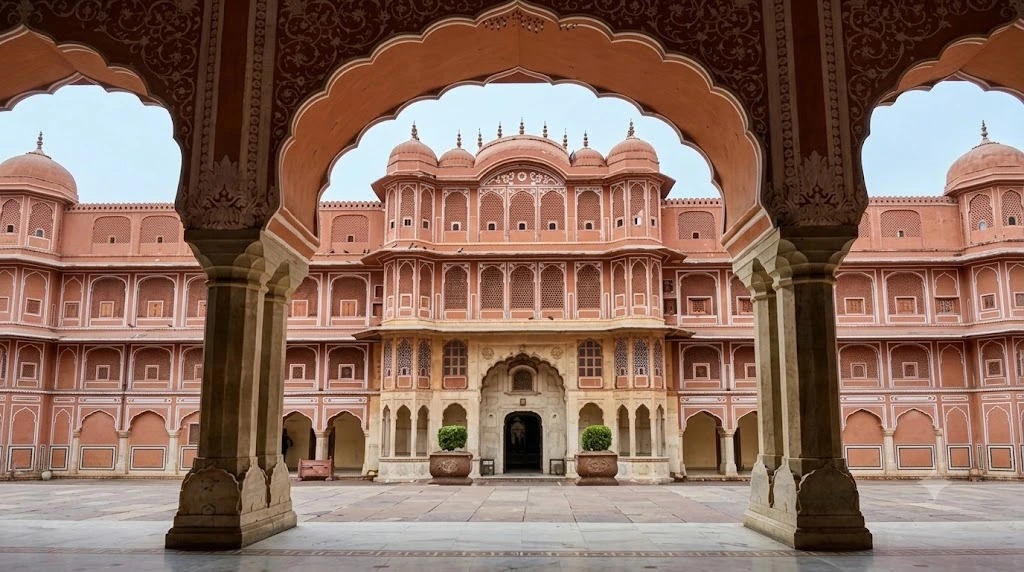
Some palaces are museums that happen to have been palaces. The City Palace in Jaipur is something rarer: a working royal residence, a museum and a ceremonial centre all at once, with a flag on its roof that still tells the city whether the Maharaja is at home. It sits at the centre of the walled Pink City, a short walk from Hawa Mahal and Jantar Mantar, and it holds a handful of details so unusual that they have become the stories every guide repeats.
This article walks through the famous ones: who built the palace, why its gates are linked to the seasons, how two silver jars travelled to England, and what the building looks like today. It also covers practical points such as City Palace timings, tickets and the best hours to avoid crowds.
The City Palace Jaipur at a Glance
The City Palace Jaipur is the old royal seat of the Kachwaha dynasty, built as the heart of the new capital that Maharaja Sawai Jai Singh II founded in 1727. Work began in the late 1720s and the main core was completed by around 1732, though the palace kept growing for the next two centuries as later rulers added courtyards, halls and gateways. That long, layered construction explains why the complex blends Rajput, Mughal and, in later wings, European influences rather than following one style.
Today the City Palace remains one of the most visited monuments in Rajasthan, and the royal family still hosts ceremonies and private events in its courtyards, so parts of it may close at short notice and it is worth checking before you go.
Jai Singh was both a warrior and a scientist, and he planned Jaipur on an orderly grid, which was unusual for Indian cities of the period. The tradition credits Vidyadhar Bhattacharya, a Bengali architect, with designing the city layout, and later work on the palace is associated with Sir Samuel Swinton Jacob, a British engineer who shaped many Rajasthani buildings. Together, their work gave the City Palace a formal geometry that older Rajput forts rarely had.
One quick note on names: this is the palace in Jaipur. Udaipur has its own, separate City Palace on Lake Pichola, so make sure you search for the right City Palace before you plan your trip.
The Four Gates of Pritam Niwas Chowk
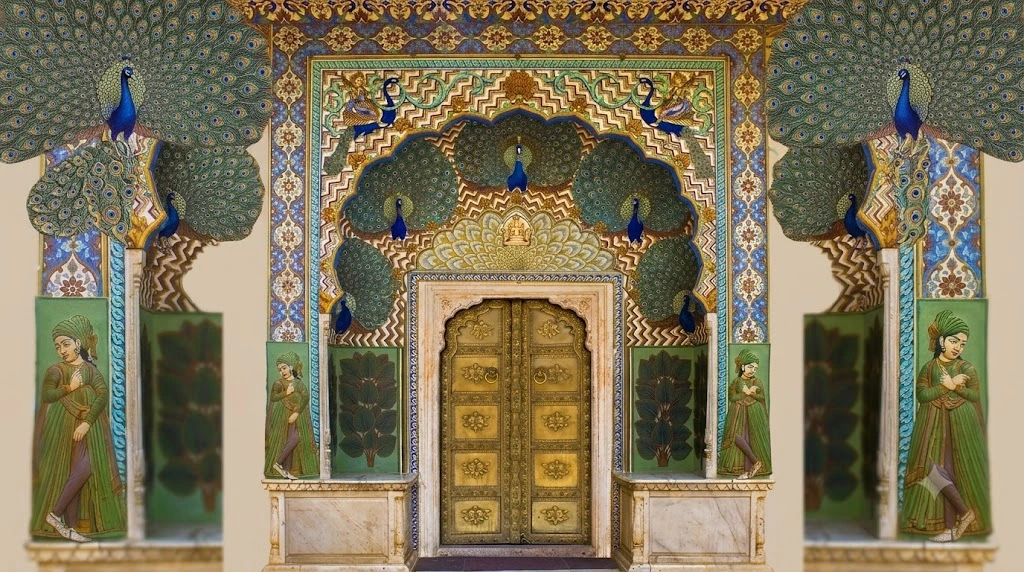
If one corner of the complex has become famous, it is Pritam Niwas Chowk, the inner courtyard that leads to Chandra Mahal. Four small, ornate doors stand around it, each linked to a season and a Hindu deity, and they are among the most photographed doorways in India.
The Peacock Gate, with its fanned blue and green birds, represents autumn and Lord Vishnu. The Lotus Gate stands for summer and Lord Shiva. The Rose Gate represents winter and the Goddess Devi, and the fourth, for spring, is associated with Ganesha and is described in different sources as the Green Gate or the Leheriya Gate, named after the wave-like pattern of its design. Each door is made of brass and carved in fine detail, so do not touch the surface, as visitors are asked to keep a respectful distance.
The Peacock Gate is the one that appears on every City Palace postcard. If you want a clean photograph without crowds, go first thing when the doors open.
The Silver Urns That Went to England
The most famous object in the complex is not a jewel or a sword but a pair of large silver jars. Two enormous urns stand in the Diwan-i-Khas, the hall of private audience, and they are recorded by Guinness World Records as the largest sterling silver objects in the world. Each weighs about 345 kilograms when empty.
They were made for a journey. When Maharaja Sawai Madho Singh II was invited to the coronation of Edward VII in London in 1902, he refused to drink anything but Ganga water, which he considered pure, and ordered silver vessels large enough to carry it by ship for the whole trip. Local silversmiths made them from silver coins. They are sometimes called the Gangajalis, a name that comes from the holy water they carried.
The story is repeated so often it has become part of the City Palace’s identity, and since the urns are on display today, you can see them yourself.
Chandra Mahal and the Flag on the Roof
Dominating the complex is Chandra Mahal, a seven-storey “Moon Palace” with mirrors, murals and open balconies. The ground floor and some upper rooms are open to visitors as part of the museum, while the upper storeys remain the home of the present royal family. The top floor, Mukut Mahal, has the best views over the old city.
A small flag fluttering on that rooftop carries a message. When the Maharaja is in residence, the flag flies, and when he is away, it is lowered. In an era when most palaces have become hotels or archives, that single flag says that the City Palace is still a home first and a monument second.
Mubarak Mahal and the Museum Collections
Near the first courtyard stands Mubarak Mahal, a reception hall built in the late nineteenth century by Madho Singh II for visiting dignitaries. Its facade blends Islamic, Rajput and European details, and today it houses displays of royal textiles and costumes.
The wider museum is named after Maharaja Sawai Man Singh II and holds a surprisingly broad range of objects. The Diwan-i-Aam area has miniature paintings, old manuscripts and embroidered carpets. The Sileh Khana, or armoury, shows swords, shields and firearms, while the carriage hall preserves old palanquins and a Victorian-era carriage said to have been a gift from the Prince of Wales in 1876.
That same year, Maharaja Ram Singh had the city painted pink to welcome the prince, because pink signified hospitality, and the colour has remained a rule for buildings in the old city ever since.
City Palace Timings, Tickets and Entry
Most sources give the City Palace timings as 9:30 AM to 5:00 PM daily, which is the schedule you should plan around. Ticket prices have changed several times, and listings quote roughly 200 rupees for Indian visitors and 700 rupees for foreign tourists, with a separate fee for cameras, so check the counter on the day. A premium “Royal Splendour” ticket, which includes access to the upper levels of Chandra Mahal and a private guide, was listed at around 3,500 rupees in 2024.
Photography at the City Palace is generally allowed in courtyards with a camera fee, but it is not allowed inside the museum galleries. Tripods are not permitted. I could not confirm a regular night schedule, so check with the ticket office if you hope to visit after dark.
When to Go and How to Plan
Come at opening time or in the late afternoon, when groups thin out and the light on the courtyards is softer. October to March is the best season, while May to July can be very hot. The nearest metro stop is Badi Chaupar, and the old city’s lanes are best handled on foot.
Plan about two to three hours at the City Palace. Jantar Mantar, which stands beside the palace, is a UNESCO World Heritage Site with 19 astronomical instruments built between 1728 and 1734, including the world’s largest stone sundial, although the City Palace itself is not on the UNESCO list. Hawa Mahal and Jantar Mantar both have their own entrances, so many visitors combine all three in a single morning, and our Hawa Mahal guide covers the pink facade in detail. If you are travelling further across Rajasthan, our Mehrangarh Fort guide takes you to Jodhpur’s great hill fort. For official context on the Pink City, see the Incredible India page on Jaipur, the Government of India’s tourism portal.
Frequently Asked Question’s
Who built the City Palace in Jaipur?
Maharaja Sawai Jai Singh II began the palace after founding Jaipur in 1727, with the core completed around 1732 and later rulers adding more wings.
What are the City Palace timings?
Most listings give 9:30 AM to 5:00 PM daily, though you should confirm at the ticket counter on the day of your visit.
What is the City Palace famous for?
It is famous for the Peacock Gate in Pritam Niwas Chowk, the giant silver urns recorded by Guinness, and Chandra Mahal, where the royal family still lives.
Is the City Palace still a royal residence?
Yes. Part of Chandra Mahal is the home of the present royal family, and a flag on the roof signals when the Maharaja is in residence.
Where is the City Palace located?
It stands in the heart of Jaipur’s Old City, beside Hawa Mahal and Jantar Mantar, close to Badi Chaupar metro station.
How much time do you need at the City Palace?
Plan around two to three hours to see the courtyards, Chandra Mahal and the museum galleries without rushing.
What lingers after a visit is how much of the City Palace is still alive. The urns can be inspected, the doors can be photographed, and the flag can be checked from the courtyard. Few palaces in India let you stand inside a home that is still being lived in, and that mix of history and daily life is the real reason to come.