

Table of Contents
Most Shiva temples give you a single linga to focus your prayers on. Trimbakeshwar Temple, set against the Sahyadri hills just outside Nashik, gives you three faces carved into one — a detail so unusual that it’s the very reason the temple carries its name. Trimbak means “three-eyed,” and the linga inside this sanctum is believed to represent Brahma, Vishnu, and Shiva together, worn smooth over centuries by the same holy water devotees pour over it every single day.
This is one of the twelve Jyotirlingas scattered across India, and arguably one of the most layered — tied not just to Shiva worship but to the literal birthplace of the Godavari river, to a Peshwa-era architectural rebuild, and to a ritual performed nowhere else in the country. If you’re someone who enjoys tracing India’s sacred geography — much like the pilgrimage circuits covered in our Kashi Vishwanath Temple guide — this piece covers the complete Trimbakeshwar temple history, its architecture, the legends tied to the Godavari, and the practical details of Trimbakeshwar temple timings and the Nashik to Trimbakeshwar distance you’ll need to plan a visit.
Where the Godavari Begins
Before you even reach Trimbakeshwar Temple’s gates, it’s worth understanding why this particular spot in the Sahyadris became sacred in the first place. According to the legend most commonly told here, the sage Gautama performed years of severe penance on the nearby Brahmagiri hill, pleading with Lord Shiva to release the celestial Ganga to earth so that his ashram and the surrounding land could be purified. Shiva agreed, and the river that descended became the Godavari — still revered today as the “Ganga of the South” and one of India’s longest rivers.
A second version of the story credits Lord Vishnu, in his Vamana or Trivikram form, with releasing the river’s waters instead. Either way, three separate springs are said to emerge from Brahmagiri, feeding into the Godavari’s source, and the sacred tank just outside Trimbakeshwar Temple — Kusavarta Kund — is considered the river’s official starting point. Pilgrims bathe here before entering the temple, treating the ritual with the same seriousness as a dip in the Ganga itself at Varanasi or Haridwar. For travellers drawn to river-origin pilgrimages, this story pairs naturally with the one behind our Omkareshwar guide, another Jyotirlinga tied closely to a sacred river.
Trimbakeshwar Temple History
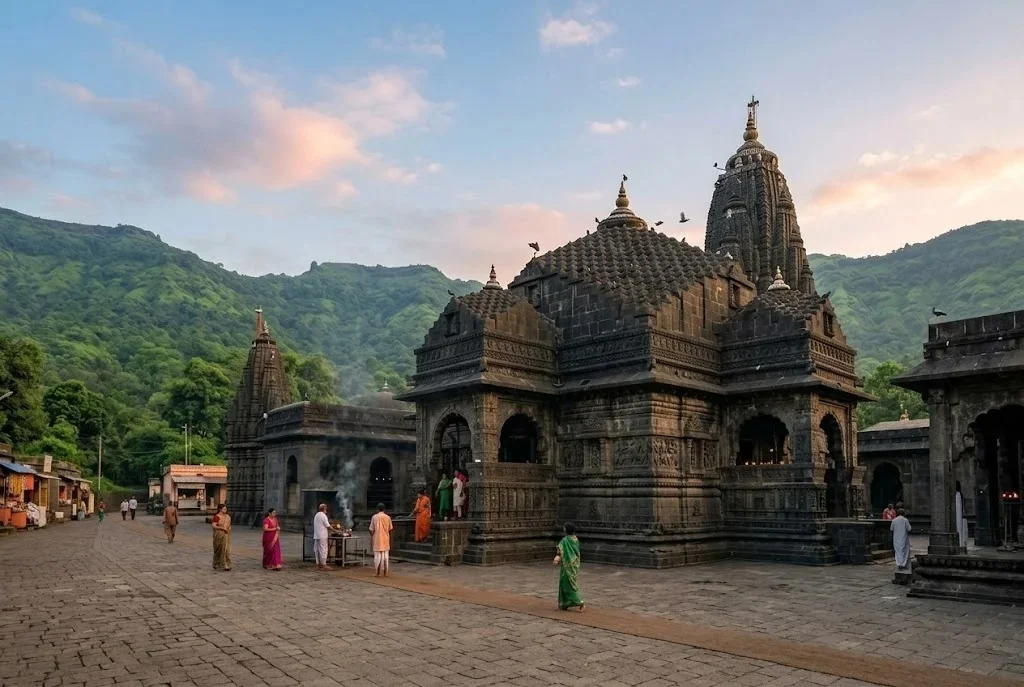
The Trimbakeshwar temple history stretches back far enough that its earliest origins are lost to legend rather than record, but the structure standing today has a documented and relatively recent past. The original shrine at this site was destroyed during the reign of the Mughal emperor Aurangzeb, part of a broader pattern of temple destruction across the empire in the 17th century. What exists now was commissioned by the Peshwa ruler Balaji Baji Rao, commonly known as Nanasaheb Peshwe, in the 18th century — making the current Trimbakeshwar Shiva Temple a product of Maratha patronage rebuilding what earlier rulers had torn down.
Built in the Hemadpanthi architectural style using black basalt stone, the temple’s construction reflects the same aesthetic language found in several other Maharashtra-era shrines from this period — heavy stone slabs, minimal mortar, and a structural solidity clearly built to last centuries rather than decades. What makes this chapter of Trimbakeshwar temple history particularly striking is the sheer level of craftsmanship invested in a reconstruction project, rather than an original build — the Peshwas clearly intended this temple to outlast the one it replaced.
The Linga That Erodes By Design
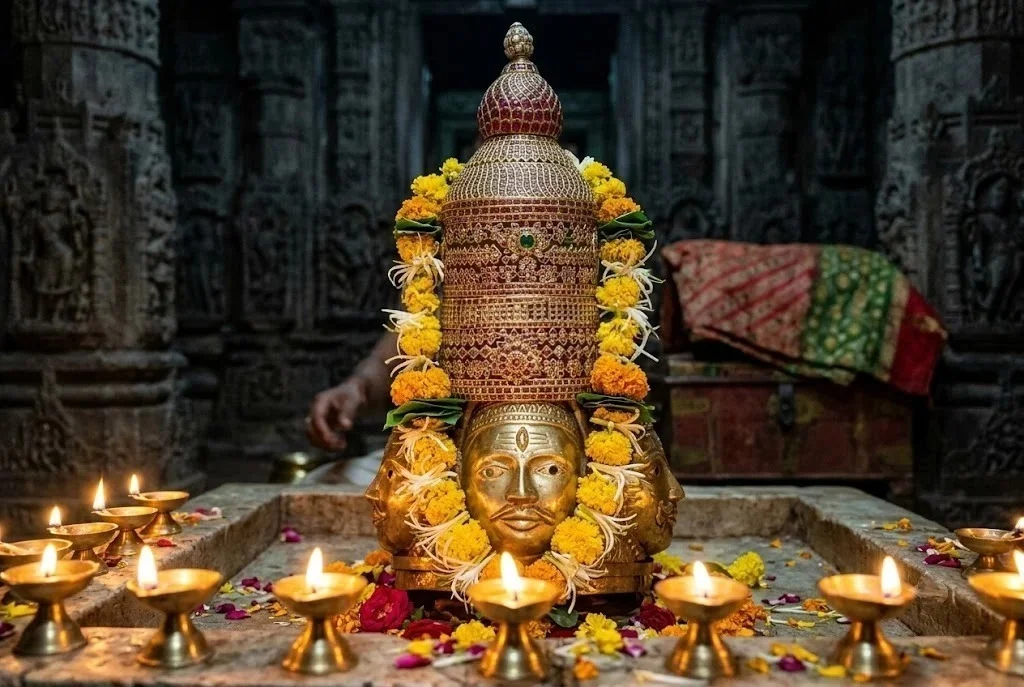
Step into Trimbakeshwar Temple’s inner sanctum and the central linga doesn’t look like most Jyotirlingas you’ll have seen elsewhere in India. Rather than a single smooth stone pillar, this one shows three distinct, barely raised faces, representing the Hindu trinity of Brahma, Vishnu, and Shiva together in a single form — a configuration unique among the twelve Jyotirlingas. Centuries of devotees pouring water, milk, and other ritual offerings directly onto the stone have gradually worn the features down, a slow erosion that temple tradition reads less as damage and more as a quiet metaphor for how even the most permanent-seeming things erode under constant human contact.
Above the linga sits a jewelled crown, reportedly dating back to the era of the Pandavas and set with diamonds and emeralds, which covers a gold mask of the three deities. It’s brought out for public display only on Monday evenings, typically between 4:00 and 5:00 PM, drawing crowds specifically timed around that single weekly window. Historically, the crown also held the legendary Nassak Diamond, looted by British forces during the Third Anglo-Maratha War in the early 19th century and now reportedly in private ownership overseas — a small but telling thread connecting Trimbakeshwar Temple to the wider story of colonial-era plunder of Indian religious artefacts.
A Ritual Performed Nowhere Else
Beyond regular Shiva worship, Trimbakeshwar Jyotirling Mandir holds a particular reputation across India for a specific set of rituals rarely, if ever, performed elsewhere: Narayan Nagbali, Kalsarpa Shanti, and Tripindi Vidhi. Narayan Nagbali in particular — a three-day ceremony believed to resolve ancestral or karmic obstacles — is said to be conducted exclusively at this temple, drawing families from across the country who travel to Trimbakeshwar Temple specifically for this purpose rather than for general darshan. Pandits at the temple also maintain genealogical records for many Hindu families, a tradition that turns a visit here into something closer to an archive consultation than a typical temple trip for some pilgrims.
This layered religious function is part of what separates Trimbakeshwar Jyotirling Mandir from many of its Jyotirlinga counterparts — it isn’t simply a stop on a pilgrimage circuit, but a destination in its own right for specific, ritually precise purposes that bring people back repeatedly throughout their lives.
The Temple Town of Trimbak
The town surrounding Trimbakeshwar Temple, also called Trimbak, sits nestled between three hills — Brahmagiri, Nilagiri, and Kalagiri — giving the whole settlement a naturally enclosed, almost amphitheatre-like feel. Beyond the main Trimbakeshwar Temple complex, the town holds smaller shrines, ghats along the Kusavarta tank, and a quiet, distinctly pilgrimage-town atmosphere that contrasts with the more commercial sprawl around some of India’s other major temple towns.
During the Nashik-Trimbakeshwar Kumbh Mela, held once every twelve years, this otherwise modest town transforms entirely, hosting one of the largest ritual bathing gatherings on Earth as part of the rotating Kumbh Mela cycle shared with Haridwar, Ujjain, and Prayagraj.
Trimbakeshwar Temple Timings
Planning around accurate Trimbakeshwar temple timings matters here more than at most temples, given how tightly the daily schedule is structured around specific rituals. Trimbakeshwar Temple generally opens for darshan around 5:30 AM and stays open, with scheduled pauses for rituals, until roughly 9:00 PM. A Rudrabhishek ceremony typically runs from 7:00 to 8:30 AM, with additional special pujas conducted around 1:00 PM and again in the late afternoon.
Because these Trimbakeshwar temple timings can shift during festivals like Mahashivratri and the Shravan month, when the temple often opens earlier and sees dramatically larger crowds, it’s worth confirming the current schedule through the temple trust before you travel. If your visit coincides with a Monday, try to time it around late afternoon to catch the brief public display of the jewelled crown.
How Far Is Trimbakeshwar From Nashik
For travellers planning the trip, the Nashik to Trimbakeshwar distance works out to roughly 28 to 30 kilometres, making it an easy half-day excursion from the city rather than a major undertaking. Regular buses and shared taxis run the route from Nashik’s central bus stands, and the drive itself cuts through pleasant Sahyadri foothill scenery, particularly scenic during and just after the monsoon.
The nearest major railway station is Nashik Road, roughly 35 to 40 kilometres away, while the closest airport is Nashik’s own Gandhinagar Airport, which connects to a handful of major Indian cities. Most visitors base themselves in Nashik itself and treat Trimbakeshwar Temple as a day trip, combining it with Nashik’s own temple circuit and its increasingly well-regarded wine country, a somewhat unexpected modern addition to this otherwise deeply traditional pilgrimage region.
Frequently Asked Question’s
What is the history of Trimbakeshwar Temple?
Trimbakeshwar temple history traces back to an original shrine destroyed during Aurangzeb’s reign, with the current structure commissioned in the 18th century by Peshwa Balaji Baji Rao (Nanasaheb Peshwe) in the Hemadpanthi style using black basalt stone.
Why is Trimbakeshwar Temple’s linga unique?
Unlike most Jyotirlingas, which feature a single stone pillar, the linga at Trimbakeshwar Shiva Temple has three distinct faces representing Brahma, Vishnu, and Shiva together, gradually worn smooth by centuries of ritual water offerings.
What are the Trimbakeshwar temple timings?
The temple is generally open for darshan from around 5:30 AM to 9:00 PM daily, with scheduled rituals through the day; timings can vary during festivals, so it’s best to confirm before visiting.
What is the Nashik to Trimbakeshwar distance?
Trimbakeshwar lies roughly 28 to 30 kilometres from Nashik city, making it an easy day trip by bus, taxi, or private vehicle.
What rituals is Trimbakeshwar Temple known for?
The temple is particularly known for Narayan Nagbali, a three-day ritual believed to be performed exclusively here, along with Kalsarpa Shanti and Tripindi Vidhi, all addressing ancestral and karmic concerns.
Is Trimbakeshwar connected to the Godavari river?
Yes, the nearby Kusavarta Kund at the foot of Brahmagiri hill is considered the origin point of the Godavari river, one of India’s longest, according to the legend of sage Gautama’s penance.
Trimbakeshwar Temple rewards the kind of visitor willing to slow down rather than rush through a single darshan. Between its three-faced linga, a crown with a diamond’s worth of colonial history attached to it, a ritual performed nowhere else in the country, and a river said to begin at its doorstep, this is a temple with far more layered meaning than its relatively modest size in photographs would suggest. For many who make the trip from Nashik, it ends up being the most memorable stop on the whole journey.
For official visitor information, rituals, and current schedules, refer to the Shri Trimbakeshwar Devasthan Trust’s official website.