

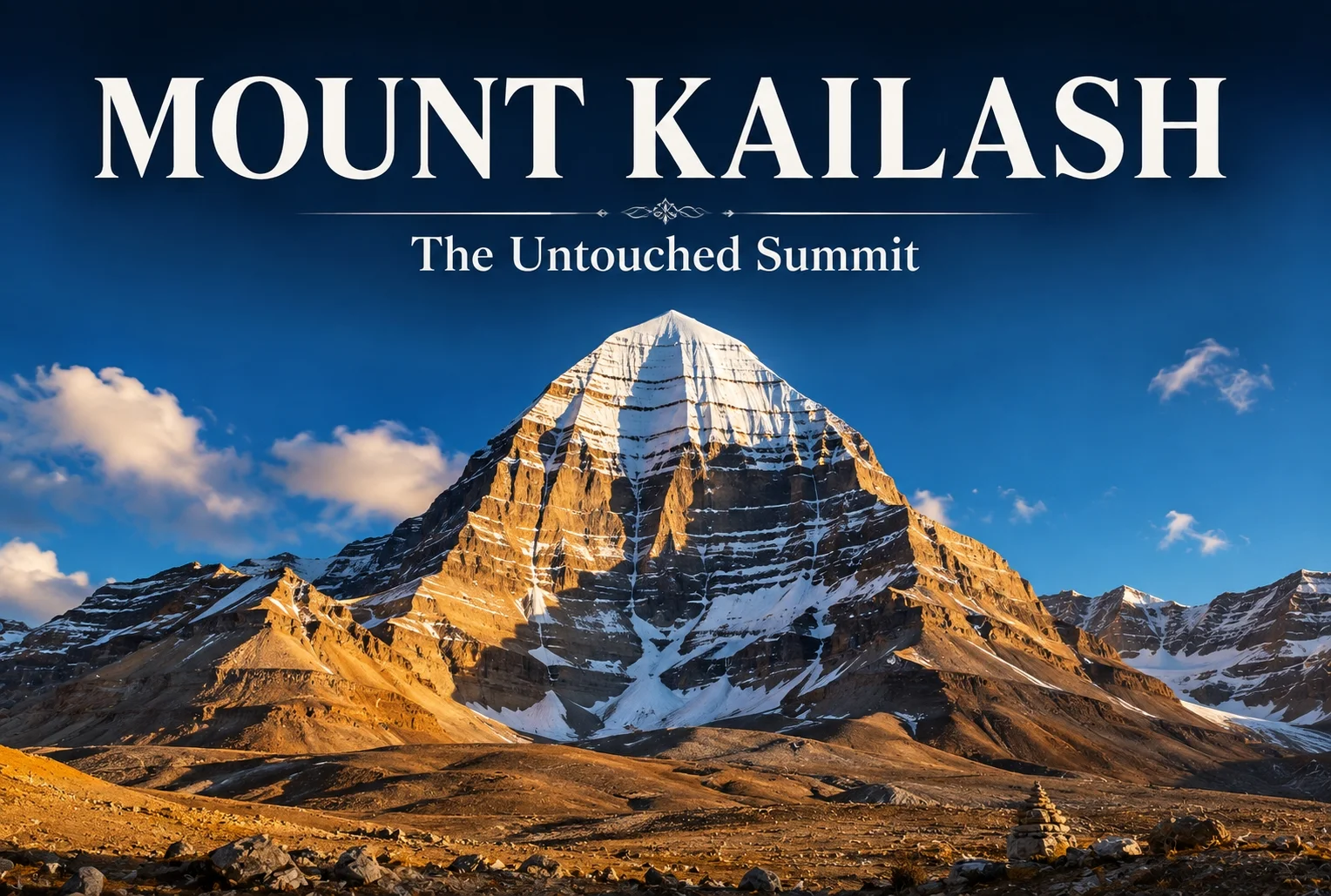
Don’t be surprised when Mount Kailash Parvat comes to your mind when you think of the most mysterious place on earth. Sitting in the remote stretch of western Tibet’s Ngari region, this peak has puzzled the scientist, pulls in across thousands of pilgrims. Or have you ever typed where Kailash Parvat is in your Google search bar or wanted to know the mystery behind the Kailash Parvat, than you are not alone. Seated at 6,638 meters height this mountain is incredibly amazing letting you fall for its immense spiritual experience and cultural important.
Due to the divine abode of Lord this Mountain marks a spiritual significance where nobody has ever reached. For those inspired by Himalayan pilgrimages closer to home, Explore Hills’ Adi Kailash Om Parvat Yatra offers a chance to experience “Chhota Kailash” in the Indian Kumaon Himalayas.
Table of Contents
Where Is Mount Kailash, Exactly?
The Mount Kailash is seated in the remote Ngari Prefecture of the Tibet Autonomous Region of China. Far from any city of real size, and that isolation is a big part of why it’s remained so untouched for so long. Getting there usually means a long overland trip through Lhasa and Shigatse, then across the high Tibetan plateau not something you’re doing over a long weekend. There are no roads to the summit, no cable cars, none of the usual trappings of a “climbable” mountain. Just windswept plains, high-altitude lakes, and a peak that seems to rise up out of nowhere.
Travelers interested in the official Kailash Mansarovar pilgrimage process can refer to the Kailash Mansarovar Yatra portal, run by India’s Ministry of External Affairs.
What is the height of Kailash Parvat?
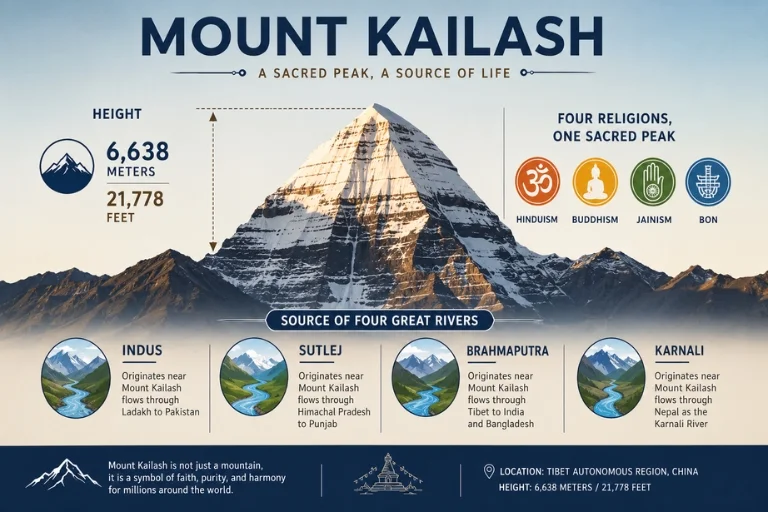
Kailash stands roughly 6,638 meters (about 21,778 feet) above sea level again, not a record-breaker in terms of elevation. What actually sets it apart is its shape. Most Himalayan summits have that jagged, irregular look you’d expect from millions of years of erosion. Kailash doesn’t. It has an almost geometric, four-sided profile that narrows to a point, which is why so many people describe it as looking pyramid-like. Geologists explain this as ordinary rock stratification combined with natural weathering nothing supernatural about it. But if you’ve ever stood at the base of it, plenty of visitors will tell you it’s hard not to feel like there’s something more deliberate going on.
Who Climbed Kailash Parvat? The Answer Might Surprise You
There is no such record of someone climbing the 6,638 meters tall Kailash Parwat yet. This mountain is one of the 4 major peaks that hasn’t been summited by anyone till date. One of the major reason that is responsible for no one climbing this summit yet is the Steep icy trails, weather that can turn without any warning, high winds and intense heat during day. Another reason responsible for it is the cultural and spiritual beliefs of 4 religion including Hindu, Buddhist, Jains and followers of Bon tradition who view it as a divine abode of Lord Shiva, due to which the government has strictly banned it.
Why Four Religions Claim the Same Mountain
What makes Kailash’s story unusual is that it isn’t just one tradition’s holy site it’s four.
- Hindus consider it the dwelling place of Lord Shiva.
- Tibetan Buddhists know it as Kang Rinpoche, tied to powerful protector deities.
- Jains regard it as the place where their first spiritual teacher achieved liberation.
- Followers of Bon, a tradition that predates Buddhism in Tibet, see it as the literal center of their spiritual world.
Very few places on Earth carry that kind of overlapping reverence, and it’s a big part of why pilgrims keep showing up, year after year, from such different corners of the world. Pilgrims seeking a similar Shiva-centered spiritual journey within India often turn to the Kedarnath Yatra.
A Quick Look at the History
The history here goes back thousands of years, well before any written records from the region exist. Kailash has functioned as a pilgrimage site across multiple civilizations and faiths, and the tradition of walking around its base known as the kora dates back centuries. It’s a roughly 52-kilometer trek, and for many people it’s considered one of the most spiritually significant journeys they’ll ever undertake, believed to bring purification and a kind of fresh start. The mountain is also the source of several major rivers that shape life across South Asia the Indus, Sutlej, Brahmaputra, and Karnali all originate near here.
For millions of people living downstream, this peak matters for reasons that go well beyond myth; it’s tied directly to the water their regions depend on. This tradition of sacred Himalayan pilgrimage circuits is mirrored in India’s own Char Dham Yatra.
The Legends People Can’t Stop Talking About
Search “Kailash Parvat mystery” and you’ll run into a long list of claims some old folklore, some newer retellings that have picked up steam online. A few of the most common:
- Snow that supposedly never melts. The rest of the mountain thaws seasonally, but the summit is said to stay permanently white, feeding rivers below without ever fully disappearing itself.
- A face in the rock. Pilgrims walking the traditional clockwise route around the mountain sometimes report seeing what looks like a calm, smiling face in the shadows of the cliffs.
- Time acting strange. Some travelers say their hair and nails seem to grow faster while they’re near the mountain. There’s no science behind this claim, but it keeps getting repeated.
- Symbols at sunset. As the sun drops low, certain rock formations reportedly cast shadows that resemble a swastika (a symbol of good fortune in several cultures) and the “Om” symbol.
- Hidden cities underneath. Local legend points to Shambhala and Agartha mythical underground realms said to lie somewhere beneath the range, home to enlightened beings cut off from the outside world.
None of this has any verified evidence behind it. But that’s often the appeal with a mountain like this the stories are part of what keeps it feeling alive rather than just another geographic coordinate.
What the Weather Is Actually Like
If you’re seriously considering a trip, the climate is worth planning around. Given the elevation, conditions are harsh. Summer roughly June through September, and the main pilgrimage window can feel almost mild in direct sunlight but still drops close to freezing once the sun goes down. Winters are brutal: temperatures regularly fall well below freezing, and heavy snow makes the region largely inaccessible. Most pilgrims and trekkers time their visit for the warmer months specifically to avoid the worst of the cold. Trekkers planning a broader Himalayan spiritual journey can also explore Explore Hills’ Uttarakhand Yatra packages.
CONCLUSION
Mount Kailash rises to 6,638 meters next to its Himalayan neighbors yet no one has ever stood on its summit and that may be because of its odd symmetry of its shape or the spiritual context. What draws people isn’t the summit but the “Kora”, a 52-kilometer walk around its base at altitudes that make breathing feel like effort, where pilgrims sometimes spend weeks prostrating the entire distance. Science has tried to explain the pull the mountain’s near-perfect pyramidal shape, its odd position feeding four major rivers but none of it accounts for why people keep circling instead of climbing.
Maybe that’s the actual mystery: not an unclimbed peak, but a mountain that convinced centuries of pilgrims that walking around something that can matter more than conquering it.
Frequently Asked Question’s
Why is Mount Kailash unclimbable?
Mount Kailash is unclimbable as it’s strictly prohibited in 4 religions due to its personal beliefs and legally protected by the government.
Has anyone touched Mount Kailash?
No one has touched Mount Kailash till now due to its religious significance and being strictly banned by the government.
Has any Indian climbed Mount Kailash?
No, there is no such record of any Indian climbing Mount Kailash.
Who owns Mount Kailash?
Mt. Kailash is owned and administered by the People’s Republic of China, located within Burang County of the Ngari Prefecture in the Tibet Autonomous Region.
1 thought on “Mount Kailash: The Untouched Summit”