

Table of Contents
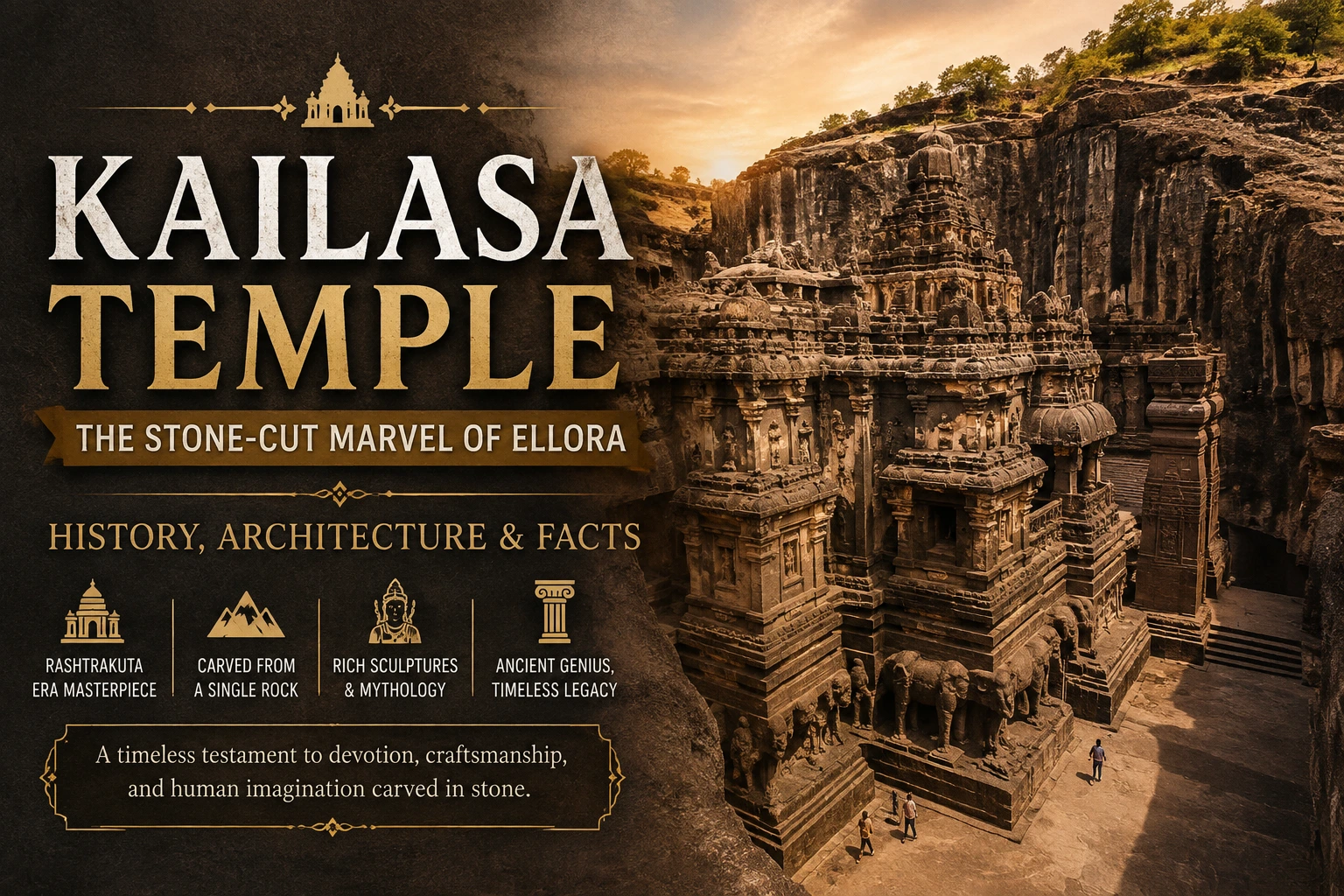
The Kailasa Temple at Ellora is the sort of monument that makes ordinary measurements feel inadequate. It does not simply stand upon the earth; it appears to have been coaxed out of it. Cut downward from a basalt escarpment, the Kailasa Temple forms a vast freestanding sanctuary whose walls, pillars, courtyards, elephants, shrines, and sculptural panels belong to the same living mass of stone.
Situated in present-day Maharashtra, the Kailasa Temple is Cave 16 of the Ellora Caves, a sprawling complex of 34 Buddhist, Hindu, and Jain monasteries and temples. UNESCO describes Ellora as an exceptional artistic achievement and identifies Cave 16 as the largest monolithic temple in the complex. The site was inscribed as a World Heritage Site in 1983.
The Historical Setting
The story of the Kailasa Temple belongs principally to the Rashtrakuta age of the Deccan. The monument is generally attributed to King Krishna I, who ruled in the eighth century. UNESCO gives the attribution as Krishna I, approximately 757–783 CE, while epigraphic evidence connects a ruler named Krishnaraja with a remarkable Shiva temple at Elapura, the ancient name associated with Ellora.
The attribution deserves a small qualification. The Kailasa Temple itself does not possess a dedicatory inscription that plainly names its patron. Instead, later copper-plate and other epigraphic records are used alongside architectural and stylistic evidence. Most historians therefore associate the Kailasa Temple with Krishna I, although discussion continues over the precise chronology of its construction and later embellishment.
The Rashtrakutas were building power across the Deccan when the Kailasa Temple emerged. A temple of such magnitude was not merely a place for worship. It could also proclaim royal authority, religious devotion, artistic sophistication, and command over an enormous workforce. In that sense, the Kailasa Temple was both sacred architecture and a statement carved into the landscape.
Why the Name Kailasa Matters
The name Kailasa refers to Mount Kailash, the mythic Himalayan abode of Shiva. The Kailasa Temple was conceived as a terrestrial evocation of that divine mountain. Its vertical massing, sculptural programme, sacred imagery, and central shrine work together to make stone resemble a cosmic residence.
This symbolism is especially vivid in the famous relief of Ravana attempting to shake or lift Mount Kailasa while Shiva remains above. The episode turns architecture into mythology: the mountain is simultaneously a carved object and the dwelling of a god. UNESCO specifically highlights this Ravana-and-Kailasa composition among the monument’s outstanding sculptures.
A Temple Carved, Not Assembled
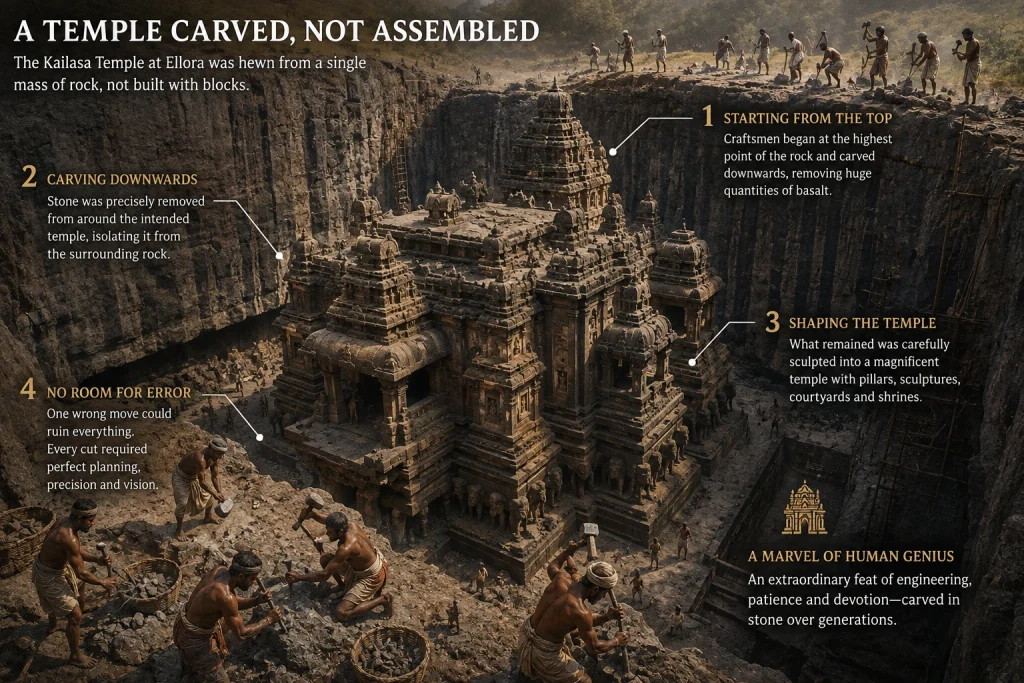
The most arresting fact about the Kailasa Temple is its method of creation. Many historic temples were assembled from separately quarried blocks. The Kailasa Temple was excavated from the living rock.
Ancient craftsmen began at the top and worked downward into the basalt. They removed enormous quantities of stone around the intended sanctuary, gradually isolating the temple from the surrounding cliff. What remained was then shaped into architecture.
That sequence required extraordinary planning. A mason working on a conventional building could replace a misplaced block. A rock-cut artisan had no such luxury. Remove too much stone and the mistake could become permanent. Every corridor, column, sculpture, ledge, and opening therefore depended upon forethought.
The Kailasa Temple consequently represents more than sculptural dexterity. It is an exercise in spatial calculation, geological understanding, sequencing, and disciplined labour. Historical descriptions of the excavation emphasize that the craftsmen worked downward from the rock mass rather than simply hollowing out a conventional cave.
The Architecture of Cave 16
The Kailasa Temple is laid out as a monumental courtyard containing a principal shrine and associated architectural elements. Its design borrows the visual language of a freestanding Dravida-style temple, even though the entire composition is hewn from one rock mass.
The main shrine contains a Shiva linga, while a Nandi shrine stands before it. Towering architectural forms rise from the excavated court, and the walls carry dense figurative sculpture. Elephants appear to support the lower portions of the complex, creating the illusion that the temple rests upon living creatures.
The monument also contains mandapas, galleries, subsidiary shrines, pillars, stairways, and sculpted façades. Its proportions are unusually ambitious for a rock-cut monument. The result feels less like a cave and more like a conventional temple that has somehow been released from the mountain.
That illusion is one of the Kailasa Temple’s greatest artistic triumphs.
Sculptures That Turn Stone Into Narrative
Walking through the Kailasa Temple is almost like reading a vast stone manuscript. Hindu mythological episodes unfold across the surfaces. Shiva receives particular prominence, but the sculptural vocabulary extends across Vaishnava and other Hindu traditions as well.
Among the best-known compositions are scenes connected with the Ramayana and Mahabharata, along with depictions of deities, celestial figures, guardians, animals, and mythic episodes. The richness of these carvings makes the monument resemble a three-dimensional archive of religious storytelling.
The Ravana panel remains especially memorable because it captures movement within an immovable material. Ravana strains beneath the mountain; Shiva’s presence above conveys calm and sovereignty. The contrast gives the sculpture unusual theatrical force.
The temple also preserves traces of paintings. UNESCO notes surviving paintings from different periods on ceilings in the front mandapa. These remnants are valuable because they remind visitors that the monument was not conceived as bare stone alone; colour once participated in its visual atmosphere.
How Long Did Construction Take?
There is no universally accepted timetable for every stage of the Kailasa Temple. The broad historical attribution places its principal creation in the eighth century, during the Rashtrakuta period. Yet scholars have debated whether some work began under Krishna I’s predecessor Dantidurga, whether later rulers expanded portions of the complex, and how subsequent additions should be dated.
This uncertainty does not diminish the monument. Instead, it reveals how difficult it is to reconstruct the biography of a building created more than a millennium ago. Styles can overlap, inscriptions can be indirect, and later generations can repair, repaint, or modify sacred spaces.
The safest conclusion is that the Kailasa Temple emerged from the Rashtrakuta architectural programme and reached its monumental form through a process more intricate than a single date on a calendar can fully explain.
Fascinating Facts About Kailasa Temple
One remarkable fact is that the Kailasa Temple is monolithic: its principal architecture was carved from the natural rock rather than assembled from independent structural blocks.
Another is its location within Ellora. The Kailasa Temple does not exist in isolation. It forms part of a sequence of monuments created between roughly the sixth and tenth centuries, where Buddhist, Hindu, and Jain traditions are represented within the same broader landscape.
The scale is another source of astonishment. The excavation involved removing a prodigious volume of basalt. Exact estimates vary by source, so claims about a single precise tonnage should be treated cautiously. What is beyond dispute is the sheer magnitude of the quarrying operation.
The monument also demonstrates that ancient Indian architecture was not limited to building upward. At Ellora, architects reversed the familiar logic. Instead of stacking material into a temple, they subtracted material until the temple emerged.
That inversion is perhaps the most ingenious fact about the Kailasa Temple.
Kailasa Temple and Ellora’s Wider Legacy
The Kailasa Temple is only one chapter in Ellora’s larger story. The surrounding caves reveal centuries of religious, artistic, and technological activity. Buddhist monasteries, Hindu sanctuaries, and Jain caves occupy the same extensive escarpment, giving the site an unusual historical breadth.
UNESCO considers this coexistence one of Ellora’s defining qualities. The complex demonstrates not only artistic achievement but also a long history of different religious communities establishing sacred spaces within the same regional cultural environment.
For that reason, the Kailasa Temple should not be viewed merely as an isolated architectural curiosity. It belongs to a much wider Deccan tradition in which faith, kingship, craftsmanship, mythology, and landscape were closely intertwined.
Why Kailasa Temple Still Captivates Visitors
The enduring fascination of the Kailasa Temple comes from the union of opposites. It is enormous yet intricately detailed. It is carved from a single rock mass yet imitates a constructed temple. It is technically severe in its demands yet saturated with mythology.
Perhaps most strikingly, the monument makes labour disappear. Visitors see the finished sanctuary, not the thousands of decisions required to extract it from a cliff. Every surviving column conceals an earlier stage of subtraction; every sculpture represents stone that was deliberately left behind while surrounding material vanished.
The Kailasa Temple therefore offers a rare glimpse into the imagination of its makers. They did not merely decorate a mountain. They reinterpreted the mountain itself.
Final Thoughts
The Kailasa Temple at Ellora remains one of India’s most extraordinary achievements in rock-cut architecture. Its Rashtrakuta-era origins, association with Krishna I, monumental scale, mythological sculpture, and audacious excavation technique have secured its place in the history of world architecture. UNESCO regards Cave 16 as a culminating achievement of Indian rock-cut architectural innovation and an exceptional expression of human creative genius.
Yet its importance reaches beyond size. The Kailasa Temple demonstrates what happens when engineering, religious imagination, royal ambition, and artistic patience converge upon a single geological canvas. More than a monument, it is a carefully orchestrated act of subtraction in which the absence of stone becomes the architecture.
That is why, after more than a thousand years, the Kailasa Temple still feels astonishing. It does not merely show what ancient craftsmen built. It shows what they dared to remove.
Frequently Asked Question’s
Where is the Kailasa Temple located?
The Kailasa Temple is located at Ellora in Maharashtra, India. It is Cave 16 within the Ellora Caves complex, which contains Buddhist, Hindu, and Jain monuments.
Who built the Kailasa Temple?
The Kailasa Temple is generally attributed to Rashtrakuta King Krishna I, who ruled during the eighth century. Its construction is associated with the Rashtrakuta period and represents one of the era’s most remarkable architectural accomplishments.
What makes the Kailasa Temple unique?
The Kailasa Temple is unique because it was carved directly from a single mass of basalt rather than assembled from separate stone blocks. Craftsmen worked downward from the top of the rock, carefully removing material to reveal the temple’s architecture, sculptures, pillars, and courtyards.
What does the name Kailasa Temple mean?
The name Kailasa refers to Mount Kailash, traditionally regarded as the sacred abode of Lord Shiva. The temple was designed as a monumental earthly representation of this divine mountain, reinforcing its religious symbolism through architecture and sculpture.
What are some famous features of the Kailasa Temple?
Notable features include its monolithic construction, elaborate Hindu sculptures, Shiva linga, Nandi shrine, monumental courtyard, carved elephants, and the celebrated depiction of Ravana attempting to shake Mount Kailasa. These elements showcase the extraordinary craftsmanship and religious imagination behind the monument.

1 thought on “Kailasa Temple: History, Architecture, Facts, and the Stone-Cut Marvel of Ellora”