

Table of Contents
On the golden, wind-swept shores of Odisha stands one of India’s most extraordinary tributes to devotion, art, and astronomy — the Konark Sun Temple. Carved entirely in the shape of a colossal stone chariot for the Sun God Surya, this UNESCO World Heritage Site has drawn pilgrims, historians, and travellers from across the world for more than 700 years. Even in its partially ruined state, it remains one of the most awe-inspiring monuments in the country, a place where mythology, engineering, and art converge in stone.
If you’re someone who loves tracing India’s sacred and architectural heritage — the same spirit that draws travellers to the ancient Himalayan shrines on our Char Dham Yatra — Konark deserves a firm place on your travel list. In this guide, we’ll walk through the complete Konark Sun Temple history, who built it, its architectural brilliance, and everything else you need to know before planning a visit.
About Konark Sun Temple
The Konark Sun Temple, also known as Surya Mandir or the “Black Pagoda,” is located about 35 km northeast of Puri, along Odisha’s eastern coastline. Its name comes from two Sanskrit words — Kona, meaning corner or angle, and Arka, meaning sun — a reference to both its geographical position and its dedication to the sun god.
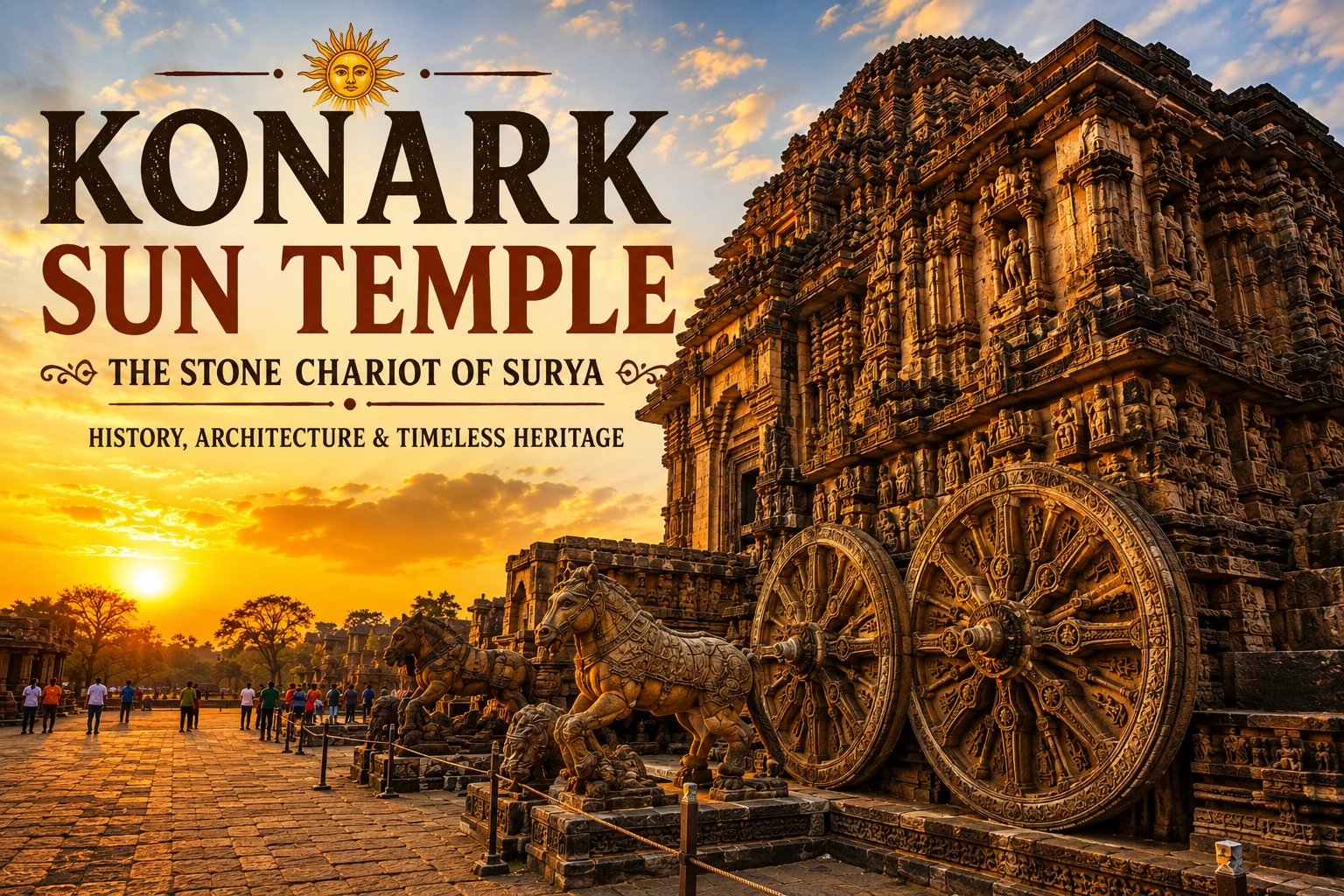
What sets Konark apart from almost every other temple in India is its concept. The entire structure was designed as a gigantic chariot of Surya, complete with 24 elaborately carved stone wheels, each about 10 feet in diameter, and seven mighty horses meant to pull the chariot across the sky. These wheels weren’t purely decorative — each one functions much like a sundial, and it’s believed they could indicate time with surprising accuracy, a remarkable feat of astronomical understanding for the 13th century.
Built primarily from black granite and chlorite stone, the temple’s surfaces are covered edge to edge with some of the finest and most detailed carvings found anywhere in Indian temple architecture. These sculptures depict royal processions, military campaigns, celestial dancers, mythical animals, and vivid scenes from everyday life in medieval Odisha, offering a window into the culture of the era in which it was built.
Though much of the original structure — including its towering spire — no longer stands, what remains continues to leave visitors spellbound with its scale, symmetry, and sheer artistic ambition.
Konark Sun Temple History
Sun worship in this coastal region of India is believed to date back many centuries, but the temple as it stands today was constructed in the 13th century CE, with most historical and archaeological evidence pointing to around 1250 CE. That makes the temple roughly 775 years old.
According to popular legend, the origins of sun worship at Konark trace back to Samba, the son of Lord Krishna, who is said to have been cured of leprosy through the grace of Surya after years of penance at this very site. This mythological connection is believed to have inspired the far grander construction that followed centuries later, commissioned by the Eastern Ganga dynasty.
Over the following centuries, the temple suffered extensive damage. Its towering shikhara, or spire, once estimated at around 227 feet — making it one of the tallest temples ever built in India — collapsed by the 19th century. Historians remain divided on the exact cause, pointing to structural weaknesses, coastal erosion, invasions, or a combination of factors. Much of the temple’s central sanctum and surrounding structures fell into ruin as a result, and several sculptures were relocated to museums and other temples over time.
Restoration efforts began in earnest during the British colonial period, when officials recognised the temple’s cultural and architectural significance. Today, the Archaeological Survey of India (ASI) continues to maintain and conserve what remains, using techniques ranging from lime mortar stabilisation to laser cleaning of delicate carvings, in partnership with UNESCO.
Who Built Konark Sun Temple
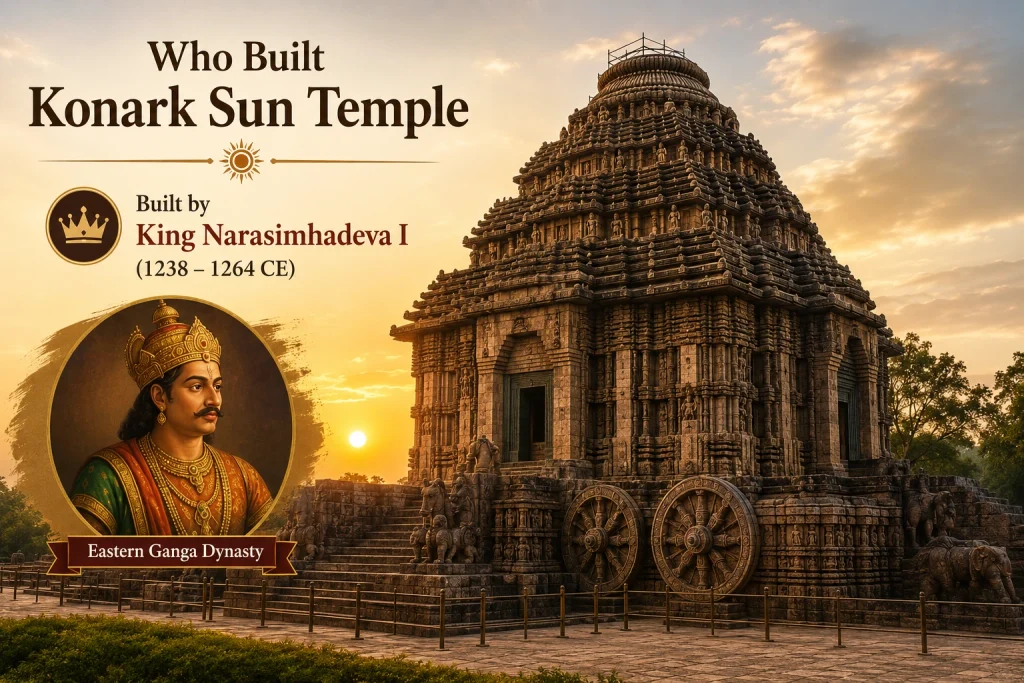
The Konark Sun Temple was built by King Narasimhadeva I, a ruler of the Eastern Ganga dynasty, who governed the region of Kalinga (present-day Odisha) between 1238 and 1264 CE. Most historians agree that construction began around 1250 CE.
There are differing theories about why the king commissioned such an ambitious project. Some historians believe it was built to commemorate his military victory over invading forces from Bengal, serving as a symbolic assertion of his power and divine right to rule. Others point to it as a profound expression of religious devotion to Surya, the sun god, whose worship held deep significance in the region during this period.
Regardless of the exact motivation, the scale of the undertaking was immense. Construction is believed to have taken over a decade and involved thousands of skilled artisans, sculptors, and labourers working in coordination — a monumental engineering feat for its time. The Eastern Ganga dynasty was also responsible for other significant architectural achievements in the region, including contributions to the Jagannath Temple in Puri, reflecting the era’s extraordinary investment in temple building and stone craftsmanship.
Konark Sun Temple Information for Visitors
If you’re planning to visit, here’s some essential Konark Sun Temple information to help you make the most of your trip:
- Location: Konark, Puri district, Odisha, on India’s eastern coastline
- Best time to visit: October to March, when the coastal weather is cool, dry, and comfortable for exploring
- Nearest airport: Biju Patnaik Airport, Bhubaneswar, approximately 65 km away
- Nearest railway station: Puri Railway Station, approximately 35 km away
- UNESCO status: Declared a World Heritage Site in 1984
- Managed by: Archaeological Survey of India (ASI)
- Nearby attraction: Chandrabhaga Beach, just a short distance from the temple complex
- Museum: The Konark Archaeological Museum houses a collection of sculptures and fragments recovered from the site
- Annual event: The Konark Dance Festival, held every December, features Odissi and other classical Indian dance forms performed against the temple’s stunning backdrop
It’s best to visit early in the morning to avoid crowds and enjoy the temple in softer light, which also makes for far better photography. Hiring a government-approved guide is highly recommended, as many of the finer architectural and symbolic details — from the wheel carvings to the mythological narratives on the walls — are easy to miss without context.
For verified visitor information, entry details, and conservation updates, you can refer to the official listing on Incredible India, the Government of India’s official tourism portal.
A Journey Beyond Konark
While Konark reflects the artistic and architectural soul of eastern India, the Himalayas hold their own share of sacred wonders built with the same devotion and craftsmanship. Travellers who are drawn to ancient temple architecture often find themselves equally captivated by shrines like the Kailasa Temple, another extraordinary example of rock-cut Indian craftsmanship, or the high-altitude pilgrimage trails we curate across Uttarakhand and Himachal Pradesh. If sacred journeys are what move you, exploring India’s temple heritage rarely stops at just one destination.
Frequently Asked Questions’s
Who built the Konark Sun Temple?
The temple was built by King Narasimhadeva I of the Eastern Ganga dynasty, with construction believed to have begun around 1250 CE.
How old is the Konark Sun Temple?
The temple is approximately 775 years old, having been constructed in the 13th century.
Why is Konark Sun Temple famous?
It’s famous for being designed as a giant stone chariot with 24 intricately carved wheels and seven horses, its extraordinary sculptural detail, and its recognition as a UNESCO World Heritage Site since 1984.
What is the best time to visit Konark Sun Temple?
October to March is ideal, thanks to the cooler, drier coastal weather during these months.
Is Konark Sun Temple still used for worship today?
No, the temple is no longer an active place of worship due to its partially ruined condition, but it remains one of India’s most visited and celebrated heritage monuments.