

Table of Contents
India’s northern frontier is defined by some of the most formidable terrain on Earth. Stretching across the Himalayas, the Karakoram, and the Garhwal ranges, the country is home to dozens of peaks soaring above 7,000 metres. But when it comes to identifying the highest mountain in India, the answer involves a little more nuance than a single number on a chart.
This guide breaks down the country’s three tallest summits, explains the geographical debate surrounding them, and looks at what makes each one significant for mountaineers, pilgrims, and travellers alike.
Kangchenjunga: The Highest Mountain in India
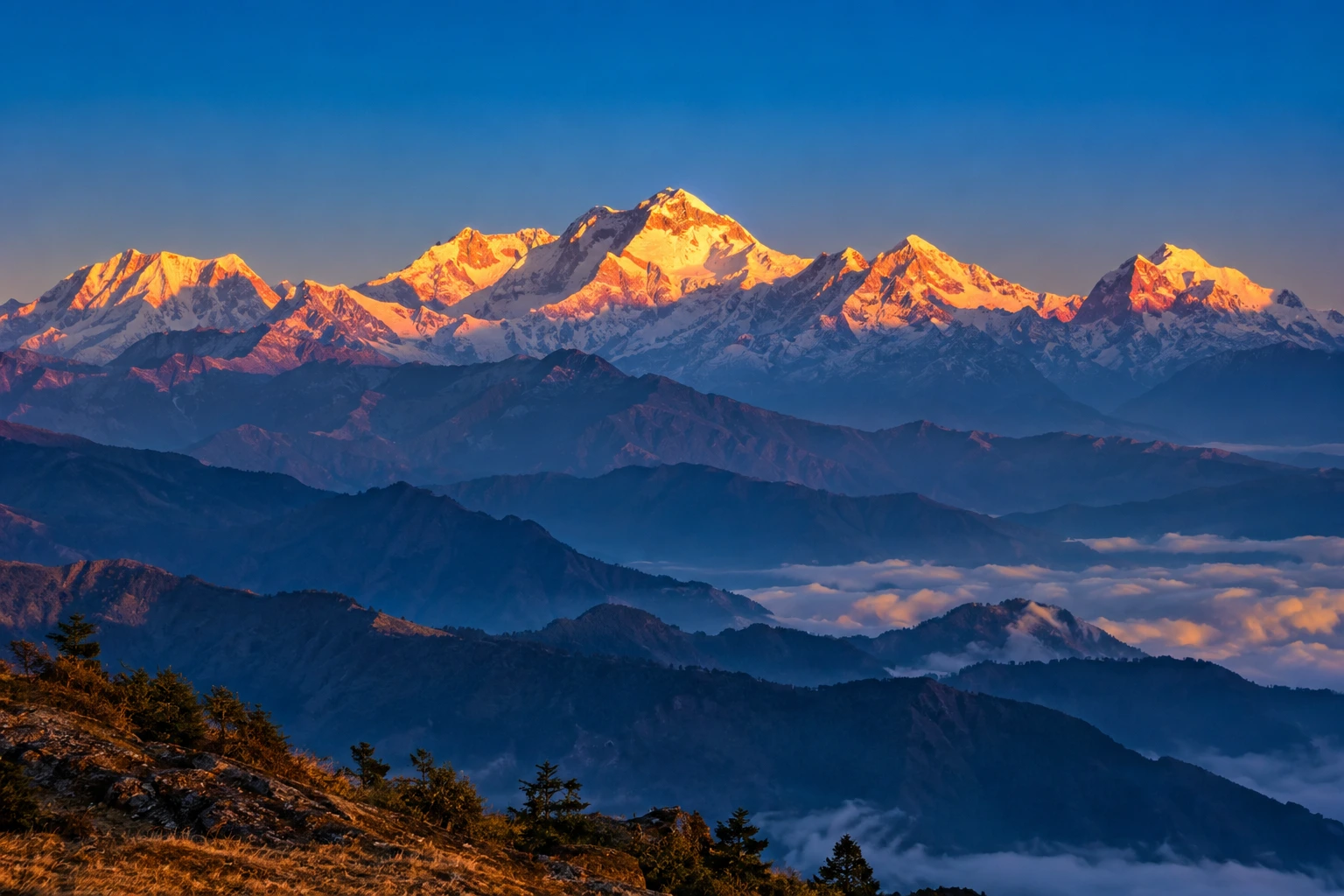
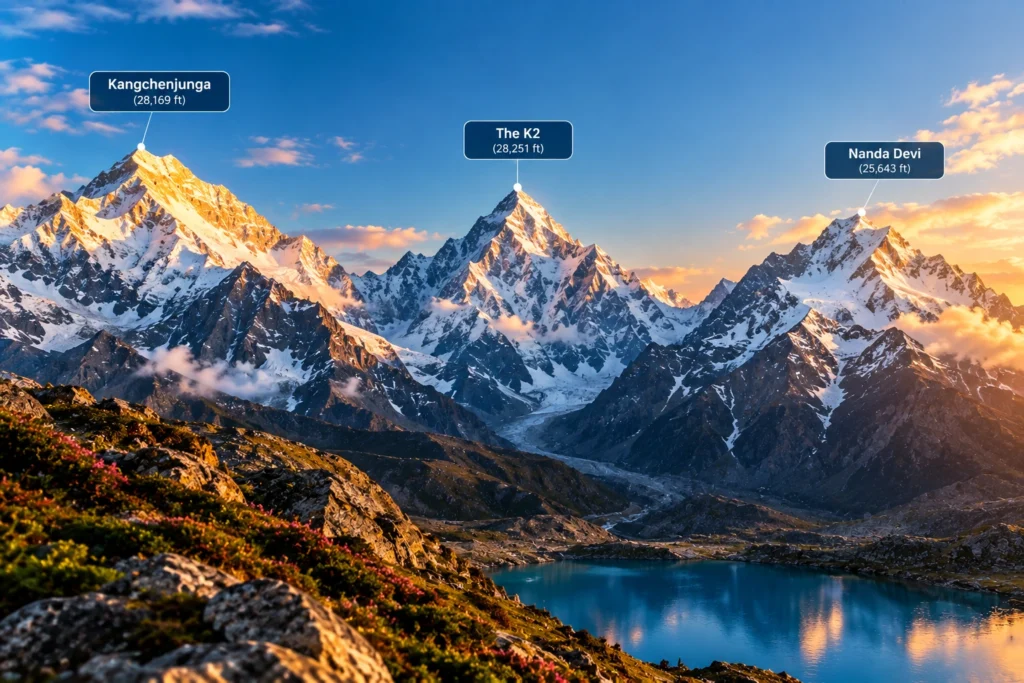
Standing at 8,586 metres (28,169 feet), Kangchenjunga is the highest mountain in India and the third-highest peak on the planet, after Everest and K2. It rises on the border between the Indian state of Sikkim and eastern Nepal, dominating the skyline for hundreds of kilometres in every direction.
The name translates roughly to “Five Treasures of the Snow,” a reference to its five distinct summits, which in local tradition are said to represent gold, silver, gems, grain, and sacred texts. For the people of Sikkim, the highest mountain in India is not merely a geographical feature but a guardian deity, and this reverence has shaped how it is treated even by outsiders.
That respect became part of mountaineering history in 1955, when the first successful expedition, led by British climbers Joe Brown and George Band, deliberately stopped a few metres short of the true summit. They had promised the Chogyal, Sikkim’s ruler at the time, that the highest point would remain untrodden. Most expeditions since have honoured the same tradition, making Kangchenjunga one of the few major peaks whose actual summit is generally left undisturbed.
The surrounding region is protected by Khangchendzonga National Park, a UNESCO World Heritage Site that shelters snow leopards, red pandas, Himalayan black bears, and an extraordinary range of alpine flora.
The K2 Question
Anyone researching the highest peak in India will eventually run into a complication: K2. At 8,611 metres, K2 is taller than Kangchenjunga and is the second-highest mountain in the world. It sits in the Karakoram range, in territory administered by Pakistan but claimed by India as part of the wider Kashmir dispute.
Because of this, some Indian sources, particularly those aimed at competitive exams, list K2 as the country’s tallest. Others treat Kangchenjunga as the highest undisputed peak, since it lies entirely within territory under Indian administration. Both positions appear in official and academic material, and which one is used generally depends on whether the writer is applying territorial claims or effective control. For practical purposes, most geographers and travel resources treat Kangchenjunga as the highest mountain in India.
Nanda Devi: The Tallest Peak Entirely Within India
At 7,816 metres (25,643 feet), Nanda Devi holds a distinction that Kangchenjunga cannot claim: it lies wholly inside Indian borders, with no shared frontier. That makes it the highest mountain in India located entirely within the country, and the 23rd-highest in the world.
Located in the Chamoli district of Uttarakhand, Nanda Devi sits at the heart of the Garhwal Himalayas and is named after the region’s patron goddess. The peak has two summits, a higher western one and a lower eastern one, and is encircled by a formidable ring of mountains known as the Nanda Devi Sanctuary, a natural amphitheatre that kept the peak unreachable for decades.
The first ascent came in 1936, when Noel Odell and Bill Tilman reached the top. At the time, it was the highest summit any human had successfully climbed, a record that stood until Annapurna was conquered in 1950.
Recognising the fragility of the surrounding ecosystem, the Government of India established the Nanda Devi Biosphere Reserve in 1982, and the Nanda Devi National Park was declared a UNESCO World Heritage Site in 1988. Access to the inner sanctuary remains heavily restricted, which has helped preserve one of the least disturbed high-altitude environments in the Himalayas.
For trekkers who want to see this giant without attempting a technical climb, the trail to Kuari Pass offers some of the finest views available. Our Kuari Pass Trek package follows the historic Curzon Trail, with Nanda Devi visible across much of the route.
Kamet: The Third-Highest
Completing the trio is Kamet, at 7,756 metres (25,446 feet), which ranks third among India’s tallest mountains and 29th in the world. Like Nanda Devi, it stands in the Chamoli district of Uttarakhand, close to the Tibetan plateau and forming part of the Zanskar range.
Kamet is more remote and less photographed than its neighbours, partly because its position behind surrounding ridges keeps it hidden from most common viewpoints. It was first climbed in 1931 by a British expedition that included Frank Smythe and Eric Shipton, and at that point it was the highest peak ever summited, a title it held briefly before Nanda Devi took it five years later.
The mountain is surrounded by several major glaciers and sits near the Mana Pass, one of the highest motorable passes in the world, which adds to the sense of isolation that defines the area.
The Highest Mountain in India and Its Closest Rivals
| Rank | Peak | Height | Location | World Rank |
|---|---|---|---|---|
| 1 | Kangchenjunga | 8,586 m | Sikkim (India–Nepal border) | 3rd |
| 2 | Nanda Devi | 7,816 m | Chamoli, Uttarakhand | 23rd |
| 3 | Kamet | 7,756 m | Chamoli, Uttarakhand | 29th |
Why These Mountains Matter
Beyond record books, the highest mountain in India and its neighbouring giants shape daily life across the north. The glaciers feeding off them supply the Ganges, the Alaknanda, and countless smaller rivers that sustain agriculture across the plains. They influence monsoon patterns, act as a natural barrier along sensitive borders, and support biodiversity found almost nowhere else.
They also carry deep cultural weight. Nanda Devi is worshipped as a goddess across Uttarakhand, honoured every twelve years in the Nanda Devi Raj Jat Yatra, one of the longest pilgrimages in the Himalayas. Kangchenjunga occupies a similar place in Sikkimese belief. In both cases, the mountains are treated less as objects to be conquered and more as presences to be respected.
For travellers who want to experience this landscape without technical mountaineering, plenty of accessible options exist. Our guide to the 10 Best Treks in India covers routes that bring you within sight of these giants at a far gentler difficulty level.
For official tourism information and travel guidance across these regions, you can refer to Incredible India, the Government of India’s official tourism portal.
Frequently Asked Question’s
Which is the highest mountain in India?
Kangchenjunga, at 8,586 metres, is generally regarded as India’s highest peak. It lies on the border between Sikkim and Nepal and is the third-highest mountain in the world.
Is K2 or Kangchenjunga the highest peak in India?
K2 is taller at 8,611 metres, but it sits in Pakistan-administered territory that India claims. Kangchenjunga is therefore usually treated as India’s highest undisputed peak, though some Indian sources list K2 instead.
Which is the highest mountain entirely within India?
Nanda Devi, at 7,816 metres in Uttarakhand, is the tallest peak located completely inside Indian territory.
Which mountain ranks third in India?
Kamet, at 7,756 metres, ranks third. It is located in the Chamoli district of Uttarakhand near the Tibetan plateau.
Can these mountains be climbed?
All three have been summited, but each requires serious technical mountaineering experience and official permits. Access to the Nanda Devi sanctuary in particular is tightly restricted for conservation reasons.