

Table of Contents
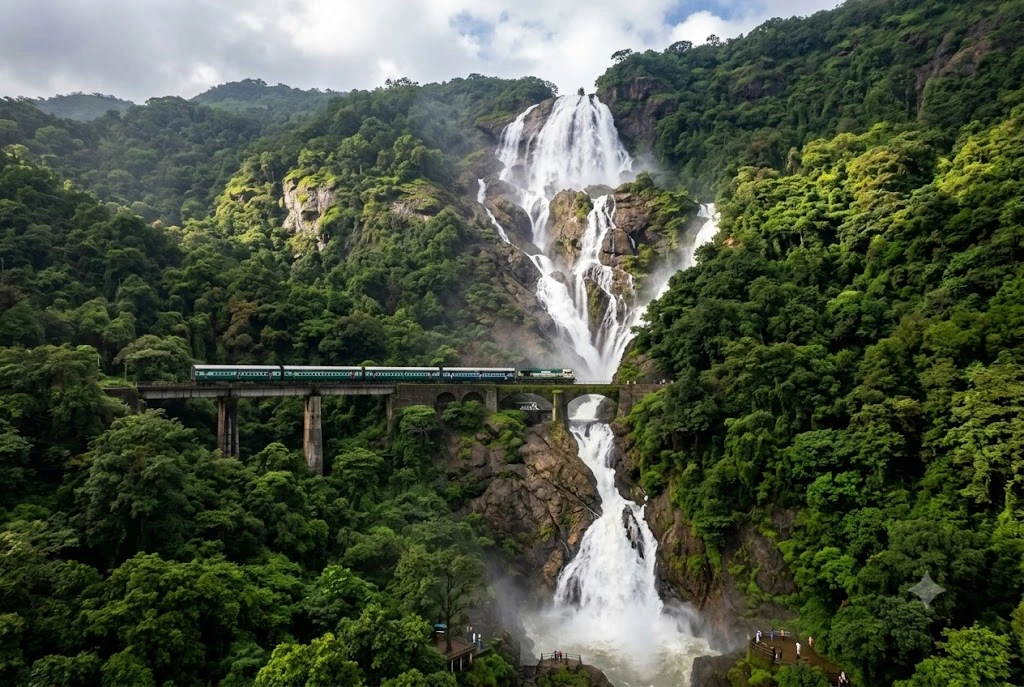
Somewhere between Goa’s beaches and Karnataka’s forested hills, a train line cuts straight across the face of a waterfall tumbling more than 300 metres down a sheer cliff. That’s Dudhsagar — a sight so unlikely that most first-time visitors assume the photos are edited until they’re standing right beneath it, watching the spray drift sideways in the wind and soak everyone within fifty metres.
This guide covers everything worth knowing before you go: the real story behind the name, what makes a Dudhsagar waterfall trip worth the effort, the practicalities of a Dudhsagar falls trek, where exactly to find it, and the best time to visit Dudhsagar so you’re not standing in front of a trickle instead of a torrent. If you enjoy chasing India’s wilder landscapes, this one pairs well with the trail covered in our Roopkund guide, a very different kind of Himalayan adventure.
Where Is Dudhsagar Waterfall
For travellers wondering exactly where is Dudhsagar waterfall located, the answer sits almost precisely on the Goa-Karnataka border, inside the Bhagwan Mahavir Wildlife Sanctuary and Mollem National Park, part of the Western Ghats. It’s roughly 60 kilometres from Panaji and about 46 kilometres east of Madgaon, fed by the Mandovi River — known as the Mahadayi upstream in Karnataka before it crosses into Goa and takes on its more familiar name.
The falls drop across four distinct tiers for a combined height of around 310 metres, spilling over a crescent-shaped valley wall roughly 30 metres wide at its average width. What makes the setting genuinely unusual, though, is the railway line running directly past it — the Belagavi to Vasco da Gama route, part of South Western Railway, threads along a viaduct practically alongside the falling water, so that a passing train and a 300-metre waterfall end up in the same frame almost by accident.
The Legend Behind the Name
Dudhsagar translates to “sea of milk,” and the name comes from the sheer volume and whiteness of the water as it crashes down the rock face during peak flow, frothing into something that genuinely resembles a river of milk rather than water. Local legend adds a more specific story to that description: a king’s daughter is said to have bathed near the top of the falls, pouring a pot of milk into the stream as part of a ritual, and from a distance below, the cascading water appeared to turn white, as though the princess’s milk itself had become the waterfall.
Whether the legend predates the physical description or grew out of it is hard to pin down, but either way, the name has stuck for long enough that it’s now how the falls are known across both Goa and Karnataka, regardless of which language you’re speaking in.
Dudhsagar Waterfall and the Forest Around It
The protected forest surrounding the falls is as much a part of the experience as the cascade itself. The Bhagwan Mahavir Wildlife Sanctuary and Mollem National Park together form a biodiverse pocket of the Western Ghats, home to deciduous forest, a wide range of birdlife, and larger mammals including elephants, leopards, and gaur, or Indian bison, though sightings depend entirely on luck and timing. Most visitors reach the base of the falls via open jeep safaris that run from Kulem, formerly spelled Collem, cutting through muddy forest tracks that are part of the adventure in their own right, especially just after monsoon rains.
For those planning a longer visit, a short walk from the jeep drop-off point brings you to pools at the base of the falls where swimming is allowed, though a life jacket is compulsory given how deep the water gets close to the cascade — these can usually be rented near the jeep stand in Kulem or at Castle Rock station on the Karnataka side.
Planning a Dudhsagar Waterfall Trip
If you’re putting together a Dudhsagar waterfall trip, it helps to decide early whether you want the straightforward jeep safari route or something more physically demanding. The jeep option from Kulem is the fastest way to reach the base of the falls and suits most travellers, including families, since it requires no serious fitness and takes a couple of hours round trip depending on queues at the sanctuary gate.
For anyone wanting a slower, more immersive version of the same trip, combining the jeep ride with time at the Dudhsagar Devi temple near Sonalium, roughly eight kilometres from Kulem, adds a cultural stop along the way and a good spot to rest and eat before continuing on.
The Dudhsagar Falls Trek
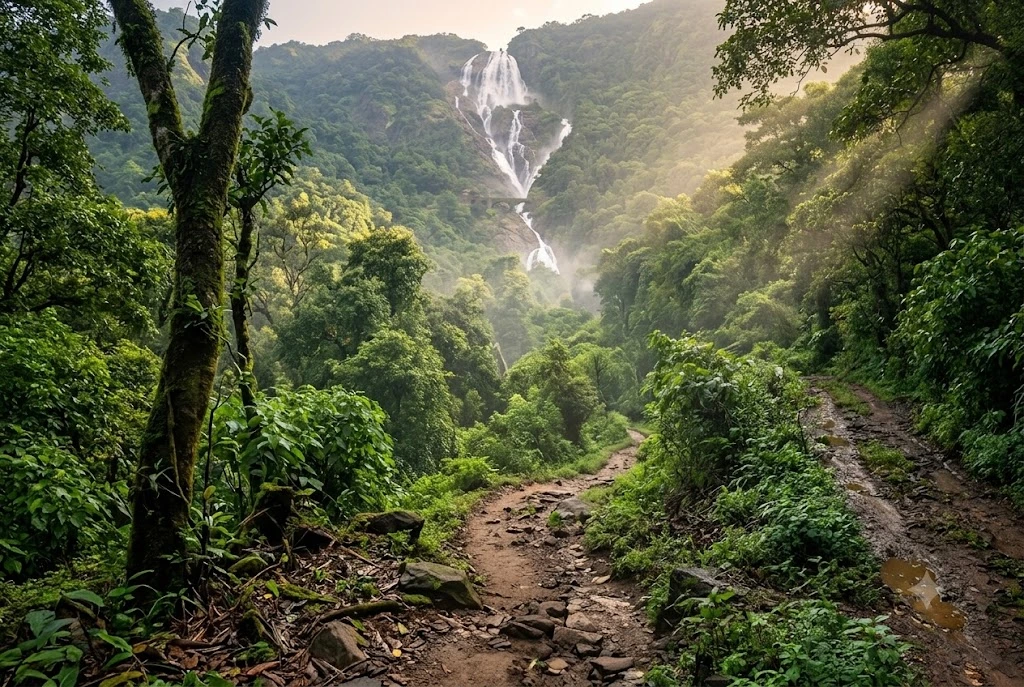
For a more demanding alternative, the Dudhsagar falls trek draws hikers who want to earn the view rather than ride to it. The most common route starts at Kulem and follows either an 11-kilometre stretch along the railway track or a roughly 12-kilometre mud road, each taking somewhere between four and six hours one way; many trekkers combine both, walking the tracks as far as Sonalium station before switching to the forest road for the remaining stretch. A longer, tougher version of this trek begins at Castle Rock on the Karnataka side, following the railway line for around 14 kilometres and taking six to eight hours one way.
Whichever route you choose, it’s worth treating distance and time estimates from mapping apps with some scepticism — the terrain, river crossings, and need to occasionally step off the tracks for passing trains all add time that a straight-line map distance won’t account for. Sturdy footwear, enough water, and an early start are non-negotiable for either trek option.
Best Time to Visit Dudhsagar
Timing matters more here than at almost any other waterfall in India, because the difference between a trickle and a genuine “sea of milk” comes down entirely to recent rainfall. The best time to visit Dudhsagar is generally considered to be from July through December, covering the monsoon months when the falls are at their most dramatic and powerful, through the post-monsoon period when the forest is lush but water levels have eased into something more manageable.
Visiting during the peak monsoon, particularly July and August, rewards you with maximum water volume but demands extra caution, since currents near the base pools get genuinely strong and access roads turn muddy and slower to navigate. Many experienced visitors instead recommend September through November, when the falls still run at an impressive, photogenic volume but conditions underfoot are considerably safer and easier to manage, especially for families or less experienced trekkers.
Getting There and Practical Tips
The nearest railway stations are Kulem in Goa and Castle Rock just across the border in Karnataka, both served by regular trains on the Vasco-Londa line, and both serving as the two main starting points for jeep safaris and treks alike. The nearest airport is Goa’s Dabolim, roughly 70 kilometres away, with Mopa International Airport also now offering an alternative entry point into the state.
Entry into the sanctuary typically requires permits and a forest department fee, arranged on the spot at the jeep safari stands rather than booked online in advance, and jeep timings usually run through daylight hours only, since the sanctuary closes to visitors after dark for safety and conservation reasons. Carrying cash, wearing quick-dry clothing, and packing a change of clothes for the ride back are small details that make a real difference once you’ve actually gotten soaked standing beneath the falls.
Frequently Asked Question’s
Where is Dudhsagar waterfall located?
Dudhsagar waterfall sits on the Goa-Karnataka border inside the Bhagwan Mahavir Wildlife Sanctuary and Mollem National Park, roughly 60 kilometres from Panaji and fed by the Mandovi River.
What is the best time to visit Dudhsagar?
The best time to visit Dudhsagar is generally July through December, with peak monsoon months offering maximum water flow and the September to November window offering a safer, still-impressive balance of volume and accessibility.
How do I reach the falls?
Most visitors reach the falls via open jeep safaris from Kulem in Goa or Castle Rock in Karnataka, both accessible by train on the Vasco-Londa railway line, with jeeps covering the final stretch through the sanctuary.
How difficult is the Dudhsagar falls trek?
The trek covers roughly 11 to 14 kilometres one way depending on the starting point, taking four to eight hours, and is considered moderately challenging due to terrain, river crossings, and the need for caution around the railway tracks.
Why is it called Dudhsagar?
Dudhsagar means “sea of milk,” referring to the white, frothy appearance of the water as it crashes down the four-tiered falls, with local legend adding a story of a princess’s milk pot overflowing into the stream.
Is swimming allowed at the falls?
Yes, swimming is permitted in designated pools at the base, though a life jacket is compulsory given the depth of the water near the falls.
Few waterfalls in India combine natural drama with such an unlikely human touch as Dudhsagar does, where a passing train and a 310-metre cascade share the same cliff face without either one feeling out of place. Whether you arrive by jeep for an easy half-day visit or commit to the full trek from Castle Rock, this is one of those places where the photos genuinely undersell what it feels like to stand beneath it. Travellers extending their trip south often pair it with the stark salt-flat landscapes covered in our Rann of Kutch guide, a similarly unforgettable but completely different side of India’s natural geography.
For official information on permits, forest rules, and current access conditions, refer to the Goa Forest Department’s official tourism page.