


Table of Contents
Perched atop Nilachal Hill in Guwahati, there’s a temple that doesn’t follow the usual rules of Hindu iconography — no idol to bow before, no conventional deity image at its core. This is Kamakhya Temple, one of the most revered Shakti Peethas in India, and its unconventional form of worship is exactly what draws pilgrims and scholars from across the country.
What Is Kamakhya Temple?
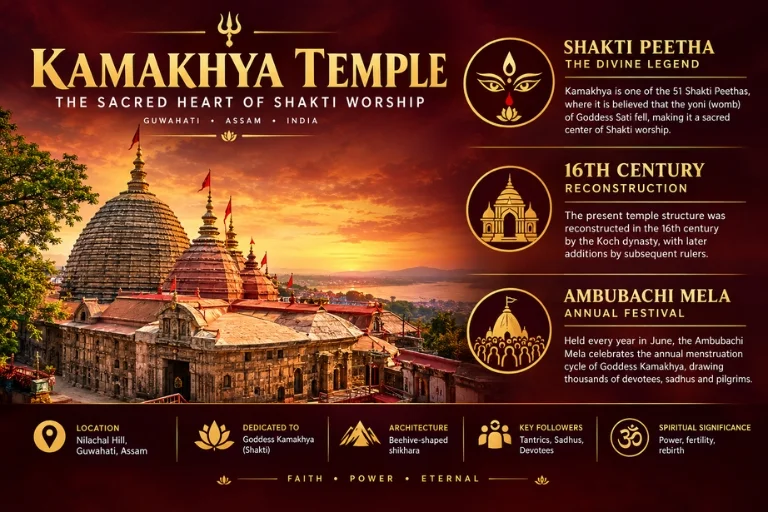
Maa Kamakhya temple is dedicated to the goddess Kamakhya Devi, a form of Shakti representing creation and fertility. Unlike most temples built around a carved idol, the sanctum here houses a natural rock formation shaped like a yoni, considered the symbolic womb of the goddess. It’s this distinction that sets Kamakhya devi temple apart from nearly every other major shrine in the country and places it firmly among the most significant Tantric worship centers in India.
Kamakhya Temple History
The Kamakhya temple history stretches back over a thousand years, though the structure visible today was largely rebuilt in the 16th century by King Naranarayana of the Koch dynasty, after an earlier temple was destroyed during invasions. The site’s origins as a place of worship, however, are believed to predate this reconstruction by centuries, rooted in older tribal and tantric traditions of the region long before formal temple architecture arrived.
Kamakhya Temple Story: The Legend of Sati
The Kamakhya temple story connects directly to one of Hinduism’s most well-known myths. According to legend, when Lord Shiva carried the body of Sati across the sky in grief after her death, Vishnu dismembered the body to ease his sorrow, and her body parts fell across different locations in India — each becoming a Shakti Peetha. At this particular site, it’s believed that Sati’s womb and reproductive organs fell, which is why the temple centers around fertility and creation rather than a conventional deity form.
Architecture and the Sanctum
The temple’s architecture blends beehive-shaped shikharas typical of the region with intricate carvings depicting various deities and mythological scenes across its outer walls. Inside, the sanctum sits below ground level, reached by a narrow stone stairway, where the natural rock formation remains perpetually moist from an underground spring — a detail that’s central to the temple’s rituals and symbolism.
The Ambubachi Mela
Every June, this temple hosts the Ambubachi Mela, one of the largest tantric festivals in India, drawing tens of thousands of pilgrims and sadhus, including many from tantric traditions who travel here specifically for this period. The temple closes for three days during the festival, symbolizing the goddess’s menstrual cycle, before reopening with elaborate rituals that mark the occasion as one of the most significant events on the region’s religious calendar.
Best Time to Visit
The temple is open year-round, but many pilgrims specifically plan trips around the Ambubachi Mela in June for the full festival experience, while others prefer the quieter months between October and March, when Guwahati’s weather is more comfortable for travel and temple visits.
How to Reach
Guwahati is well-connected by air, rail, and road, with Lokpriya Gopinath Bordoloi International Airport serving as the region’s main airport. From the city center, Nilachal Hill is a short drive away, with the temple accessible by road or a moderate uphill walk for those who prefer it. For travelers whose pilgrimage circuit includes other major Shakti and Shiva shrines across India, Explore Hills’ Do Dham Yatra covers two of Uttarakhand’s most significant pilgrimage sites, and the broader Yatra Packages collection covers several other Himalayan pilgrimage routes for those planning a multi-region spiritual trip.
For official tourism information and travel advisories for Guwahati and the Nilachal Hill region, you can refer to the Assam Tourism Department, the state government body overseeing tourist infrastructure in the area.
Conclusion
This temple doesn’t fit the mold of a typical pilgrimage stop, and that’s precisely its appeal. Between its unconventional sanctum, its deep tantric roots, and the intensity of the Ambubachi Mela each year, it remains one of the most distinctive and spiritually significant sites in the country — a place where mythology, ritual, and geography come together in a way few other temples manage.
Frequently Asked Questions
What is Kamakhya Temple famous for?
It is famous for housing a natural rock formation representing the goddess Kamakhya Devi, rather than a conventional idol, and for being one of the most significant Shakti Peethas in India.
What is the history behind Kamakhya Temple?
The temple’s history dates back over a thousand years, with the current structure largely rebuilt in the 16th century by King Naranarayana after an earlier temple was destroyed.
What is the story connecting Kamakhya Temple to Hindu mythology?
According to legend, Sati’s womb fell at this site after Vishnu dismembered her body, making it one of the Shakti Peethas associated with different parts of her body.
When is the best time to visit Maa Kamakhya temple?
Many pilgrims visit during the Ambubachi Mela in June for the full festival experience, while October to March offers cooler, more comfortable weather for a regular visit.