

Table of Contents
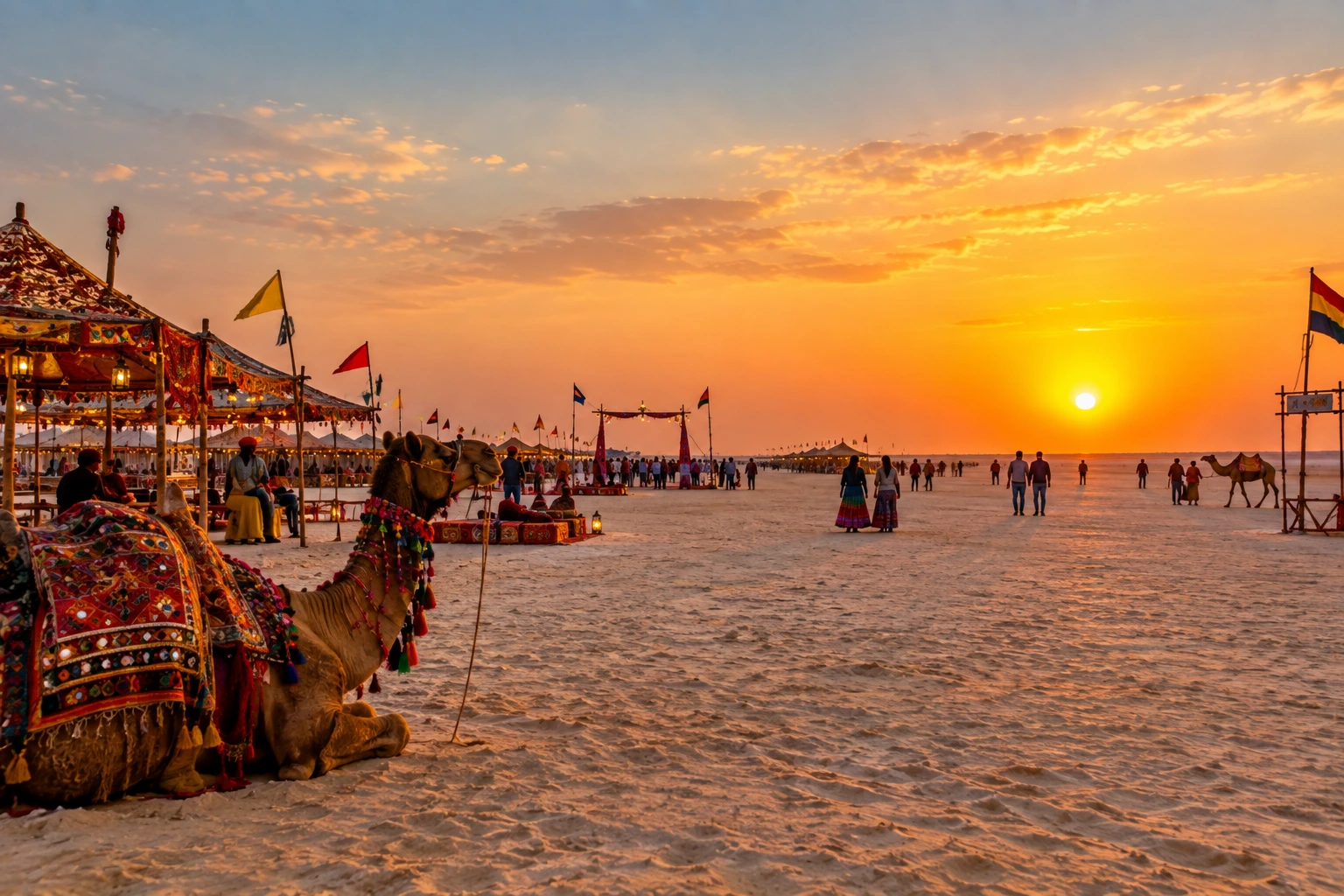
Somewhere along India’s western border, where Gujarat meets Pakistan, the earth turns white. Not with snow — with salt. Stretching for thousands of square kilometres, this seasonal desert is unlike anything else on the subcontinent: a flat, cracked, shimmering expanse that seems to dissolve into the sky at the horizon. This is the Rann of Kutch, and once you’ve seen it under a full moon, it’s hard to describe it to anyone who hasn’t.
Quick Facts Before You Go
Here’s a snapshot of the Rann of Kutch before we get into the details:
| Location | Kutch district, Gujarat, near the India–Pakistan border |
| Size | Roughly 26,000 sq km, among the largest salt deserts on Earth |
| Best known for | The White Rann and the Rann Utsav festival |
| Best time to visit | November to February |
| Nearest town | Bhuj, roughly 80 km from Dhordo |
| Entry | Regulated, with permits required near the border zone |
Where Is Rann of Kutch, Exactly?
This question comes up constantly, and for good reason — the geography here is unusual. The region sits in the Kutch district of Gujarat, in India’s far west, hugging the international border. It’s split into two distinct sections: the Great Rann to the north and the Little Rann to the south, together forming one of the largest salt marshes anywhere in the world.
Most of what travellers picture — the blinding white flats, the full-moon tent festival, the camel carts crossing an empty horizon — belongs specifically to the Great Rann, and more precisely, to a stretch near the village of Dhordo.
Great vs. White: What’s the Difference?
Here’s where a lot of first-time visitors to the Rann of Kutch get confused, so it’s worth untangling.
The Great Rann of Kutch refers to the entire salt marsh in the northern part of the district — a vast, largely uninhabited stretch that floods during the monsoon and dries into a hard salt crust afterward. Within this larger region lies the part everyone actually comes to photograph: the White Rann of Kutch, also called the Safed Rann, centred near Dhordo. This is the section that turns into an almost impossibly flat sheet of white salt once the water evaporates, and it’s where the Rann Utsav festival is staged every winter.
So think of it this way: the Great Rann is the whole landscape, and the White Rann is its most photogenic, most visited corner.
The Festival That Made It Famous
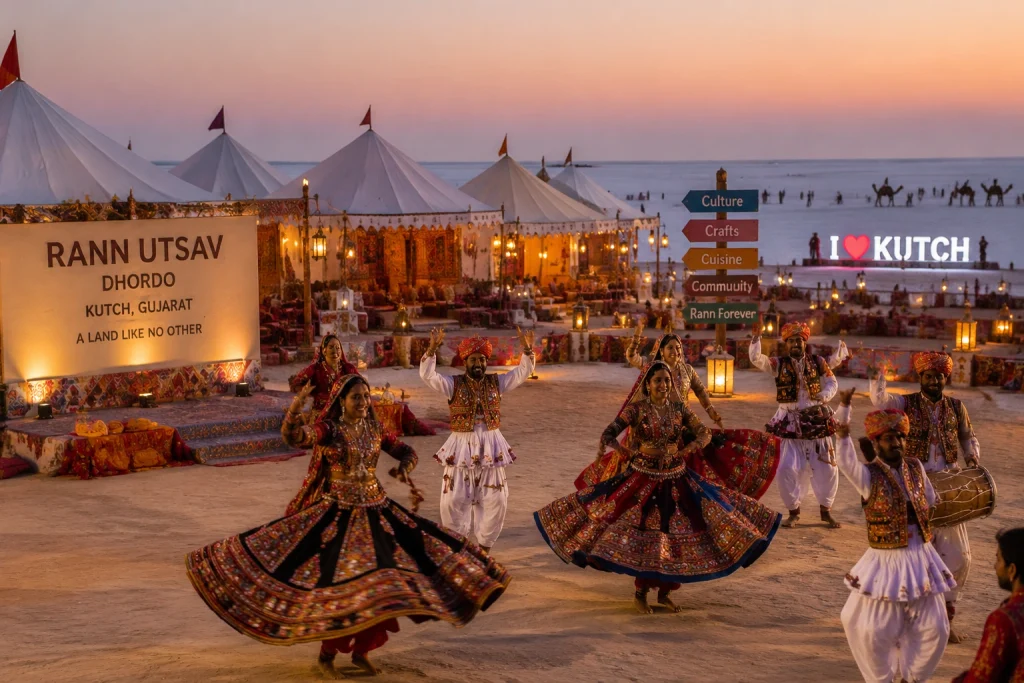
For most of the year, the Rann of Kutch sees relatively few visitors. Then, every winter, something changes entirely.
The Rann of Kutch festival, better known as Rann Utsav, transforms the area around Dhordo into a sprawling tented city. Folk music, Garba and Dandiya performances, handicraft stalls, camel safaris, and even paramotoring over the salt flats all become part of daily life for the duration of the season. The idea is credited to Narendra Modi during his tenure as Gujarat’s chief minister, and it has since grown into one of the state’s biggest tourism draws.
The real highlight, though, has nothing to do with the entertainment schedule. It’s stepping out onto the salt under a full moon, watching the entire desert glow silver in every direction. Locals and repeat visitors alike tend to plan their trips specifically around these lunar nights.
Best Time to Visit Rann of Kutch
Timing here isn’t just a matter of comfort — it fundamentally changes what you’ll see. The best time to visit Rann of Kutch falls between November and February, when daytime temperatures hover in a comfortable range and the salt desert is fully dry and walkable.
Within that window, December through February tends to draw the biggest crowds, largely because it overlaps with the full-moon nights that make the Rann Utsav so memorable. Early November through the start of December offers a quieter alternative, with cooler weather and noticeably fewer tourists.
Avoid the summer months entirely — temperatures can climb brutally high, and the desert offers little shade or relief. The monsoon, from roughly July to September, brings its own transformation: the Rann floods and becomes an inland sea, submerging the salt flats and closing off most tourist activity, though it does turn nearby wetlands into a haven for migratory birds.
Getting There
Bhuj serves as the main gateway to the Rann of Kutch, connected by both rail and air to major Indian cities. From Bhuj, it’s roughly a 1.5 to 2-hour drive to Dhordo and the White Rann. Because the area sits close to a sensitive international border, entry is regulated, and visitors typically need to register or carry identification for checkpoints along the way — a detail worth confirming before you travel, since requirements can shift.
For travellers exploring beyond Gujarat afterward, it’s worth noting that India’s landscape diversity runs in the opposite direction too — from salt deserts to snow-capped peaks. Our guide to the 10 Best Treks in India covers the Himalayan side of that contrast, while our Popular Destinations page rounds up more offbeat trips across the country.
A Traveler’s Checklist for the Rann of Kutch
- Book Rann Utsav tent accommodation well in advance — the season fills up fast, especially around full-moon dates
- Carry warm layers for the evenings; desert nights get surprisingly cold even in a region known for heat
- Bring a valid photo ID, since entry near the border is monitored
- Try to time your visit around a full moon for the most striking version of the white salt flats
- Combine your trip with nearby stops like Bhuj, Mandvi Beach, or the UNESCO-listed ruins at Dholavira
For verified travel advisories, permit information, and official updates, refer to Gujarat Tourism, the state government’s official tourism portal.
Frequently Asked Question’s
Where is the Rann of Kutch located?
It’s located in the Kutch district of Gujarat, in western India, close to the border with Pakistan, split into the Great Rann and Little Rann.
What’s the difference between the Great Rann and the White Rann?
The Great Rann is the entire salt marsh region, while the White Rann is a specific, more famous stretch near Dhordo where the salt crust turns strikingly white and the Rann Utsav is held.
When does the Rann of Kutch festival take place?
Rann Utsav typically runs from late October or early November through early March, with peak crowds during the December-to-February full-moon period.
Can you visit the Rann of Kutch during monsoon?
No, the monsoon floods the Rann entirely, turning it into a shallow inland sea and closing off access to the salt flats until the water evaporates in autumn.
Is a permit required to visit the Rann of Kutch?
Yes, since the region borders Pakistan, entry is regulated and visitors are generally required to carry identification for checkpoints along the route.