

Table of Contents
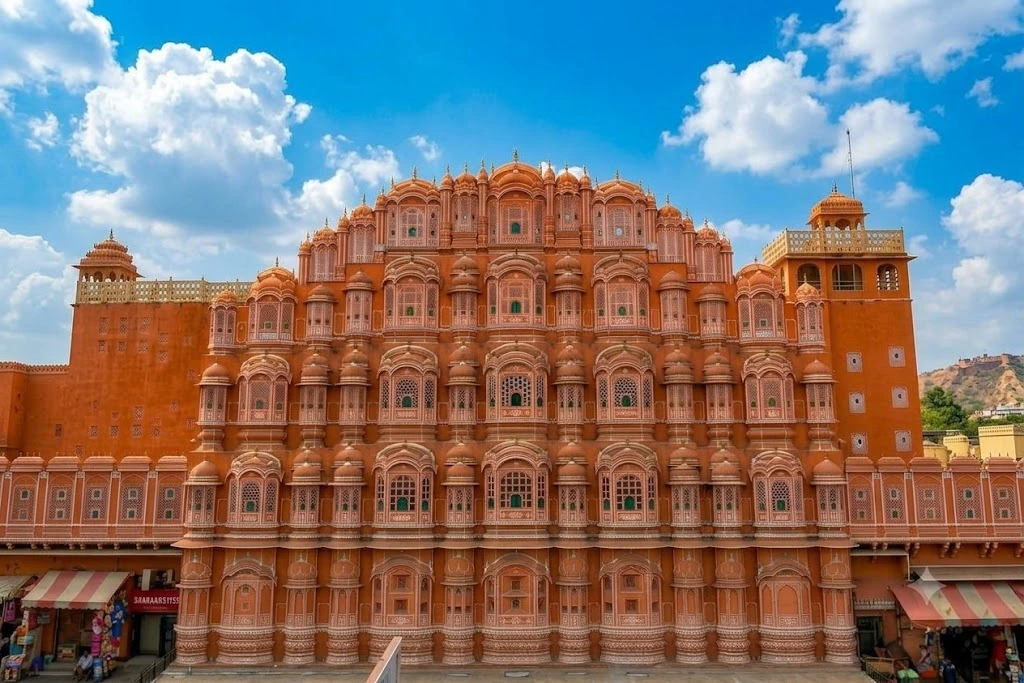
Stand on the busy road outside Jaipur’s City Palace and look up, and you will see one of the strangest buildings in India. It is only a few rooms deep, yet its front rises five storeys in a pyramid of pink sandstone, pierced by hundreds of tiny windows that glow like a honeycomb in the sun. This is Hawa Mahal, the “Palace of Winds,” and almost everything about it was designed around a single idea: letting people look out without letting anyone look in.
Most visitors tick it off in ten minutes from the pavement, which is a pity, because the story behind the facade is better than the photograph. This guide covers where Hawa Mahal stands, who built it and why, what the windows actually do, how to plan your visit around the official hours, and what the building looks like after dark.
Where Is Hawa Mahal Located
Travellers often ask where is Hawa Mahal located, and the answer is the heart of the Old City. The palace stands on Badi Chaupar in Jaipur, Rajasthan, at the edge of the City Palace complex, along the main road that runs through the walled “Pink City.” Jaipur Junction railway station is about 5.5 kilometres away, roughly twenty minutes by taxi or auto-rickshaw, and Jaipur International Airport is a little further out on the southern side of town.
One detail catches almost everyone out. The grand street face is not the entrance. There is no door on the front, and visitors enter through a gateway at the back, passing through a courtyard before reaching the building. Hawa Mahal Jaipur looks like a freestanding monument from the road, but it was built as a part of the royal women’s quarters, the zenana, which explains why the approach is tucked behind the City Palace side.
Who Built Hawa Mahal and Who Designed It
If you are wondering who built Hawa Mahal, the credit goes to Maharaja Sawai Pratap Singh, who completed it in 1799. He was a grandson of Sawai Jai Singh II, the astronomer-king who founded Jaipur in 1727. The designer was Lal Chand Ustad, an architect-craftsman whose name appears on the official tourism listing for the palace.
Pratap Singh was a poet and a devotee of Krishna, and the top of the building is popularly said to resemble Krishna’s crown, a comparison the Government of India’s tourism portal repeats. Historians also note that he took inspiration from the Khetri Mahal in Rajasthan’s Shekhawati region, whose latticed upper storeys served a similar purpose. In other words, the idea was not entirely new, but the scale and the street-facing drama were.
Hawa Mahal History and Purpose
The real Hawa Mahal history is a story about privacy. Rajput royal women of the period observed purdah, which meant they could not appear in public view, yet the city below was full of festivals, processions and markets they would otherwise miss. The solution was to build an extension of the zenana facing the main street, with a screen of tiny windows through which the women could watch Jaipur’s life unseen. A famous latticed grill known as the Aakash Patal Jali is said to have been designed so they could look down on the bustling Johari Bazaar area.
The architecture mixes two traditions. Rajput elements such as domed canopies and lotus motifs sit alongside Mughal-influenced arches and stone inlay, a blend common across 18th-century Rajasthan. The result is a building that feels both fortress and filigree, something heavy and delicate at once.
The palace did not escape time. By the late 20th century the structure had suffered from decades of neglect, and a major renovation followed in 2006 after a gap of roughly fifty years. Today Hawa Mahal is maintained by the state’s archaeology and museums department and ranks among the most photographed monuments in Rajasthan.
953 Windows and a Natural Air Conditioner
The number every guidebook quotes is 953, and it is correct: that is how many small windows, or jharokhas, cover the facade. Each is framed with carved sandstone and many are closed with fine latticework, arranged in tiers so that the whole front looks like a beehive.
The windows were not purely decorative. The latticed openings let air move through the building, and because narrow openings speed up airflow, the interior stays noticeably cooler on hot days, which is why the palace earned its name. In a city where summer highs near 44 degrees Celsius are common, a passive cooling system built in 1799 is a quiet bit of engineering.
The building is made of red and pink sandstone, which suits Jaipur’s famous colour scheme. The city was painted pink in the 19th century to welcome a royal visitor, and the shade stuck, with later rules requiring buildings to follow the same palette.
Inside the Building, Floor by Floor
Few visitors realise there is real space behind the facade. The palace has five storeys, each named for a function or a feature. The first floor, Sharad Mandir, is known for coloured glasswork, and the second is Ratan Mandir. Above it come Vichitra Mandir, Prakash Mandir and, at the top, Hawa Mandir, where the wind actually flows through the openings.
Inside, there are no staircases between the upper levels. Instead, gentle ramps lead to the higher floors, a design commonly explained as easier for royal ladies in heavy dress and palanquins. A small museum in the courtyard displays archaeological finds and Rajasthani miniature paintings, and from the top-floor balconies you look across the rooftops of the Old City toward the Jantar Mantar observatory and the City Palace.
Hawa Mahal in Night: What the Facade Looks Like After Dark
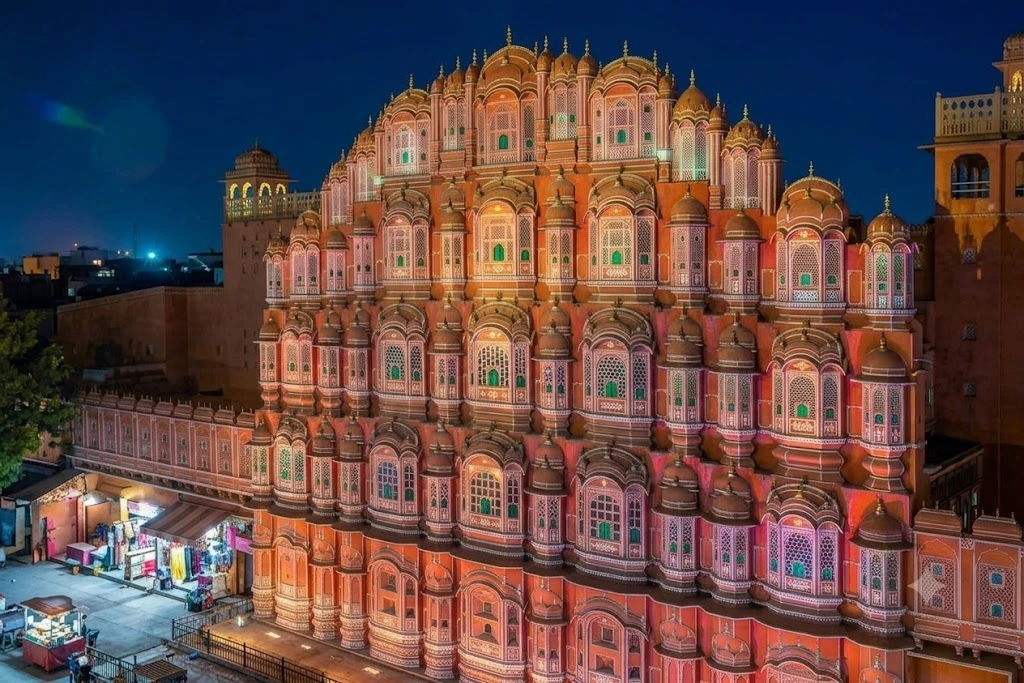
Ask anyone who has seen Hawa Mahal in night light and they usually say the same thing: it looks like a different building. In the evening the facade is lit warmly, and the carved windows turn into hundreds of small glowing frames against a darkening sky. Because the palace is an exterior-led monument, you do not need to be inside to enjoy this. The best viewing points are on the pavement across the road and from the rooftop cafes opposite, where you can sit with a cup of tea and watch the colour change from pink to gold.
Keep in mind that the monument itself closes in the late afternoon, so the night view is from outside only. I could not confirm exact illumination hours from an official source, so check at the time of your visit. The streets around it stay busy until late, which makes the area lively, if crowded.
Hawa Mahal Timings and Entry
According to the Government of India’s tourism listing, the Hawa Mahal timings are 9:00 AM to 4:30 PM. The doors open early, and the best light for photographing the facade comes in the morning, when the sun hits the pink sandstone directly. By early afternoon the front face goes into shade, and the colours look flatter.
The entry fee is modest and differs for Indian and foreign visitors, with commercial listings quoting slightly different figures, so it is safest to check the ticket counter or the Rajasthan government’s channels for the current rate. Allow roughly 45 minutes to an hour for the interior, longer if you want to read the museum displays.
Best Time to Visit and Practical Tips
October to March is the most comfortable season, with cool mornings and clear skies. Summer (April to June) is very hot, and midday visits can be uncomfortable. The monsoon brings green hills and fewer crowds, though some days are damp.
A few small tips make a Hawa Mahal visit easier:
- Arrive at opening time, when the line is short and the light is best for photographs.
- Wear comfortable shoes, since the ramps and courtyards involve some walking.
- Combine the visit with the nearby City Palace and Jantar Mantar, both within walking distance.
- If you are touring other Rajasthan forts, our Mehrangarh Fort guide covers Jodhpur’s great hill fort, and our Chittorgarh Fort guide covers the largest fort in India.
- For verified details on the monument, see the Incredible India page on Hawa Mahal, the Government of India’s official tourism portal.
Frequently Asked Question’s
Where is Hawa Mahal located?
Hawa Mahal stands on Badi Chaupar in the Old City of Jaipur, Rajasthan, at the edge of the City Palace complex, with the entrance at the back rather than the street front.
Who built Hawa Mahal?
Maharaja Sawai Pratap Singh built it in 1799, and Lal Chand Ustad designed it.
Why was Hawa Mahal built?
It was built so the royal women of the zenana could watch festivals and street life without being seen, in keeping with the purdah tradition of the time.
How many windows does Hawa Mahal have?
The facade has 953 small windows, called jharokhas, many with carved latticework that lets air circulate.
What are the Hawa Mahal timings?
Official tourism listings give the timings as 9:00 AM to 4:30 PM, though it is wise to confirm before you travel, especially around festivals.
Can you go inside Hawa Mahal?
Yes. Visitors enter through the rear gateway and can climb ramps to the upper floors, which have small balconies and a museum in the courtyard.
What stays with you about Hawa Mahal is its contradiction. It was built to hide the people inside, and today it is one of the most looked-at buildings in India. Take the time to go in, climb to the top, and watch the old city through the same small windows the women once used. The view is the point.