

Table of Contents
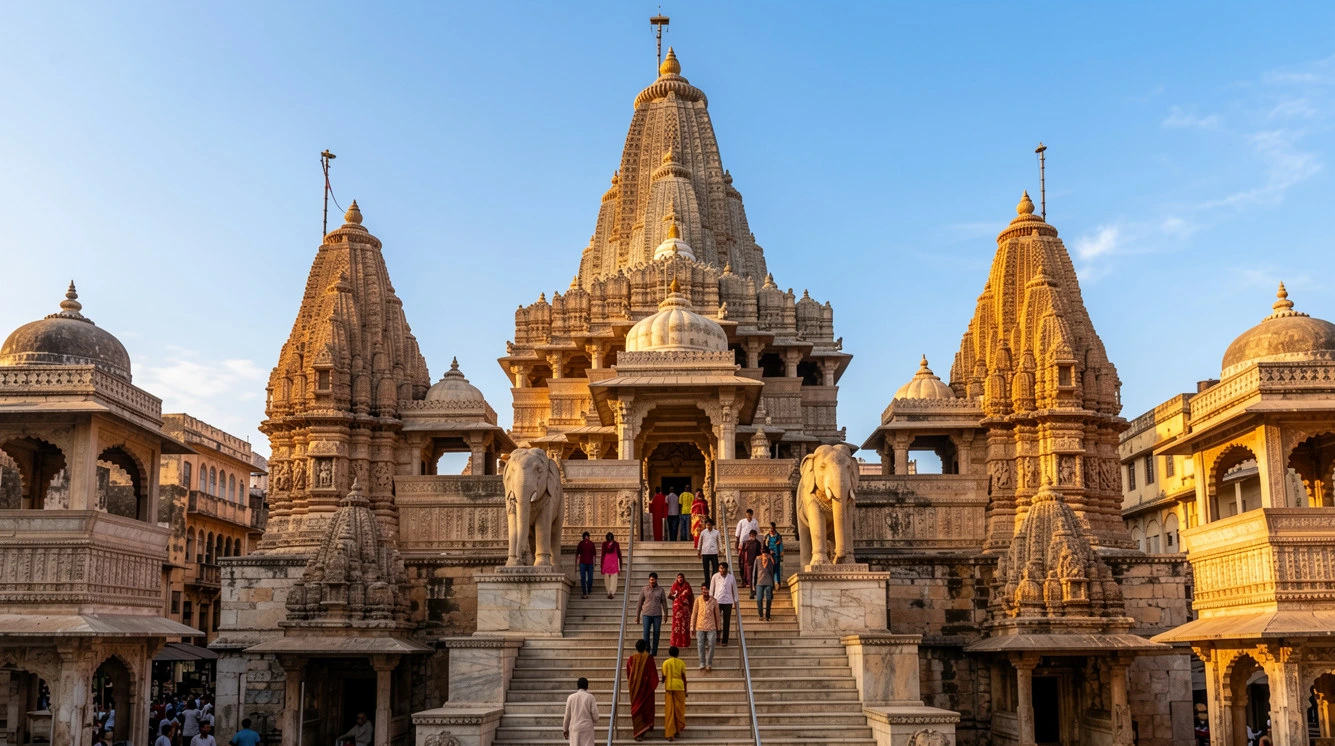
Walk up from the lanes of Udaipur’s old city, past stalls of silver jewellery and miniature paintings, and the street suddenly lifts into a flight of white marble steps guarded by two stone elephants. At the top stands a spire so densely carved that it looks less like a building and more like a sculpture. This is Jagdish Temple, a seventeenth-century shrine that has been in continuous worship since the day it opened, and one of the most photographed religious sites in Rajasthan.
Most visitors treat Jagdish Temple as a quick stop between the City Palace and Lake Pichola. That is a shame, because the temple carries a story of royal devotion, a dream, a Mughal-era battle and a distinctive building style. This guide covers where it stands, who built it, what to look for on the carvings, and how to plan around the daily schedule.
Where Jagdish Temple Stands
Jagdish Temple sits in the heart of Udaipur’s old city, just outside the royal palace complex and a short walk from the City Palace. That position is deliberate. Jagdish Temple was built by the Mewar rulers as a royal place of worship, close enough to the palace to be reached on foot during festivals, yet open to the public from the start. Lake Pichola lies a few minutes away in one direction, and the busy bazaar streets run in the other, which makes the temple easy to combine with a day of old-city sightseeing.
The nearest airport is Maharana Pratap Airport, about 22 kilometres from the city, and Udaipur City railway station is the closest rail link. From either, an auto-rickshaw or taxi can drop you near the bottom of the steps, since the lanes around the temple are narrow and best covered on foot.
Jagdish Temple Udaipur History: A Dream and a King
The tradition most often repeated about Jagdish Temple Udaipur history begins with a dream. According to one account, Maharana Jagat Singh I was directed in a dream to build a shrine to Lord Vishnu at this exact spot, and he began work soon after. Jagat Singh ruled Mewar in the mid-seventeenth century, a period of relative stability, and his reign left Udaipur with several lasting buildings.
Jagdish Temple was completed in 1651, though a board at the site gives 1652, which is a small difference you will see mentioned in different sources. The cost is recorded as roughly 1.5 million rupees, an enormous sum for the time. Originally called the temple of Jagannath Rai, it is now known by the shorter name Jagdish-ji, a form of Jagadish, meaning “Lord of the Universe.”
Its worship has continued without a break since. Few temples of this age in Rajasthan can say as much, because many were damaged, closed or rebuilt during the turbulent decades that followed.
The Defence of 1680
The site also has a battle story. A painting and a board inside the complex describe how the temple was defended during a Mughal advance on Mewar around 1680. The account credits Naruji Barhat, a Charan warrior, and twenty companions with holding the temple against the attackers, at the cost of their lives. Historians differ on the details, and the board represents local memory rather than a detailed chronicle, but the event is part of how the temple is remembered in Udaipur. Visitors can still see the painting that commemorates it.
A Temple Built in the Māru-Gurjara Style
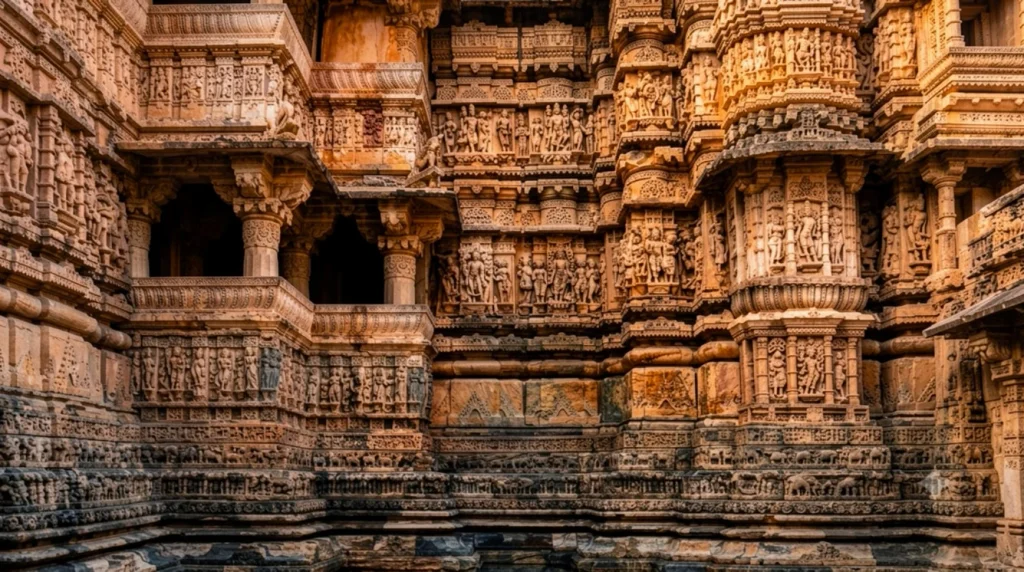
Architecture is where Jagdish Temple really stands apart. It follows the Māru-Gurjara tradition, also described as Indo-Aryan, a style found in the Maru and Gujarat regions and known for tall towers, elaborate pillared halls and layered sculpture.
The temple rises on a high terrace, with a double-storey hall in front of a sanctum topped by a spire about 79 feet high. It is crowned by a tower that, from below, looks like several storeys, though a few of those levels are purely decorative. Every wall is covered with hand-carved figures: elephants in procession, dancers, musicians and divine figures, including an instrument that resembles a rudra veena. Once you start looking, the carving keeps revealing new detail, so give yourself time at the foot of the steps before climbing. The overall effect, designed to be read from below as you climb, is of a sacred mountain rising out of the street.
Climbing the 32 Steps
The approach itself is part of the experience. Thirty-two marble steps lead up to the main entrance, flanked by two large stone elephants, and at the top, facing the sanctum, stands a brass image of Garuda, the eagle-mount of Vishnu. Garuda always faces the god he serves, which is why he is positioned here, gazing at the main idol in the inner chamber.
Many travellers sit on the steps of Jagdish Temple in the evening, because the view over the old city rooftops and the sound of temple bells gives the place a quiet atmosphere compared with the busy street below.
Inside: The Black-Stone Jagannath
Inside the sanctum stands the central idol, a four-armed figure carved from a single piece of black stone. It is a form of Vishnu worshipped here as Jagannath, though local tradition also links it to Krishna. The dark stone and the jewelled decoration used on festival days give the image a striking presence, especially under the glow of oil lamps.
Four smaller shrines stand around the main one, dedicated to Ganesha, Surya, Shakti and Shiva, following the pancha-ayatana pattern in which several deities are honoured around a principal one. Those shrines are quieter than the main sanctum and worth a short stop. At Jagdish Temple, as in most Vaishnava temples, the day is organised around a cycle of rituals and aarti, which visitors can watch from the hall in front of the sanctum.
If this style of worship interests you, our Jagannath Temple guide covers the great Puri temple that gives this form of Vishnu its name.
Festivals at the Temple
Jagdish Temple’s busiest period comes during major festivals. The annual Rath Yatra is its most notable event, when the deity is taken out in procession through the old city. Janmashtami, Diwali and Holi also bring special prayers, music and decoration, and crowds grow considerably on those days. Visiting during a festival is rewarding but busy, so come early and expect a longer wait.
Jagdish Temple Timings and Visiting Tips
According to the Government of India’s tourism portal, the Jagdish Temple timings are 4:30 AM to 1:00 PM and 5:00 PM to 8:00 PM, with a midday closure. Other travel listings give slightly different hours, so it is sensible to confirm at the gate, especially during festivals, when schedules often change.
A few practical points:
- Entry is generally free, though it is customary to leave a small offering.
- Dress modestly and remove footwear before climbing the steps, since you will walk barefoot on marble that gets hot by midday in summer.
- Photography inside the sanctum is usually restricted, and professional equipment is generally not allowed. Ask before you shoot.
- Early morning and evening are the best times, with softer light and fewer tour groups.
- October to March is the most comfortable season, while April to June can be very hot.
What to See Nearby
Few places are as well placed as Jagdish Temple Udaipur for a full day of sightseeing. The City Palace is next door, Bagore Ki Haveli is a short walk away and hosts evening cultural shows, and Lake Pichola offers boat rides with views of the Lake Palace. Saheliyon Ki Bari, a garden built for the royal ladies, is a little further out. If your trip continues across Rajasthan, our Chittorgarh Fort guide covers the great Mewar fortress that preceded Udaipur as the kingdom’s capital.
For verified visitor details, see the Incredible India page on Jagdish Temple, the Government of India’s official tourism portal.
Frequently Asked Question’s
Who built Jagdish Temple?
Maharana Jagat Singh I of Mewar built it, completing the temple in 1651, though a board at the site gives 1652.
Where is Jagdish Temple located?
It stands in the old city of Udaipur, Rajasthan, just outside the City Palace complex and a few minutes’ walk from Lake Pichola.
Which deity is worshipped at Jagdish Temple?
The main idol is Jagannath, a four-armed form of Vishnu carved from a single piece of black stone.
How many steps lead up to Jagdish Temple?
There are 32 marble steps, flanked by two stone elephants, leading to the entrance and the brass Garuda image.
What are the Jagdish Temple timings?
Official tourism listings give 4:30 AM to 1:00 PM and 5:00 PM to 8:00 PM, though it is wise to confirm locally during festivals.
What architectural style is Jagdish Temple?
It is built in the Māru-Gurjara, or Indo-Aryan, style, with a tall carved spire, pillared halls and richly sculpted walls.
What makes Jagdish Temple memorable is not one detail but the layering: a king’s dream, a black-stone god, a wall of carved elephants and a daily rhythm of bells that has barely changed in centuries. Give it an hour at either end of the day and you will see why Udaipur’s residents still treat it as the heart of the old city.