

Table of Contents
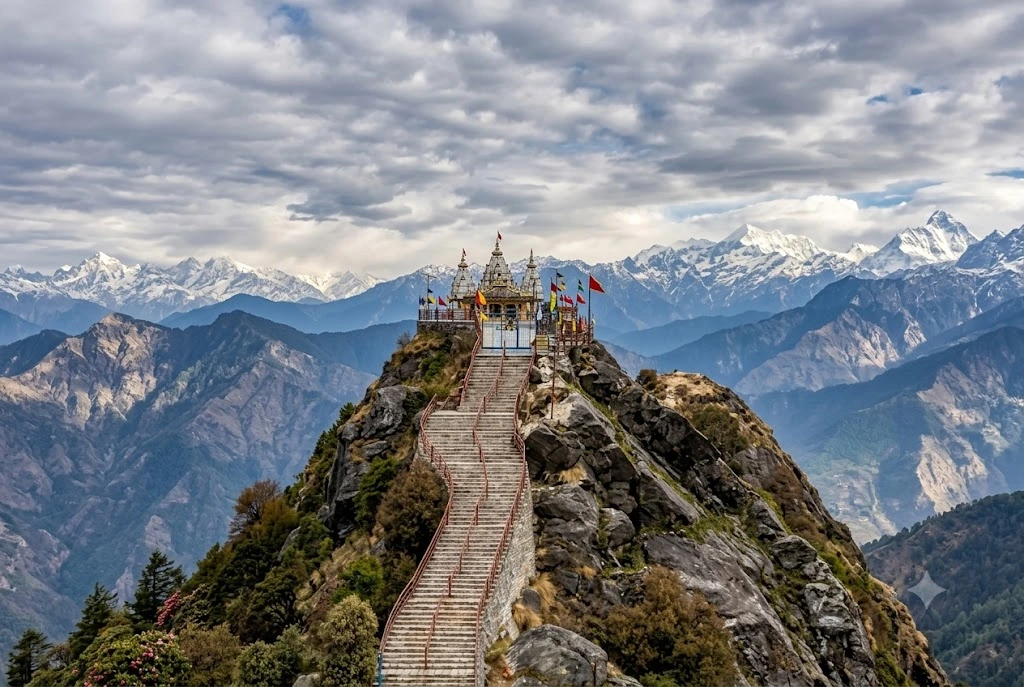
Somewhere above the clouds in Rudraprayag district, on a narrow ridge where the wind never really stops, sits a small stone shrine with one of the more unusual origin stories in Himalayan mythology. Kartik Swami Temple isn’t dedicated to Lord Kartikeya in his usual warrior form, spear in hand, peacock at his side. Here, legend says, he gave up his body entirely — and the temple marks the exact spot where that sacrifice is believed to have happened.
Before getting into facts and figures, it’s worth starting with why anyone built a temple on this particular ridge in the first place, because the story explains almost everything else about the place: why it’s rare in North India, why pilgrims and trekkers alike make the climb, and why the Kartik Swami temple trek itself feels less like a sightseeing walk and more like following an old, half-forgotten family story uphill.
The Legend Behind Kartik Swami
According to the tale still told around Rudraprayag’s villages, Lord Shiva and Parvati once set their two sons, Ganesha and Kartikeya, a challenge: whoever could circle the universe three times first would win a prized fruit. Kartikeya, ever literal, immediately set off on his peacock to physically circle the cosmos. Ganesha, cleverer or perhaps simply wiser, instead walked three times around his own parents, reasoning that they were his entire universe. Shiva and Parvati declared Ganesha the winner.
When Kartikeya returned from his long journey and learned he’d lost, he was overcome with anger and humiliation. Rather than return to Mount Kailash to face his family, he retreated to Kronch Parvat, the very ridge Kartik Swami Temple now sits on, and in a final act of surrender, offered his own flesh and bones to Shiva as a gesture of devotion. Local tradition holds that the temple was built on the exact spot where his bones are believed to have fallen, and it’s this story — not a conventional foundation date or royal patron — that forms the real Kartik Swami temple history.
Why This Temple Is Genuinely Rare
Kartikeya, also worshipped as Murugan, Skanda, or Subramanya, is an enormously popular deity across South India, with major temples drawing millions of devotees in Tamil Nadu and Andhra Pradesh. In the Himalayas, though, dedicated shrines to him are unusual, which is exactly what makes Kartik Swami Temple stand out on Uttarakhand’s crowded pilgrimage map. For South Indian devotees travelling north, finding a temple to Skanda tucked into the Garhwal Himalayas carries a particular significance, bridging two very different regional traditions of the same god.
Local authorities have taken note of this draw too, with recent efforts to develop infrastructure around the roughly two-century-old Kartik Swami Temple specifically to welcome more visitors from South India, recognising its growing pull well beyond the immediate region.
Planning the Kartik Swami Temple Trek
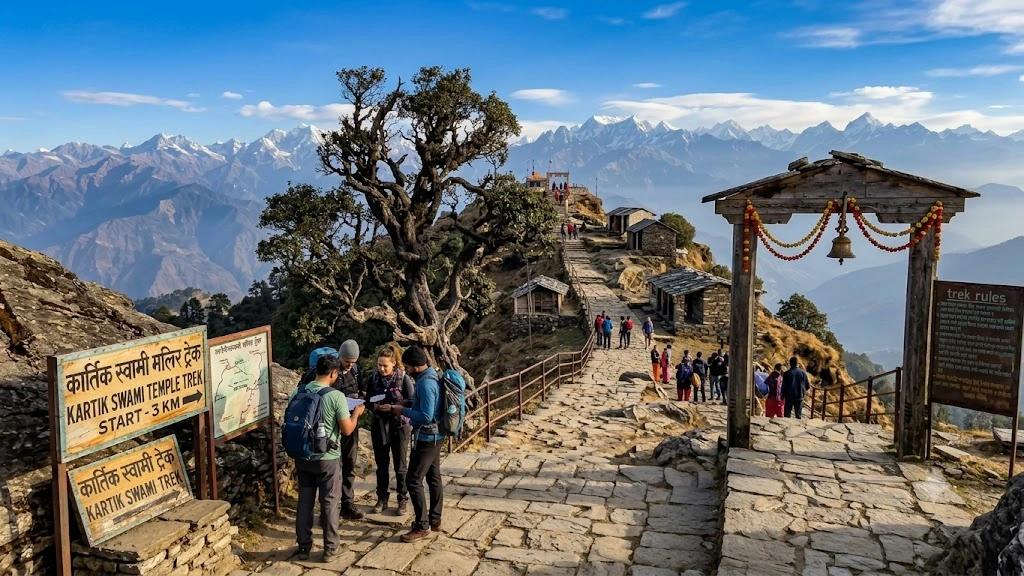
The Kartik Swami temple trek begins at the small village of Kanakchauri, reachable by road roughly 38 kilometres from Rudraprayag town along the Rudraprayag-Pokhri route. From there, the climb itself runs somewhere between 3 and 4 kilometres depending on which path you take, typically taking three to four hours for a comfortable round trip. Hundreds of stone steps lead up the final stretch to Kartik Swami Temple, built directly into the ridge rather than around it, which keeps the trek firmly in “easy to moderate” territory rather than anything technical.
What makes this particular trek memorable isn’t the distance so much as what unfolds around you as you climb. The forest thins gradually, rhododendrons giving way to open ridge-line meadows, until the final approach leaves you walking along a genuinely narrow spine of rock with sweeping drops on either side — not dangerous with reasonable care, but enough to make the final few hundred metres feel earned rather than routine.
The View That Makes the Climb Worth It
Reach Kartik Swami Temple and the reward is immediate: a genuinely rare 360-degree panorama of the Garhwal Himalayas, with named peaks visible in nearly every direction on a clear day. Chaukhamba, Neelkanth, Nanda Devi, Trishul, Nanda Ghunti, Dronagiri, the Kedarnath Dome, and the twin peaks of Meru and Sumeru are all visible from the ridge, strung out across the horizon like a geography lesson come to life. Few temples anywhere in Uttarakhand offer quite this unobstructed a sweep of snow peaks from a single standing point, which is a large part of why trekkers who have no particular religious interest still make the climb.
Sitting at roughly 3,048 metres above sea level, Kartik Swami Temple catches weather quickly, so clouds can roll in and erase the entire view within minutes, then clear again just as fast — part of what makes timing a visit to Kartik Swami Temple a little bit of a gamble worth taking.
When to Go
March through June tends to suit most visitors, when rhododendron forests along the lower trail are in full bloom and the weather stays generally cooperative. September through November offers a different, arguably better reward: cooler air, cleared monsoon skies, and some of the sharpest, clearest mountain views of the year, with the surrounding forest turning gold as autumn sets in. Mid-July through August is best avoided altogether, since heavy monsoon rain makes the trail slippery and raises landslide risk along the approach road. Winter brings snow to the upper reaches, which has its own quiet appeal for travellers prepared for the cold, though the final stretch becomes considerably harder to manage underfoot.
Getting There and Practical Notes
The nearest major town is Rudraprayag, connected by road to Rishikesh and Haridwar, both of which have the closest railway stations, roughly 140 to 160 kilometres away depending on the exact route taken. Jolly Grant Airport in Dehradun is the nearest airport, typically used as the starting point for most travellers combining this trek with a wider Garhwal itinerary.
From Rudraprayag, the drive to Kanakchauri takes a couple of hours along winding mountain roads, and it’s worth starting early enough to finish the trek, including some time at the summit, before the afternoon cloud cover typically rolls in. There’s limited accommodation directly at Kanakchauri near Kartik Swami Temple, so most visitors base themselves in Rudraprayag or nearby Chopta, which also makes this an easy add-on to a longer Chopta-Tungnath-Chandrashila itinerary for anyone already exploring that stretch of the Garhwal Himalayas.
Frequently Asked Question’s
What is the history of Kartik Swami Temple?
Kartik Swami temple history traces to a legend in which Lord Kartikeya, after losing a contest to his brother Ganesha, offered his flesh and bones to Shiva at this spot on Kronch Parvat, with the temple believed to mark where his remains fell.
How difficult is the Kartik Swami temple trek?
The trek is generally rated easy to moderate, covering roughly 3 to 4 kilometres one way from Kanakchauri village, with several hundred stone steps on the final approach, taking around three to four hours round trip.
What can you see from Kartik Swami Temple?
The temple offers a 360-degree panoramic view of major Himalayan peaks including Chaukhamba, Nanda Devi, Trishul, Neelkanth, Dronagiri, Nanda Ghunti, and the Kedarnath Dome.
Why is Kartik Swami considered a rare temple in North India?
Kartikeya is primarily worshipped in South India as Murugan or Skanda, making this Himalayan shrine one of the few dedicated temples to him in the north, which gives it particular significance for South Indian devotees.
What is the best time to visit Kartik Swami Temple?
March to June and September to November are considered the best windows, offering either blooming rhododendrons or clear post-monsoon mountain views, while mid-July to August should be avoided due to landslide risk.
How do I reach the starting point of the trek?
Most visitors reach Kanakchauri village by road from Rudraprayag, roughly 38 kilometres away, with Dehradun’s Jolly Grant Airport serving as the nearest major airport for longer journeys.
What stays with most people after visiting Kartik Swami Temple isn’t really the legend or even the Kartik Swami temple trek itself, but that final stretch along the open ridge, with mountains on every side and nothing between you and the sky. It’s a small temple by most measures, easy to miss on a map of Uttarakhand’s bigger pilgrimage sites, but for anyone willing to make the climb, it offers one of the most complete mountain views in the entire Garhwal region.
If you’re planning a longer trip through this part of Uttarakhand, this trek pairs naturally with our Chopta Tungnath guide, covering the world’s highest Shiva temple just a short drive away, and with our Kuari Pass guide for travellers chasing more of the region’s high-altitude ridge and panoramic views.
For official travel advisories and current road conditions, refer to the Uttarakhand Tourism official website.