

Table of Contents
Few ideas in Hinduism have shaped the map of a whole subcontinent the way the Shakti Peeth tradition has. The legend says the body of the goddess Sati was scattered across the land, and every spot where a part of her fell became a Shakti Peeth, a seat of the divine feminine. From a cave on the Balochistan coast to a hilltop in Assam, from the ghats of Varanasi to a seaside shrine in Sri Lanka, the 51 Shakti Peeth sites read like a sacred atlas drawn across South Asia.
This guide answers the questions people search for most: the total Shakti Peeth count and why it changes depending on who you ask, the 51 Shakti Peeth list with states, which Shakti Peeth in India are best known, and how to plan a visit without getting lost in a tradition that has several different counting systems.
How Many Shakti Peeth Are There?
The most widely accepted answer is 51. The Pithanirnaya text describes 51 peeths, each with a goddess form and a paired Bhairava, the guardian form of Shiva, and the Mahabhagavata Purana counts 51 as well. If you want one number for the total Shakti Peeth, that is the number you will see on most temple boards and in most pilgrimage guides.
It is not the only number in the tradition, though. Some Bengali traditions count 52. The Brahmanda Purana speaks of 64 pithas, while the Devi Bhagavata Purana and the Matsya Purana list 108. The Shivacharita names 51 maha-pithas and adds 26 smaller upa-pithas. And Adi Shankaracharya’s Ashtadasha stotram names 18 Maha Shakti Peeth, a shorter list that many devotees treat as the core. These are different counting systems, not contradictions, and knowing that saves a lot of confusion when two guides give you two answers.
The Story Behind Every Shakti Peeth
The legend begins with Sati, daughter of Prajapati Daksha, who married Shiva against her father’s wishes. Daksha later organised a great yajna and deliberately left out his daughter and her husband. Sati went anyway, was insulted in front of the assembly, and gave up her body. Accounts differ on how: some say she entered the sacrificial fire, others that she released her life through yogic concentration.
Shiva’s grief and fury were enormous. He created the fierce Virabhadra, who destroyed the yajna and beheaded Daksha. Then, carrying Sati’s body across the earth, Shiva began a dance of sorrow that threatened creation itself. To end it, Vishnu used his Sudarshana Chakra to cut the body apart, and the pieces fell to earth in different places. Each site became a peeth, and each is guarded by a Bhairava, a form of Shiva who stays beside the goddess there.
51 Shakti Peeth List With States
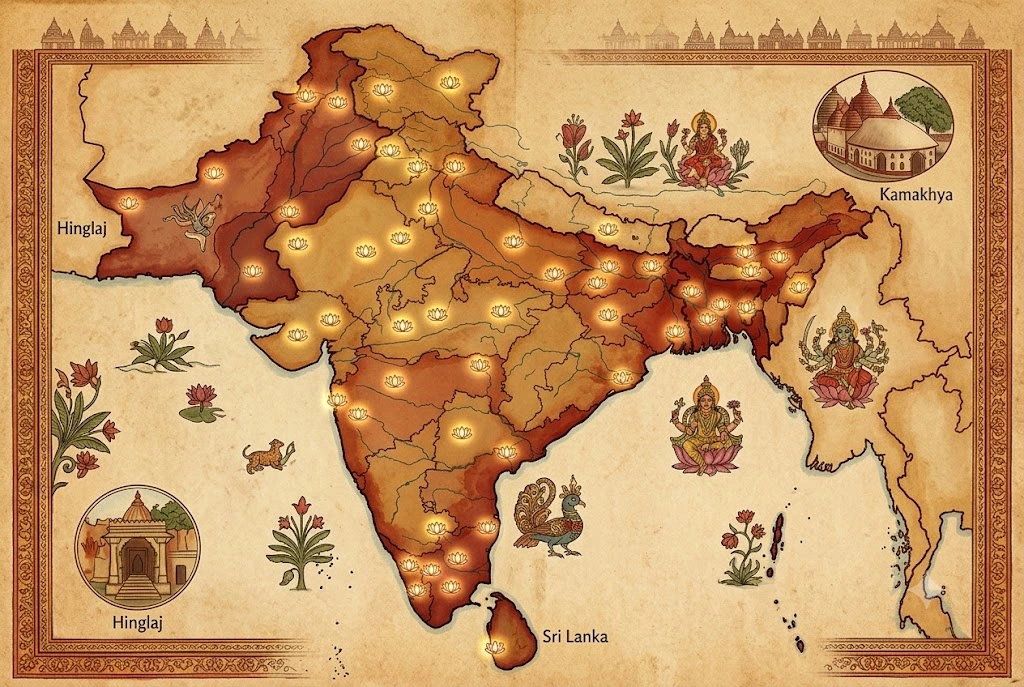
Lists of the 51 Shakti Peeth differ at the edges, since a few sites are swapped or added in different regional traditions. The table below follows the widely published version and groups the sites in India by state, with the body part linked to each. In this version about 40 of the 51 sit inside India, and a few lists add sites in states such as Rajasthan, Bihar and Jharkhand.
| State | Peeth (location, body part) |
|---|---|
| Jammu & Kashmir | Mahamaya (Amarnath, throat) |
| Himachal Pradesh | Jwalamukhi (tongue), Brajeshwari (Kangra, left breast), Chhinnamastika (Chintpurni, feet) |
| Haryana | Bhadrakali (Kurukshetra, ankle) |
| Punjab | Tripuramalini (Jalandhar, left breast) |
| Uttar Pradesh | Vishalakshi (Varanasi, earring), Varahi (Panchasagar, lower teeth), Lalita (Prayagraj, fingers), Katyayani (Vrindavan, hair), Shivani (Ramgiri, right breast) |
| Madhya Pradesh | Avanti and Mangal Chandika (Ujjain, upper lip and elbow), Sharada (Maihar, necklace), Kaalmadhav and Narmada (Amarkantak, hips) |
| Chhattisgarh | Danteshwari (Dantewada, tooth) |
| Gujarat | Mahakali (Pavagadh, right toe), Chandrabhaga (Prabhas, stomach) |
| Maharashtra | Bhramari or Saptashrungi (Nashik, chin) |
| Odisha | Vimala (Puri, feet), Tara Tarini (Ganjam, breasts) |
| West Bengal | Kalighat (Kolkata, toes of right foot), Yogadya, Bahula, Kankalitala, Phullara, Ratnavali, Mahishasuramardini (Bakreshwar), Nandikeshwari, Kiriteshwari, Bargabhima |
| Assam | Kamakhya (Guwahati, yoni) |
| Meghalaya | Jayanti (Nartiang, left thigh) |
| Tripura | Tripura Sundari (Udaipur, right foot) |
| Andhra Pradesh | Bhramaramba (Srisailam, neck), Vishweshwari (Rajahmundry, cheeks) |
| Karnataka | Chamundeshwari (Mysuru, hair) |
| Tamil Nadu | Kamakshi (Kanchipuram, navel), Sarvani (Kanyakumari, spine) |
The remaining sites lie outside India: Hinglaj in Balochistan, Sharada in Kashmir on the Pakistan side of the Line of Control, and Shivaharkaray at Karachi; four in Bangladesh, including Jeshoreshwari and Bhavanipur; Gandaki Chandi and Guhyeshwari in Nepal; Dakshayani at Manasarovar in Tibet; and Indrakshi in Sri Lanka, where texts disagree between Nainativu and Trincomalee.
Shakti Peeth in India: Five You Should Know
With roughly 40 sites, Shakti Peeth in India run from the Himalayan foothills to the southern tip, and a handful have become pilgrimage centres in their own right.
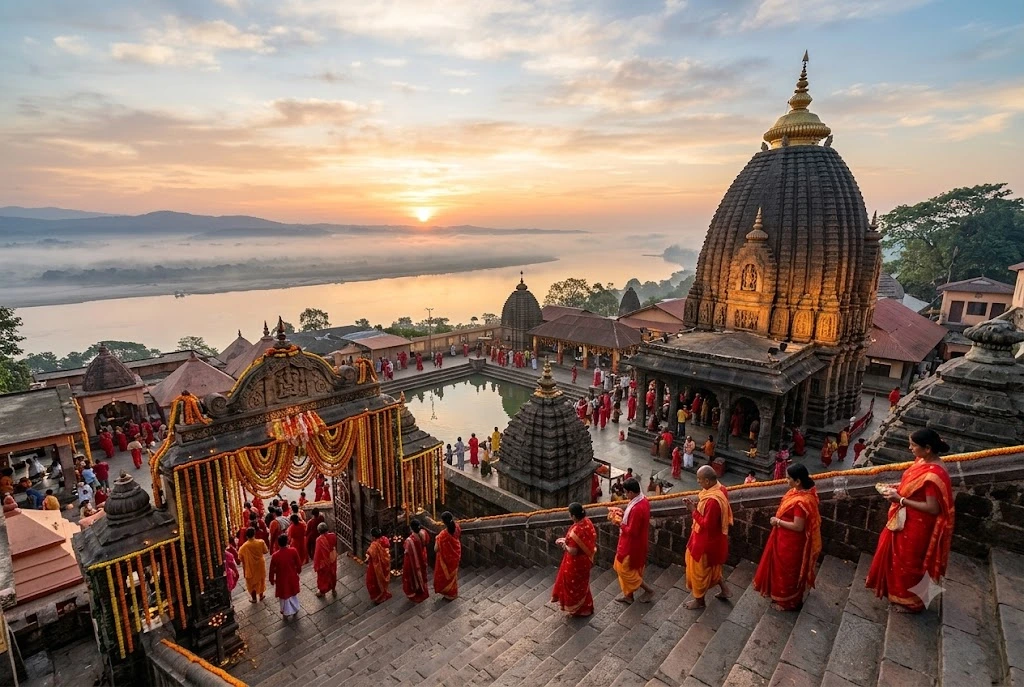
Kamakhya, Assam. On Nilachal Hill in Guwahati, Kamakhya marks the spot where Sati’s yoni is believed to have fallen. It is one of the four principal pithas named in the Kalika Purana and the Devi Bhagavata, and it fills to bursting during the annual Ambubachi Mela. The shrine holds no conventional idol, which surprises first-time visitors.
Kalighat, West Bengal. Kolkata’s Kalighat is where the toes of Sati’s right foot are said to have landed, and it is the namesake of the city’s old riverside quarter. West Bengal alone holds ten sites in the common list, which makes it the richest state for anyone building a Shakti Peeth circuit.
Jwalamukhi, Himachal Pradesh. Here the goddess is worshipped as flame rather than as a statue. Natural flames burn from the rock in the sanctum near Kangra, and devotees see them as the tongue of Sati. With Brajeshwari and Chintpurni close by, Himachal gives you three peeths within a single regional trip.
Vimala, Odisha. The Vimala Temple in Puri, tied to the feet of Sati, sits within the same sacred precinct as the famous Jagannath shrine, a link we explore in our Jagannath Temple guide.
Vishalakshi, Uttar Pradesh. In Varanasi, the Vishalakshi peeth is associated with Sati’s earring and lies in the same city as the Kashi Vishwanath shrine, which our Kashi Vishwanath Temple article covers in detail.
Beyond India’s Borders
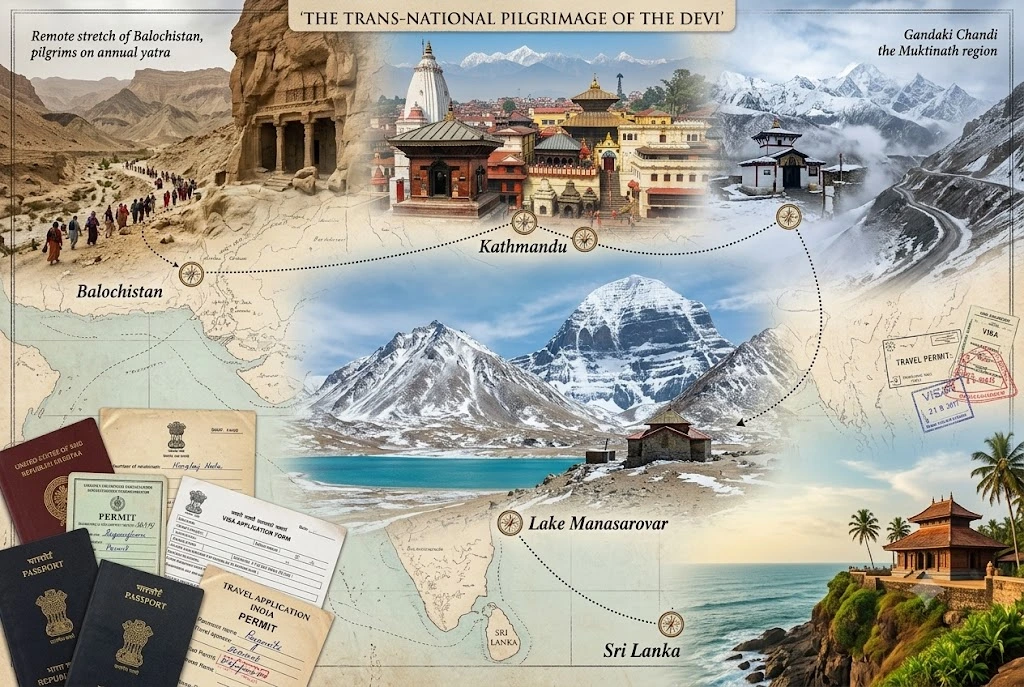
The tradition was never limited to one modern country. Hinglaj Mata, where the crown of Sati’s head is said to have fallen, sits in a remote stretch of Balochistan and draws Hindu pilgrims on an annual yatra. In Kathmandu, Guhyeshwari stands beside the Pashupatinath complex, and Gandaki Chandi sits in the Muktinath region of Nepal. Dakshayani at Lake Manasarovar in Tibet is among the most remote of all, and Indrakshi in Sri Lanka rounds out the list.
For travellers, that means a full circuit requires planning around visas and permits, and several of these sites are realistically visited on dedicated, separate trips rather than as one itinerary.
Planning a Shakti Peeth Yatra
Because the sites are so spread out, most devotees visit them in regional clusters rather than attempting all 51 at once. West Bengal’s ten peeths make a natural group, as do the three around Kangra in Himachal Pradesh and the two in Ujjain. Many pilgrims also combine Kamakhya with other northeastern sites.
Navratri, which comes twice a year, is the busiest time at almost every peeth, and lines can run for hours. Visiting on an ordinary weekday outside festival weeks usually means a calmer darshan. Dress modestly, carry some cash for offerings, and check local rules, since some temples restrict photography or specific rituals. For verified visitor details on one of the best-known sites, refer to the Incredible India listing on Kamakhya Temple, the Government of India’s official tourism portal.
Frequently Asked Question’s
How many Shakti Peeth are there in total?
Most traditions count 51, based on the Pithanirnaya and the Mahabhagavata Purana, though some texts count 52, 64 or 108, and Adi Shankaracharya’s list names 18 Maha Shakti Peeth.
How many Shakti Peeth are in India?
Roughly 40 of the 51 are in India in the commonly published list, with West Bengal holding the most, followed by Uttar Pradesh and Madhya Pradesh, though counts shift slightly between sources.
Which are the four principal pithas?
The Kalika Purana and the Devi Bhagavata name Kamakhya in Assam, Vimala in Puri, Kalighat in West Bengal, and Tara Tarini in Odisha as the four principal pithas.
Which body part fell at Kamakhya?
Kamakhya in Guwahati is associated with the fall of Sati’s yoni, which is why the shrine is worshipped without a conventional idol.
Are there Shakti Peeth outside India?
Yes. Sites are located in Pakistan, Bangladesh, Nepal, Tibet and Sri Lanka, including Hinglaj in Balochistan, Guhyeshwari in Kathmandu, and Indrakshi in Sri Lanka.
What are the 18 Maha Shakti Peeth?
They are the 18 major pithas listed in Adi Shankaracharya’s Ashtadasha Shakti Peeth stotram, including Shankari in Sri Lanka, Kamakshi in Kanchipuram, Vishalakshi in Varanasi, Sharada in Kashmir, and the revered trio of Kamakhya, Gaya and Ujjain.
The Shakti Peeth tradition is less a list than a way of reading the land. Every river bend, hilltop and old city quarter on the map carries a story of loss turned into worship, and that is why the sites keep drawing people long after the legend was first told. Whether you set out to visit one peeth or chase all 51, the journey tends to teach you as much about the country as about the goddess.