

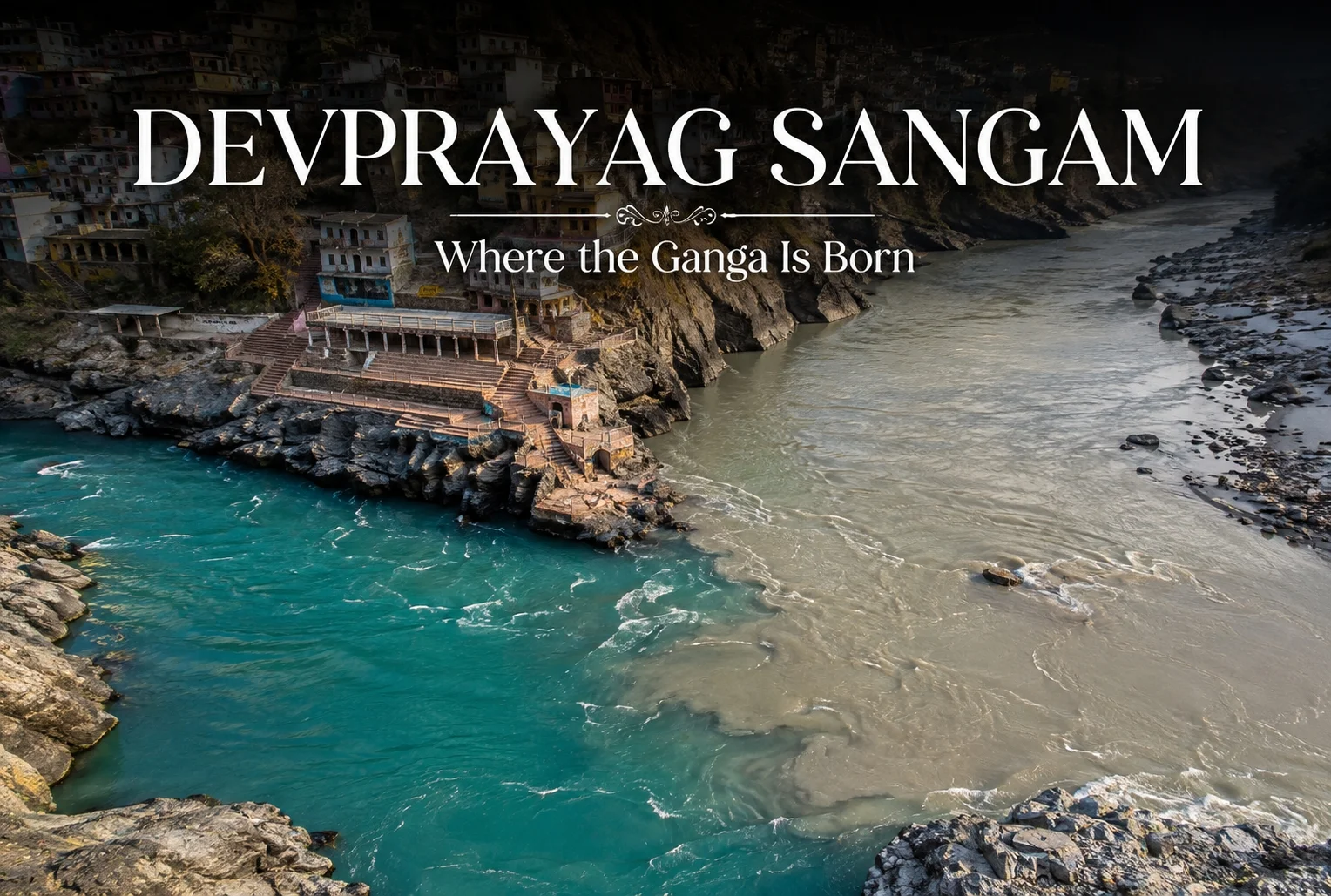
There’s a small town in Uttarakhand where two rivers meet, and the moment they do, one of them stops existing by name entirely. That town is Devprayag, and the confluence it’s built around is one of the most spiritually significant spots in all of India.
Table of Contents
What Is Devprayag Sangam?
The Devprayag Sangam is the point where the Alaknanda and Bhagirathi rivers physically merge. It’s the first — and holiest — of the five sacred river confluences in Uttarakhand collectively known as the Panch Prayag (the other four being Rudraprayag, Karnaprayag, Nandprayag, and Vishnuprayag). This confluence sits at the very bottom of that chain, which is what makes it so significant: everything upstream funnels into this one point.
Devprayag Sangam River Name: What Happens After the Merge
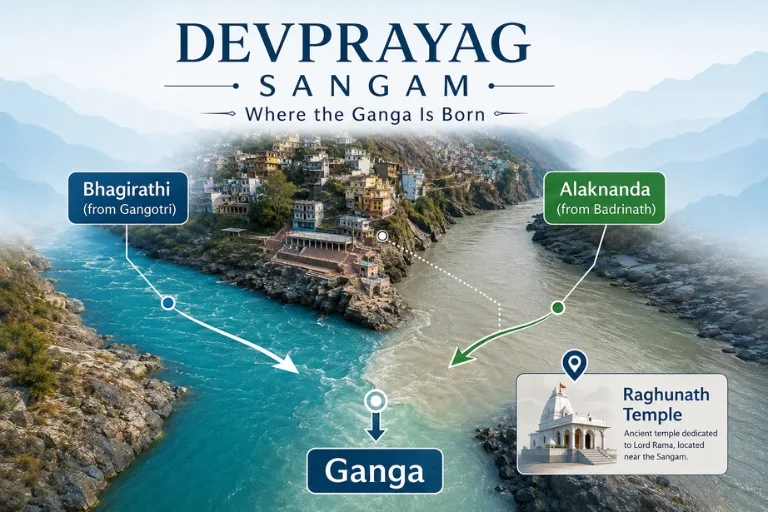
This is probably the most-asked question about the place, and the answer surprises a lot of first-time visitors. Before this confluence, the river coming down from Gangotri and the Gaumukh glacier is called the Bhagirathi. The river coming from Badrinath and the Satopanth glacier is called the Alaknanda. Here, the two physically merge — and from this exact point onward, the combined river is simply called the Ganga. So technically, the river most of India worships and depends on doesn’t even carry the name “Ganga” until it passes through this one small Himalayan town.
Devprayag Sangam Story: The Mythology Behind the Merge
The Devprayag Sangam story goes back to sage Devsharma, who is said to have performed penance here, which is where the town gets its name — “Dev” (god) and “Prayag” (confluence). The site is also linked to sage Bharadwaj, believed to have meditated on the banks of the confluence for years. There’s a widely told local belief that this is where Lord Rama himself performed penance after the events of the Ramayana, seeking forgiveness for killing Ravana, who was a Brahmin by birth. That layered mythology is part of why pilgrims treat a dip at this sacred spot as one of the most purifying acts on the entire Char Dham circuit — not a detour from the pilgrimage, but part of it.
Raghunath Temple: The Town’s Spiritual Anchor
Overlooking the confluence is the Raghunath Temple, dedicated to Lord Rama, believed to be several centuries old and built in a stone pyramid-style architecture unlike most Himalayan temples. Pilgrims typically bathe at the sangam first, then climb up to the temple — a short but steep walk through the old town’s narrow stone lanes.
Why the Two Rivers Look Different at the Point of Merging
One detail visitors always notice: the Bhagirathi runs a striking, clear blue-green, while the Alaknanda carries a muddier, greyish tone from glacial silt. For a short stretch after the merge, you can actually see the two colors running side by side before they fully blend — a visual that’s become one of the most photographed sights on the route to Badrinath.
Best Time to Visit Devprayag
This confluence town is accessible almost year-round since it sits at a relatively low elevation (around 830 meters), unlike the high-altitude Char Dham shrines that shut down in winter. That said, the best window is between March and June, and again from September to November, when the water is calmer and the weather is clear enough to properly see both rivers meeting. Since the town lies directly on the route to Badrinath, most travelers experience it as a stop along Explore Hills’ Char Dham Yatra, rather than a standalone destination.
How to Reach Devprayag
The town lies on the Rishikesh–Badrinath highway, roughly 70 km from Rishikesh, making it an easy stop for anyone already heading toward the high-altitude shrines. The nearest railway station is Rishikesh, and the nearest airport is Jolly Grant Airport in Dehradun. Most pilgrims pass through here on the way to or from Badrinath, folding it naturally into a longer Uttarakhand itinerary such as Explore Hills’ Uttarakhand Yatra packages.
For official river health data and conservation updates on the Ganga basin, including the stretch originating here, you can refer to the National Mission for Clean Ganga, a Government of India initiative under the Ministry of Jal Shakti.
Conclusion
This confluence town doesn’t get the same spotlight as Kedarnath or Badrinath, but in many ways, it’s the quieter starting point of everything those shrines represent. Two rivers, two colors, one meeting point — and from there, a river that shapes the identity of an entire subcontinent. It’s a short stop on paper, but it’s one worth actually stopping for.
Frequently Asked Question’s
What is the Devprayag Sangam river named after the two rivers merge?
After merging at Devprayag Sangam, the combined river is called the Ganga, regardless of which of the two original rivers contributed more water.
What is the Devprayag Sangam story behind its religious importance?
The Devprayag Sangam story is tied to sage Devsharma and sage Bharadwaj, and local belief also connects the site to Lord Rama’s penance after the Ramayana.
Can you see both rivers separately at Devprayag?
Yes, for a short stretch after the merge, the clear blue-green Bhagirathi and the greyish Alaknanda remain visibly distinct before fully blending into the Ganga.