

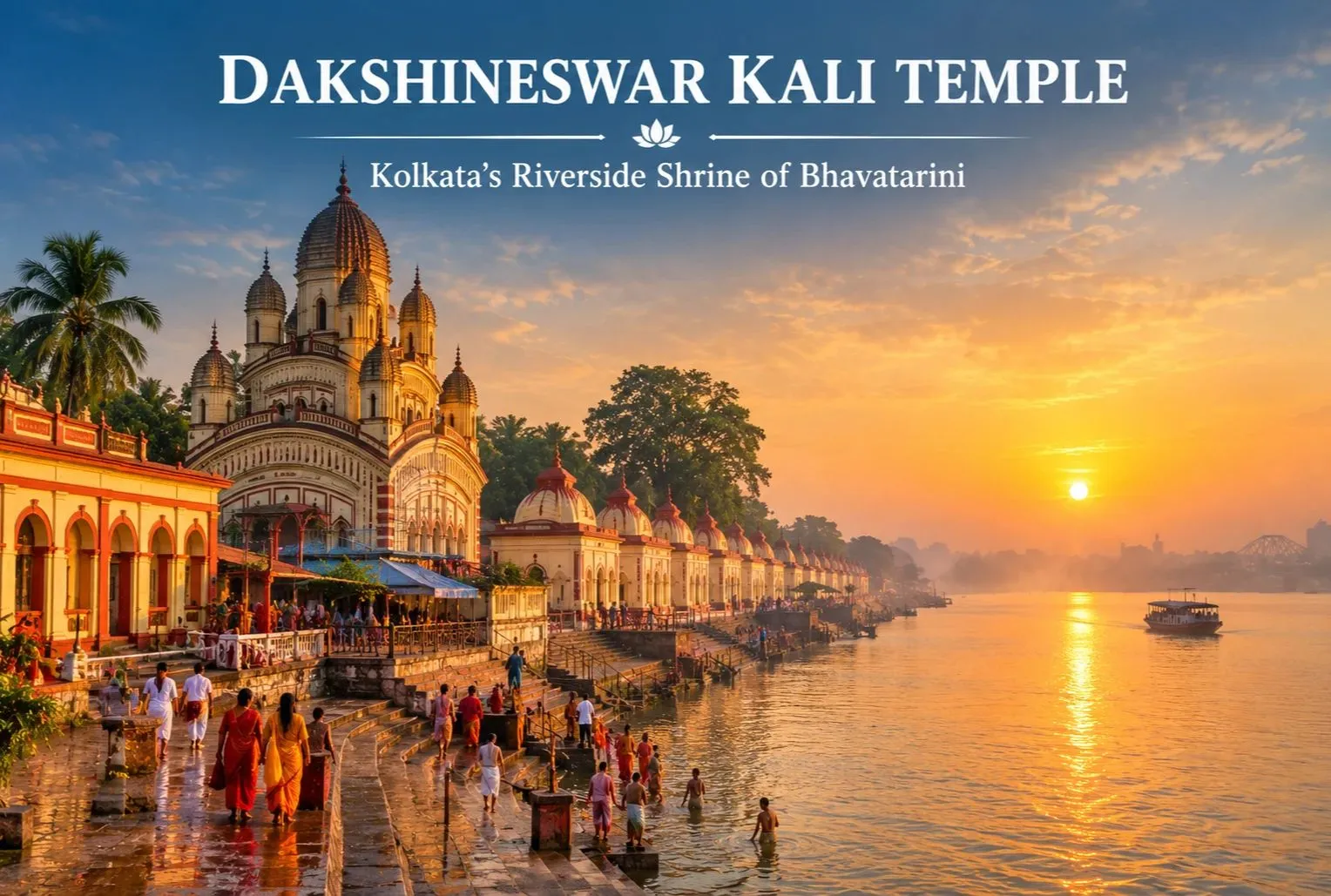
On the eastern bank of the Hooghly River, a short distance north of central Kolkata, stands one of Bengal’s best-known temples. Dakshineswar draws devotees, history readers, and curious travelers every day, and its tall spired shrine is easy to spot from the water. This guide covers Dakshineswar Temple history, visiting hours, how to get there, and tips for planning your day.
Table of Contents
About Dakshineswar Kali Temple
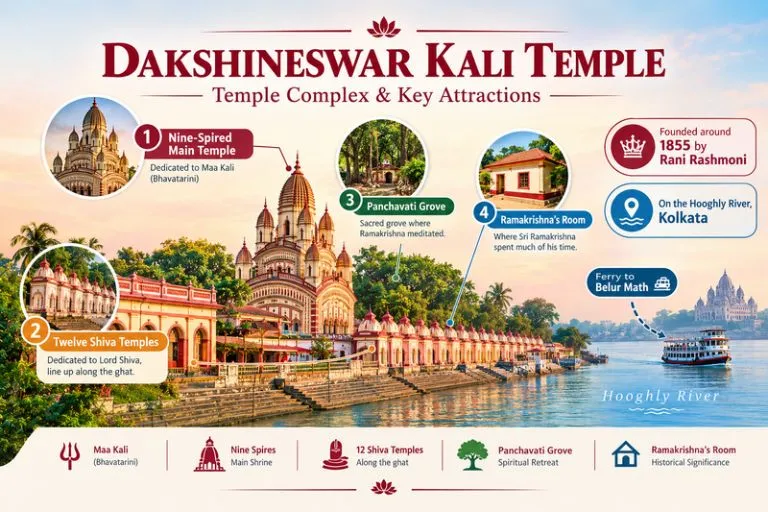
The Dakshineswar Kali Temple complex is dedicated to Goddess Kali in her form as Bhavatarini, a name often translated as the one who saves devotees from the ocean of worldly existence. The main shrine stands within a large courtyard. The complex also holds twelve Shiva temples along the riverbank, a Radha-Krishna temple, and the nahabat, a small building linked to Sarada Devi. The site is also known across India for its link with Sri Ramakrishna Paramahamsa, who served as a priest here in the 19th century.
Dakshineswar Kali Temple History
The temple was founded by Rani Rashmoni, a wealthy philanthropist from Kolkata, and is generally dated to 1855. According to tradition, she planned a pilgrimage to Varanasi but received a dream instructing her to build a temple to the goddess on the riverbank instead. Dates and details vary between accounts, so ask a guide or read the information boards on site to see which version they follow.
Ramakrishna Paramahamsa joined the temple as a priest soon after it opened, and his devotion shaped its spiritual fame. His room in the complex is open to visitors. Many travelers pair this stop with Belur Math, the Ramakrishna Mission headquarters across the river.
Architecture and What to See
The main temple follows the navaratna style, with nine spires arranged on a raised platform in a three-storied form. Many sources describe it as around 100 feet high, though figures vary. Inside, the idol of Bhavatarini stands on a silver lotus above a figure of Shiva. Beyond the main shrine, you can see:
- The row of twelve Shiva temples facing the river
- The Radha-Kanta Krishna temple in the courtyard
- Ramakrishna’s room and the nahabat
- The Panchavati, a grove of five sacred trees where he is said to have meditated
- The bathing ghat on the Hooghly
Dakshineswar Kali Temple Timings
Dakshineswar Kali temple timings usually follow a morning session and an evening session, with a break in the afternoon. Many visitors report an opening around 6:00 AM, a midday closing, a reopening around 3:30 PM, and an evening close near 8:30 PM, with hours shifting by season. I have not checked live timings, so confirm the current schedule with the temple office before you go. Early mornings and weekdays are the calmest, while Sundays and festival days bring long queues.
Festivals
Kali Puja, held on the new moon night in the Hindu month of Kartika (usually October or November), is the biggest festival here, and the temple stays crowded through the night. Snana Yatra, Poila Baisakh (the Bengali New Year), and Ramakrishna’s birth anniversary also draw large crowds. Dates follow the lunar calendar, so check the current year’s dates before you plan.
How to Reach Dakshineswar
- By air: Netaji Subhas Chandra Bose International Airport at Dum Dum is the nearest, roughly 10-15 km away.
- By metro: Dakshineswar has its own station on the Kolkata Metro’s Blue Line, which is one of the easiest ways to arrive.
- By train and road: Howrah and Sealdah stations are linked to the area by road, and buses, taxis, and app cabs run to the temple.
- By ferry: Ferries connect the temple ghat with Belur Math across the river.
Distances and services change, so confirm them locally. For official tourism information, you can refer to the West Bengal Tourism Department, the state government’s official tourism body.
Best Time to Visit
October to March is the most comfortable season, with cooler weather for walking the courtyard and the ghat. Summers are hot and humid, and the monsoon brings heavy rain from June to September. Kali Puja in autumn is spectacular but very crowded.
Visiting Tips
- Dress modestly and remove footwear before entering
- Bags and phones may be restricted, so use the locker or cloakroom if one is offered
- Carry small cash for offerings
- Start early and avoid Sundays if you want shorter queues
- Keep a close eye on your belongings in crowded areas
Pilgrims who like river-linked shrines can also look at Explore Hills’ Gaumukh Tapovan Trek, which follows the Ganga up to its glacier source.
Conclusion
Dakshineswar blends a founding legend, a saint’s life, and a riverside setting into a place that suits devotees and history lovers alike. Plan around the timings, dress modestly, and leave time to walk the ghat and the Shiva temples. If you are planning a Himalayan pilgrimage next, Explore Hills’ Do Dham Yatra is a good place to start.
Frequently Asked Questions
What is Dakshineswar Kali Temple famous for?
It is famous as the shrine of Bhavatarini Kali, founded by Rani Rashmoni and linked to Sri Ramakrishna Paramahamsa, who served as a priest here.
What are the Dakshineswar Kali temple timings?
There is usually a morning session, an afternoon break, and an evening session, but hours change by season and on festival days, so confirm locally before you visit.
What is the Dakshineswar Temple history?
Rani Rashmoni founded the temple, generally dated to 1855, and details vary between sources, so check the information boards on site.
Where is Dakshineswar located?
It is on the eastern bank of the Hooghly River in northern Kolkata, close to Belur Math, which is across the river.
What is the best time to visit Dakshineswar?
October to March is the most comfortable period, while Kali Puja is the busiest time of year.