

Table of Contents
Some temples are best understood as a single story. Jagannath Temple is not one of them. Peel back its surface and you find a legend older than the structure itself, a 12th-century construction project that took generations to complete, an architectural style unique to one Indian region, and a set of daily rituals so intricate that over fifty are performed before most pilgrims have even finished their morning tea. This guide moves through those layers of Jagannath Temple one at a time — legend, history, architecture, and living practice — before covering what you’ll actually need to know for a visit.
Layer One: The Legend Before the Stone
Long before any construction began, the site of modern-day Puri already carried religious weight. According to tradition, it was King Indradyumna of Avanti who, in the mythic Satya Yuga, first established worship of Jagannath here, guided by a vision instructing him to find a sacred image washed ashore. Whether read as literal history or as devotional storytelling, this legend matters because it frames the site as sacred long before the Puri Jagannath Temple we see today was ever built — the stone structure, in this telling, is simply the latest home for a far older presence.
Layer Two: The Builders Who Shaped It
The Jagannath Temple standing in Puri today traces to the 12th century CE, constructed roughly between 1135 and 1150 under King Anantavarman Chodaganga Deva, the founding ruler of the Eastern Ganga dynasty. Epigraphic evidence and temple chronicles, collectively known as the Madala Panji, record a project that wasn’t completed within a single reign — his successor, Anangabhima Deva III, carried the work forward and is remembered for an unusual act of devotion: he formally dedicated his entire kingdom to Lord Jagannath and styled himself as the deity’s servant rather than its ruler.
This is central to understanding Jagannath Temple history — it isn’t the product of one king’s ambition, but a multi-generational undertaking shaped by political power, religious devotion, and, over the centuries, repeated rebuilding after invasions and natural damage recorded in the temple’s own chronicles.
Layer Three: A Style Found Nowhere Else
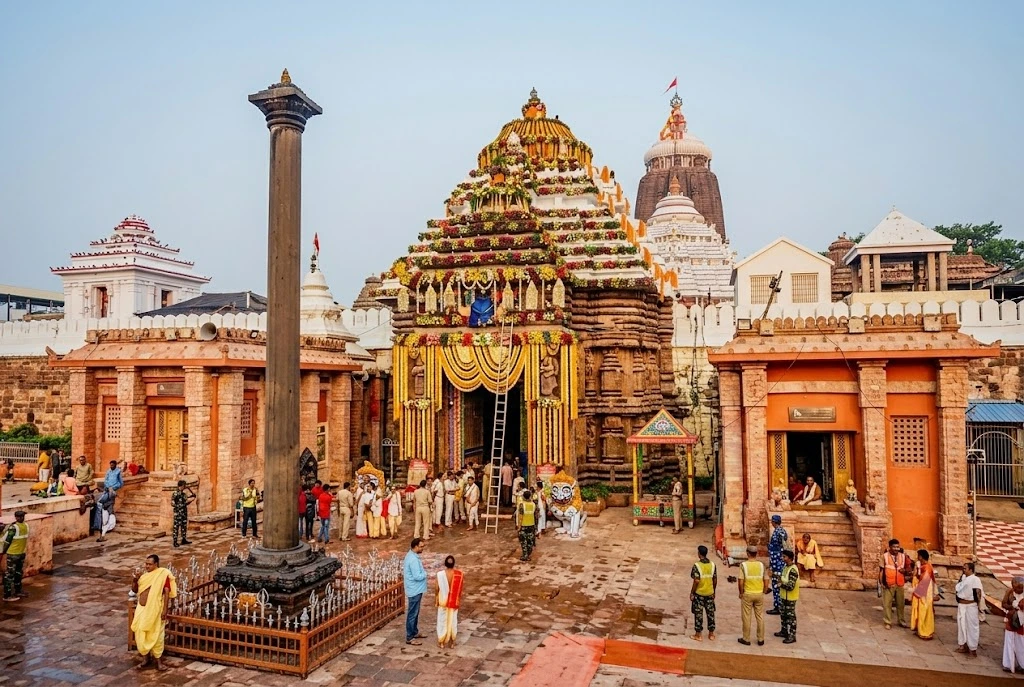
What rises from that history at Jagannath Temple is a textbook example of Kalinga architecture, a style distinct to the historic Odisha region and rarely seen with such scale elsewhere in India. The main spire climbs to roughly 65 metres (214 feet), dominating Puri’s skyline and visible from well out at sea — sailors once reportedly used it as a navigational marker.
The complex follows a Pancha Deula layout, built around four connected structures: the Garbha Griha, or sanctum housing the deities; the Jagamohana, an assembly hall; the Nata Mandira, a dance hall; and the Bhoga Mandapa, where food offerings are prepared. The entire compound sits inside a 20-foot boundary wall known as the Meghanada Prachira, spanning over 400,000 square feet. At the entrance stands the Aruna Stambha, a monolithic pillar depicting Aruna, the charioteer of the sun god — originally installed at the Konark Sun Temple before being relocated here in the 18th century, quietly linking two of Odisha’s most significant monuments.
Inside, the deities themselves depart from convention. Jagannath, Balabhadra, and Subhadra are carved from neem wood rather than stone or metal, with distinctive large eyes and famously incomplete limbs — a visual signature instantly recognisable across Indian religious art.
Layer Four: A Temple That Never Stops Moving
Unlike many ancient shrines that function primarily as static monuments, Jagannath Temple runs on an almost theatrical daily schedule. More than fifty separate rituals take place over the course of a single day, from the Mangal Aarti at dawn through to the closing Pahuda rites late at night. Mahaprasad, food cooked in earthen pots and offered to the deities, is then shared with devotees regardless of caste or social status — a practice the temple treats as a core expression of its philosophy that Jagannath belongs to everyone equally.
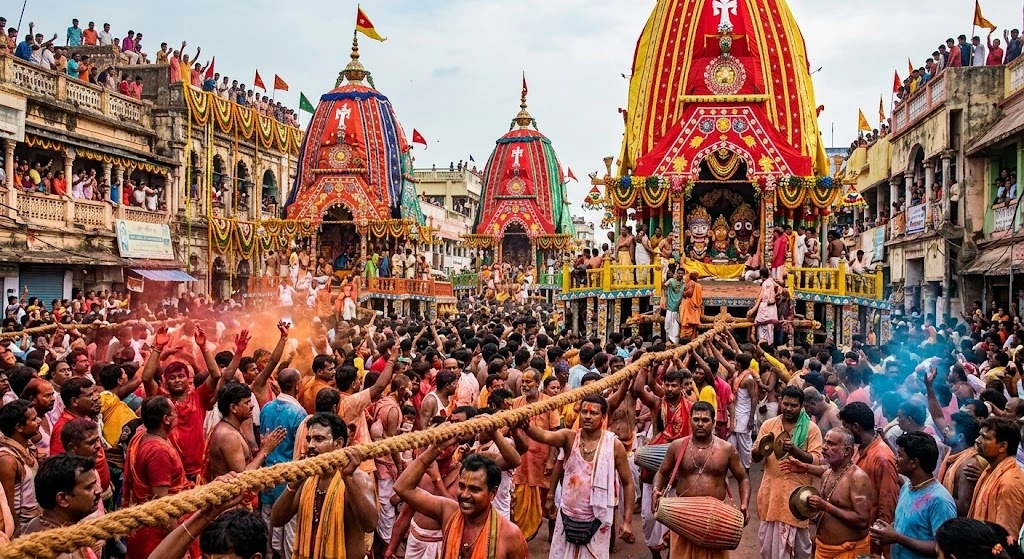
That philosophy finds its most visible expression once a year during the Ratha Yatra, the chariot festival held in the month of Ashadha, usually falling in June or July. The three deities are brought out of the sanctum and placed on massive hand-built wooden chariots, then pulled roughly three kilometres through Puri’s streets to the Gundicha Temple by thousands of devotees. For many pilgrims, witnessing or participating in this festival is the single most anticipated moment of their devotional life.
Visiting Today
The Shree Jagannath Temple follows a detailed daily schedule, generally opening around 5:00 AM with the Mangal Aarti and continuing in sessions, with breaks between rituals, until the final evening Aarti closes the day. Because exact windows shift slightly around festivals and administrative changes, it’s worth checking current Jagannath Temple timings with the temple office or official sources before planning your visit, rather than relying on any single published schedule.
One detail surprises many first-time visitors: entry to the inner temple complex has traditionally been restricted to Hindus. This is a long-standing practice maintained by the temple administration, and non-Hindu visitors are generally directed instead to the rooftop of the nearby Raghunandan Library, which offers a panoramic view of the temple from outside the walls. The one notable exception is Ratha Yatra itself, when the deities are brought out into the open streets and become visible to everyone, regardless of faith.
A few practical notes for anyone visiting: there’s no entry fee for general darshan, though mobile phones, cameras, and leather articles aren’t permitted inside. Early morning visits tend to offer shorter queues and a calmer atmosphere than the mid-morning rush.
Interestingly, Puri’s Jagannath Temple is also counted among the original Char Dham, the four sacred pilgrimage sites across India established in Hindu tradition — alongside Badrinath, Dwarka, and Rameswaram — distinct from the “Chota Char Dham” circuit within Uttarakhand that our Char Dham Yatra package covers. For travellers curious about India’s wider pilgrimage landscape, our Popular Destinations page rounds up more sacred and scenic trips across the country.
For official information on darshan timings, festival schedules, and temple guidelines, you can refer to Odisha Tourism, the state government’s official tourism portal.
Frequently Asked Question’s
Who built the Jagannath Temple?
The present structure was built by King Anantavarman Chodaganga Deva of the Eastern Ganga dynasty in the 12th century CE, and later completed by his successor, Anangabhima Deva III.
What are the Jagannath Temple timings?
The temple generally opens around 5:00 AM with Mangal Aarti and closes late at night after the final evening Aarti, though exact timings can shift around festivals, so it’s best to confirm before visiting.
Can non-Hindus enter the Jagannath Temple?
No, entry to the main temple complex is traditionally restricted to Hindus. Non-Hindu visitors can view the temple from the nearby Raghunandan Library rooftop, except during Ratha Yatra, when the deities are visible to all.
What is the Jagannath Temple famous for?
It’s best known for its unique Kalinga architecture, its neem-wood deities with distinctive features, and the annual Ratha Yatra chariot festival, one of the most significant events in the Hindu calendar.
Is there an entry fee for the Puri Jagannath Temple?
No, general darshan is free, though visitors cannot carry mobile phones, cameras, or leather items inside.