


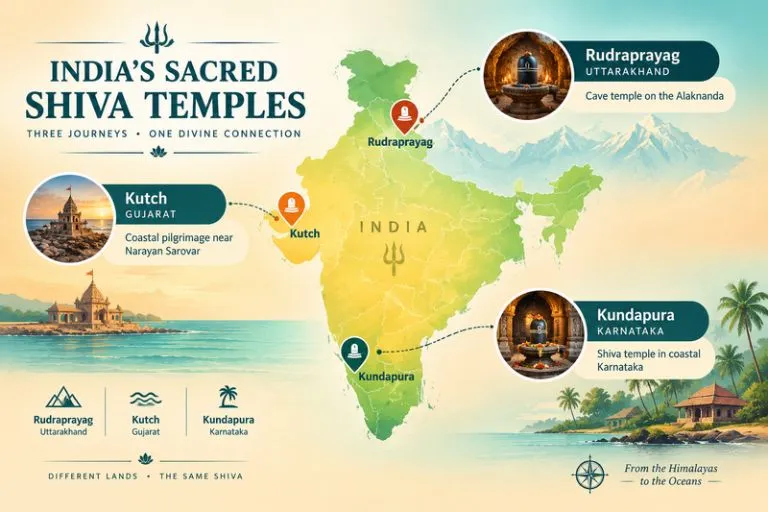
Search for the Koteshwar Mahadev Temple and you will find results from three different corners of India. The name is shared by several Shiva shrines, each with its own setting, legend, and travel route. This guide separates them so you can plan the right visit.
Table of Contents
What Does Koteshwar Mean?
“Koteshwar” is commonly read as a name of Shiva linked to “koti,” often understood as a crore, though explanations vary from place to place. Because many regions use the name, a Koteshwar temple in one state can be unrelated to another by history, region, and tradition. The three below are among the most searched.
Baba Koteshwar Mahadev Temple, Rudraprayag (Uttarakhand)
Baba Koteshwar Mahadev temple in Rudraprayag district is a cave shrine beside the Alaknanda river, a few kilometres from Rudraprayag town on the highway toward Srinagar. Devotees worship natural rock formations inside the cave as Shivlingas. Local tradition says Shiva meditated here before moving on toward Kedarnath, and that the Pandavas sought his blessing at this spot. This is devotional tradition rather than documented history.
The temple sits on the route that pilgrims use for Kedarnath and Badrinath, so many travelers treat it as a short stop. A brief walk down from the road leads to the cave, and most visits take under an hour.
Koteshwar Mahadev, Kutch (Gujarat)
Koteshwar Mahadev in Kutch stands near the western tip of Gujarat, close to the sea and not far from Narayan Sarovar, in Lakhpat taluka. It is one of the remote pilgrimage sites of the region, with a coastal, windswept setting that feels very different from the Himalayan version. Local tradition connects the temple to the Atmalinga story from the Ramayana, in which a linga is said to have broken or scattered into many forms. Versions differ, so treat it as local belief.
The site is roughly in the range of 100 to 150 km from Bhuj by road, which makes it a long day trip. Please confirm the distance and road conditions on a live map before you go.
Koteshwara Temple, Kundapura (Karnataka)
In coastal Karnataka, the Koteshwara temple lies in Kundapura taluk of Udupi district, a short distance from Kundapura town. It is a well-known Shiva temple in the Tulu and Kannada region, with local festivals and traditions of its own. Since this temple has a separate history from the other two, a local guide or the temple office is the best source for its legends and ritual calendar.
Quick Comparison
| Detail | Rudraprayag | Kutch | Kundapura |
|---|---|---|---|
| State | Uttarakhand | Gujarat | Karnataka |
| Setting | Cave beside the Alaknanda | Coastal, near Narayan Sarovar | Coastal Karnataka village |
| Best known for | Cave shrine on the Kedarnath route | Remote sea-edge pilgrimage | Local Shiva worship and festivals |
| Nearest big city | Rishikesh and Dehradun | Bhuj | Kundapura and Mangaluru |
Timings
Shiva temples usually open in the early morning, close for a midday break, and reopen in the evening, with aarti at fixed times. Timings differ by temple and change with festivals, so please confirm them locally before you travel.
Best Time to Visit Each Koteshwar Mahadev Temple
- Rudraprayag: March to June and September to November. The monsoon can bring landslides on the highway.
- Kutch: October to March is the most comfortable, since summers are very hot.
- Kundapura: October to February, outside the heavy coastal monsoon.
How to Reach
For Rudraprayag, Jolly Grant Airport in Dehradun and Rishikesh railway station are the usual gateways, followed by a drive along the Badrinath highway. For Kutch, Bhuj has the nearest airport and railhead, with a long road journey onward. For Kundapura, Mangaluru is the main airport, and Kundapura has its own railway station on the Konkan line. Please check live maps and schedules, since I haven’t confirmed exact figures.
Planning a Wider Shiva Pilgrimage
If this guide has you thinking about a longer circuit, Explore Hills’ Panch Kedar Trek links five Shiva shrines in the Garhwal Himalayas, and the Do Dham Yatra covers two of Uttarakhand’s most important pilgrimage sites in a shorter trip.
For official travel information across India, you can refer to the Ministry of Tourism, Government of India, the national tourism authority.
What to Keep in Mind Before Visiting
- Dress modestly and remove footwear before entering the shrine
- Carry cash, as card use can be limited near smaller temples
- Check road and weather conditions in monsoon, especially in Uttarakhand
- Confirm which Koteshwar temple you are booking transport for, since the names are shared
Conclusion
The Koteshwar Mahadev Temple is really three different journeys under one name: a cave beside a Himalayan river, a remote coastal shrine in Kutch, and a Shiva temple in coastal Karnataka. Pick the one that fits your route, confirm local details, and you will find that each has its own quiet character.
Frequently Asked Questions
Where is Koteshwar Mahadev Temple located?
There are several, including one in Rudraprayag in Uttarakhand, one in Kutch in Gujarat, and one near Kundapura in Karnataka.
Which is the Baba Koteshwar Mahadev temple?
Baba Koteshwar Mahadev temple usually refers to the cave shrine beside the Alaknanda in the Rudraprayag district, Uttarakhand.
Is the Koteshwar temple in Gujarat the same as the one in Uttarakhand?
No. They are separate shrines in different regions, each with its own legends and traditions, even though they share the Koteshwar name.
What is the best time to visit Koteshwar Mahadev?
It depends on the region: March to June and September to November for Rudraprayag, and October to March for Kutch and Karnataka.
How long does a Koteshwar Mahadev Temple visit take?
The Rudraprayag cave temple usually takes under an hour, while the Kutch and Karnataka temples need more travel time to reach.