

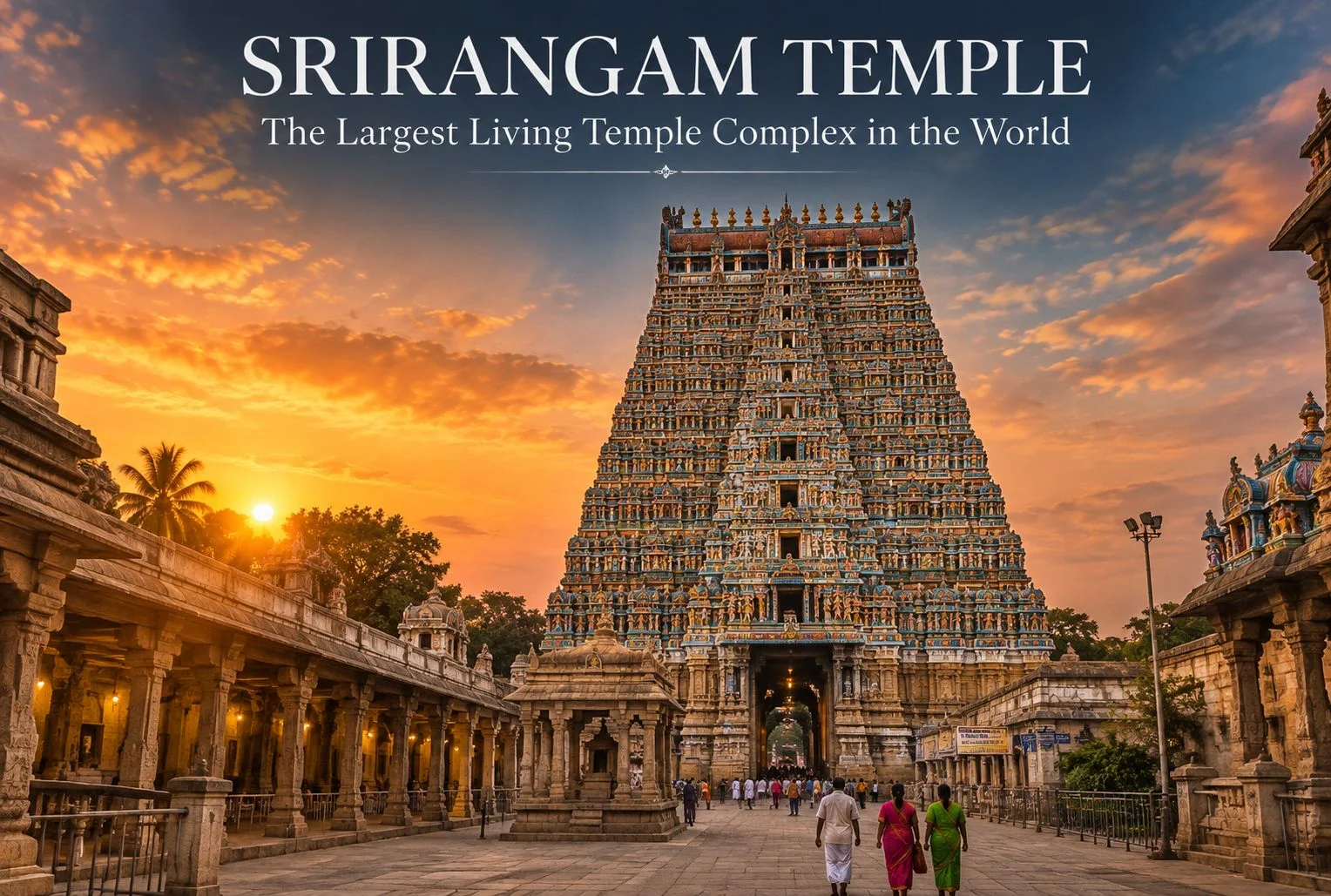
Quick answer: Srirangam Temple — formally known as Sri Ranganathaswamy Temple — is a Vaishnavite pilgrimage site in Tiruchirappalli, Tamil Nadu, dedicated to Lord Vishnu in his reclining form as Ranganatha. It is the largest functioning Hindu temple complex in the world, covering 156 acres with seven concentric enclosure walls and 21 gopurams. October to March is the best time to visit.
Table of Contents
Sri Ranganathaswamy Temple sits on a river island formed by the Kaveri and Kollidam rivers, and calling it a temple undersells it. Inside its seven concentric walls you’ll find streets, shops, residences, and shrines — an entire functioning settlement organized around one sanctum. Few religious sites in India blur the boundary between monument and living town as completely as this one does.
This guide covers the Srirangam Temple history, architecture, deities, key rituals, and the practical details — timings, dress code, how to get there, where to stay — that you’ll actually need to plan your visit.
Quick Facts: Srirangam Temple
| Information | Details |
| Location | Srirangam island, Tiruchirappalli, Tamil Nadu |
| Deity | Lord Vishnu as Ranganatha (reclining form) |
| Temple Area | 156 acres |
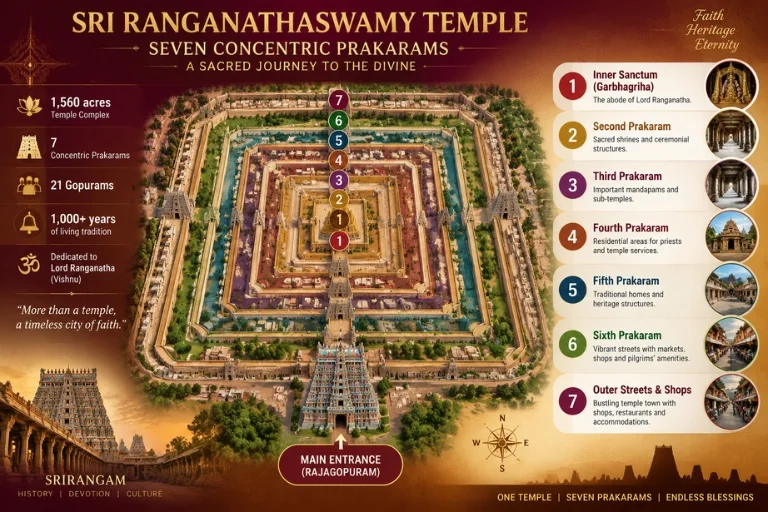
| Gopurams | 21 |
| Rajagopuram Height | Approx. 236 feet |
| Enclosure Walls | 7 prakarams |
| Best Time to Visit | October to March |
| Nearest Airport | Tiruchirappalli International Airport (~15 km) |
| Nearest Railway Station | Srirangam Railway Station (on site); Tiruchirappalli Junction (~10 km) |
| Entry Fee | Free for outer prakarams; nominal fee for special darshan |
Srirangam Temple History
The origins of Srirangam Temple combine religious tradition with more than a thousand years of documented dynastic history — and both layers matter to understanding why it carries such weight in Vaishnavite belief.
How Was the Temple Founded?
According to temple tradition, the idol of Ranganatha was originally worshipped by Brahma, passed down through successive rulers including King Ikshvaku (an ancestor of Lord Rama), and finally installed at Srirangam by Vibhishana — the brother of Ravana — after the events of the Ramayana. As the tradition holds, Vibhishana was carrying the idol toward Lanka when he set it down briefly on the banks of the Kaveri, and it became immovable, choosing Srirangam as its permanent home. Devotees believe this founding myth explains why the temple is considered among the holiest Vishnu shrines in existence.
How Did the Temple Develop Over the Centuries?
The documented Srirangam Temple history spans more than a millennium. The Cholas, Pandyas, Hoysalas, and the Vijayanagara Empire each contributed phases of construction, adding gopurams, mandapams, and subsidiary shrines across successive centuries. The temple endured serious disruption during 14th-century invasions, after which the main idol was reportedly hidden and later reinstated. What you see today is not the product of a single era but a layered accumulation of architecture, theology, and restoration built up over nearly a thousand years.
Why Does It Matter in Hindu Tradition?
Srirangam Temple holds the top rank among the 108 Divya Desams — the sacred Vishnu temples celebrated in the devotional verses of the Alvars, the Tamil poet-saints of Vaishnavism. It is often called “Bhoologa Vaikuntam,” meaning heaven on earth. For Sri Vaishnavites, a pilgrimage to the Ranganathaswamy Temple is among the most spiritually significant journeys a devotee can undertake.
Architecture: What Makes Srirangam Temple Distinctive
The temple follows the Dravidian style, but its scale separates it from every other temple in that tradition.
The Rajagopuram and the 21 Gopurams
The complex has 21 gopurams in total. The tallest, the Rajagopuram at the main entrance, stands at approximately 236 feet — one of the tallest temple towers in Asia. Construction on it began centuries ago but was only completed in 1987. Each gopuram is covered in carved figures of deities, mythological scenes, and decorative motifs, with the intricacy of the carvings increasing as you move deeper into the complex toward the sanctum.
The Seven Concentric Prakarams
The Ranganathaswamy Temple is structured as seven concentric rectangular enclosures, known as prakarams, with the inner sanctum at the center. The outer prakarams function as active streets — people live and trade here — while the inner enclosures are reserved for worship and ritual. Moving inward means moving through progressively more sacred and restricted space. It’s a physical representation of a spiritual journey, and walking that progression is part of what makes a visit to Srirangam genuinely different from a typical temple stop.
Other Structural Highlights
Two features deserve specific attention: the Sesharayar Mandapam, known for its rearing horse sculptures carved from single granite blocks, and the Hall of a Thousand Pillars (Ayiram Kaal Mandapam), which actually contains 953 intricately carved columns. These aren’t incidental details — they represent generations of stone-working expertise executed at a scale that’s hard to appreciate until you’re standing inside.
Deities and Rituals at Sri Ranganathaswamy Temple
The Principal Deity: Ranganatha
The main deity is Lord Vishnu depicted in his reclining form as Ranganatha, resting on the coils of the serpent Adisesha. This posture — called the shayana or reclining form — is less common in Vishnu temples than the standing or seated forms, and it gives this temple its name and much of its iconographic distinctiveness.
Other Deities and Shrines
Goddess Ranganayaki, a form of Lakshmi, has her own shrine within the complex and is worshipped alongside Ranganatha. The temple also honors Sri Ramanuja, the 11th–12th century Vaishnavite philosopher whose Vishishtadvaita (qualified non-dualism) theology was closely tied to his time at Srirangam. His shrine here remains a pilgrimage point for devotees interested in the philosophical tradition as much as the ritual one. Smaller shrines to various forms of Vishnu and associated Alvars are distributed across the prakarams.
Daily Worship and Festivals
Daily ritual follows a structured sequence of pujas maintained according to Vaishnavite Agama tradition — from the early-morning Suprabhatam (waking ritual) through to the Ekanta Seva that closes the temple at night. These rites have been performed in an unbroken continuity for centuries.
The major annual event is Vaikunta Ekadashi, typically observed in December or January. During this festival, the Paramapada Vasal — the Gateway to Heaven — is opened, and devotees believe passing through it on this day brings moksha (liberation). The crowds during Vaikunta Ekadashi are large, sometimes reaching hundreds of thousands over the festival window. Other significant events include the Chithirai Festival and Vaikasi Utsavam, both involving elaborate processions of temple deities through Srirangam’s streets.
Places to Visit in Srirangam
The temple complex itself contains several distinct sites worth seeking out. A few nearby destinations also combine well into the same trip.
| Place | What to Know |
| Main Sanctum (Garbhagriha) | Houses the reclining Ranganatha idol; some inner sections are restricted to Hindus |
| Rajagopuram | Main entrance tower, approx. 236 feet tall |
| Hall of a Thousand Pillars | 953 carved granite pillars; a highlight of Dravidian stone craftsmanship |
| Theerthams (Temple Tanks) | Sacred water tanks including the Chandra Pushkarani; used for ritual bathing |
| Sesharayar Mandapam | Known for its granite horse sculptures |
| Temple Gardens | Quieter green areas in the outer prakarams; useful for a slower circuit |
| Jambukeswarar Temple | A short distance away in Thiruvanaikaval; dedicated to Shiva; commonly visited alongside Srirangam |
| Rock Fort Temple | About 8 km away in central Tiruchirappalli; good to combine into the same day trip |
Srirangam rewards a slow visit. If you move too quickly toward the sanctum, you’ll miss the smaller shrines and carvings in the outer prakarams — and those are where a lot of the temple’s character actually lives.
Best Time to Visit Srirangam Temple
October to March is the best window. Tiruchirappalli sits in a climate zone where April through June can be punishing — temperatures regularly exceed 40°C — and the post-monsoon and winter months bring noticeably more manageable conditions for walking the prakarams and exploring the complex on foot.
If your schedule is flexible, plan around Vaikunta Ekadashi in December or January. The atmosphere during this period is unlike any other time of year. Just be prepared for significant crowds — the festival draws visitors from across Tamil Nadu and beyond.
| Season | Conditions | Suitability |
| October–March | Mild and dry | Best for all visitors |
| April–June | Very hot (often 38–42°C) | Manageable with early morning visits; avoid midday |
| July–September | Monsoon rains | Feasible but check road conditions; humidity is high |
| December–January | Cool and festive (Vaikunta Ekadashi) | Best for festival experience; expect large crowds |
How to Reach Srirangam Temple
By Air
Tiruchirappalli International Airport is approximately 15 km from the temple. It has regular connections to major Indian cities including Chennai, Bengaluru, Mumbai, and Delhi, as well as some international routes. Confirm current schedules before travel.
By Train
Srirangam has its own railway station with direct connectivity to several Tamil Nadu cities. Tiruchirappalli Junction — a major rail hub — is about 10 km away and connects to most major Indian cities. The train option is often the most practical for travelers coming from Chennai or Madurai.
By Road
Tiruchirappalli is well connected by national highways. Local buses and autorickshaws run regularly between the city center and Srirangam. The island is easily accessible by road, though parking near the main gopuram can be congested during festival periods.
Entry, Dress Code, and Photography
General entry to the outer prakarams is free. Special darshan tickets at a nominal fee are available to reduce queue time — exact pricing varies and is best confirmed directly at the temple counter.
Modest dress is expected throughout the complex. Avoid shorts and sleeveless tops. Footwear must be removed before entering the inner areas — shoe storage is available near the entrance points.
Some inner sanctum sections restrict entry to Hindus only. This is consistent with standard practice at many traditional South Indian temples.
Photography is generally restricted inside the inner sanctum and certain prakarams. Check posted signs or ask staff before using a camera. Exterior shots of the gopurams and outer courtyards are typically permitted.
Where to Stay and Eat
Tiruchirappalli has accommodation across all budget ranges — from basic guesthouses near the temple to full-service hotels in the city center. For most travelers, staying closer to the city center gives better transport access while keeping the temple about 10–15 minutes away.
For food, vegetarian Tamil restaurants around Srirangam are your best option near the temple. Many serve traditional thali meals on banana leaves — worth trying at least once if you’re visiting the region for the first time. Non-vegetarian options are more readily available in central Tiruchirappalli rather than in the temple town itself.
The Spiritual Experience at Srirangam
For pilgrims, Srirangam is not simply a heritage site — it’s one of the most direct paths to spiritual merit within Vaishnavite belief. Many devotees make a full circuit of all seven prakarams as a deliberate act of devotion, and the experience of moving from the busy outer streets inward toward the sanctum has a rhythm and structure that’s unique to this temple.
Sri Ramanuja’s presence looms large here. His philosophical framework — Vishishtadvaita, or qualified non-dualism — was developed in close connection with Srirangam, and his shrine remains a point of focus for those interested in the intellectual tradition that underpins the ritual.
For visitors who aren’t approaching the site as pilgrims, the experience is different but similarly hard to replicate. The sheer fact that this is a functioning town — not a preserved monument — means the energy here is continuous. Rituals that began centuries ago continue every morning and evening, and the streets between the prakarams carry the kind of daily activity that most ancient religious sites lost long ago.
Planning Your Visit: Final Tips
Give Srirangam Temple at least half a day. Three to four hours covers the main sanctum, gopurams, and Hall of a Thousand Pillars comfortably. Set aside more time if you want to walk the outer prakarams at a slower pace, visit the temple tanks, or explore nearby sites like Jambukeswarar Temple in Thiruvanaikaval.
Combine the trip with Rock Fort Temple in central Tiruchirappalli — about 8 km away — if you’re spending a full day in the area. Time your visit for October through March, arrive early to beat the midday heat, and check the temple’s festival calendar before finalizing your dates.
If temple architecture and pilgrimage travel are interests you want to explore further, Explore Hills covers sacred destinations across India through its pilgrimage and yatra travel guides — including mountain shrines like Kedarnath that share a similar tradition of devoted pilgrimage across challenging terrain.
Frequently Asked Questions
What is Srirangam Temple famous for?
Srirangam Temple is the largest functioning Hindu temple in the world, covering 156 acres with seven concentric enclosure walls and 21 gopurams. It is dedicated to Lord Vishnu as Ranganatha and holds the foremost position among the 108 Divya Desams in Vaishnavite tradition.
How much time do you need to visit Srirangam Temple?
Three to four hours covers the main sanctum, Rajagopuram, and Hall of a Thousand Pillars. Give yourself half a day if you want to explore the outer prakarams and nearby temples without rushing.
Is Srirangam Temple open to non-Hindus?
The outer prakarams and most of the complex are open to all visitors. Certain inner sanctum areas restrict entry to Hindus only — this is standard practice at traditional South Indian temples.
What is the difference between Srirangam Temple and Ranganathaswamy Temple?
There is no difference. Both names refer to the same site. Srirangam is the name of the island and town, while Sri Ranganathaswamy Temple is the formal name of the temple complex.
What is the best time to visit Srirangam Temple?
October to March is the most comfortable window, avoiding the peak heat of summer. Visiting during Vaikunta Ekadashi in December or January adds a festival dimension, though crowds will be significantly larger.
Is photography allowed inside Srirangam Temple?
Photography is restricted in the inner sanctum and some prakarams. Exterior shots of the gopurams are generally permitted. Always check posted signs or ask temple staff before photographing.
How do I reach Srirangam Temple from Chennai?
By train from Chennai, Tiruchirappalli Junction is roughly 6–7 hours away on express services. From there, Srirangam is about 10 km by auto or local bus. Flying from Chennai to Tiruchirappalli International Airport takes under an hour and is the faster option.