


Nestled in the lap of Garhwal Himalayas, it is one of the most divine and deeply honored jyotirlingas in Hinduism. Every year hundreds of thousands devotees come here to receive the blessing of Lord Shiva. Some come for faith, some to explore and some to discover the powerful connection with nature and Himalayas. Before you plan your next journey, make sure you know what’s so special about this beautiful and divine trek. Travelers looking to combine Kedarnath with the wider Himalayan pilgrimage circuit can explore Explore Hills’ Char Dham Yatra package.
Table of Contents
The history behind the temple
The story of the temple can be traced back to Mahabharata. The Pandavas were plagued by remorse after the war that they had slained their own kin, and were seeking Shiva for forgiveness. Shiva was not to be found he changed into a bull and left his hump in the mountains. The Pandavas finally found him and when he was trying to disappear into the ground, he appeared again in five different places also known as Panch Kedar. This is the most important site considering that his hump lies here at Kedarnath. Later on, temples were erected at all five places; however, the great temple at Kedarnath still stands.
It is one of the four Chota Char Dham sites (with Badrinath, Gangotri and Yamunotri), and is also the highest-altitude of the twelve recognised jyotirlinga sites all over India. For those wanting to visit all five Panch Kedar shrines, Explore Hills’ Panch Kedar Trek covers the complete circuit.
Where is Kedarnath Located?
Kedarnath is located in the midst of Garhwal Himalayas, in the district of Rudraprayag, Uttarakhand. Seated on the bank of Mandakini river and Chorabari Glacier at an elevation of 3,583 metres (11,755 feet). This pilgrimage receives heavy snow leading to route blockage and zero-temperature. As you draw closer to this spiritual place you faith grows much deeper.
When does the Kedarnath Temple open and close?
Because it follows the Hindu lunar calendar, the exact opening date shifts a bit year to year, but the pattern is fairly consistent:
- Opens on the first day of Vaishakh usually late April into early May
- Closes around Diwali, on the first day of Karthik (October or November)
- Once winter sets in, snow makes the whole area inaccessible and the shrine shuts down completely
On a normal day, darshan runs from 4 AM to 3 PM, breaks, then picks back up from 5 to 9 PM. Morning aarti happens between 4 and 7 AM; evening aarti runs roughly 6 to 7:30 PM.
Kedarnath Weather & Temperature: What to Expect Each Season?
Don’t trust a single forecast here the temperature can swing wildly within the same day thanks to the altitude.
| Season | Rough Temperature | What to Expect |
|---|---|---|
| May–June | 5°C to 18°C | Nice by day, cold once the sun drops |
| July–August (monsoon) | 8°C to 16°C | Heavy rain, real landslide risk |
| September–October | 2°C to 15°C | Clear skies, the best visibility of the year |
| November onward | Sub-zero | Snowed in, temple closed |
Bring proper woollens and waterproof layers no matter which month you go. Even in June, once the sun’s gone, it gets cold fast.
How to Reach Kedarnath: Getting There
Your first real destination is Guptakashi it’s the last town with proper hotel infrastructure before things get rural.
- Fly into Jolly Grant Airport in Dehradun
- Or take a train to Rishikesh (Haridwar works too as a backup)
- From either, grab a taxi, tempo traveller, or state bus heading toward Guptakashi, then on to Sonaprayag
Kedarnath Trek from Gaurikund
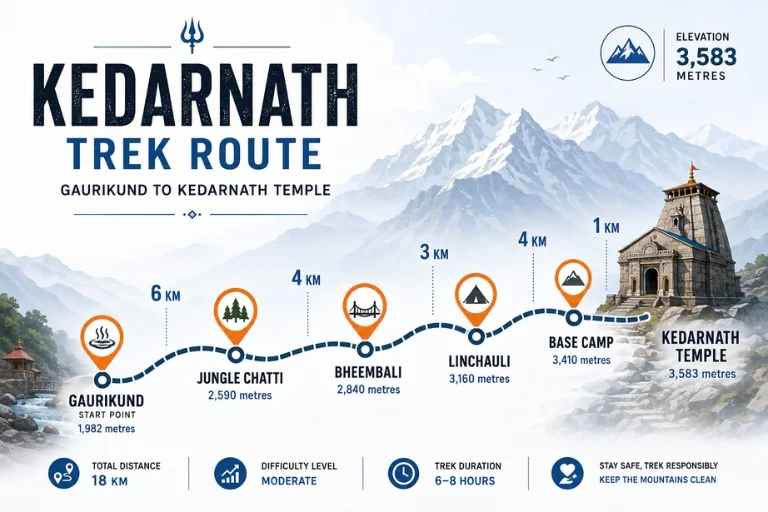
This is the classic route, the one pilgrims have walked for generations. A short shared jeep ride from Sonaprayag drops you at Gaurikund, and that’s where the actual climb starts.
Roughly, the trail breaks down like this:
- Gaurikund to Jungle Chatti — 6 km
- Jungle Chatti to Bheembali — 4 km
- Bheembali to Linchauli — 3 km
- Linchauli to Kedarnath Base Camp — 4 km
- Base Camp to the temple — 1 km
That’s about 18 km one way, and it’s no casual stroll even if you’re in decent shape. Ponies, palanquins, and porters (locally called “pitthu”) are available if walking the whole thing isn’t realistic for you, though rates climb fast once peak season hits. If you’d rather combine Kedarnath with the nearby Tungnath temple trek, check out Explore Hills’ Kedarnath-Tungnath Tour.
Kedarnath Helicopter Service: Booking, Bases & Important Tips
If time is tight or the trek just isn’t an option, flying in has become the go-to alternative. Helicopters run out of three bases near Guptakashi Phata, Sersi, and Guptakashi town operated by a handful of licensed private companies. Pricing depends on which base you fly from, and it climbs noticeably during high season and around festivals. Slots typically open about a month out and disappear within minutes, so book through the official government portal the moment it opens, or go through a local agent you trust. Bookings can be made directly through the official IRCTC Heli Yatra portal, the government-authorized platform for Char Dham helicopter services.
A few things worth knowing before you fly:
- Show up at the helipad at least two hours before your slot
- Weather grounds flights often always have a backup plan
- Round-trip charters from Dehradun cost a lot more than a straight joyride from Guptakashi
CONCLUSION
Kedarnath tests you as much as it moves you. Between the mythology behind it, the scale of the mountains around it, and the sheer physical effort it takes to get there, it leaves a mark that’s hard to shake. Plan around the opening dates, lock in your transport and stay early, and pack for weather that won’t cooperate do that, and the Himalayas will give you something worth the trip. If you are serious about visiting this spiritual and divine place, start your reservation now. Explore Hills’ Kedarnath Yatra package handles the full journey end-to-end.
Frequently Asked Question’s
How many days are considered to be an optimum duration for a Kedarnath tour?
Approximately 3-5 days are often considered appropriate to complete the Kedarnath Trek.
Will the Kedarnath trek be hard for the beginners?
Due to the tough pathway, this trek is often considered risky for beginners.
Do I have to get permission to visit Kedarnath?
Yes, you should book your slot before visiting Kedarnath.
Is it possible to go to Kedarnath during winter?
Due to heavy snowfall, traveling to Kedarnath can often be risky.
1 thought on “Kedarnath: A Traveler’s Guide to India’s Sacred Himalayan Shrine”