


Quick answer: Maharashtra is home to three universally recognized Jyotirlingas—Trimbakeshwar (Nashik), Bhimashankar (Pune district), and Grishneshwar (near Ellora, Chhatrapati Sambhajinagar). Two more sites, Parli Vaijnath (Beed) and Aundha Nagnath (Hingoli), are also worshipped as Jyotirlingas by local tradition, though these two identities are contested by similarly named shrines in other states. Depending on which tradition you follow, Maharashtra claims either 3 or 5 of the 12 Jyotirlingas.
Table of Contents
If you’ve searched for the jyotirlinga in Maharashtra, you’ve probably run into two different answers — some sources say three, others say five. That inconsistency isn’t a mistake on anyone’s part. It comes down to genuine, long-standing disagreement within Hindu tradition about the exact location of two of the twelve Jyotirlingas, and Maharashtra happens to sit at the center of both disputes.
This guide sorts out which Jyotirlingas in Maharashtra are undisputed, which are debated, and why. You’ll also find the exact distance from Mumbai and Pune to each shrine, what to expect when you visit, and how to sequence a multi-temple yatra without wasting days on backtracking.
What Is a Jyotirlinga, and Why Does Maharashtra Have So Many?
A Jyotirlinga is a shrine where Lord Shiva is worshipped in the form of a “linga of light.” According to Hindu tradition, there are twelve such sites across India, each believed to mark a place where Shiva manifested in a radiant, self-formed pillar of light. The Shiva Purana lists all twelve, and pilgrims consider visiting them collectively — the Dwadash Jyotirlinga Yatra — one of the most significant spiritual journeys in Shaivism.
Maharashtra’s concentration of Jyotirlingas isn’t accidental. The state has one of the longest and most continuous traditions of Shiva worship in India, tied closely to the Godavari river basin, the Sahyadri hill temples, and centuries of temple patronage under regional dynasties. Three of the twelve Jyotirlingas fall within Maharashtra’s borders without dispute, and the state is also home to two more shrines that are locally worshipped as Jyotirlingas, even though their canonical status is debated elsewhere in the country.
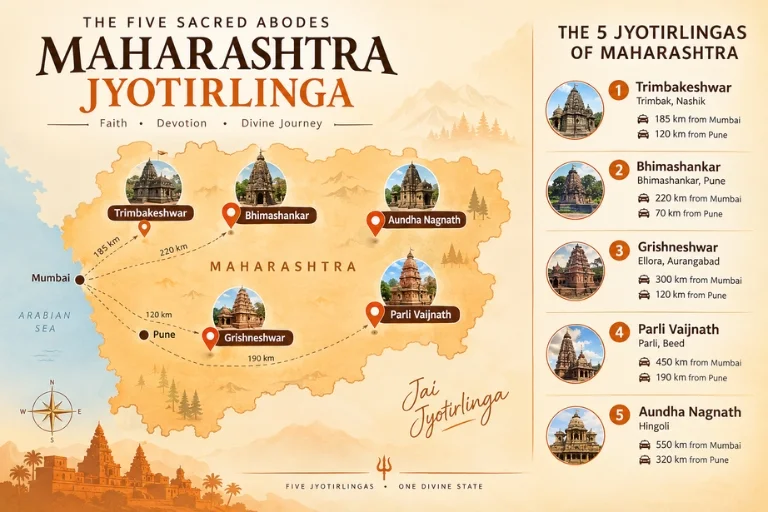
How Many Jyotirlinga Are There in Maharashtra?
This is the most commonly asked question about the topic, so it deserves a direct answer before anything else.
Three Jyotirlingas in Maharashtra are undisputed:
- Trimbakeshwar (Nashik)
- Bhimashankar (Pune district)
- Grishneshwar (near Ellora, Chhatrapati Sambhajinagar)
Two additional sites are worshipped as Jyotirlingas in Maharashtra, but their identity is contested:
- Parli Vaijnath (Beed district) — worshipped locally as the Vaidyanath Jyotirlinga, a title also claimed by the Baidyanath Dham temple in Deoghar, Jharkhand.
- Aundha Nagnath (Hingoli district) — worshipped locally as the Nageshwar Jyotirlinga, a title also claimed by the Nageshwar Temple near Dwarka, Gujarat.
So if someone asks how many Jyotirlinga are in Maharashtra, the honest answer depends on which regional tradition you follow. Pilgrims from Maharashtra generally count all five as part of their state’s sacred geography, while pan-India tradition and most Sanskrit textual sources recognize only Trimbakeshwar, Bhimashankar, and Grishneshwar without dispute. Both positions are held sincerely by different communities, and neither is presented here as more correct than the other — this guide simply flags where the disagreement exists so you can plan with accurate expectations.
What Are the Names of the Jyotirlinga in Maharashtra?
Here’s a quick-reference table covering all five, including the three undisputed sites and the two locally claimed ones.
| Jyotirlinga Name | District / City | Nearest Major City | Approx. Distance from Mumbai | Approx. Distance from Pune | Status |
| Trimbakeshwar | Nashik | Nashik (28 km) | ~180 km | ~225 km | Undisputed |
| Bhimashankar | Pune district | Pune (110 km) | ~225 km | ~110 km | Undisputed |
| Grishneshwar | Chhatrapati Sambhajinagar (Aurangabad) | Aurangabad (30 km) | ~350 km | ~235 km | Undisputed |
| Parli Vaijnath | Beed | Parli town | ~450 km | ~340 km | Locally worshipped; identity contested |
| Aundha Nagnath | Hingoli | Hingoli town | ~600 km | ~440 km | Locally worshipped; identity contested |
These figures are approximate road distances and can vary depending on your exact starting point and route. Always confirm the current distance and driving time using a live maps service before you finalize your itinerary, especially for the longer legs to Beed and Hingoli.
Trimbakeshwar: The Jyotirlinga at the Source of the Godavari
Trimbakeshwar sits about 28 km from Nashik city, right at the base of the Brahmagiri hills — the traditional source of the Godavari river, one of India’s most sacred waterways. The temple’s linga is unusual among Jyotirlingas: it has three small faces representing Brahma, Vishnu, and Shiva, which is where the “Trimbak” (three-eyed) name comes from.
The current structure was built in the 18th century under Peshwa Nanasaheb, replacing an older temple on the same site, and its black stone carving is considered some of the finest Peshwa-era temple architecture in Maharashtra. Trimbakeshwar is also where the Kumbh Mela is held every twelve years, alternating with Nashik’s Ramkund ghats, which tells you how central this site is to the region’s religious calendar.
If you’re combining this with a Nashik trip, plan for a half-day visit including the temple and Brahmagiri hill, which has a short trek to its base for those who want a wider view of the valley.
Bhimashankar: A Jyotirlinga Inside a Wildlife Sanctuary
Bhimashankar is roughly 110 km from Pune, tucked into the Sahyadri range inside the Bhimashankar Wildlife Sanctuary — a detail that sets it apart from every other Jyotirlinga on this list. You’re not just visiting a temple here; you’re driving through dense forest that’s home to the Malabar giant squirrel, among other species protected under the sanctuary’s conservation status.
According to tradition, this is where Shiva took the form of Bhima to defeat the demon Tripurasura, and the river Bhima is said to originate near the temple. The current temple structure dates to the 18th century, built in a style that blends Nagara and later architectural influences, with detailed carvings on its sabha mandap (assembly hall).
Because Bhimashankar sits inside a protected forest, plan your visit for daylight hours, and check ahead if you intend to combine the temple visit with any nature trail inside the sanctuary.
Grishneshwar: The Jyotirlinga Next to the Ellora Caves
Grishneshwar is the most conveniently located Jyotirlinga on this list for travelers already planning a heritage trip, since it sits barely a kilometer from the Ellora Caves — a UNESCO World Heritage Site and one of India’s most significant rock-cut temple complexes. The Kailasa Temple at Ellora, carved entirely from a single rock face, is one of the standout monuments in that complex and is well worth pairing with your Grishneshwar visit on the same day.
The temple you see today was rebuilt in the 18th century by Ahilyabai Holkar, the Maratha queen responsible for restoring several major Hindu temples across India after earlier periods of destruction. Its five-tiered shikhara (spire) is built from red volcanic rock, distinct from the stone used at most other Jyotirlingas on this list.
Because Grishneshwar and Ellora sit so close together, most travelers treat this as a single day trip from Chhatrapati Sambhajinagar (Aurangabad), roughly 30 km away.
Parli Vaijnath: Maharashtra’s Contested Vaidyanath Jyotirlinga
Parli Vaijnath, in Beed district, is worshipped by many Maharashtrian pilgrims as the Vaidyanath Jyotirlinga — the shrine associated with Shiva in his form as the “Lord of Physicians.” The dispute here isn’t about whether Parli Vaijnath is a significant, ancient Shiva temple — it clearly is — but about whether it, or the Baidyanath Dham temple in Deoghar, Jharkhand, holds the original Vaidyanath Jyotirlinga status described in the Shiva Purana. Both temples have long, independently documented pilgrimage traditions, and travelers from Maharashtra typically visit Parli Vaijnath as part of their state’s Jyotirlinga circuit regardless of the broader debate.
The temple itself, rebuilt by Ahilyabai Holkar like Grishneshwar, sits on a small hillock in Parli town and is known for its finely carved black stone mandap.
Aundha Nagnath: Maharashtra’s Contested Nageshwar Jyotirlinga
Aundha Nagnath, in Hingoli district, is the more remote of the two contested sites and sees noticeably fewer pilgrims than the other four temples on this list, partly because of the longer drive from both Mumbai and Pune. Local tradition identifies this as the Nageshwar Jyotirlinga, a title more widely associated with the Nageshwar Temple near Dwarka in Gujarat. As with Parli Vaijnath, this is a case of two long-standing regional traditions claiming the same identity rather than one temple being more “authentic” than the other.
The temple’s carved stone architecture is considered historically significant in its own right, with inscriptions and structural elements dating back several centuries, independent of the Jyotirlinga naming dispute.
What’s the Best Way to Plan a Jyotirlinga Yatra Across Maharashtra?
Trying to cover all five sites in one trip is possible, but only if you accept a fair amount of driving — the distance between Bhimashankar and Aundha Nagnath alone is close to 500 km. Here’s a more realistic way to break it up:
- If you have 2–3 days: Cover Trimbakeshwar and Grishneshwar together via Nashik and Aurangabad, adding the Ellora Caves to the same trip.
- If you have 3–4 days and are based in Pune: Combine Bhimashankar with Trimbakeshwar, since both are reachable from Pune within a half-day drive of each other via Nashik.
- If you want all five sites: Budget 7–8 days minimum, sequencing Trimbakeshwar → Bhimashankar → Grishneshwar → Parli Vaijnath → Aundha Nagnath (or the reverse) to avoid unnecessary backtracking across the state.
Most of these temples get busy on Mondays, since the day is traditionally associated with Shiva worship, and during the month of Shravan (typically falling between July and August), when queues can extend well beyond an hour. If your schedule allows flexibility, visiting on a weekday outside Shravan makes for a noticeably calmer experience at each shrine.
Quick Facts Table: Maharashtra Jyotirlinga at a Glance
| Detail | Information |
| Total Jyotirlingas in India | 12 |
| Undisputed Jyotirlingas in Maharashtra | 3 (Trimbakeshwar, Bhimashankar, Grishneshwar) |
| Additional locally worshipped sites | 2 (Parli Vaijnath, Aundha Nagnath) |
| Nearest major cities for a base | Nashik, Pune, Chhatrapati Sambhajinagar (Aurangabad) |
| Busiest period | Shravan month (typically July–August) and Mondays |
| Nearby heritage site | Ellora Caves (adjacent to Grishneshwar) |
What Should You Carry for a Temple Visit Like This?
Each of these temples follows standard Hindu temple etiquette, so a few basics will keep your visit smooth:
- Modest clothing that covers shoulders and knees
- A change of clothes if you plan to bathe in the temple kund before darshan, as is customary at several of these sites
- Cash in small denominations for offerings and local transport, since card acceptance is inconsistent in smaller temple towns like Parli and Aundha
- Comfortable, easy-to-remove footwear, since shoes aren’t permitted inside the temple premises
- A basic first-aid kit if you’re combining the Bhimashankar visit with any walking inside the wildlife sanctuary
According to the Maharashtra Tourism Development Corporation, visitors should also confirm current darshan timings directly with each temple trust before traveling, since hours can shift around major festivals.
Planning Beyond Maharashtra’s Jyotirlinga Circuit
If this deep dive into Maharashtra’s Jyotirlinga sites has you thinking about India’s broader pilgrimage landscape, it’s worth knowing that four more of the twelve Jyotirlingas — Kashi Vishwanath, Kedarnath is separate from the Jyotirlinga at Ujjain and Omkareshwar, but the Himalayan pilgrimage circuit that includes Kedarnath remains one of the most significant Shiva-related yatras in the country. If a mountain pilgrimage interests you alongside your Maharashtra temple visits, Explore Hills’ Kedarnath Yatra and Char Dham Yatra packages cover guided travel to some of the most revered shrines in the Himalayas, with the Kedarnath shrine guide offering more detail on what to expect at the temple itself.
Whichever direction your yatra takes you next, Maharashtra’s Jyotirlinga sites are worth the drive — five ancient shrines, each with its own architecture, landscape, and story, all within a state you can cross by road in under a week.
Frequently Asked Questions
How many Jyotirlinga are there in Maharashtra?
Three Jyotirlingas in Maharashtra are undisputed — Trimbakeshwar, Bhimashankar, and Grishneshwar. Two more, Parli Vaijnath and Aundha Nagnath, are worshipped locally as Jyotirlingas, bringing the state’s total to five according to regional tradition, though their identity is contested by similarly named temples in Jharkhand and Gujarat.
What are the names of the Jyotirlinga temples in Maharashtra?
The five temples associated with Jyotirlinga worship in Maharashtra are Trimbakeshwar (Nashik), Bhimashankar (Pune district), Grishneshwar (Chhatrapati Sambhajinagar), Parli Vaijnath (Beed), and Aundha Nagnath (Hingoli).
Which Jyotirlinga is closest to Mumbai?
Trimbakeshwar, near Nashik, is the closest at approximately 180 km from Mumbai, making it feasible as a long day trip or an easy overnight visit.
Which Jyotirlinga is closest to Pune?
Bhimashankar is closest to Pune, at roughly 110 km, and is a common day-trip destination for pilgrims based in the city.
Can I visit all five Jyotirlinga sites in Maharashtra in one trip?
Yes, but it requires at least 7–8 days given the distances involved, particularly the long stretch between Bhimashankar and the more remote sites of Parli Vaijnath and Aundha Nagnath in eastern Maharashtra.
Why is there a dispute over some Jyotirlinga locations in Maharashtra?
Two of the twelve Jyotirlingas described in the Shiva Purana — Vaidyanath and Nageshwar — are each claimed by more than one temple in different states. Maharashtra’s Parli Vaijnath and Aundha Nagnath are among the temples claiming these identities, alongside temples in Jharkhand and Gujarat respectively. Both positions are held sincerely within their respective regional traditions.
Is Grishneshwar close to the Ellora Caves?
Yes, Grishneshwar is located barely a kilometer from the Ellora Caves, making it easy to combine a temple visit with a half-day or full-day exploration of the UNESCO-listed rock-cut monuments, including the Kailasa Temple.
What is the best time of year to visit the Jyotirlinga temples in Maharashtra?
Most pilgrims visit during the Shravan month, typically falling in July or August, though this is also when crowds peak. Weekdays outside this period offer a quieter, more comfortable darshan experience at all five sites.