

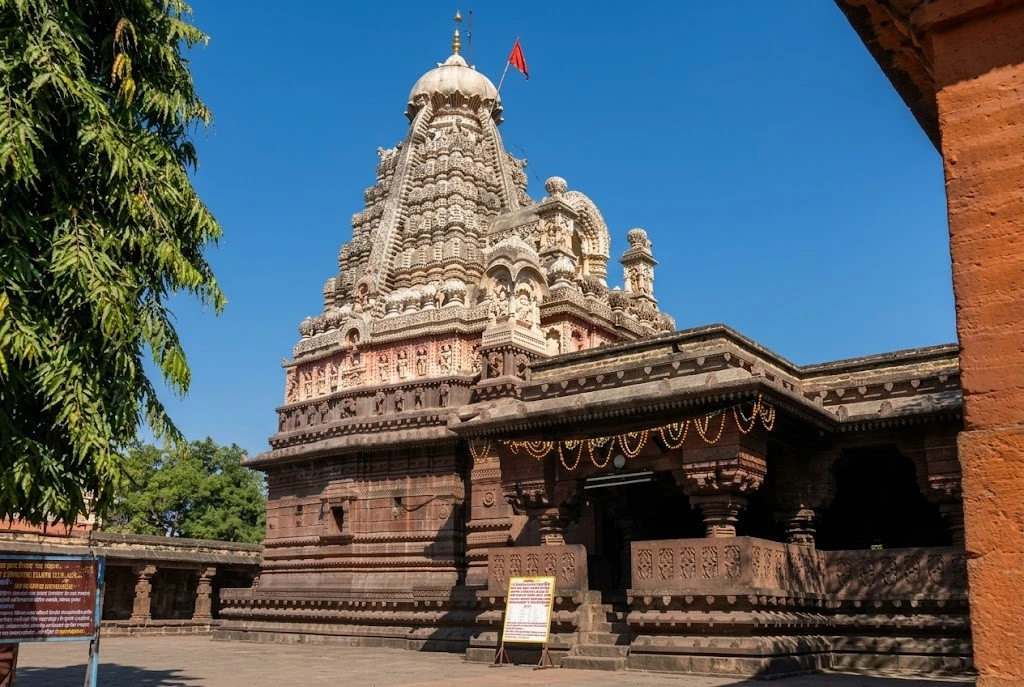

Grishneshwar

Explore articles related to this topic from ExploreHills.

Explore by Category

Jyotirlinga in Maharashtra
Temples and Spiritual Places

Jyotirlinga in Maharashtra: Names, Locations & Travel Guide

Quick answer: Maharashtra is home to three universally recognized Jyotirlingas—Trimbakeshwar (Nashik), Bhimashankar (Pune district), and Grishneshwar (near Ellora, Chhatrapati Sambhajinagar). Two more sites, Parli Vaijnath (Beed) and Aundha Nagnath (Hingoli), are also worshipped as Jyotirlingas by local tradition, though these two identities…
September 24, 202612 min read

Grishneshwar Temple: The Last of the Twelve Jyotirlingas, Beside the Caves of Ellora

Grishneshwar Jyotirlinga

Most pilgrims who reach the last of India’s twelve Jyotirlingas arrive with a sense of completion. The shrine sits in a quiet village in Maharashtra, a short walk from some of the greatest rock-cut architecture in the world, and it carries one of the gentlest legends in Shaiva tradition: a story about forgiveness rather than destruction. Grishneshwar is also known as Ghrishneshwar and Ghushmeshwar, and the different spellings you will see on signboards and maps all point to the same place.

This guide covers where the temple stands, its legend, the history of its rebuilding, the rules for darshan and the road distances from the other Maharashtra Jyotirlingas, so you can plan a visit without confusion.

Where Is Grishneshwar Jyotirlinga

If you are asking where is Grishneshwar Jyotirlinga, the answer is Verul (also written Vellur), a village in the Chhatrapati Sambhajinagar district of Maharashtra, formerly known as Aurangabad. The temple stands about 30 kilometres northwest of the city and just over a kilometre from the Ellora Caves, a UNESCO World Heritage Site, so the two are easily combined in a single day.

Getting there is simple. The nearest airport is Chhatrapati Sambhajinagar Airport, about 30 to 37 kilometres away, and Aurangabad railway station is around 27 to 30 kilometres from the temple. The drive from either takes about 45 minutes to an hour, and state buses and taxis run regularly towards Ellora. Mumbai is roughly 300 kilometres away by road.

The Grishneshwar Legend: A Story of Forgiveness

The legend of this Grishneshwar Jyotirlinga temple appears in the Shiva Purana and other texts. It is the story of two sisters, Sudeha and Ghushma, who were married to the same Brahmin, Sudharma. Sudeha had no children, and so she arranged for Ghushma to marry him. Ghushma was deeply devoted to Shiva, and each day she made 101 small lingas, worshipped them and immersed them in a lake.

When Ghushma had a son, Sudeha grew jealous and, in a moment of rage, killed the boy and threw his body into the same lake. Ghushma did not abandon her worship. As she immersed her lingas, her son returned to life. Shiva appeared, ready to punish Sudeha, but Ghushma asked him to forgive her sister instead. Moved by her compassion, Shiva agreed and promised to remain at the site as a Jyotirlinga, known as Ghushmeshwar, “the lord of Ghushma.”

Different texts vary in the details, and the name itself is explained in more than one way, including as a reference to Ghushma or to saffron. A rarer form, Ghrineshwara, is translated as “lord of compassion,” which suits the story.

Grishneshwar Temple History

The Grishneshwar Temple has been destroyed and rebuilt more than once. One expert suggests the original foundations date to around the Yadava period in the 12th century, though early records are missing. The Delhi Sultanate attacked the temple in the 13th and 14th centuries, and it suffered further damage during the later Mughal and Maratha conflicts.

Its restoration is tied to the Bhosale family of Verul, the ancestors of Chhatrapati Shivaji Maharaj. Maloji Bhosale, Shivaji’s grandfather, is credited with restoring the temple, and an inscription in the complex is said to name members of the family. The shrine was rebuilt again in the 18th century under the Holkars of Indore, with Ahilyabai Holkar widely credited, though one account names Gautama Bai Holkar for the rebuilding. The Holkar queens rebuilt several famous temples across India, which is why the same name appears at Kashi, Somnath and elsewhere.

Architecture and What You Will See
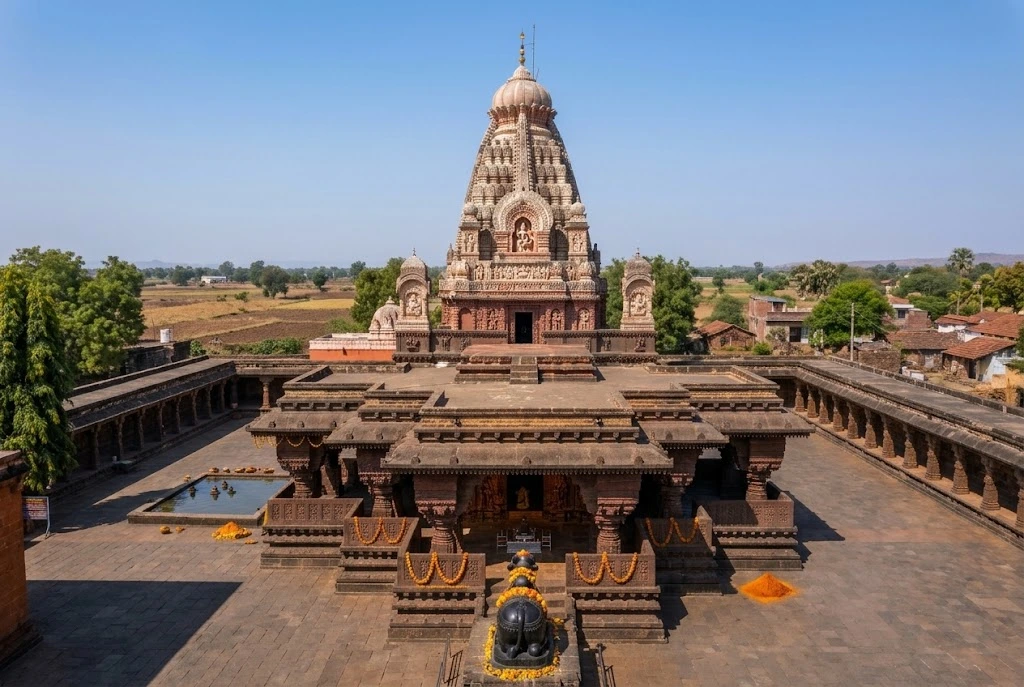
Grishneshwar Temple

The temple is built mostly of local red stone, with a multi-tiered tower topped by plaster sculptures of gods, scenes from the Ramayana and Mahabharata and the incarnations of Vishnu. Its design does not match the large towers of North or South India, which gives it a regional character of its own. The complex covers about 44,000 square feet.

Inside, the assembly hall has carved pillars showing hunting scenes and fantastic composite figures, and a large Nandi statue sits in front of the main door, facing the inner sanctum. The Jyotirlinga stands in the garbhagriha, the innermost chamber, and the walls around it have fine carvings. Grishneshwar is smaller than some other pilgrimage centres, which makes it quieter and easier to take in.

Our Trimbakeshwar Temple article covers another Maharashtra Jyotirlinga with a very different setting, on the slopes of the Sahyadri hills near the source of the Godavari.

Grishneshwar Temple Timings and Rules

Popular listings give the Grishneshwar temple timings as 5:30 AM to 9:30 PM, with morning darshan until about noon and an evening session from around 4:00 PM. Timings change on festival days and during the month of Shravan, so check on the day.

Dress rules matter here. Men are expected to remove their shirts before entering the sanctum, and women are advised to wear modest traditional clothes, such as a saree or salwar kameez. The outer premises have no such restriction. Queues are usually shorter on weekdays and mornings, and much longer on Mondays, during Shravan and on Mahashivratri, when thousands visit.

Combining the Temple with Ellora and Daulatabad

One advantage of Grishneshwar is that it sits beside something extraordinary. The Ellora Caves, a short distance away, hold Buddhist, Hindu and Jain monuments carved from solid rock, including the huge Kailasa Temple. They are open six days a week and closed on Tuesdays, with separate entry fees for Indian and foreign visitors. Daulatabad Fort, the old Deogiri fortress, is also nearby on the road back to Aurangabad. Most visitors spend the morning at Grishneshwar and the rest of the day at Ellora, or the other way round.

If you are building a longer Jyotirlinga circuit across central India, our Omkareshwar guide covers another of the twelve on the Narmada.

Best Time to Visit and Practical Tips

October to March is the most comfortable season, with temperatures around 15 to 30 degrees Celsius. Summers are hot, and the monsoon brings green hills and heavy crowds at Ellora. Shravan, the holy month, and Mahashivratri are the most spiritually significant times but also the busiest.

  • Carry minimal luggage, since bags may have to be left at the cloakroom.
  • Keep cash for offerings and local meals.
  • Wear easy-to-remove clothing and footwear.
  • Allow at least half a day for the temple and a full day if you add Ellora.
  • For official information about the temple, see the Maharashtra Tourism page on Ghrishneshwar, published by the Government of Maharashtra.

Frequently Asked Question’s

  1. Where is Grishneshwar Jyotirlinga located?

    It is in Verul village, about 30 kilometres from Chhatrapati Sambhajinagar (Aurangabad) in Maharashtra, close to the Ellora Caves.

  2. Why is Grishneshwar the last Jyotirlinga?

    It is commonly counted as the twelfth and last of the Jyotirlingas in traditional lists, and many pilgrims treat it as the final stop of their circuit.

  3. What are the Grishneshwar temple timings?

    Listings give 5:30 AM to 9:30 PM daily, though it is wise to confirm during festivals and Shravan.

  4. What is the Trimbakeshwar to Grishneshwar distance?

    It is roughly 180 to 200 kilometres by road, a drive of about four to five hours.

  5. What is the Bhimashankar to Grishneshwar distance?

    It is around 300 to 320 kilometres, roughly six to seven hours by road, depending on the route.

  6. Is there a dress code at Grishneshwar?

    Yes. Men remove their shirts to enter the sanctum, and women are advised to wear modest traditional clothing.

The temple is small, but its story is among the kindest in the Jyotirlinga tradition: a woman who forgave the person who wronged her, and a god who stayed because of it. That, more than the carvings or the crowds, is why this last of the twelve tends to feel like a quiet ending to a long pilgrimage.

Jyotirlinga in Maharashtra: Names, Locations & Travel Guide

Jyotirlinga in Maharashtra

Quick answer: Maharashtra is home to three universally recognized Jyotirlingas—Trimbakeshwar (Nashik), Bhimashankar (Pune district), and Grishneshwar (near Ellora, Chhatrapati Sambhajinagar). Two more sites, Parli Vaijnath (Beed) and Aundha Nagnath (Hingoli), are also worshipped as Jyotirlingas by local tradition, though these two identities are contested by similarly named shrines in other states. Depending on which tradition you follow, Maharashtra claims either 3 or 5 of the 12 Jyotirlingas.

If you’ve searched for the jyotirlinga in Maharashtra, you’ve probably run into two different answers — some sources say three, others say five. That inconsistency isn’t a mistake on anyone’s part. It comes down to genuine, long-standing disagreement within Hindu tradition about the exact location of two of the twelve Jyotirlingas, and Maharashtra happens to sit at the center of both disputes.

This guide sorts out which Jyotirlingas in Maharashtra are undisputed, which are debated, and why. You’ll also find the exact distance from Mumbai and Pune to each shrine, what to expect when you visit, and how to sequence a multi-temple yatra without wasting days on backtracking.

What Is a Jyotirlinga, and Why Does Maharashtra Have So Many?

A Jyotirlinga is a shrine where Lord Shiva is worshipped in the form of a “linga of light.” According to Hindu tradition, there are twelve such sites across India, each believed to mark a place where Shiva manifested in a radiant, self-formed pillar of light. The Shiva Purana lists all twelve, and pilgrims consider visiting them collectively — the Dwadash Jyotirlinga Yatra — one of the most significant spiritual journeys in Shaivism.

Maharashtra’s concentration of Jyotirlingas isn’t accidental. The state has one of the longest and most continuous traditions of Shiva worship in India, tied closely to the Godavari river basin, the Sahyadri hill temples, and centuries of temple patronage under regional dynasties. Three of the twelve Jyotirlingas fall within Maharashtra’s borders without dispute, and the state is also home to two more shrines that are locally worshipped as Jyotirlingas, even though their canonical status is debated elsewhere in the country.

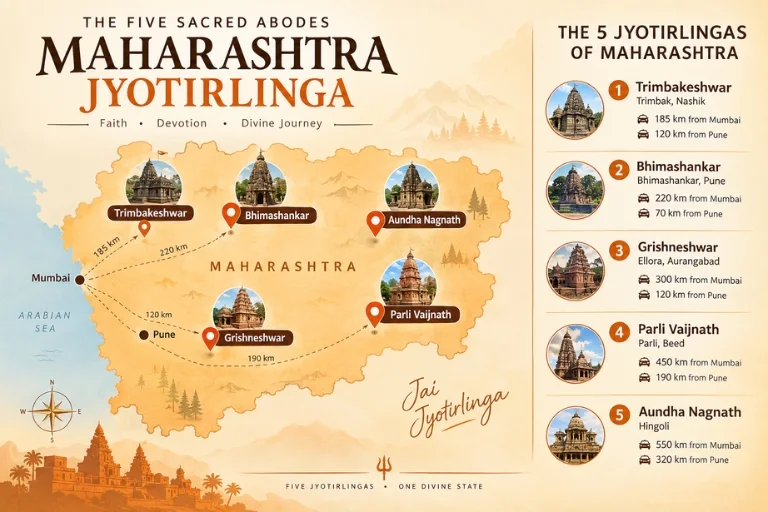
The Five Sacred Abodes Maharashtra Jyotirlinga

How Many Jyotirlinga Are There in Maharashtra?

This is the most commonly asked question about the topic, so it deserves a direct answer before anything else.

Three Jyotirlingas in Maharashtra are undisputed:

  1. Trimbakeshwar (Nashik)
  2. Bhimashankar (Pune district)
  3. Grishneshwar (near Ellora, Chhatrapati Sambhajinagar)

Two additional sites are worshipped as Jyotirlingas in Maharashtra, but their identity is contested:

  1. Parli Vaijnath (Beed district) — worshipped locally as the Vaidyanath Jyotirlinga, a title also claimed by the Baidyanath Dham temple in Deoghar, Jharkhand.
  2. Aundha Nagnath (Hingoli district) — worshipped locally as the Nageshwar Jyotirlinga, a title also claimed by the Nageshwar Temple near Dwarka, Gujarat.

So if someone asks how many Jyotirlinga are in Maharashtra, the honest answer depends on which regional tradition you follow. Pilgrims from Maharashtra generally count all five as part of their state’s sacred geography, while pan-India tradition and most Sanskrit textual sources recognize only Trimbakeshwar, Bhimashankar, and Grishneshwar without dispute. Both positions are held sincerely by different communities, and neither is presented here as more correct than the other — this guide simply flags where the disagreement exists so you can plan with accurate expectations.

What Are the Names of the Jyotirlinga in Maharashtra?

Here’s a quick-reference table covering all five, including the three undisputed sites and the two locally claimed ones.

Jyotirlinga NameDistrict / CityNearest Major CityApprox. Distance from MumbaiApprox. Distance from PuneStatus
TrimbakeshwarNashikNashik (28 km)~180 km~225 kmUndisputed
BhimashankarPune districtPune (110 km)~225 km~110 kmUndisputed
GrishneshwarChhatrapati Sambhajinagar (Aurangabad)Aurangabad (30 km)~350 km~235 kmUndisputed
Parli VaijnathBeedParli town~450 km~340 kmLocally worshipped; identity contested
Aundha NagnathHingoliHingoli town~600 km~440 kmLocally worshipped; identity contested

These figures are approximate road distances and can vary depending on your exact starting point and route. Always confirm the current distance and driving time using a live maps service before you finalize your itinerary, especially for the longer legs to Beed and Hingoli.

Trimbakeshwar: The Jyotirlinga at the Source of the Godavari

Trimbakeshwar sits about 28 km from Nashik city, right at the base of the Brahmagiri hills — the traditional source of the Godavari river, one of India’s most sacred waterways. The temple’s linga is unusual among Jyotirlingas: it has three small faces representing Brahma, Vishnu, and Shiva, which is where the “Trimbak” (three-eyed) name comes from.

The current structure was built in the 18th century under Peshwa Nanasaheb, replacing an older temple on the same site, and its black stone carving is considered some of the finest Peshwa-era temple architecture in Maharashtra. Trimbakeshwar is also where the Kumbh Mela is held every twelve years, alternating with Nashik’s Ramkund ghats, which tells you how central this site is to the region’s religious calendar.

If you’re combining this with a Nashik trip, plan for a half-day visit including the temple and Brahmagiri hill, which has a short trek to its base for those who want a wider view of the valley.

Bhimashankar: A Jyotirlinga Inside a Wildlife Sanctuary

Bhimashankar is roughly 110 km from Pune, tucked into the Sahyadri range inside the Bhimashankar Wildlife Sanctuary — a detail that sets it apart from every other Jyotirlinga on this list. You’re not just visiting a temple here; you’re driving through dense forest that’s home to the Malabar giant squirrel, among other species protected under the sanctuary’s conservation status.

According to tradition, this is where Shiva took the form of Bhima to defeat the demon Tripurasura, and the river Bhima is said to originate near the temple. The current temple structure dates to the 18th century, built in a style that blends Nagara and later architectural influences, with detailed carvings on its sabha mandap (assembly hall).

Because Bhimashankar sits inside a protected forest, plan your visit for daylight hours, and check ahead if you intend to combine the temple visit with any nature trail inside the sanctuary.

Grishneshwar: The Jyotirlinga Next to the Ellora Caves

Grishneshwar is the most conveniently located Jyotirlinga on this list for travelers already planning a heritage trip, since it sits barely a kilometer from the Ellora Caves — a UNESCO World Heritage Site and one of India’s most significant rock-cut temple complexes. The Kailasa Temple at Ellora, carved entirely from a single rock face, is one of the standout monuments in that complex and is well worth pairing with your Grishneshwar visit on the same day.

The temple you see today was rebuilt in the 18th century by Ahilyabai Holkar, the Maratha queen responsible for restoring several major Hindu temples across India after earlier periods of destruction. Its five-tiered shikhara (spire) is built from red volcanic rock, distinct from the stone used at most other Jyotirlingas on this list.

Because Grishneshwar and Ellora sit so close together, most travelers treat this as a single day trip from Chhatrapati Sambhajinagar (Aurangabad), roughly 30 km away.

Parli Vaijnath: Maharashtra’s Contested Vaidyanath Jyotirlinga

Parli Vaijnath, in Beed district, is worshipped by many Maharashtrian pilgrims as the Vaidyanath Jyotirlinga — the shrine associated with Shiva in his form as the “Lord of Physicians.” The dispute here isn’t about whether Parli Vaijnath is a significant, ancient Shiva temple — it clearly is — but about whether it, or the Baidyanath Dham temple in Deoghar, Jharkhand, holds the original Vaidyanath Jyotirlinga status described in the Shiva Purana. Both temples have long, independently documented pilgrimage traditions, and travelers from Maharashtra typically visit Parli Vaijnath as part of their state’s Jyotirlinga circuit regardless of the broader debate.

The temple itself, rebuilt by Ahilyabai Holkar like Grishneshwar, sits on a small hillock in Parli town and is known for its finely carved black stone mandap.

Aundha Nagnath: Maharashtra’s Contested Nageshwar Jyotirlinga

Aundha Nagnath, in Hingoli district, is the more remote of the two contested sites and sees noticeably fewer pilgrims than the other four temples on this list, partly because of the longer drive from both Mumbai and Pune. Local tradition identifies this as the Nageshwar Jyotirlinga, a title more widely associated with the Nageshwar Temple near Dwarka in Gujarat. As with Parli Vaijnath, this is a case of two long-standing regional traditions claiming the same identity rather than one temple being more “authentic” than the other.

The temple’s carved stone architecture is considered historically significant in its own right, with inscriptions and structural elements dating back several centuries, independent of the Jyotirlinga naming dispute.

What’s the Best Way to Plan a Jyotirlinga Yatra Across Maharashtra?

Trying to cover all five sites in one trip is possible, but only if you accept a fair amount of driving — the distance between Bhimashankar and Aundha Nagnath alone is close to 500 km. Here’s a more realistic way to break it up:

  • If you have 2–3 days: Cover Trimbakeshwar and Grishneshwar together via Nashik and Aurangabad, adding the Ellora Caves to the same trip.
  • If you have 3–4 days and are based in Pune: Combine Bhimashankar with Trimbakeshwar, since both are reachable from Pune within a half-day drive of each other via Nashik.
  • If you want all five sites: Budget 7–8 days minimum, sequencing Trimbakeshwar → Bhimashankar → Grishneshwar → Parli Vaijnath → Aundha Nagnath (or the reverse) to avoid unnecessary backtracking across the state.

Most of these temples get busy on Mondays, since the day is traditionally associated with Shiva worship, and during the month of Shravan (typically falling between July and August), when queues can extend well beyond an hour. If your schedule allows flexibility, visiting on a weekday outside Shravan makes for a noticeably calmer experience at each shrine.

Quick Facts Table: Maharashtra Jyotirlinga at a Glance

DetailInformation
Total Jyotirlingas in India12
Undisputed Jyotirlingas in Maharashtra3 (Trimbakeshwar, Bhimashankar, Grishneshwar)
Additional locally worshipped sites2 (Parli Vaijnath, Aundha Nagnath)
Nearest major cities for a baseNashik, Pune, Chhatrapati Sambhajinagar (Aurangabad)
Busiest periodShravan month (typically July–August) and Mondays
Nearby heritage siteEllora Caves (adjacent to Grishneshwar)

What Should You Carry for a Temple Visit Like This?

Each of these temples follows standard Hindu temple etiquette, so a few basics will keep your visit smooth:

  • Modest clothing that covers shoulders and knees
  • A change of clothes if you plan to bathe in the temple kund before darshan, as is customary at several of these sites
  • Cash in small denominations for offerings and local transport, since card acceptance is inconsistent in smaller temple towns like Parli and Aundha
  • Comfortable, easy-to-remove footwear, since shoes aren’t permitted inside the temple premises
  • A basic first-aid kit if you’re combining the Bhimashankar visit with any walking inside the wildlife sanctuary

According to the Maharashtra Tourism Development Corporation, visitors should also confirm current darshan timings directly with each temple trust before traveling, since hours can shift around major festivals.

Planning Beyond Maharashtra’s Jyotirlinga Circuit

If this deep dive into Maharashtra’s Jyotirlinga sites has you thinking about India’s broader pilgrimage landscape, it’s worth knowing that four more of the twelve Jyotirlingas — Kashi Vishwanath, Kedarnath is separate from the Jyotirlinga at Ujjain and Omkareshwar, but the Himalayan pilgrimage circuit that includes Kedarnath remains one of the most significant Shiva-related yatras in the country. If a mountain pilgrimage interests you alongside your Maharashtra temple visits, Explore Hills’ Kedarnath Yatra and Char Dham Yatra packages cover guided travel to some of the most revered shrines in the Himalayas, with the Kedarnath shrine guide offering more detail on what to expect at the temple itself.

Whichever direction your yatra takes you next, Maharashtra’s Jyotirlinga sites are worth the drive — five ancient shrines, each with its own architecture, landscape, and story, all within a state you can cross by road in under a week.

Frequently Asked Questions

How many Jyotirlinga are there in Maharashtra?

Three Jyotirlingas in Maharashtra are undisputed — Trimbakeshwar, Bhimashankar, and Grishneshwar. Two more, Parli Vaijnath and Aundha Nagnath, are worshipped locally as Jyotirlingas, bringing the state’s total to five according to regional tradition, though their identity is contested by similarly named temples in Jharkhand and Gujarat.

What are the names of the Jyotirlinga temples in Maharashtra?

The five temples associated with Jyotirlinga worship in Maharashtra are Trimbakeshwar (Nashik), Bhimashankar (Pune district), Grishneshwar (Chhatrapati Sambhajinagar), Parli Vaijnath (Beed), and Aundha Nagnath (Hingoli).

Which Jyotirlinga is closest to Mumbai?

Trimbakeshwar, near Nashik, is the closest at approximately 180 km from Mumbai, making it feasible as a long day trip or an easy overnight visit.

Which Jyotirlinga is closest to Pune?

Bhimashankar is closest to Pune, at roughly 110 km, and is a common day-trip destination for pilgrims based in the city.

Can I visit all five Jyotirlinga sites in Maharashtra in one trip?

Yes, but it requires at least 7–8 days given the distances involved, particularly the long stretch between Bhimashankar and the more remote sites of Parli Vaijnath and Aundha Nagnath in eastern Maharashtra.

Why is there a dispute over some Jyotirlinga locations in Maharashtra?

Two of the twelve Jyotirlingas described in the Shiva Purana — Vaidyanath and Nageshwar — are each claimed by more than one temple in different states. Maharashtra’s Parli Vaijnath and Aundha Nagnath are among the temples claiming these identities, alongside temples in Jharkhand and Gujarat respectively. Both positions are held sincerely within their respective regional traditions.

Is Grishneshwar close to the Ellora Caves?

Yes, Grishneshwar is located barely a kilometer from the Ellora Caves, making it easy to combine a temple visit with a half-day or full-day exploration of the UNESCO-listed rock-cut monuments, including the Kailasa Temple.

What is the best time of year to visit the Jyotirlinga temples in Maharashtra?

Most pilgrims visit during the Shravan month, typically falling in July or August, though this is also when crowds peak. Weekdays outside this period offer a quieter, more comfortable darshan experience at all five sites.