

Table of Contents
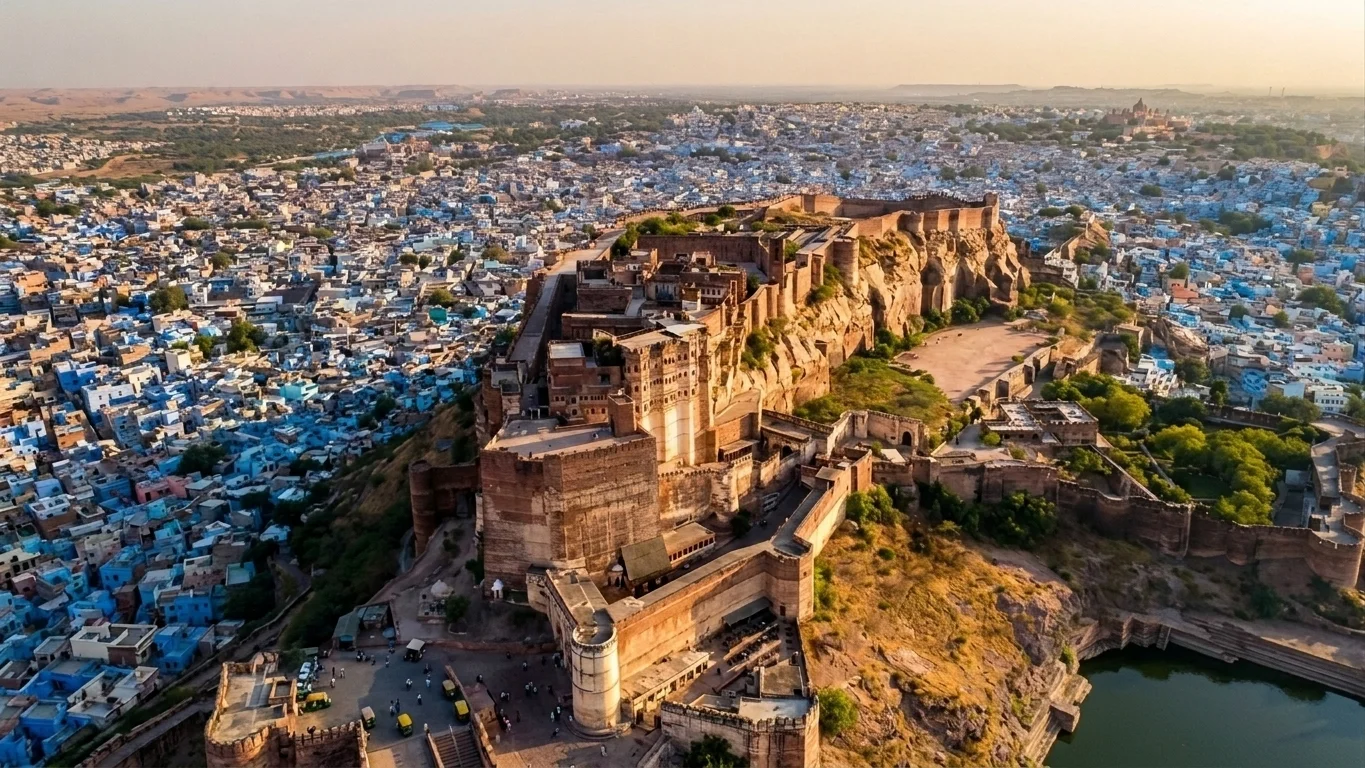
There’s a moment, as you climb the winding path up to Mehrangarh Fort, when the city of Jodhpur suddenly falls away beneath you in a wash of blue rooftops, and the fort’s honey-coloured ramparts seem to grow directly out of the rock itself. That’s not an accident of architecture. Rao Jodha, the Rathore ruler who founded this fort in 1459, built it this way on purpose — walls that rise nearly 36 metres in places, so seamlessly fused with the cliff that from a distance it’s hard to tell where the hill ends and the fortress begins.
Perched 122 metres above the plains on a rocky outcrop known as Bhaurcheeria, “the mountain of birds,” Mehrangarh Fort has stood watch over Marwar for well over five and a half centuries. It has outlasted sieges, survived a ruler’s broken promise to a hermit, and now houses one of the finest living museums in India. For travellers who enjoy tracing Rajasthan’s desert heritage, this fort pairs naturally with the salt-flat landscapes covered in our Rann of Kutch guide. This piece walks through Mehrangarh Fort’s history, the legends that still get retold in Jodhpur’s old city, its architecture, and the practical details you’ll need for Mehrangarh Fort Jodhpur, including current Mehrangarh Fort timings.
A Fort Born of a Curse
Every great Rajasthani fort seems to carry a founding legend, and Mehrangarh Fort’s is one of the more haunting. When Rao Jodha chose this hilltop for his new capital, the site was home to a hermit named Cheeria Nathji, the “Lord of Birds.” Displacing him went poorly. The hermit cursed Rao Jodha: “May your citadel ever suffer a scarcity of water.” Rattled, the king built the hermit a house and a temple within the fort walls to appease him — and to this day, locals point out that Jodhpur, on the Thar Desert’s edge, struggles with water security.
A second, grimmer legend sits beneath the foundation stone. Local tradition holds that a man named Raja Ram Meghwal volunteered to be buried alive at the site to ensure the fort’s strength, and his family was granted land in return — a story that, true or not, says a great deal about how seriously fortification was taken in 15th-century Marwar.
The Rise of a Desert Stronghold
Construction began under Rao Jodha, but the Mehrangarh most visitors walk through today owes much more to his descendants, particularly Maharaja Jaswant Singh in the 17th century, who added many of the fort’s most ornate interiors. Over roughly 500 years, successive Rathore rulers kept building, layering palace upon palace, courtyard upon courtyard, until the complex sprawled across nearly 1,200 acres of rock and desert scrub.
What makes Mehrangarh Fort genuinely remarkable from an engineering standpoint is its sheer scale of defence. The walls run up to 36 metres high and, in places, a full 21 metres thick — thick enough that cannons could be mounted directly on top of them, which is exactly what the Rathores did. You can still see the scars from Mughal cannon fire on the Dedh Kangra Pol, one of the fort’s seven gates, a small but vivid reminder that this was never simply a palace. It was built to take a beating and keep standing.
Passing Through Seven Gates
Visitors reach the upper fort through a sequence of seven gates, each telling its own fragment of history. Jai Pol, the “Gate of Victory,” was raised in 1806 to mark a win over the armies of Jaipur and Bikaner. Fateh Pol commemorates an earlier triumph, the defeat of a Mughal army in 1707. Loha Pol, the final gate before the palace courtyards, carries something far more sombre: the small handprints, or sati marks, left by the royal widows who walked through it before committing sati on their husbands’ funeral pyres — a practice outlawed in the 19th century but one whose physical trace the fort has chosen to preserve rather than erase.
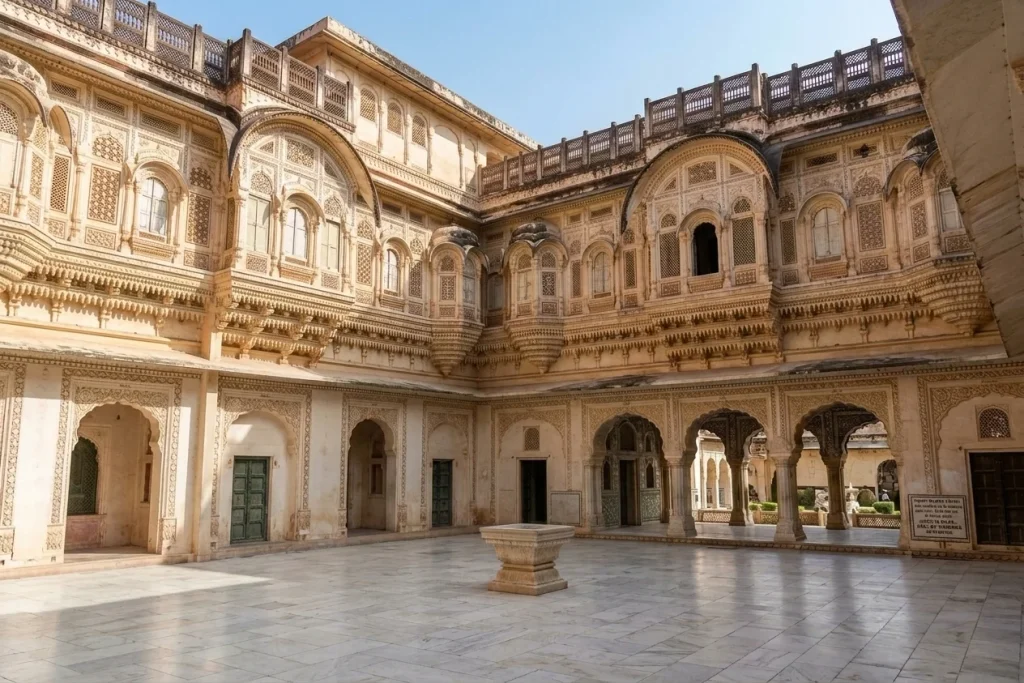
Inside, the palaces soften considerably. Moti Mahal, the Pearl Palace, was once the hall where the Rathore rulers held court. Phool Mahal, the Flower Palace, is covered in gold leaf and miniature paintings and was reserved for private entertainment. Sheesha Mahal, the Mirror Palace, catches candlelight across thousands of tiny mirrored tiles in a way that photographs rarely do justice to in person.
The Museum Inside the Walls
Today, much of Mehrangarh Fort functions as a museum, and a genuinely well-curated one. The collection includes royal palanquins and howdahs used to carry queens and maharajas, an armoury holding swords once belonging to Akbar and the Central Asian conqueror Timur, intricately carved cradles used by infant princes, and galleries of Rajput miniature paintings. It’s run by the Mehrangarh Museum Trust, a private trust set up by the current head of the Jodhpur royal family, which has kept the fort in considerably better condition than many government-managed monuments elsewhere in India.
A short walk from the main ramparts, the Chamunda Mataji Temple holds particular significance — the goddess was Rao Jodha’s chosen deity, and her idol was carried here from the old capital of Mandore in 1460, a year after the fort’s foundation was laid. It remains an active place of worship, not simply a historical relic.
Beyond the Walls: Rao Jodha Desert Rock Park
One of the more unusual additions to Mehrangarh Fort in recent years sits just below its ramparts. The Rao Jodha Desert Rock Park is a 72-hectare ecological restoration project, reclaiming land that had been overrun by invasive thorn scrub and returning it to native desert vegetation. It’s a quiet, almost meditative contrast to the grandeur above — rocky trails, native flora, and some of the best unobstructed views of Mehrangarh Fort’s walls rising out of the stone.
Visiting Mehrangarh Fort Jodhpur
If you’re planning a trip to Mehrangarh Fort Jodhpur, a little preparation goes a long way, since the complex is large enough to easily absorb half a day or more. Most travellers reach it either by a steep walk up from the old city’s clock tower market or by taxi, which drops you much closer to the entrance.
As for Mehrangarh Fort timings, the complex is typically open daily from around 9:00 AM to 5:00 PM, with the last entry usually permitted about half an hour before closing. It’s worth confirming current Mehrangarh Fort timings before you travel, since hours can shift slightly around festivals or maintenance closures. An audio guide is included with most ticket options and is genuinely worth using — the fort’s history is dense enough that wandering through without context means missing most of what makes each courtyard significant.
Early mornings tend to be the most comfortable time to visit, both for lighter crowds and softer light for photography, particularly if you want a clear view over Jodhpur’s blue-painted old city from the fort’s ramparts. October through March remains the most pleasant season, since Jodhpur’s summer heat can be genuinely punishing by midday.
For official visitor information and current ticket details, refer to the Mehrangarh Museum Trust’s official website, the fort’s own governing body, and the Incredible India listing on Mehrangarh Fort, the Government of India’s official tourism portal.
Frequently Asked Question’s
Who built Mehrangarh Fort?
Mehrangarh Fort was built in 1459 by Rao Jodha, the Rathore ruler who founded Jodhpur, though most of the ornate palaces visible today were added over the following two centuries by his descendants, particularly Maharaja Jaswant Singh.
How tall are the walls of Mehrangarh Fort?
The fort’s walls rise up to 36 metres high and, in places, measure roughly 21 metres thick, making it one of the most formidable fortifications in Rajasthan.
What are the current Mehrangarh Fort timings?
The fort is generally open daily from around 9:00 AM to 5:00 PM, with last entry typically around 4:30 PM, though it’s best to confirm before visiting as hours can vary.
What is the legend behind Mehrangarh Fort?
According to local tradition, a hermit named Cheeria Nathji cursed Rao Jodha with water scarcity after being displaced from the hill, prompting the king to build him a temple within the fort to lift the curse.
What else is there to see near Mehrangarh Fort?
Nearby attractions include the Chamunda Mataji Temple within the fort complex, the Rao Jodha Desert Rock Park just below the ramparts, and the marble cenotaph of Jaswant Thada a short distance away.
Mehrangarh Fort isn’t a monument that simply sits on a hill — it feels carved into Jodhpur’s identity, visible from nearly every street in the blue city below. Between its cannon-scarred gates, its sati handprints, its gold-leafed palaces, and a curse that locals still half-believe explains the region’s water troubles, this is a fort that rewards slow, curious wandering rather than a quick photo stop. Few places in Rajasthan pack quite this much living history into a single climb.