

Table of Contents
Some pilgrimage sites are built first and mythologised later. Hemkund Sahib went the other way around — it existed in scripture for over two centuries before anyone knew exactly where it was. Today Hemkund Sahib stands as the highest Sikh shrine in the world, a small gurudwara beside a glacial lake at over 4,300 metres in the Garhwal Himalayas. Its story unfolds in distinct chapters: a vision written into scripture, a search that took decades, an engineering feat carried out at extreme altitude, and a trek that tens of thousands of pilgrims still undertake every summer.
Chapter One: A Vision in the Dasam Granth
Long before there was a shrine, there was a verse. In the Dasam Granth, a scripture attributed to Guru Gobind Singh, the tenth Sikh Guru, he describes meditating in a previous life at a mountain lake called Hemkunt Parbat, encircled by seven snow-covered peaks. The passage is part of the Bachitar Natak, an autobiographical section of the text, and for generations it remained just that — a description, with no confirmed location anywhere in the Himalayas.
This is central to understanding Hemkund Sahib history: the site’s spiritual identity was established in text long before its physical location was known. Sikh pilgrims believed the place existed, but where in the vast Garhwal range it might be remained an open question well into the 20th century.
Chapter Two: Finding Lokpal Lake
The search finally bore fruit in the early 1930s, when Sant Sohan Singh, a Sikh scholar and ascetic, began tracing clues from the Dasam Granth against the geography of the region. Working alongside Bhai Modan Singh, he identified a remote glacial lake locally known as Lokpal, tucked into a valley near Ghangaria in present-day Chamoli district, as matching the description in scripture.
The identification gained wider acceptance among Sikh scholars and pilgrims through the remainder of the decade, and by the late 1930s, the first structures began appearing at Hemkund Sahib to mark it as a place of pilgrimage.
Chapter Three: Building on the Roof of the World
Constructing a permanent gurudwara at Hemkund Sahib, over 4,300 metres above sea level, was no small undertaking. The modern structure owes much to Major General Harkirat Singh, an engineer with the Indian Army, who took charge of the project and selected architect Manmohan Singh Siali of the Military Engineering Services to lead the design. Gursikh contractors — among them Sahib Singh, Harbhajan Singh, and Gursharan Singh — carried out construction despite extreme weather, thin air, and the sheer logistical difficulty of moving materials to such a remote, high-altitude site.
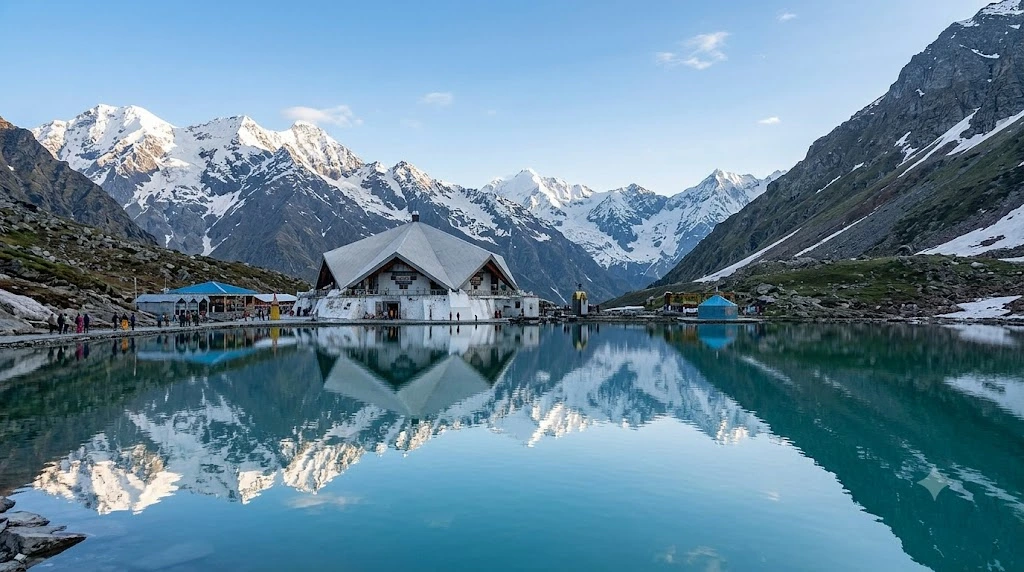
The result is the Hemkund Sahib Gurudwara as it stands today: a star-shaped structure beside the lake, dedicated to Guru Gobind Singh, open only during the short window each year when snow permits access. Because the altitude here is genuinely extreme, medical studies have found that roughly a third of pilgrims experience some degree of acute mountain sickness during their visit, a detail worth taking seriously when planning your own trip.
Chapter Four: The Trek Pilgrims Take
Reaching Hemkund Sahib today still means following largely the same route that early pilgrims once walked. The Hemkund Sahib trek begins at Govindghat, reachable by road from Rishikesh or Haridwar, and covers a total distance of approximately 19 kilometres one way.
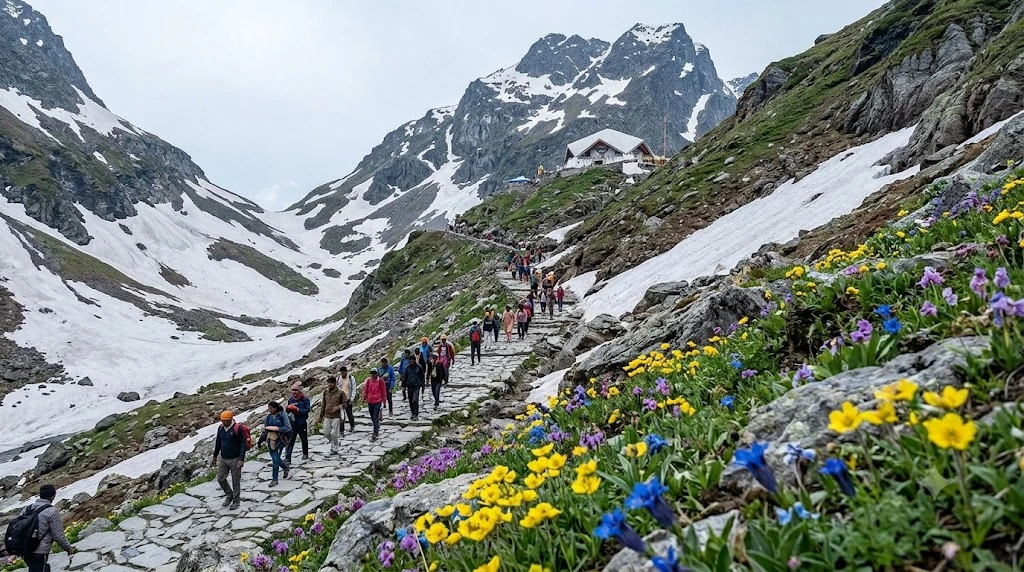
The journey splits into two distinct stages. The first, roughly 13 km from Govindghat to Ghangaria (also called Gobind Dham), follows a gradual ascent alongside the Pushpawati River, passing through forest and small mountain settlements. The second stage, from Ghangaria to the shrine itself, covers about 6 km of noticeably steeper, stone-paved trail, climbing through alpine terrain before the lake and gurudwara finally come into view. Pony and mule rides are available for both stages for those unable to walk the full distance.
Ghangaria also serves as the base for the Valley of Flowers, one of India’s most celebrated high-altitude meadows, making it common for pilgrims to combine both destinations into a single trip. Our Valley of Flowers Trek package covers this combined route in detail for travellers looking to experience both in one journey.
Chapter Five: When to Go
The shrine and the surrounding trail are only accessible for a narrow window each year, roughly from late May or early June through late September or early October, depending on snowfall. Outside this period, heavy snow makes the route impassable and the gurudwara itself closes.
Within the season, June through August tends to see the heaviest pilgrim traffic, coinciding with school holidays and pleasant weather in the plains. September offers a quieter alternative, with clearer skies and thinner crowds, though shorter daylight hours mean an earlier start is essential.
Practical Details for Your Visit
- Altitude: Approximately 4,329 metres (14,200 feet), among the highest Sikh shrines in the world
- Base point: Govindghat, Chamoli district, Uttarakhand
- Total trek distance: Approximately 19 km one way, via Ghangaria
- Season: Late May/June to late September/October
- Nearest airport: Jolly Grant Airport, Dehradun
- Nearest railway station: Rishikesh
- Health note: Acclimatise gradually and watch for symptoms of altitude sickness during the final ascent
For travellers looking to combine this pilgrimage with other significant Himalayan shrines, our Kedarnath Yatra package offers another deeply meaningful high-altitude pilgrimage experience in the same region.
For official gurudwara information and updated travel guidance, you can refer to the Gurudwara Hemkund Sahib Management Trust, which maintains current details on the shrine and pilgrimage season.
Frequently Asked Question’s
What is the altitude of Hemkund Sahib?
Hemkund Sahib sits at approximately 4,329 metres (14,200 feet) above sea level, making it one of the highest Sikh shrines in the world.
What is the trek distance to Hemkund Sahib?
The total trek distance is approximately 19 km one way from Govindghat, split into 13 km to Ghangaria and a further 6 km to the shrine itself.
What is the historical significance of Hemkund Sahib?
It is associated with Guru Gobind Singh, the tenth Sikh Guru, who described meditating at this location in a previous life in the Dasam Granth, though its exact location was only identified in the 1930s by Sant Sohan Singh.
When is the best time to visit Hemkund Sahib?
The shrine is accessible only from late May or June through late September or October, with June to August seeing the highest pilgrim numbers.
Is the Hemkund Sahib trek difficult?
It is considered moderate to difficult, primarily due to the high altitude and a steep final stretch, and pilgrims are advised to acclimatise and watch for symptoms of altitude sickness.