

Table of Contents
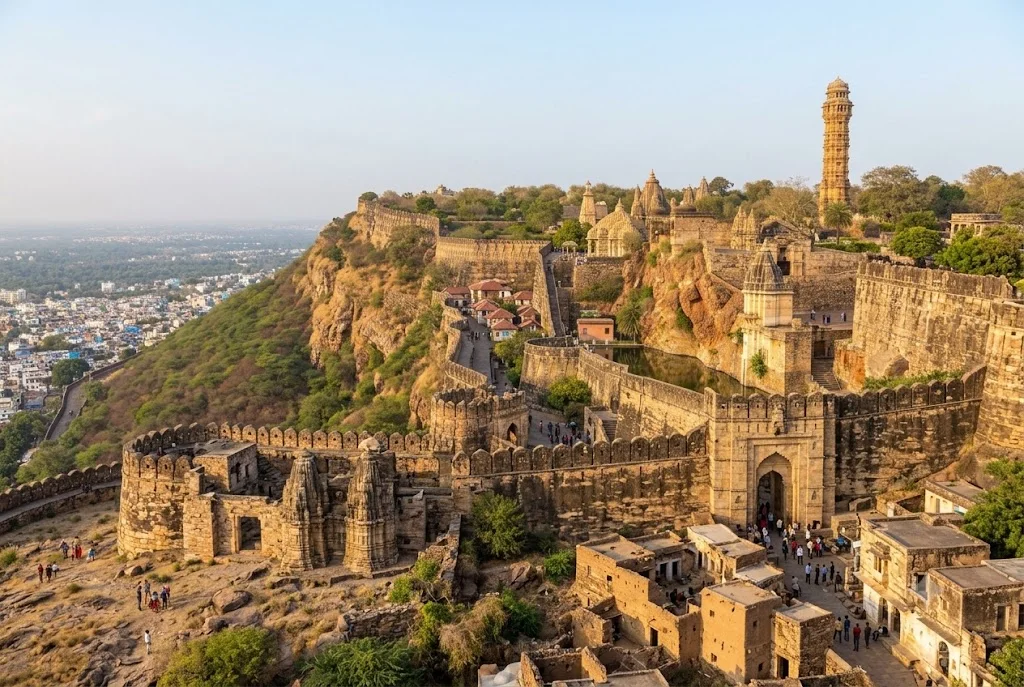
On a limestone hill rising above the plains of southern Rajasthan stands one of India’s most formidable tributes to defiance and sacrifice — Chittorgarh Fort. Spread across 700 acres and enclosed by a 13-kilometre wall, this is the largest fort in India, and a UNESCO World Heritage Site counted among the celebrated Hill Forts of Rajasthan. It has drawn historians, travellers, and pilgrims of Rajput history for generations, each coming to walk through a fortress that survived three of the most brutal sieges ever recorded on Indian soil.
If you’re someone who loves tracing India’s layered heritage — the same spirit that draws travellers to the desert landscapes on our Rann of Kutch guide — this fort deserves a firm place on your travel list. In this guide, we’ll walk through its complete history, who built it, its architecture, and everything else you need to know before planning a visit, including its location and current visiting hours.
About Chittorgarh Fort
This fort sits atop a steep hill overlooking the town of Chittorgarh, roughly midway between Udaipur and Kota in southern Rajasthan. The complex is so vast it functions almost like a self-contained town, approached through seven imposing gates — Padan Pol, Bhairon Pol, Hanuman Pol, Ganesh Pol, Jodla Pol, Lakshman Pol, and the final Ram Pol — each named after a historical event or hero tied to its defence.
What sets this fort apart from almost every other fortress in India is the sheer density of its history. Within its walls stand more than 65 structures, including four palaces, nineteen temples, and several step-wells that once sustained the population through long sieges. But it is the fort’s association with three catastrophic sieges, each ending in jauhar and saka, that has made it one of the most storied monuments in the country — a place where mythology, memory, and architecture converge in stone.
Chittorgarh Fort History
Sun-baked and weathered by centuries, the Chittorgarh Fort history stretches back well over a thousand years, with the hill believed to have been fortified even earlier than recorded evidence suggests. Most historians trace its early development to the Mori Rajput rulers around the 7th century CE, before it passed to the Guhila dynasty, ancestors of the Sisodia Rajputs who made it the capital of Mewar for roughly eight centuries.
What makes that history so remarkable is its repeated role as the stage for Rajasthan’s most legendary last stands:
- 1303 CE: Alauddin Khilji of the Delhi Sultanate besieges the fort, reportedly drawn by tales of Rani Padmini’s beauty. After a prolonged siege, it falls, and tradition holds that Rani Padmini led thousands of women in jauhar rather than face capture.
- 1535 CE: Bahadur Shah, the Sultan of Gujarat, lays siege to the stronghold. Rani Karnavati, regent for the young Maharana Vikramaditya, leads a second mass jauhar as the fort’s defenders make their final stand.
- 1567–1568 CE: Emperor Akbar personally commands a siege lasting several months. Jaimal Rathore and Patta Sisodia, both barely out of their teens, lead the defence after Maharana Udai Singh II relocates the capital. A third jauhar follows, and Akbar is said to have erected statues of both commanders at the gates of Agra Fort in tribute to their courage.
Three jauhars, three sakas — few monuments anywhere carry this particular weight of sacrifice, and it’s this history, as much as the architecture, that continues to draw visitors from across the world.
Who Built Chittorgarh Fort
The question of who built Chittorgarh Fort doesn’t have a single tidy answer, because the structure visible today is the product of multiple dynasties building, rebuilding, and expanding across centuries. Its earliest fortifications are generally credited to the Mauryan or Mori rulers of the region, with local legend attributing the fort’s name to a Mori chief, Chitrangada Mori.
The fort came into its own under the Guhila and later Sisodia rulers of Mewar, who made it their capital and expanded it into the fortress-town that stands today. Rana Kumbha, who ruled Mewar in the 15th century, is credited with much of its monumental construction, including the celebrated Vijay Stambh, or Tower of Victory, built to commemorate his triumph over the combined armies of Malwa and Gujarat in 1440 CE. So the honest answer spans Mori chieftains, Guhila kings, and above all the Sisodia Maharanas of Mewar, each adding their own chapter to the hill.
Architecture and Legends Within the Walls
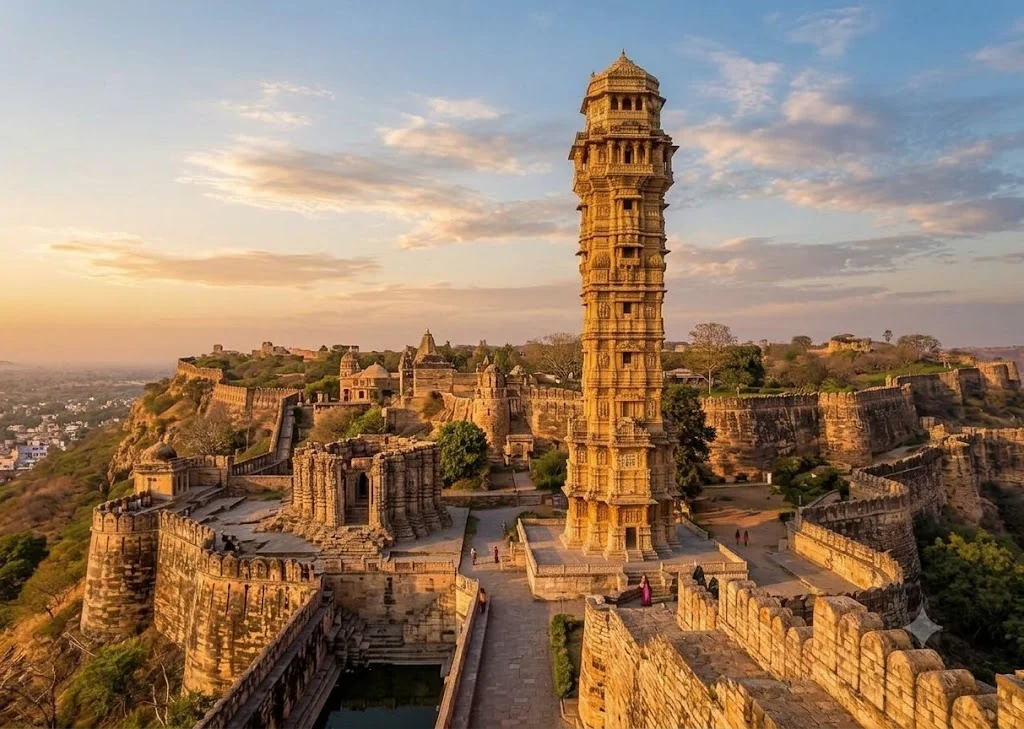
The fort’s architecture puts function before flourish — this was a working citadel first, built to withstand siege rather than simply impress. The two towers dominate its skyline: the Vijay Stambh, nine storeys and roughly 37 metres tall, is carved edge to edge with Hindu deities, while the older Kirti Stambh, a 22-metre Jain tower dedicated to Adinath, predates it by centuries.
The Rana Kumbha Palace is believed to be the birthplace of Maharana Pratap, one of Mewar’s most celebrated warrior-kings, while the adjoining Padmini Palace is associated, by legend, with the queen whose story triggered the fort’s first great siege. The heroism of Jaimal and Patta is still recited in Rajasthani folk ballads, and Panna Dhai, the nursemaid said to have sacrificed her own son to protect the infant prince Udai Singh, adds a quieter note of personal sacrifice to the fort’s larger story. A detail that catches most visitors off guard: unrolled, the 13-kilometre perimeter wall would stretch from one end of a small city to the other, making this not a single compact monument but genuinely walkable terrain.
Chittorgarh Fort Information for Visitors
If you’re planning a trip, here’s some essential Chittorgarh Fort information to help you make the most of your visit:
- Location: Chittorgarh district, southern Rajasthan — roughly 115 km from Udaipur and 185 km from Kota
- Best time to visit: October to March, when the weather is cool enough for a full day of walking
- Nearest airport: Maharana Pratap Airport, Udaipur, approximately 90 km away
- Nearest railway station: Chittorgarh Junction, well connected to Delhi, Mumbai, Udaipur, and Jaipur
- Chittorgarh Fort timings: Generally 10:00 AM to 6:00 PM for ticketed sightseeing, with an evening sound-and-light show; exact hours can shift slightly by season
- UNESCO status: One of the six Hill Forts of Rajasthan, inscribed in 2013
- Managed by: Archaeological Survey of India (ASI)
For travellers wondering exactly where this landmark sits relative to the rest of Rajasthan, it lies comfortably within a wider heritage circuit, making it easy to combine with a tour of Udaipur’s palaces or Jodhpur and Jaisalmer’s desert forts.
It’s best to visit early to avoid the midday heat and crowds, and hiring a government-approved guide is highly recommended, since many of the finer architectural and legendary details are easy to miss without context.
For official visitor information and conservation updates, refer to the Incredible India listing, the Government of India’s official tourism portal, and the UNESCO World Heritage Centre listing on the Hill Forts of Rajasthan for World Heritage documentation.
A Journey Beyond the Fort
While Chittorgarh Fort reflects the martial and architectural soul of Rajasthan, India’s heritage trail rarely stops at just one destination. Travellers drawn to desert landscapes and historic grandeur often find themselves equally captivated by the salt flats and cultural richness of the Rann of Kutch, or the wider network of heritage circuits across Rajasthan and Gujarat.
Frequently Asked Question’s
Who built Chittorgarh Fort?
Chittorgarh Fort was built and expanded over centuries, with early fortifications credited to the Mori Rajput rulers around the 7th century CE, followed by major development under the Guhila and Sisodia dynasties of Mewar — particularly Rana Kumbha in the 15th century, who added the Vijay Stambh and much of the fort’s monumental architecture.
What is the history of Chittorgarh Fort?
Chittorgarh Fort served as the capital of Mewar for roughly eight centuries and witnessed three major sieges — by Alauddin Khilji in 1303, Bahadur Shah of Gujarat in 1535, and Akbar in 1567-68 — each ending in jauhar and a final saka by the fort’s defenders.
Where is Chittorgarh Fort located?
Chittorgarh Fort is located in Chittorgarh district in southern Rajasthan, roughly 115 km from Udaipur and 185 km from Kota, making it an easy stop on a wider Rajasthan heritage circuit.
What are the Chittorgarh Fort timings?
The fort is generally open from around 10:00 AM to 6:00 PM for ticketed sightseeing, with an evening sound-and-light show narrating its history, though timings can vary slightly by season.
Why is Chittorgarh Fort famous?
It is famous for being the largest fort in India by area, its UNESCO World Heritage status as one of the Hill Forts of Rajasthan, and its legends of Rani Padmini, Jaimal and Patta, and three historic jauhars.
Chittorgarh Fort isn’t a monument you simply photograph and move on from — it’s a place that asks you to sit with its history for a while. Three sieges, three jauhars, a thousand years of dynasties rising and falling on the same hilltop: few places in India carry quite this much lived memory within one boundary wall. Whether you’re a history enthusiast, an architecture lover, or simply someone chasing India’s most iconic heritage landmarks, Chittorgarh Fort is a journey that stays with you long after you leave.