

Table of Contents
Tucked into the busy junction of Prabhadevi, where Mumbai’s local trains rattle past and traffic rarely stops moving, sits a small shrine that has become one of the wealthiest and most visited temples in the country. Shree Siddhivinayak Temple wasn’t built by a king or a dynasty. It was built by an ordinary woman named Deubai Patil, who simply wanted a wish fulfilled — and the story of how that modest 1801 shrine grew into the institution it is today says a lot about how devotion spreads in this city.
If you’re someone who enjoys tracing India’s living temple traditions — the same curiosity that draws travellers to our Akshardham Temple guide — this piece digs into the real history behind Shree Siddhivinayak Temple, what makes the idol inside genuinely unusual, the Siddhivinayak temple timings you’ll need before you go, and a few details about the Siddhivinayak ganpati temple that even regular visitors often don’t know.
A Temple Born From a Childless Woman’s Prayer
The story behind this temple is quieter than most. In the late 1700s, Prabhadevi was farmland, nothing like the dense, honking neighbourhood it is today. A wealthy local woman named Deubai Patil, who had no children of her own, prayed that Lord Ganesha would grant children to any woman who came to this spot and asked sincerely. Moved by her own devotion, she commissioned a small shrine, and it was Laxman Vithu Patil, a local contractor, who actually built it. Shree Siddhivinayak Temple was consecrated on 19 November 1801 — a date that’s still recorded as the shrine’s official founding day.
What’s striking about Shree Siddhivinayak Temple’s history is how deliberately ordinary its origins were. There was no royal patronage, no grand architectural ambition at the start. It was one woman’s private hope, turned into a public place of worship, and as word spread that prayers made here seemed to be answered, the crowds simply never stopped coming.
The Idol That Breaks the Rules
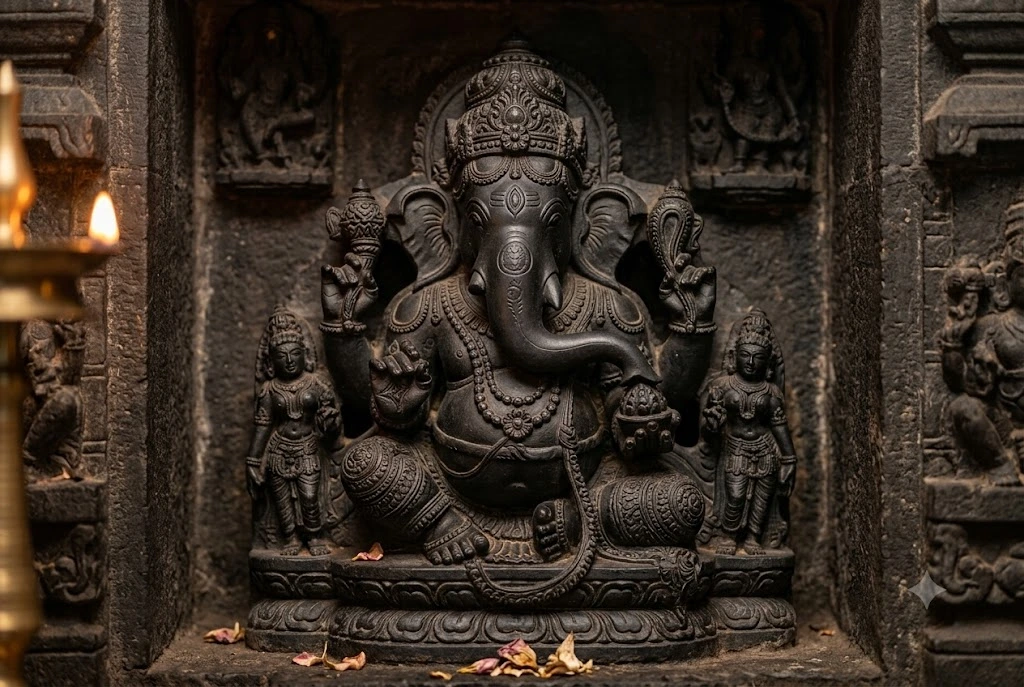
Walk up to Shree Siddhivinayak Temple’s inner sanctum and you’ll notice something that long-time devotees of Ganesha temples across Maharashtra immediately clock as unusual. The idol, carved from a single block of black stone, has its trunk curving to the right rather than the left. Most Ganpati idols across India follow the left-trunk form, considered easier to appease in daily worship; a right-trunked idol is traditionally regarded as a more powerful, “Siddhi” form, requiring stricter rituals to worship correctly. It’s this feature, more than anything else, that gives Shree Siddhivinayak Temple its name — “Siddhi Vinayak,” the Ganesha who grants siddhi, or spiritual accomplishment and wish fulfilment.
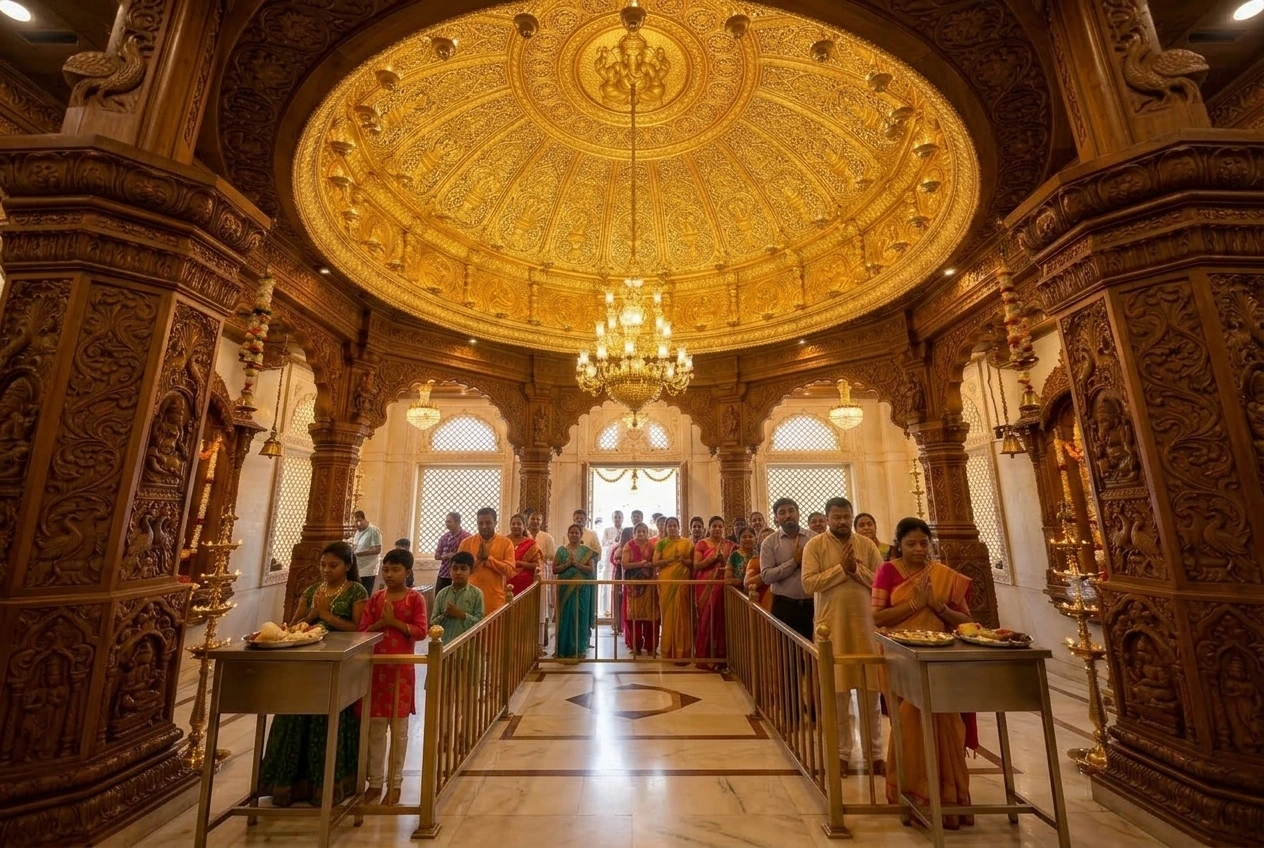
The idol also carries a small third eye carved into the forehead, a detail linking it visually to Lord Shiva, and is flanked on either side by Riddhi and Siddhi, Ganesha’s two consorts representing prosperity and spiritual power respectively. The inner sanctum’s roof is plated in gold, and the temple’s wooden doors and pillars are carved with depictions of the Ashtavinayaka — the eight legendary manifestations of Ganesha worshipped across Maharashtra — which turns even a short visit into something of a visual pilgrimage in itself.
From Village Shrine to Mumbai’s Richest Trust
For nearly a century and a half, Shree Siddhivinayak Temple remained a modest neighbourhood shrine. Its transformation into the institution recognisable today happened gradually through the 20th century, as Mumbai itself exploded outward from a port town into India’s financial capital, and Prabhadevi went from farmland to prime city real estate.
Today, the Shree Siddhivinayak Ganapati Temple Trust manages the complex, governed under the Bombay Public Trusts Act and a dedicated state legislation passed in 1980. It’s widely reported as the richest temple trust in Mumbai, collecting somewhere between ₹10 and ₹15 crore annually in donations — figures that have, at various points, drawn legal scrutiny over how those funds are spent, including a Bombay High Court-appointed committee in the mid-2000s that reviewed transparency in the trust’s charitable disbursements. Security has also tightened considerably since the 2008 Mumbai terror attacks, with bulletproof enclosures now surrounding the inner sanctum and checkpoints at every entrance.
Why Tuesdays Are Different Here
If you’ve ever tried visiting on a Tuesday and found the queues stretching for blocks, there’s a reason. Tuesday is considered Lord Ganesha’s day across Hindu tradition, and at Shree Siddhivinayak Temple it’s treated almost as a second festival every single week. Shree Siddhivinayak Temple opens far earlier than usual, with special early darshan beginning around 3:15 AM, well before the general public timings kick in on other days.
This weekly surge pulls in everyone from daily commuters stopping before work to Boll ywood actors and politicians, many of whom are known to visit before a film release or a major decision, hoping the siddhivinayak ganpati temple’s reputation for removing obstacles holds up one more time. During the pandemic years, the trust introduced app-based slot booking and QR-code entry to manage crowd flow, a system that has largely stayed in place for busier days since.
Siddhivinayak Temple Timings
Planning around accurate Siddhivinayak temple timings genuinely matters here, since Shree Siddhivinayak Temple’s schedule shifts noticeably between Tuesdays and the rest of the week. On regular days, from Wednesday through Monday, Shree Siddhivinayak Temple generally opens around 6:00 AM for darshan and stays open in sessions, with the final evening aarti and closing around 9:50 PM. On Tuesdays, the schedule changes substantially — early darshan can begin as early as 3:15 AM, and the temple stays open, with brief breaks for rituals, well past midnight.
Because these siddhivinayak temple timings have shifted over the years, especially around festivals like Ganesh Chaturthi when the temple stays open for extended, almost round-the-clock hours, it’s worth checking current timings through the temple trust’s official channels before you plan a visit. Early mornings on non-Tuesday days tend to offer the shortest queues for anyone hoping to avoid the crowds.
Visiting Shree Siddhivinayak Temple
Shree Siddhivinayak Temple sits in Prabhadevi, close to Dadar, making it easy to reach by Mumbai’s suburban rail network — Dadar station is the nearest major stop, a short auto-rickshaw ride away. Chhatrapati Shivaji Maharaj International Airport lies roughly 10 kilometres away, making a visit easy to combine with other stops in the city.
Modest attire is expected inside the sanctum, and photography is generally restricted near the inner shrine, so it’s best to check current rules at the entrance. Given how central Shree Siddhivinayak Temple has become to Mumbai’s everyday rhythm — film crews, cricket teams, and newlyweds all show up here before big moments — it’s less a tourist stop than a genuine working part of the city’s life, and visiting feels like stepping briefly into that rhythm rather than observing it from outside.
Frequently Asked Question’s
Who built Shree Siddhivinayak Temple?
Shree Siddhivinayak Temple was built in 1801 by contractor Laxman Vithu Patil, commissioned by Deubai Patil, a local woman who wished for the shrine to help childless women conceive.
What is the history of Shree Siddhivinayak Temple?
Siddhivinayak temple history traces back to 19 November 1801, when the shrine was consecrated in what was then farmland in Prabhadevi. It grew from a small neighbourhood temple into one of India’s wealthiest and most visited Hindu shrines over the following two centuries.
Why is the idol at Siddhivinayak Temple considered unique?
Unlike most Ganesha idols, which have their trunk curving left, the black stone idol here has its trunk curving right, traditionally regarded as a more powerful “Siddhi” form of Ganesha, which is also where the temple gets its name.
What are the Siddhivinayak temple timings?
On regular days, Shree Siddhivinayak Temple is generally open from around 6:00 AM to 9:50 PM. On Tuesdays, considered Ganesha’s day, early darshan can begin as early as 3:15 AM, with the temple open, barring short ritual breaks, well into the night.
Why are Tuesdays significant at Siddhivinayak Ganpati Temple?
Tuesday is traditionally associated with Lord Ganesha, and Shree Siddhivinayak Temple sees significantly larger crowds and an extended, earlier schedule on this day compared to the rest of the week.
Who manages Shree Siddhivinayak Temple today?
The temple is managed by the Shree Siddhivinayak Ganapati Temple Trust, governed under the Bombay Public Trusts Act and a dedicated Maharashtra state legislation passed in 1980.
What makes Shree Siddhivinayak Temple worth understanding, beyond just its wealth or its celebrity visitors, is that none of that was the point when Deubai Patil first built it. A quiet, personal prayer from over two centuries ago somehow grew into one of the most continuously busy religious sites in India, visited daily by people hoping, much like she once did, that an honest request made here doesn’t go unanswered.
For official visitor information and current ticket or darshan details, refer to the Shree Siddhivinayak Ganapati Temple Trust’s official website.