

Table of Contents
There’s a reason the queue at Tirupati Balaji Temple can stretch for hours and devotees still don’t flinch. This isn’t just one of India’s most visited pilgrimage sites — by most financial measures, it’s the wealthiest religious institution on the planet, pulling in roughly 24 million visitors a year to a hilltop shrine perched on the seventh peak of the Seshachalam range in Andhra Pradesh. Yet for all the numbers attached to it, what actually draws people here hasn’t changed much in over a thousand years: a quiet belief that Lord Venkateswara, the presiding deity, personally hears what’s asked of him in this particular sanctum.
This piece digs into the real Tirupati Balaji temple history, how it grew from a modest hill shrine into its current scale, the rituals that make a visit here unlike any other Hindu pilgrimage, and what you’ll actually need to know before planning a trip to Shree Tirupati Balaji Temple yourself. If you’re someone who enjoys tracing India’s major pilgrimage circuits, this one pairs naturally with our Kashi Vishwanath Temple guide, another ancient shrine shaped by centuries of royal patronage.
A History Written in Donations
Piecing together the Tirupati Balaji temple history means reading it less like a single construction story and more like a layered record of devotion from dynasty after dynasty. The earliest reference to this sacred hill appears in the Tamil epic Silappathikaram, usually dated to around the 2nd century CE, and tradition holds that an early shrine here was established under a local Thondaman king around 300 CE. For centuries after that, it remained a relatively modest hill temple rather than the sprawling complex it is today.
What changed its trajectory was a long sequence of royal patronage. The Pallava queen Samavai is recorded as making one of the earliest formal endowments, gifting jewels and land to fund temple festivals. The Chola and Pandya dynasties that followed both acted as devoted, periodic patrons, reforming and expanding the structure across several centuries. But it was the Vijayanagara Empire that transformed Tirupati Balaji Temple into something closer to its current grandeur, pouring in donations of gold and diamonds on a scale no previous dynasty had matched.
No single royal name is tied more closely to this phase of Tirupati Balaji temple history than Krishnadevaraya, the celebrated Vijayanagara emperor. He visited frequently and donated generously enough that his gifts of gold and jewels funded the gilding of the inner shrine’s roof. In a detail that still surprises first-time visitors, he went a step further in 1517, installing a statue of himself and his queens inside the temple premises — a rare instance of a ruler placing his own image so close to the sanctum of a deity he worshipped.
The Golden Roof and the Seven Hills
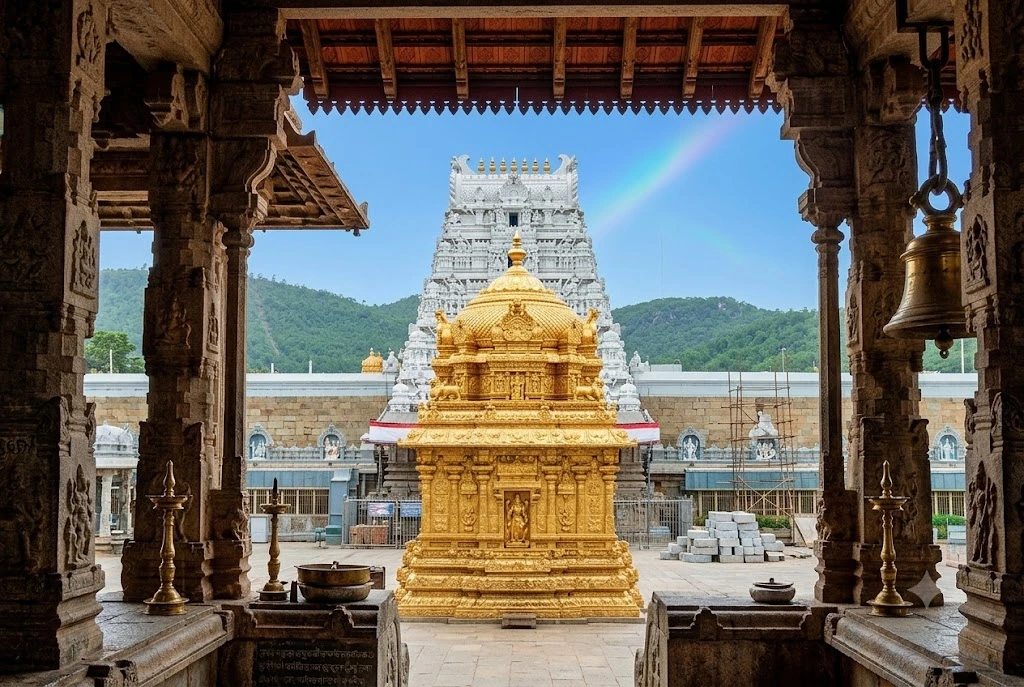
At the heart of Tirupati Balaji Temple sits the Ananda Nilayam, a three-tiered gold vimana rising directly above the inner sanctum, plated in gilt copper and crowned with a golden kalasam. It’s the single most photographed element of Shree Tirupati Balaji Temple, visible glinting in the sun long before pilgrims reach the inner courtyards, and it remains the clearest physical symbol of just how much wealth has poured into this site across centuries of continuous patronage.
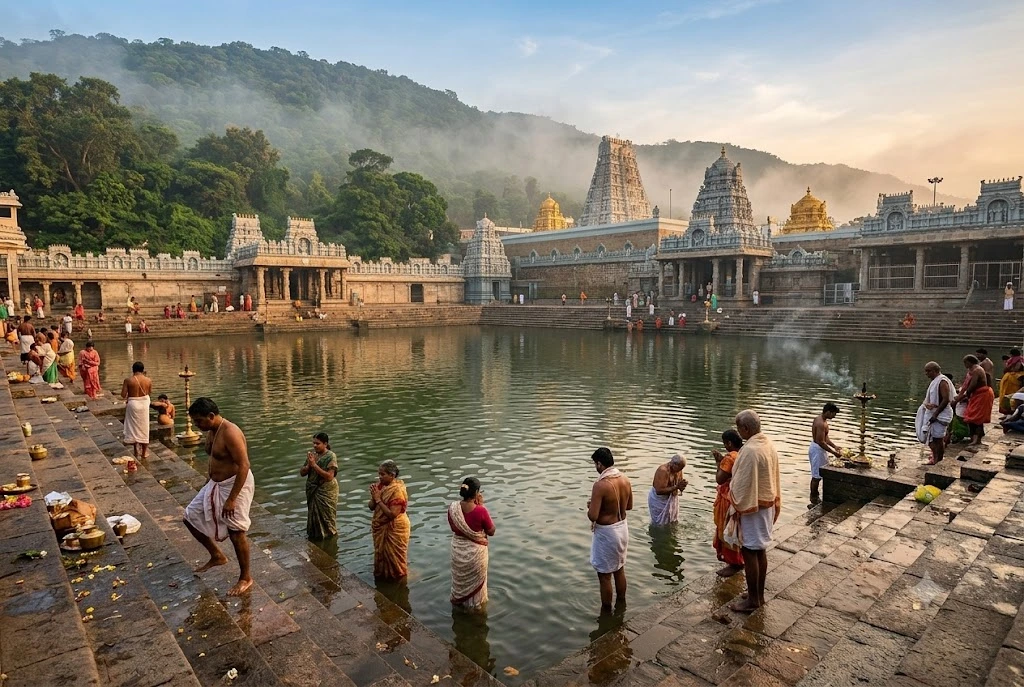
Tirupati Balaji Temple itself sits on Venkatadri, the seventh and final peak of the Seshachalam range, collectively known as the Saptagiri or Seven Hills — Vrushabhadri, Anjanadri, Neeladri, Garudadri, Seshadri, Narayanadri, and Venkatadri. Local tradition holds that these seven peaks represent the seven hoods of Adishesha, the great serpent on whom Lord Vishnu reclines, giving the entire hill range a mythological identity well beyond the temple building itself. Just below the main complex, the Swami Pushkarini tank provides the traditional ritual bathing spot for pilgrims before darshan, considered sacred in its own right rather than simply a practical water source.
The Hair That Funds a Temple
Few rituals associated with Indian temples are as instantly recognisable as the tonsuring tradition at Tirupati Balaji Temple, a practice that sets this pilgrimage apart from almost any other in the country. Devotees shave their heads as an offering, fulfilling vows made in moments of hardship or gratitude, and the scale of this practice is genuinely staggering — well over a tonne of hair is collected here daily. Far from being discarded, this hair is auctioned internationally to wig and extension manufacturers, generating a surprising but very real stream of revenue for the temple trust.
The custom traces back to the legend of Neela Devi, a Gandharva princess associated with the hill Neeladri, one of the seven peaks. Whatever its precise origin, the ritual has become one of the most visible and distinctive features of a pilgrimage here, with dedicated tonsuring halls processing thousands of devotees a day without much disruption to the broader flow of visitors.
Why This Is the Richest Temple on Earth
It’s worth pausing on just how significant the financial side of Tirupati Balaji Temple actually is, because the numbers attached to Shree Tirupati Balaji Temple aren’t exaggeration. Estimates place the temple trust’s total assets above ₹2.5 lakh crore, including vast gold reserves that have grown year over year, alongside tens of thousands of crores held in fixed deposits. Much of this wealth flows in through the hundi, the donation box pilgrims drop cash, jewellery, and gold into as part of their visit, which alone brings in well over a thousand crore rupees annually.
The Tirumala Tirupati Devasthanams, or TTD, manages this wealth and Tirupati Balaji Temple’s daily operations, channelling significant portions into charitable trusts, educational institutions, and free meal programmes for pilgrims — turning what could simply be religious wealth into a genuinely large-scale public institution.
The Laddu Everyone Talks About
No account of Tirupati Balaji Temple, or Shree Tirupati Balaji Temple as it’s formally known, feels complete without mentioning its prasadam. The Tirupati Laddu holds an official Geographical Indication tag, meaning only the TTD is legally permitted to manufacture or sell it under that name — a rare instance of a religious offering receiving the same kind of protected status usually reserved for regional foods like Darjeeling tea or Basmati rice. Pilgrims leaving the temple almost always carry a box or two home, and for many, it’s as much a part of the pilgrimage as the darshan itself.
Planning Your Visit
Reaching Shree Tirupati Balaji Temple typically means first arriving in Tirupati town at the base of the hills, with Tirupati Airport and Tirupati Railway Station both well connected to major Indian cities, before making the climb up to Tirumala by road, a journey of roughly 18 kilometres with dramatic views across the Seshachalam forests.
Darshan at the temple runs across an extended daily schedule, beginning with the pre-dawn Suprabhatam ritual that ceremonially wakes the deity, followed by free Sarva Darshan and paid Seeghra Darshan options for pilgrims wanting faster access. Because queues can run into several hours during peak season, festivals, and weekends, it’s worth checking current timings and booking darshan slots in advance through the temple trust’s official channels before you travel. Modest traditional attire is expected, and most visitors set aside a full day, if not more, to properly experience the temple, the surrounding hills, and the tonsuring halls without rushing.
Travellers building a wider South Indian temple circuit often combine this trip with our Ramanathaswamy Temple guide, another richly layered pilgrimage site further south in Tamil Nadu.
Frequently Asked Question’s
What is the history of Tirupati Balaji Temple?
Tirupati Balaji temple history traces back to around 300 CE, with early patronage from the Pallava, Chola, and Pandya dynasties, before the Vijayanagara Empire, particularly under Krishnadevaraya, transformed it into its current grand scale through extensive gold and diamond donations.
Who built Tirupati Balaji Temple?
No single ruler is credited with building the temple. It developed over centuries through continuous royal patronage, from an early Thondaman-era shrine through Pallava, Chola, Pandya, and especially Vijayanagara contributions.
Why is Tirupati Balaji Temple considered the richest temple in the world?
Its trust holds assets estimated above ₹2.5 lakh crore, including substantial gold reserves and fixed deposits, funded largely through hundi donations and the sale of devotee-offered hair, collected by the millions of pilgrims who visit annually.
What is the significance of the hair-shaving ritual at Shree Tirupati Balaji Temple?
Devotees offer their hair as a vow of gratitude or devotion, a tradition tied to the legend of Neela Devi, and the collected hair is sold internationally, generating significant revenue for the temple trust.
What is special about the Tirupati Laddu?
It holds an official Geographical Indication tag, meaning only the Tirumala Tirupati Devasthanams is legally permitted to manufacture or sell it, making it one of the few religious offerings with this protected status.
What makes Tirupati Balaji Temple genuinely remarkable isn’t just the scale of its wealth or the length of its queues — it’s that none of that seems to dilute the devotion driving it. Kings donated gold centuries ago for the same basic reason an ordinary pilgrim shaves their head today: a belief that something here is worth the effort. Few temples in the world carry quite this much history, wealth, and sheer daily human traffic, and somehow still feel personal to everyone who makes the climb.
For official darshan booking, current timings, and verified visitor information, refer to the Tirumala Tirupati Devasthanams’ official website.