

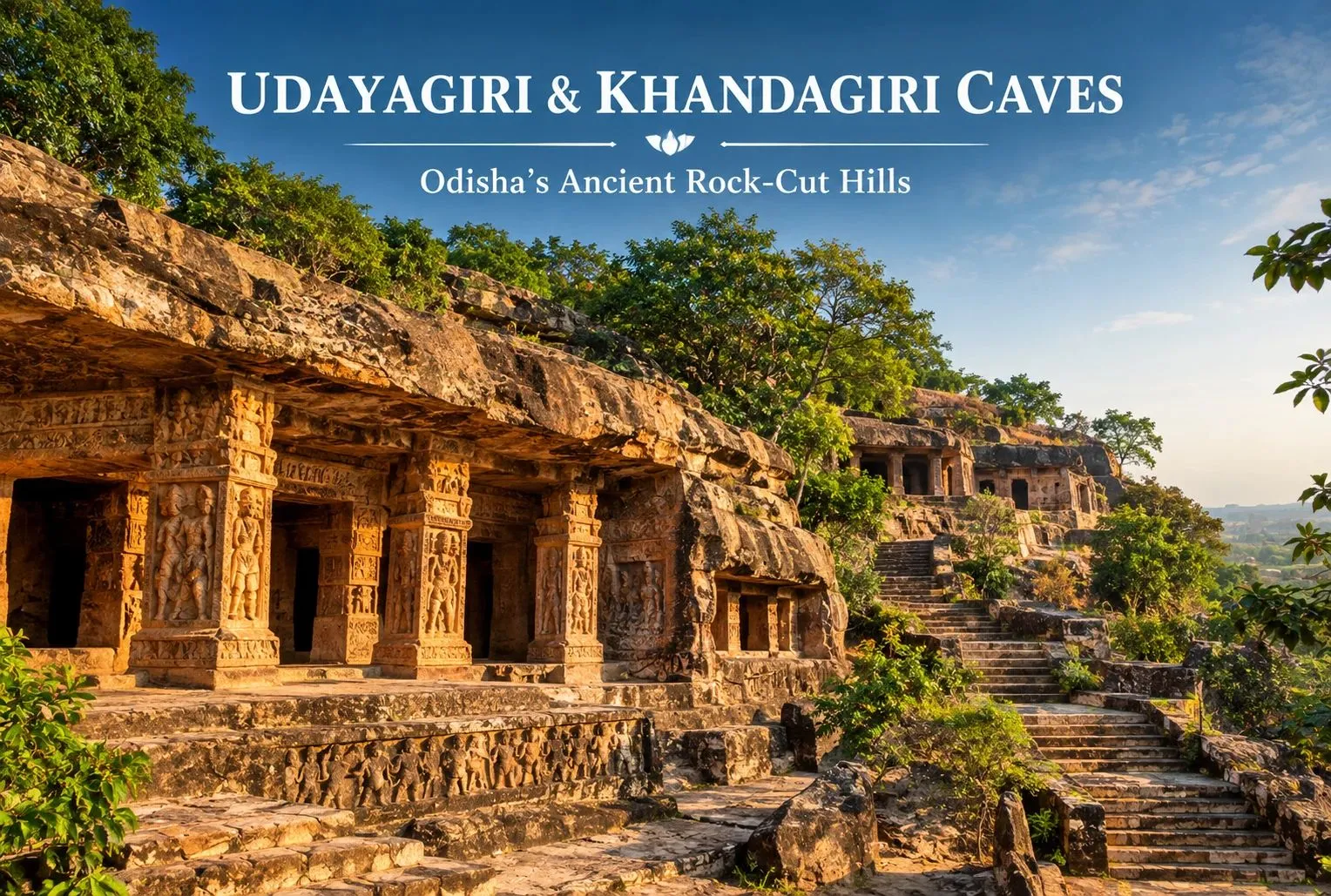
Just outside Bhubaneswar, two low sandstone hills face each other across a road, and both are honeycombed with carved caves. The Udayagiri and Khandagiri Caves are among Odisha’s oldest surviving rock-cut monuments, and they reward visitors who enjoy reading history in stone. This guide covers the history, the key caves, visiting hours, and how to plan your trip.
Table of Contents
About the Udayagiri and Khandagiri Caves
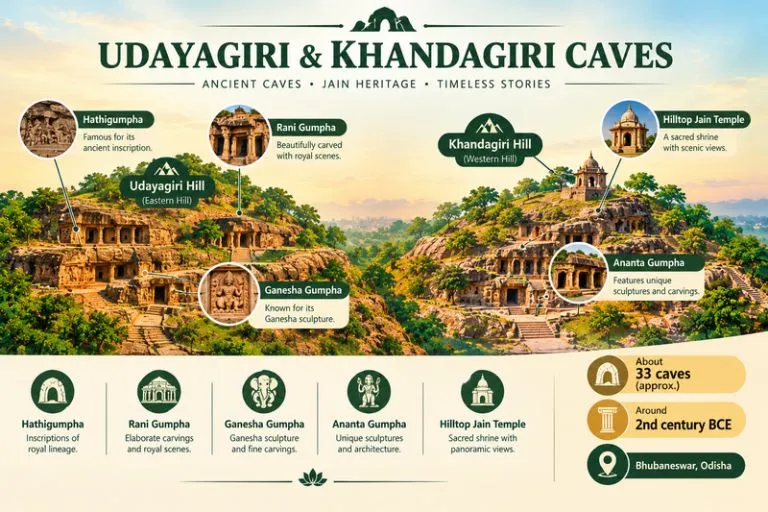
The Khandagiri and Udayagiri hills lie on the western edge of Bhubaneswar, a short drive from the old town. Together they hold dozens of caves, commonly counted as about 33, with roughly 18 on Udayagiri and 15 on Khandagiri. Counts differ between sources, so treat these as approximate. The caves were cut into the rock as residential cells and halls, and many are decorated with carved friezes, pillars, and inscriptions. The site is protected, and the Archaeological Survey of India looks after it.
Udayagiri and Khandagiri Caves History
The caves are generally dated to around the 2nd century BCE, and most scholars link their creation to Jain monks and royal patronage. King Kharavela of the Chedi dynasty, who ruled Kalinga, is the best known name connected with the site. His reign is described in the Hathigumpha inscription, a long Brahmi inscription carved on the roof of a cave on Udayagiri, which is one of the most important historical records from ancient Odisha.
Dates and attributions vary between sources, so check the information boards on site or ask a licensed guide which account they follow. Later periods added carvings and shrines, and a modern Jain temple stands at the top of Khandagiri.
Highlights of Udayagiri
- Hathigumpha (Elephant Cave): a large natural-looking cavern, best known for the long inscription on its roof.
- Rani Gumpha (Queen’s Cave): a two-story cave with carved friezes and sculpted figures, often described as the most elaborate on the hill.
- Ganesha Gumpha: named for a later carving of Ganesha inside the cave.
- Ganga and other caves along the path: small cells and shaded galleries that are easy to walk between.
Highlights of Khandagiri
- Ananta Gumpha: a cave with carved figures including animals, women, and symbols, along with a few carved Jain motifs.
- Navamuni and Barabhuji caves: later caves holding Jain figures carved in the rock.
- The hilltop Jain temple: reached by a flight of steps, with wide views back toward Bhubaneswar.
Udayagiri and Khandagiri Caves Timings
The Udayagiri and Khandagiri Caves timings follow a daytime schedule. Many visitors report an opening around 8:00 AM and a closing around 6:00 PM, with the site open every day. An entry ticket is usually charged, with a lower rate for Indian visitors. I have not verified live timings or fees, so confirm the current schedule and prices with the Archaeological Survey of India or the Odisha tourism office before you go.
How to Reach
- By air: Biju Patnaik International Airport in Bhubaneswar is the nearest, roughly 10 km away.
- By train: Bhubaneswar Railway Station is roughly 8 km away and is well linked to major cities.
- By road: Taxis, autos, and city buses run to the caves. Many visitors combine the site with the Lingaraj Temple and Nandankanan on the same day.
Distances are approximate, so confirm routes locally. For official site details, you can refer to the Archaeological Survey of India, the Government of India body that protects monuments like this one.
Best Time to Visit
October to March is the most comfortable season, with cooler weather for walking the steps and rocky paths. Summers are hot and humid, and the monsoon brings rain from June to September, which can make the steps slippery. Early morning is the best time of day.
Visiting Tips
- Wear comfortable shoes with grip, since there are many steps and uneven rock
- Carry water and sun protection
- Allow two to three hours to see both hills at an easy pace
- Do not touch, climb on, or write on the carvings
- Keep an eye on monkeys that may be near the paths
- Hire a licensed guide if you want help reading the inscriptions
Travelers who like ancient history can also look at Explore Hills’ Roopkund Trek, a high-altitude route known for its mysterious lake.
Conclusion
The Udayagiri and Khandagiri Caves give a close look at early Jain monastic life and the kings who supported it, all in a compact, walkable setting. Plan around the timings, wear good shoes, and leave time for the hilltop views. If you are planning a mountain temple trek next, Explore Hills’ Yulla Kanda Krishna Temple Trek is a good place to start.
Frequently Asked Questions
What are the Udayagiri and Khandagiri Caves?
They are a group of ancient rock-cut caves on two hills near Bhubaneswar, commonly dated to around the 2nd century BCE and linked to Jain monks and royal patronage.
What are the Udayagiri and Khandagiri Caves timings?
They are usually open during the day, from about 8:00 AM to 6:00 PM, but hours can change, so confirm locally before you visit.
What is the history of the Udayagiri and Khandagiri Caves?
The caves are linked to King Kharavela and the Hathigumpha inscription, along with later Jain additions. Dates vary between sources.
Where are the Khandagiri and Udayagiri hills located?
They are on the western edge of Bhubaneswar in Odisha, a short drive from the old town.
What is the best time to visit?
October to March is the most comfortable season, and early morning is the best time of day.
How many caves are there?
They are commonly counted at about 33, with roughly 18 on Udayagiri and 15 on Khandagiri, though counts vary.