

Table of Contents
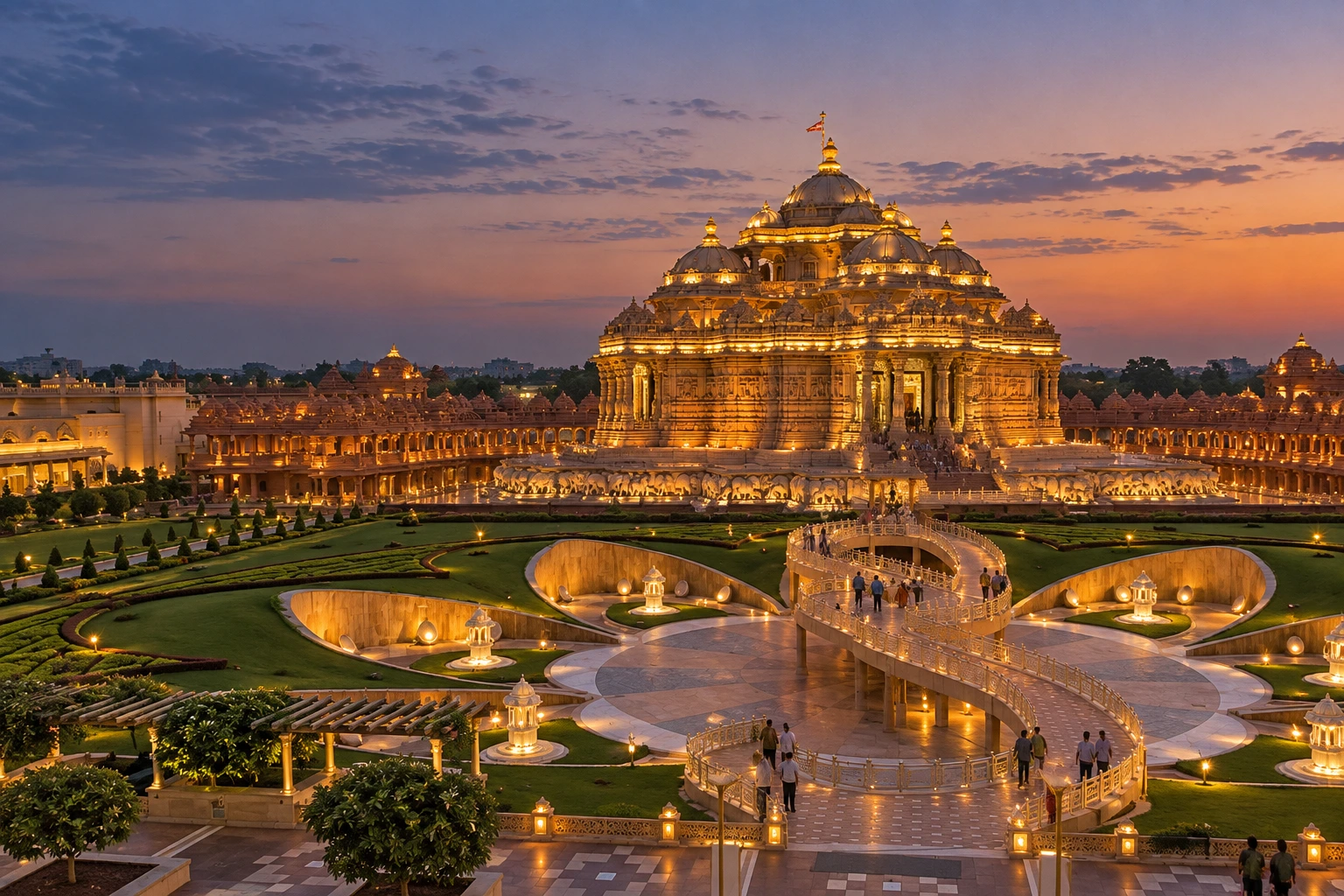
Say the words “Akshardham Temple” to ten different travellers, and you’ll likely get two different mental images. Some picture the vast pink sandstone complex rising beside the Yamuna in Delhi. Others think first of Gujarat, where the very first Akshardham was built — and where, in 2002, the complex became the site of one of India’s most devastating terror attacks. Both places share the name, the spiritual tradition, and an extraordinary architectural ambition. This guide untangles both stories, and gives you everything you need to know before visiting Akshardham Temple.
Two Akshardhams, One Tradition
Before diving into details, it helps to clear up the confusion at the source. Akshardham is not one single Akshardham Temple — it’s a name shared by two major temple complexes built by the BAPS Swaminarayan Sanstha, a Hindu spiritual organisation.
The original, Akshardham Gujarat, opened in Gandhinagar in 1992, conceived by Pramukh Swami Maharaj as a tribute to his predecessor, Yogiji Maharaj. Over a decade later, Akshardham Delhi opened in 2005, on a far larger scale, eventually earning a Guinness World Record as the largest comprehensive Hindu temple on the planet. Both are dedicated to Bhagwan Swaminarayan, the 18th-century spiritual figure at the heart of the Swaminarayan tradition, but the two complexes differ significantly in scale, layout, and the experiences they offer visitors today.
Building the Delhi Complex: A Record-Breaking Temple
The idea for this Akshardham Temple in Delhi traces back to 1968, when Yogiji Maharaj first envisioned it. It wasn’t until 1982 that his successor, Pramukh Swami Maharaj, began actively pursuing the project, and construction finally began in November 2000, after the Delhi Development Authority and the Uttar Pradesh government allocated 60 and 30 acres of land respectively.
What followed was a genuinely remarkable construction effort. Roughly 11,000 artisans and volunteers worked on the project, building the entire complex from pink sandstone and white marble without using any steel or concrete — a deliberate choice rooted in traditional temple-building methods. The complex was completed in about five years and officially inaugurated on 6th November 2005, with a ceremony attended by then-President A.P.J. Abdul Kalam, Prime Minister Manmohan Singh, and opposition leader L.K. Advani.
In 2007, Guinness World Records formally recognised the achievement, naming Akshardham Temple the world’s largest comprehensive Hindu temple — a title that continues to draw visitors from across India and abroad.
Visitor Essentials: Hours and Entry Costs
For anyone planning a trip to Akshardham Temple, the Akshardham Temple timings and pricing structure are fairly straightforward, though it helps to know the details in advance.
The complex is open from 10:00 AM to 8:00 PM, Tuesday through Sunday, and remains closed every Monday. Last entry into the main complex is typically around 6:30 PM, though this can shift slightly on festival days.
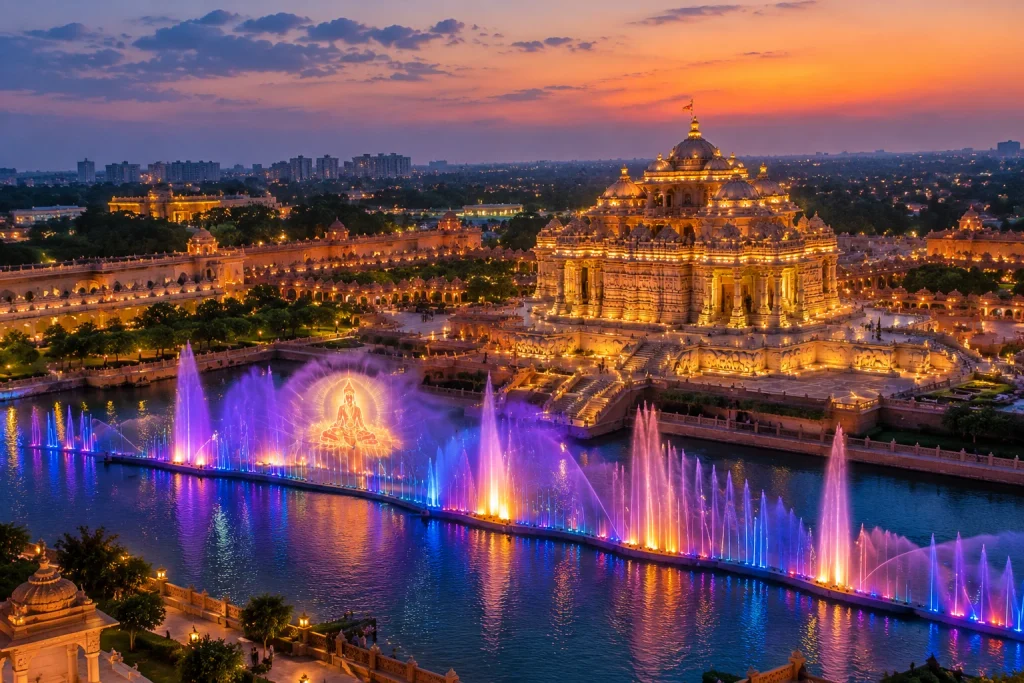
Temple darshan itself is completely free at Akshardham Temple. Where the Akshardham Temple ticket price comes in is for the exhibitions and shows: combined exhibition tickets generally run between ₹170 and ₹260 for adults, with separate pricing for children and senior citizens. The Sahaj Anand Water Show, a 24-minute multimedia performance combining lasers, water jets, and underwater flames, typically begins around sunset, between 7:15 and 7:45 PM, with its own separate ticket.
A few practical notes worth knowing before you go: mobile phones, cameras, smartwatches, and USB drives are strictly not allowed inside, and there are no exceptions at security. It’s best to travel light and store valuables elsewhere.
What You’ll Find Inside
The Akshardham Temple complex is far more than a single shrine. Visitors move through beautifully landscaped gardens, open courtyards, and water bodies, alongside exhibition halls designed to walk you through roughly 10,000 years of Indian history and spiritual thought. A cultural boat ride, detailed sculptural work, and the central mandir itself — intricately carved with depictions of deities, dancers, and musicians — make up a visit that easily stretches across several hours.
For travellers looking to pair a Delhi trip with a Himalayan pilgrimage circuit afterward, our Char Dham Yatra package offers a completely different but equally profound spiritual journey through Uttarakhand.
Where the Story Began: The Original Complex in Gujarat
While the Delhi complex draws the larger crowds today, this Akshardham Temple in Gandhinagar remains deeply significant as the original site and a major pilgrimage destination in its own right. Spread across expansive grounds, it draws an estimated 2.2 million visitors annually and includes its own exhibition halls, gardens, and the central mandir dedicated to Bhagwan Swaminarayan.
It was here, rather than in Delhi, that Indian history took a tragic turn in 2002, when the Akshardham attack unfolded — an event that remains part of the complex’s story to this day.
A Dark Chapter: The 2002 Siege
On 24th September 2002, the Gandhinagar Akshardham Temple became the target of a terrorist attack that shocked the country. Two gunmen, later identified as operatives linked to Lashkar-e-Taiba, entered the complex around 4:45 PM carrying automatic weapons and grenades, opening fire on pilgrims and staff.
The siege lasted through the night, with Gujarat Police, the National Security Guard, and other security forces eventually neutralising both attackers by the following morning. By the end of the attack, 33 people had lost their lives, including both terrorists, and more than 80 were injured. BAPS volunteers inside the complex were credited with quickly securing entrances to the main temple, preventing the attackers from reaching the inner sanctum and likely saving many more lives.
In the aftermath, Pramukh Swami Maharaj appealed publicly for calm and peace, and remarkably, the complex reopened to the public just two weeks later, on 7th October 2002. Several individuals were later arrested in connection with the attack, though the Supreme Court acquitted all six accused in 2014, citing insufficient evidence. The event remains one of the most significant instances of temple security being tested and ultimately strengthened at major religious sites across India.
Getting There
The Delhi Akshardham Temple is easily reached by metro, with Akshardham Station on the Blue Line sitting just a short walk from the main gate. For those travelling by road, it’s located near Noida Mor on NH 24, making it accessible from most parts of the city.
For official information on visiting hours, security guidelines, and any temporary closures, it’s worth checking directly with the Swaminarayan Akshardham official website before you travel, since timings can shift around major festivals.
Frequently Asked Questions
What are the Akshardham Temple timings?
The complex is open from 10:00 AM to 8:00 PM, Tuesday through Sunday, and remains closed every Monday. Last entry is typically around 6:30 PM.
What is the Akshardham Temple ticket price?
Temple darshan is free. Exhibition tickets generally cost between ₹170 and ₹260 for adults, with separate pricing for the water show and for children and senior citizens.
What happened in the Akshardham attack?
On 24th September 2002, two terrorists attacked the Akshardham complex in Gandhinagar, Gujarat, killing 33 people and injuring more than 80 before being neutralised by security forces the following morning.
What is the difference between Akshardham Delhi and Akshardham Gujarat?
Akshardham Gujarat, in Gandhinagar, opened in 1992 and was the first of its kind, while Akshardham Delhi opened in 2005 on a much larger scale and holds the Guinness World Record for the largest comprehensive Hindu temple.
How do I reach Akshardham Delhi?
The easiest way is by metro, with Akshardham Station on the Blue Line located a short walk from the entrance. It’s also accessible by road near Noida Mor on NH 24.