

Table of Contents
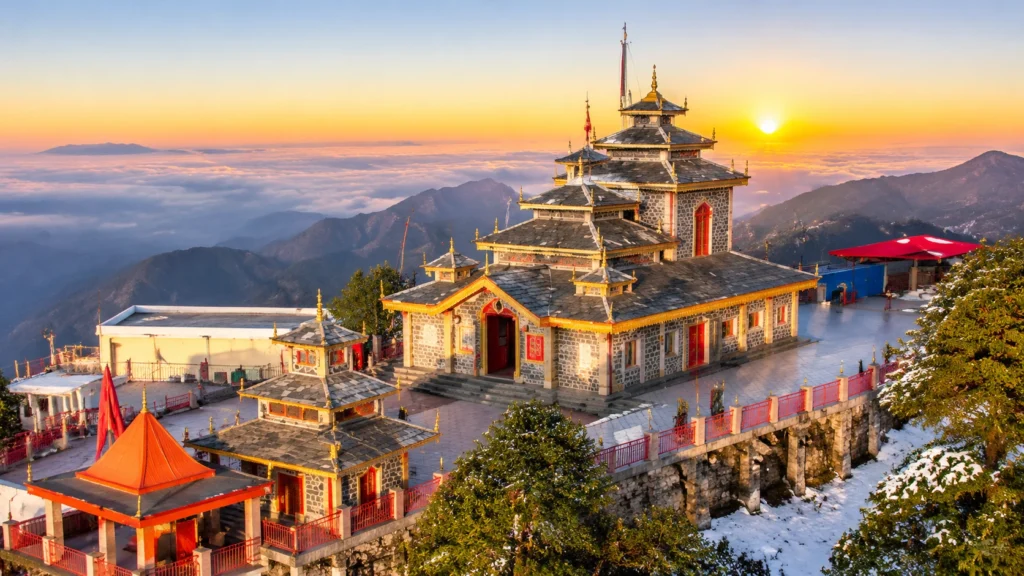
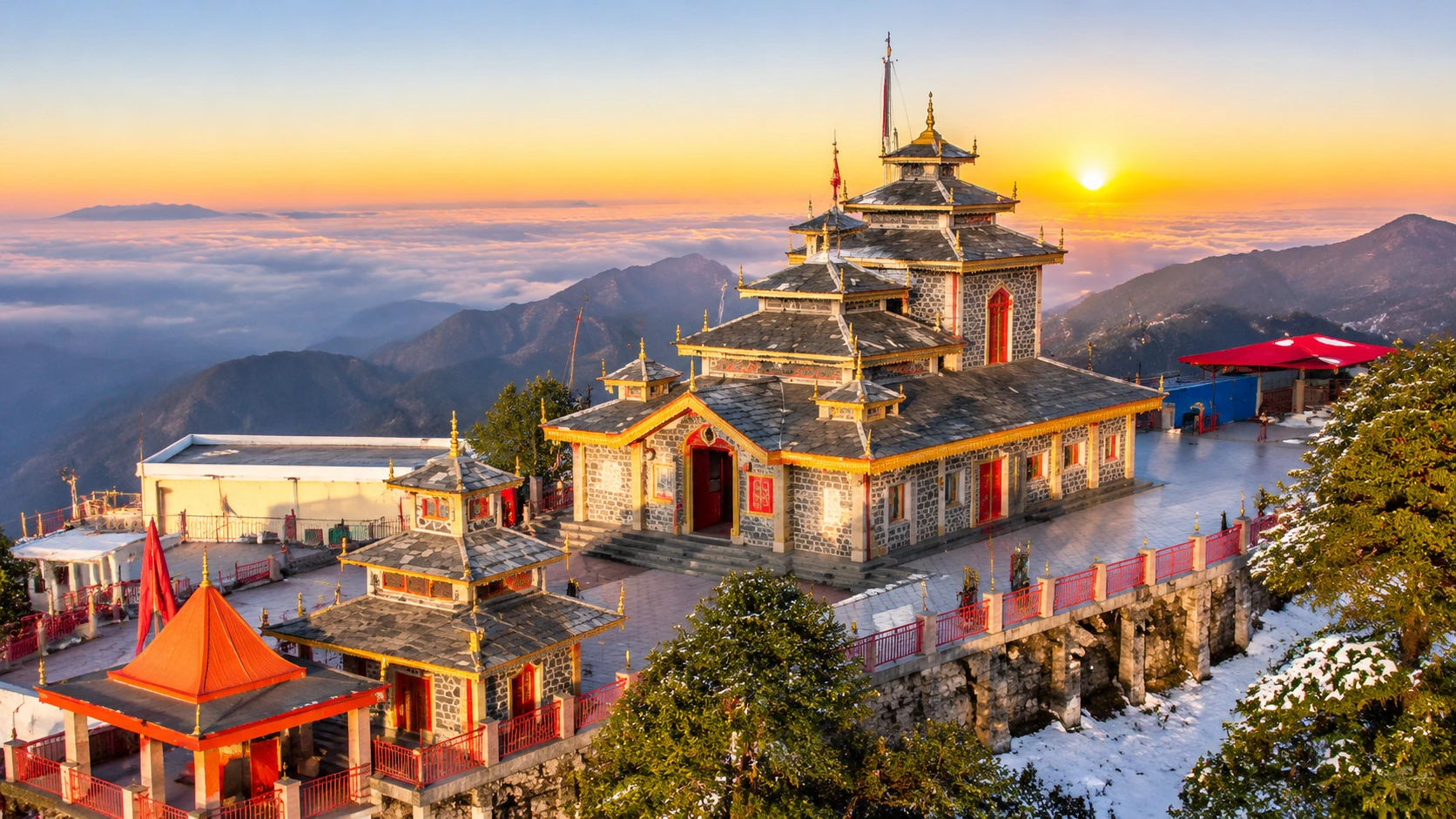
The road from Mussoorie to Dhanaulti winds through deodar forest until it reaches a roadside settlement called Kaddukhal. A flight of steps leaves the tarmac there and disappears into the trees. At the top, about 45 minutes later, a small red-and-white shrine sits on a bare summit with the Himalaya laid out in front of it. That is the Surkanda Devi Temple, one of the most striking hill shrines in Uttarakhand, and it can be done in half a day from Mussoorie.
This article gives you the numbers first, then the story, the walk, the ropeway and the practical details. Where sources disagree, it says so.
On the Signboard: Quick Facts
| Detail | What to know |
|---|---|
| Location | Kaddukhal, near Dhanaulti, Tehri Garhwal, Uttarakhand |
| Altitude | About 2,750 metres (roughly 9,000 feet) |
| Climb | About 2.5 km on foot from Kaddukhal, taking 45 to 60 minutes |
| Ropeway | About 502 metres, a ride of roughly five minutes |
| Deity | Surkanda Devi, a form of Shakti |
| Big festival | Ganga Dussehra, in May or June |
| Best season | April to June and September to November |
The Surkanda Devi Story: Where the Head Fell
The best-known Surkanda Devi story is part of the Sati legend. Sati, the daughter of King Daksha, died in the sacrificial fire after her father insulted her husband Shiva. Shiva, overcome with grief, carried her body across the heavens, and Vishnu used his Sudarshan Chakra to divide it so that the world could be restored to balance. The places where the parts fell became the Shakti Peethas, and the head is said to have fallen on this summit.
The name records the event. It comes from Sirkanda, often explained as “where the head fell,” and over time it became Surkanda. The temple boards give this derivation, and the Tehri district administration notes the same change from “Sirkhanda.”
A local tale adds a human touch. According to one account, a villager named Anand Singh Rawat of Jadipani was gathering ringal bamboo when he found a stone idol. It became too heavy to lift until he carried it to the summit, following the instruction the Goddess gave him in a vision. That is tradition, not documented history, but it explains why locals feel the shrine chose its own place. Local belief also lists the shrine among the three Siddhpeeths of the region, together with Kunjapuri and Chandrabadani.
Surkanda Devi Temple Height and What You See From It
Sources give slightly different figures for the Surkanda Devi temple height. The Tehri district administration and several guides give about 2,750 metres (roughly 9,022 feet), and Wikipedia gives about 2,756 metres. One travel article says about 3,000 metres, and a Dehradun district listing says 3,030 metres. The most consistent figure is 2,750 metres, and that is the one used here.
The summit of the Surkanda Devi Temple gives a wide panorama. To the north on clear days you can see the Nanda Devi, Kedarnath, Chaukhamba and Trishul ranges, and to the south the view runs over the Doon Valley towards Rishikesh. If you like that kind of wide view, our Nanda Devi article covers the great peak you may be looking at.
Surkanda Devi Trek or Ropeway?
You have two choices for the last stretch, and they feel very different.
| On Foot | By Ropeway | |
|---|---|---|
| Distance | About 2.5 km (some guides say 1.5 to 2 km) | About 502 metres |
| Time | 45 to 60 minutes | About 5 minutes, plus waiting |
| Cost | Free (ponies cost extra) | About 225 rupees return, per a 2026 guide |
| Best for | Fit visitors who want the forest | Families, older pilgrims, tight schedules |
The Surkanda Devi trek is a steep, paved path through dense forest, and it is shorter than it sounds. The Surkanda Devi temple ropeway was inaugurated on 1 May 2022 as the state tourism department’s first major ropeway project, and it can carry about 500 people an hour. A 2026 guide lists its hours as 8:00 AM to 6:00 PM, with fares of about 225 rupees return and 120 rupees one way. An older source puts the return fare near 500 rupees, so confirm at the ticket counter. Weekends can bring a wait of 20 to 30 minutes, so many visitors walk up and ride down.
Mussoorie to Surkanda Devi Distance
The Mussoorie to Surkanda Devi distance depends on where you measure to, because the road ends at Kaddukhal and the temple is a climb beyond it. Listings put Kaddukhal between 24 and 40 km from Mussoorie, with most guides saying about 34 to 35 km, and the drive usually takes between one and two hours. Dhanaulti is the closest town, about 8 km from the trailhead on the Mussoorie–Chamba road.
Dehradun to Surkanda Devi Distance
The Dehradun to Surkanda Devi distance is about 66 km from Dehradun railway station, according to the Tehri district administration, and it is about 94 km from Jolly Grant Airport. Other sources round these to 67 km and 100 km. Because the route climbs through Mussoorie and Dhanaulti, allow around three hours, plus the climb to the shrine. Buses and shared taxis run towards Mussoorie, and private cabs are the easiest way to reach Kaddukhal.
Surkanda Devi Temple Timings and Darshan
The Surkanda Devi temple timings listed by Incredible India are 5:00 AM to 10:00 PM, and another guide says the temple is open all year. Timings may change on festival days, and the ropeway has its own hours, so plan to reach the base before 9:00 AM. Early mornings are also best for views, because clouds often build by noon.
Locals simply call it the Surkanda Devi Mandir, and the ritual is simple. Pilgrims offer flowers, coconuts and sweets, ring the bell and take darshan of the goddess. The architecture is plain, a small pagoda-style stone temple painted in red and white, and its charm comes from the setting, not the carving. The temple may be crowded during Navratri, held in October, so go on a weekday if you prefer quiet.
Festivals: Ganga Dussehra and Navratri
The biggest event at the Surkanda Devi Temple is the fair at Ganga Dussehra, held every year in May or June, when pilgrims climb to the summit in large numbers. Navratri in October is the other peak period, and both add spiritual energy and heavy crowds. If you want atmosphere, book accommodation early and start the climb at dawn.
Planning Your Surkanda Devi Temple Visit by Season
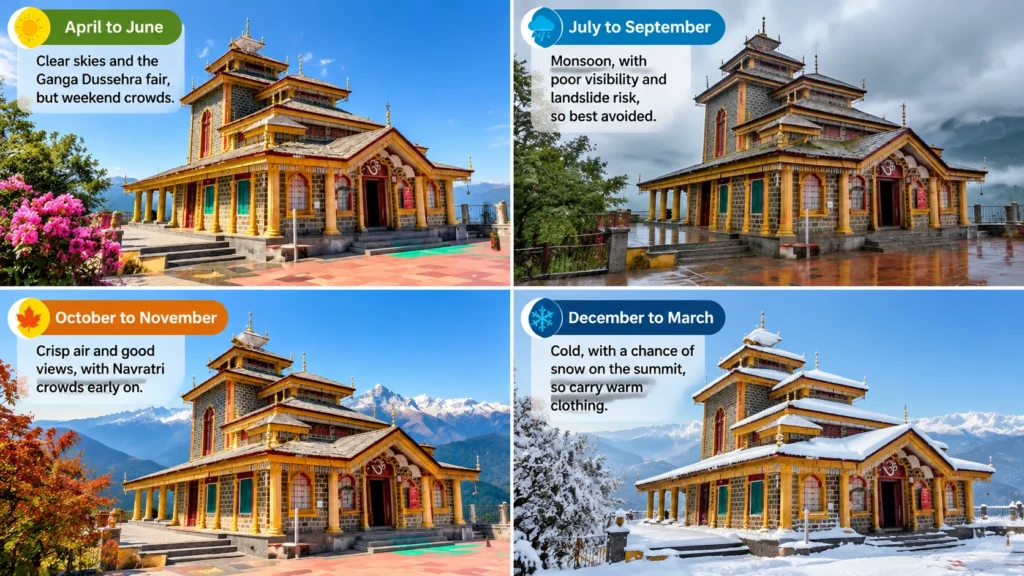
- April to June: Clear skies and the Ganga Dussehra fair, but weekend crowds.
- July to September: Monsoon, with poor visibility and landslide risk, so best avoided.
- October to November: Crisp air and good views, with Navratri crowds early on.
- December to March: Cold, with a chance of snow on the summit, so carry warm clothing.
Five Mistakes to Avoid
- Starting late. Parking at Kaddukhal fills up and the ropeway queue grows after 9:00 AM.
- Skipping cash. Many vendors and parking attendants only take cash.
- Wearing smooth soles. The path is paved but steep, and closed shoes with grip help.
- Ignoring the cold. Even in April, the summit is windy.
- Planning only the temple. Dhanaulti’s forests and Mussoorie are right nearby, and our places to visit in Mussoorie guide covers a good two-day plan.
For official information, see the Tehri Garhwal district administration’s page on Surkanda, published by the Government of Uttarakhand.
Frequently Asked Question’s
Where is Surkanda Devi Temple located?
It is at Kaddukhal near Dhanaulti in the Tehri Garhwal district of Uttarakhand, on the Mussoorie–Chamba road.
What is the height of Surkanda Devi Temple?
It stands at about 2,750 metres (roughly 9,022 feet), though some sources give figures up to about 3,000 metres.
How long is the Surkanda Devi trek?
It is about 2.5 km uphill from Kaddukhal, and most walkers take 45 to 60 minutes.
Is there a ropeway to Surkanda Devi Temple?
Yes. A 502-metre ropeway opened in 2022, and the ride takes about five minutes.
What is the Surkanda Devi story?
The temple marks the spot where Sati’s head is said to have fallen, and its name comes from Sirkanda.
What are the Surkanda Devi Temple timings?
Incredible India lists 5:00 AM to 10:00 PM, while the ropeway is listed from 8:00 AM to 6:00 PM, so confirm on the day.
The climb to the Surkanda Devi Temple is short, the shrine is small and the story is old. What stays with most visitors is the moment at the top, when the forest drops away and the whole Himalaya seems to be waiting at the temple’s door.