

Table of Contents
Before dawn in Ujjain, while most of the city is still dark, a line of devotees in plain clothes waits outside a temple gate. Inside, priests are preparing for a ritual that happens nowhere else in quite this way: the lingam is bathed, adorned and covered with sacred ash as the first lamps are lit. This is the Bhasma Aarti at Mahakaleshwar, and it is one of the reasons this shrine has been called the most unusual of all twelve Jyotirlingas.
This guide covers what pilgrims and travellers most often ask about Mahakaleshwar: where the temple stands, the story behind it, its long and turbulent history, what makes the lingam special, and how to plan a visit around the daily schedule.
Where Is Mahakaleshwar Temple
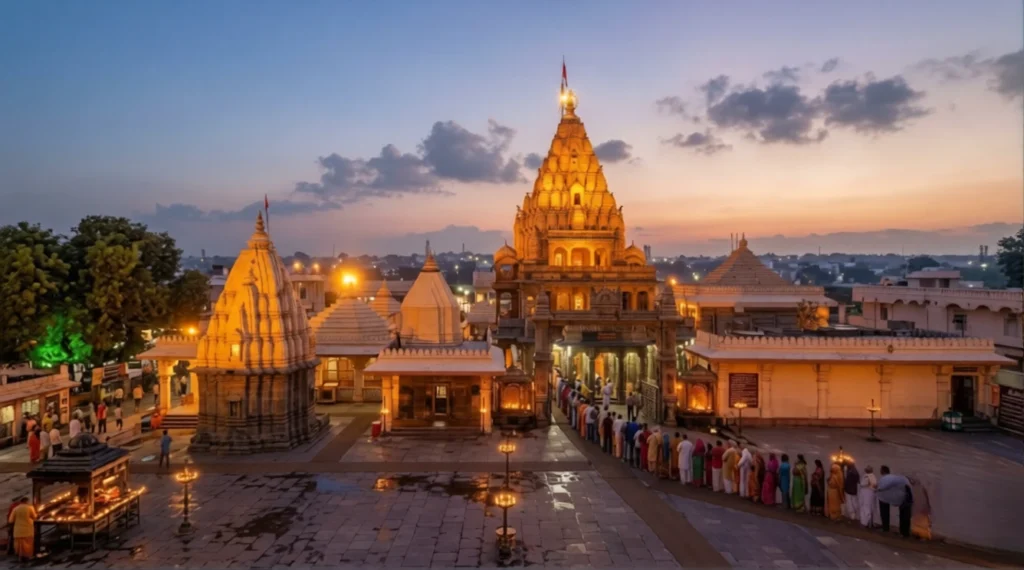
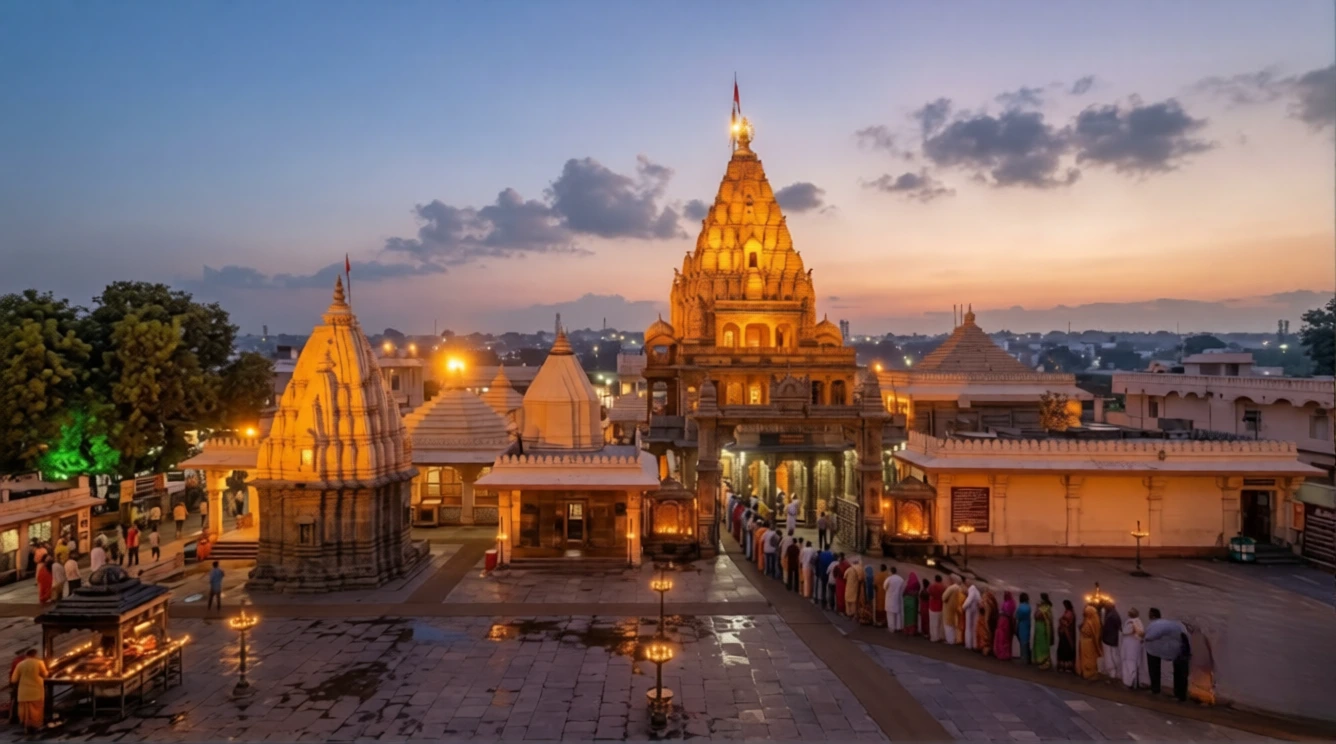
If you are asking where is Mahakaleshwar Temple, the answer is Ujjain, a historic city in the Malwa region of Madhya Pradesh, on the banks of the Shipra (Kshipra) river. The temple stands beside the Rudra Sagar lake in the heart of the old city, and the shrine is part of a larger complex that has grown around it over the centuries.
Getting there is straightforward. Ujjain Junction railway station is only about two kilometres away, and the nearest airport is Devi Ahilyabai Holkar Airport in Indore, around 58 kilometres by road. Taxis, buses and trains run regularly between Indore and Ujjain, so most visitors arrive the day before and stay in the city. The Varaha Purana is cited as placing the earth’s central point at Ujjain, and the city’s old role as a centre of astronomy and time-keeping makes the idea feel fitting for a temple dedicated to Lord Shiva as the master of time.
The Mahakaleshwar Story: A Boy, a King and a Demon
The best-known Mahakaleshwar story takes place in ancient Ujjain, when the city was ruled by King Chandrasena, a devoted worshipper of Shiva. Enemy kings, helped by a demon named Dushan, attacked the city, and the people had no means to defend themselves. Two devotees, a young boy named Shrikhar and a priest named Vridhi, prayed to Shiva for protection.
Shiva appeared as Mahakala, the fierce form that destroys evil, and defeated the attackers. When the devotees asked him to stay and guard the city for ever, he agreed, and the lingam that rose in Ujjain became the Shri Mahakaleshwar Jyotirlinga. The name itself means “Lord of Time and Death,” which explains why people visit to ask for protection from untimely death and for a long life.
There are variations of the tale, including versions in which the demon is destroyed along with other asuras, but all of them share the idea that Shiva chose to live here as Ujjain’s protector.
Mahakaleshwar Temple History
The long Mahakaleshwar Temple history stretches across more than two thousand years. Puranic accounts credit Prajapita Brahma with founding the shrine, and historians note that the temple was already established by the 6th century BC, when a ruler named Chanda Pradyota is said to have appointed a prince, Kumarasena, to look after it. Punch-marked coins from Ujjain, dating to the 4th and 3rd centuries BC, show Shiva, which suggests the deity’s importance was long recognised.
The temple was reconstructed in the 12th century by rulers such as Udayaditya and Naravarman, but its worst blow came in the 13th century. In 1234 to 1235, the Delhi sultan Iltutmish attacked Ujjain and destroyed the temple complex. Later rulers, including the Khaljis, attacked it again, and for centuries the shrine was damaged and reduced.
Its revival began in the 18th century under the Marathas. Ranoji Shinde, a commander serving under Peshwa Bajirao I, took control of Ujjain, and his minister, Ramachandra Baba Sukthankar, is widely credited with rebuilding the temple around the 1730s. The structure standing today largely reflects that Maratha-era rebuilding, with later additions.
Why This Jyotirlinga Is Different
Many temples claim a unique feature, but Mahakaleshwar has several that are well documented:
- It faces south. The idol is Dakshinamurti, or dakshinamukhi, and it is considered the only south-facing lingam among the twelve Jyotirlingas. South is the direction associated with Yama, the god of death, which links the shrine to Shiva’s role as conqueror of death.
- It is self-manifested. The lingam is regarded as swayambhu, meaning it arose on its own and draws its power from within, rather than from mantras used to install it.
- It has the Bhasma Aarti. The pre-dawn ritual, in which the lingam is decorated with sacred ash, is one of the most distinctive ceremonies in India.
- It has several levels. The temple has five levels, one of them underground.
Other Jyotirlinga pilgrimages in India tell different stories. Our Kashi Vishwanath Temple guide covers another of the twelve, set on the Ganga in Varanasi.
The Bhasma Aarti
The Bhasma Aarti at Mahakaleshwar begins at around 4:00 AM, when the lingam is awakened. It is decorated with a silver crown, a serpent and jewels, and is covered with holy ash. Phones and photography are generally restricted, and dress and conduct rules apply, so it is not a casual sightseeing stop.
Because the number of places is limited, an advance online pass is mandatory, and slots fill weeks or even months ahead, especially around festivals. If you want to attend, book through the official temple channels as early as possible and avoid third-party agents who charge extra. If you cannot get a pass, the regular morning, midday and evening aartis offer a quieter way to see the temple in worship.
Architecture and the Levels of the Temple
The Mahakaleshwar Temple’s design reflects the history of its rebuilding. It blends Maratha, Bhumija and Chalukya influences, with a tall, layered spire rising above the sanctum. The Sabha Mandap and the Garbha Griha, the inner chamber, carry carved figures of deities and scenes from mythology.
The main lingam sits below, while the idol of Omkareshwar is installed in the sanctum above it. On the third storey is Nagchandreshwar, which opens to devotees only once a year, on Nag Panchami. Images of Ganesha, Parvati and Kartikeya are placed around the sanctum, with Nandi to the south.
A few hours’ drive away, Omkareshwar on the Narmada is another of the twelve Jyotirlingas, and our Omkareshwar guide covers it for those planning a longer Madhya Pradesh circuit.
Festivals, Sawari and Mahakal Lok
The calendar at Mahakaleshwar is full. Maha Shivaratri draws huge crowds, with all-night worship and a large fair. During the monsoon months of Shravan and Bhadrapada, the Mahakal Ki Sawari procession carries the deity through the streets of Ujjain to the Shipra ghat, and it is one of the city’s most striking events. Ujjain also hosts the Simhastha Kumbh Mela once every twelve years, with the next one expected in 2028.
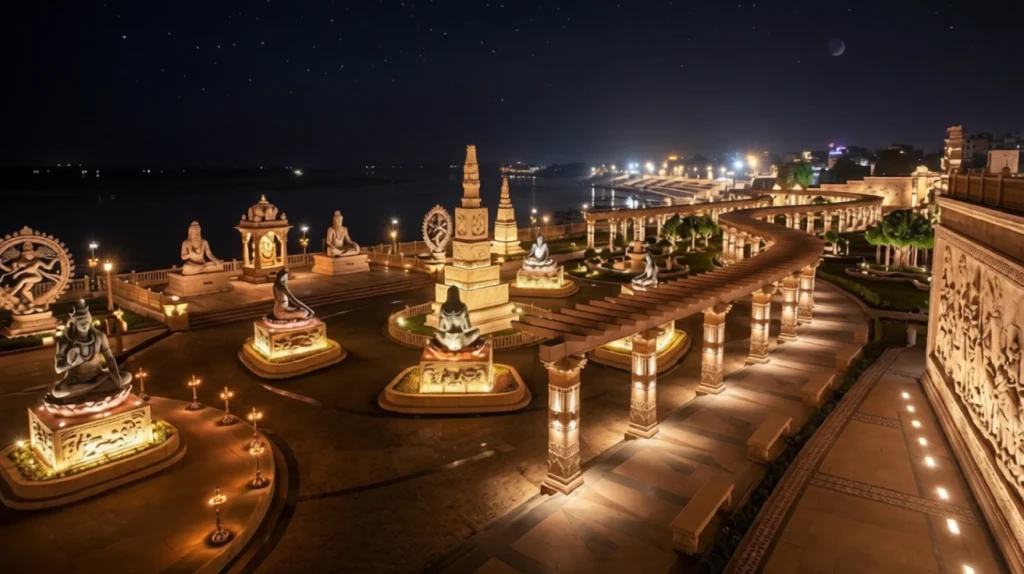
In October 2022, the Mahakal Lok corridor was opened, a large redevelopment that created a walkway, sculptures and lit installations leading to the temple. It has changed how the area looks and increased visitor numbers, though some pilgrims prefer the older, quieter approach.
Timings and Practical Tips
According to Madhya Pradesh Tourism, darshan runs from 4:00 AM to 11:00 PM. Other listings say the gates close slightly earlier, at around 10:00 PM, so confirm the closing time on the day. A typical schedule includes:
- Bhasma Aarti: about 4:00 to 6:00 AM, with an advance pass.
- Morning and midday aarti: around 7:00 and 10:00 AM, open to the general queue.
- Sandhya Aarti: around 5:00 PM, with an advance pass.
- Shayan Aarti: around 10:30 PM, with an advance pass.
Afternoons usually have shorter queues at Mahakaleshwar Temple. Dress modestly for Mahakaleshwar, carry only essentials, and expect security checks. Mobile phones and bags may need to be left in lockers outside, so check the current rules at the gate. Winter and festival periods change timings by up to half an hour. If you are travelling with family, plan at least half a day for the Shri Mahakaleshwar darshan, since queues, security checks and the walk through the corridor all take time. Many visitors combine the visit with the ghats on the Shipra and other temples in the old city, so a two-day stay in Ujjain works well.
The cooler months, from October to March, are the most comfortable, while April to June can be very hot. For official visitor information, see the Madhya Pradesh Tourism page on Mahakaleshwar Temple, the Madhya Pradesh government’s official tourism portal.
Frequently Asked Question’s
Where is Mahakaleshwar Temple located?
It is in Ujjain, Madhya Pradesh, on the banks of the Shipra river, about two kilometres from Ujjain Junction railway station.
Why is Mahakaleshwar special among the twelve Jyotirlingas?
It is the only south-facing Jyotirlinga, it is considered self-manifested and it hosts the pre-dawn Bhasma Aarti.
What is the Mahakaleshwar story?
Shiva appeared as Mahakala to protect Ujjain and King Chandrasena from invaders and a demon, at the prayer of the boy Shrikhar and a priest, and agreed to stay in the city for ever.
What are the Mahakaleshwar Temple timings?
Darshan is listed from 4:00 AM to 11:00 PM, though gate timings can differ slightly, so confirm before you go.
Is booking required for the Mahakaleshwar Bhasma Aarti?
Yes. An advance online pass is mandatory, and slots often fill weeks ahead.
Who rebuilt Mahakaleshwar Temple?
The Marathas rebuilt it in the 18th century under Ranoji Shinde, with his minister Ramachandra Baba Sukthankar widely credited.
What stays with most visitors is not a single detail but the rhythm. The temple wakes before sunrise, ends its day close to midnight, and has done so, with interruptions, for over two thousand years. In a country full of ancient shrines, Mahakaleshwar still feels like a place where time is treated with respect.