

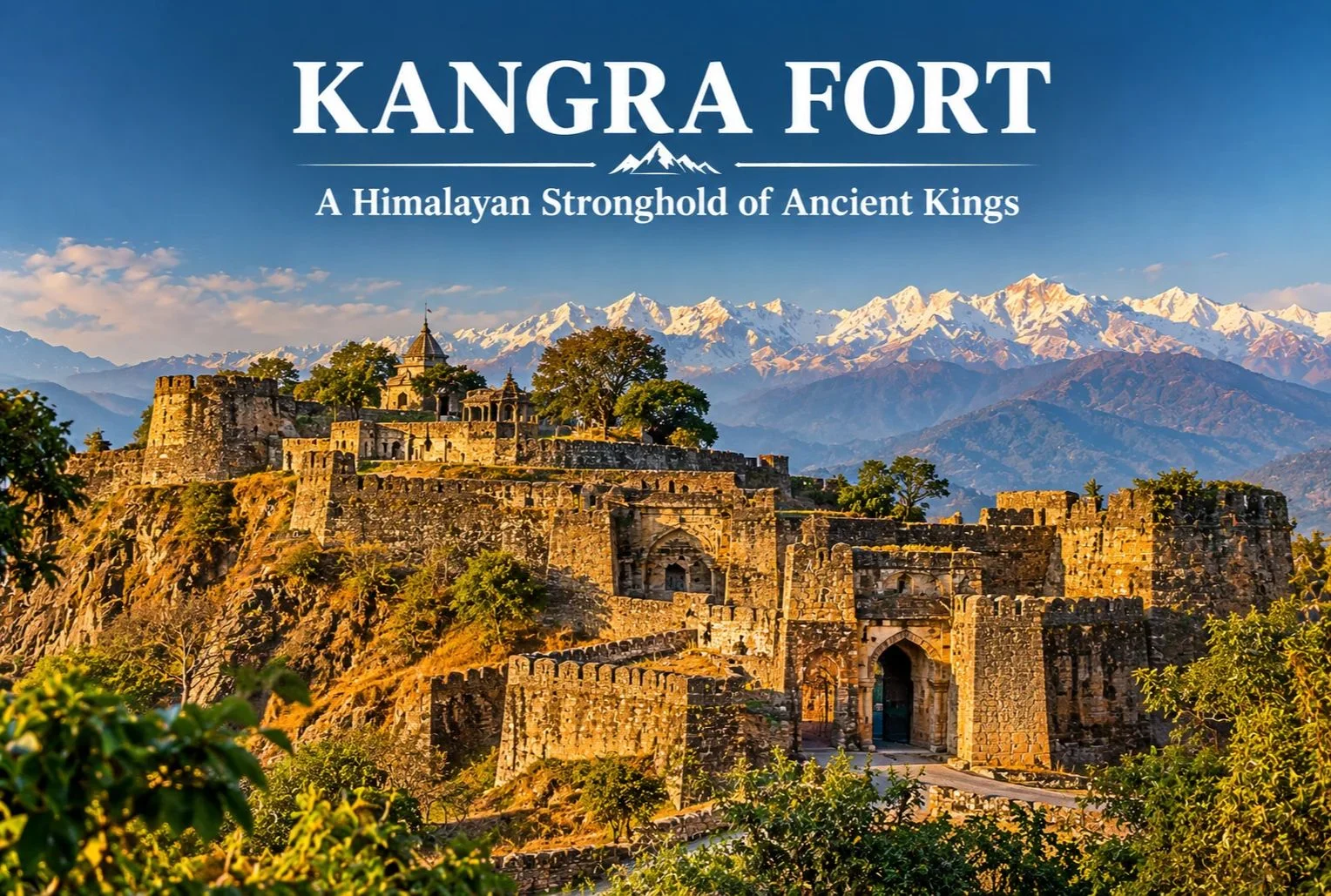
Few forts in India have been attacked, looted, and rebuilt as many times as this one. Perched on a rocky ridge between two rivers, Kangra Fort is among the oldest and most contested strongholds in the Himalayan foothills, and its long record of sieges is a large part of why it still draws history lovers today.
Table of Contents
What Is the Kangra Fort?
The Kangra Fort stands near Kangra town in Himachal Pradesh, on a ridge above the confluence of the Banganga and Majhi rivers, with the snow-capped Dhauladhar range rising behind it. The fort is traditionally linked to the Katoch dynasty, one of the oldest ruling Rajput lineages in India, whose rulers held this commanding position for many generations. The setting made it hard to approach, with steep cliffs on several sides and a long, winding entry path guarded by successive gateways.
Kangra Fort History
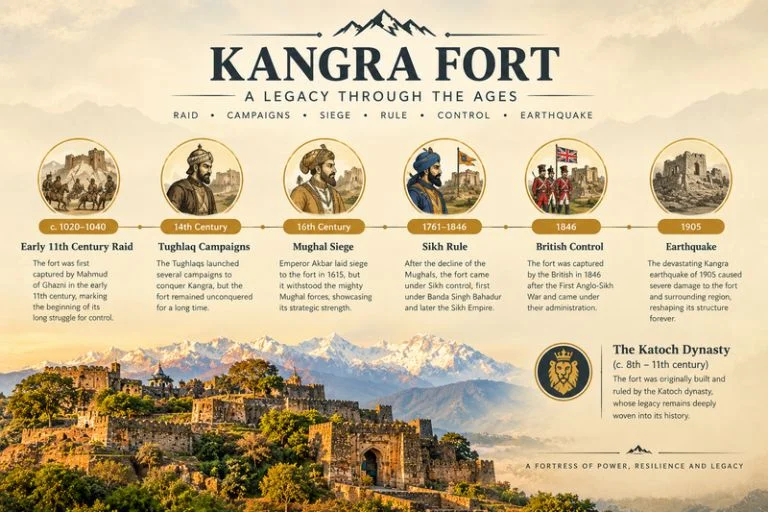
Kangra Fort history stretches across roughly a thousand years of recorded conflict, and traditional accounts place its origins even earlier. Local tradition connects the Katoch lineage to ancient times, though the earliest dates are better treated as tradition than firm record. The fort’s wealth, much of it held in the nearby Brajeshwari Devi Temple, attracted repeated invasions.
- Early 11th century: Mahmud of Ghazni is recorded as raiding the fort and carrying off large amounts of treasure.
- 14th century: Sultans of Delhi, including Muhammad bin Tughluq and later Firoz Shah Tughlaq, campaigned against the fort.
- Mughal era: Akbar’s forces besieged it, and the fort came under Mughal control in the early 17th century under Jahangir after a long siege.
- Early 19th century: Sikh forces under Maharaja Ranjit Singh took the fort, after earlier Gurkha pressure on the region.
- 1846: The British took control following the Anglo-Sikh wars.
- 1905: A major earthquake in the Kangra Valley caused heavy damage to the fort and much of the region.
Exact dates and details vary between sources, so it’s worth checking a museum plaque or a local guide on site for the version they follow.
What You’ll See Inside the Fort
The complex is large, with multiple gateways, bastions, and a series of ruined courtyards and temples spread over the ridge. The entrance runs through a sequence of fortified gates, including the Ahani and Amiri Darwaza, which were designed so attackers had to climb under fire. Higher up, you’ll find old temple remains, water tanks, and the palace area, along with wide views over the valley and the Dhauladhar range. A small museum near the fort displays artifacts and information on the Katoch family and the fort’s past.
Brajeshwari Devi Temple Nearby
Close to the fort in Kangra town, the Brajeshwari Devi Temple is one of the best-known Shakti shrines in the region and was historically a major repository of wealth, which is part of why invaders targeted this area. Many visitors combine the temple and the fort in a single outing.
Best Time to Visit
October to March gives the most comfortable weather for climbing through the fort’s gates and ruins, with clear views of the mountains on good days. Summers can be hot at midday, while the monsoon brings heavy rain that makes the stone paths slippery.
How to Reach the Kangra Fort
By Air
Kangra (Gaggal) Airport is the nearest airport, roughly 10-15 km from Kangra town, with limited flight connections.
By Train
The narrow-gauge Kangra Valley railway serves Kangra, and Pathankot is the main broad-gauge railhead, a few hours away by road.
By Road
Kangra town is well connected by road to Dharamshala (roughly 20 km) and Pathankot, with regular buses and taxis. Please confirm current distances and timings locally before you travel.
Combining the Fort With Other Trips
Since Kangra sits close to Dharamshala and McLeod Ganj, it fits easily into a wider Dhauladhar itinerary. Explore Hills’ Triund Trek is a popular short trek from the same area, and the Kareri Lake Trek adds a quieter alpine lake route in the Kangra Valley for trekkers who want more time in the mountains.
For current opening hours, entry details, and visitor guidance, you can refer to the Himachal Pradesh Tourism Department, the state government’s official tourism body.
What to Keep in Mind Before Visiting
- Wear sturdy shoes, since the climb has uneven stone steps
- Carry water and sun protection, especially outside winter
- Allow two to three hours to walk the complex at a relaxed pace
- Check timings and ticket details locally, as they can change
Conclusion
The Kangra Fort rewards visitors who enjoy reading a landscape for its past. Between its long history of sieges, its dramatic ridge-top setting, and the mountain views behind it, it stands out as one of the most rewarding heritage stops in the Kangra Valley, and it pairs easily with the temples and trails around Dharamshala.
Frequently Asked Questions
Where is the Kangra Fort located?
The Kangra Fort is in the Kangra district of Himachal Pradesh, on a ridge near Kangra town, roughly 20 km from Dharamshala.
What is Kangra Fort history in brief?
Kangra Fort’s history covers about a thousand years of sieges, with Mahmud of Ghazni, Delhi sultans, the Mughals, the Sikhs, and the British all connected to its story.
Which dynasty is linked to the Kangra Fort?
The fort is traditionally associated with the Katoch dynasty, one of the oldest Rajput ruling families in India.
What is the best time to visit the Kangra Fort?
October to March offers the most comfortable weather for exploring the fort and enjoying views of the Dhauladhar range.
Can I visit the Kangra Fort and Brajeshwari Devi Temple together?
Yes, both are in Kangra town, and most visitors cover them in a single half-day outing.