

Table of Contents
Wait at a quiet forest track near Chilla at 6:30 in the morning and the jungle begins to move. A langur barks a warning, a spotted deer freezes, and then the ground shakes slightly as an elephant herd steps out of the sal trees. This is Rajaji National Park, a forest of Shivalik hills, riverbeds and grassland that lies within an hour or two of Haridwar, Rishikesh and Dehradun, and yet feels a world away from the pilgrim crowds.
This guide covers where Rajaji National Park is, what lives in it, how the safari works, when to go and where to stay. It also points out the places where sources disagree, because the numbers are not always consistent.
At a Glance
| Detail | What to know |
|---|---|
| State | Uttarakhand |
| Districts | Haridwar, Dehradun and Pauri Garhwal |
| Area | About 820 sq km as a national park; about 1,075 sq km as a tiger reserve |
| National park status | 1983 |
| Tiger reserve status | 2015 |
| Day-visit season | 15 November to 15 June |
| Birds | Roughly 315 species |
| Nearest cities | Haridwar, Rishikesh, Dehradun |
Which State Is It In, and How Big Is It?
Many first-time visitors ask the same question: Rajaji National Park is located in which state? The answer is Uttarakhand, where the forest stretches across the Haridwar, Dehradun and Pauri Garhwal districts, along the Shivalik range where the Himalayan foothills meet the Indo-Gangetic plain. The Ganga flows through it and divides the forest into a western part (the old Rajaji and Motichur sanctuaries) and an eastern part (Chilla).
The area is quoted slightly differently by different pages. Wikipedia gives about 820.5 sq km, the figure used for the national park itself. The official Rajaji Tiger Reserve page lists 820.42 sq km, with 255.63 sq km of buffer forest added in 2015, which brings the tiger reserve to about 1,075 sq km. In other words, the numbers are not in conflict. They simply measure two different boundaries.
A Short History
Rajaji National Park began as a sanctuary in 1948, and in 1983 the Rajaji, Motichur and Chilla sanctuaries were merged to form the national park. It is widely reported that the park carries the name of the statesman C. Rajagopalachari, though the Wikipedia page does not state this, so treat it as common attribution rather than a documented fact here. Tiger reserve status followed in 2015, and the added buffer forest improved protection for the animals that roam between the foothills and the river.
The Elephant Is the Star
Rajaji National Park is famous for which animal? The answer is the Asian elephant. Herds move through the park all year, using the riverbeds and the corridors between the eastern and western halves. The reserve’s official page lists elephants and tigers as its largest populations. Population counts vary by survey year and by source, so this article does not quote a single number.
Alongside them live leopards, sloth bears, Himalayan black bears, sambar, chital, wild boar and several snake and reptile species. Roughly 315 species of birds have been recorded, and the riverside forest rewards patient binocular work. Tigers are present in Rajaji National Park, but they are rarely seen on a short drive, so go for the elephants and treat a tiger as a bonus.
The Jungle Safari: Zones, Timings and Fees
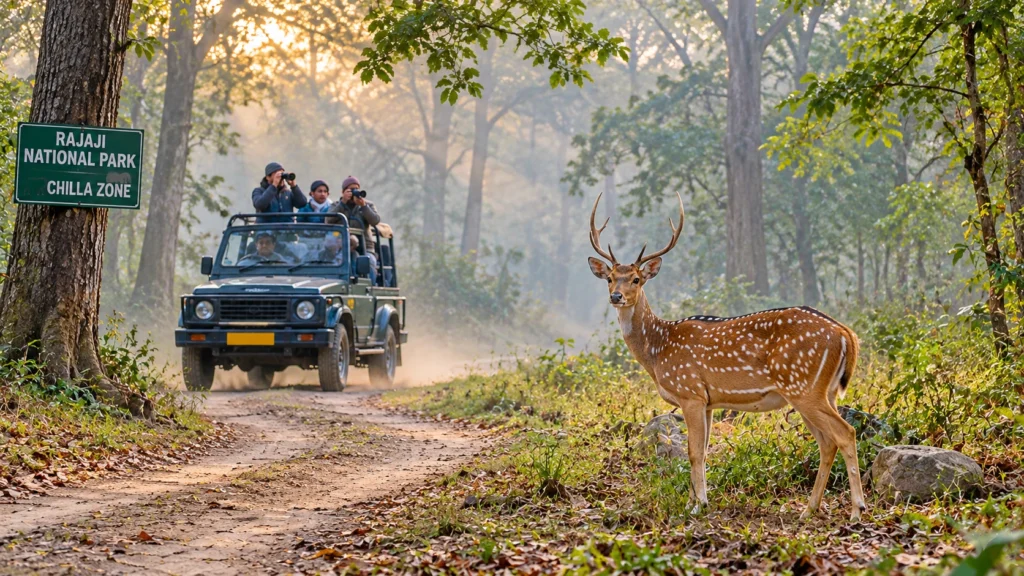
A Rajaji National Park jungle safari is a jeep ride of two to three hours, and each vehicle usually carries six or seven adults. The Chilla zone, near Haridwar, is the most popular, and Motichur is another well-known gate. Sources disagree on the full list. One guide names Chilla, Motichur, Haridwar, Ramgarh and Chillawali/Mohand, with Gohari and Jhilmil as special zones, while the official page simply says there are five zones. Ranipur and Kunao are mainly forest rest-house locations rather than standard safari gates.
Rajaji National Park timings depend on the season, and one third-party guide lists these gate-entry windows:
| Season | Morning entry | Afternoon entry |
|---|---|---|
| 15 Nov to 15 Feb | 6:30 to 8:00 AM | 1:30 to 3:00 PM |
| 16 Feb to 15 Apr | 6:00 to 7:30 AM | 2:00 to 3:30 PM |
| 16 Apr to 15 Jun | 5:30 to 7:00 AM | 3:00 to 4:30 PM |
The official page gives a simpler window of 6 to 10 AM and 2 to 6 PM, so confirm the schedule with the forest office before you travel. Reach the gate about 20 minutes before the last entry time, since late arrivals are turned back. The listed fee is 150 rupees per Indian visitor and 600 rupees per foreigner, plus a vehicle charge of about 250 rupees and an online booking fee, according to the guide above. Entry permits are mandatory and safaris are booked zone by zone.
When to Go
Rajaji National Park is open to day visitors from 15 November to 15 June and closed from 16 June to 14 November for the monsoon. Winter mornings are cool and clear, and spring brings dry forest and thirsty animals that gather at the water. Late May and early June are hot, but animal sightings near the riverbeds can be excellent. The Chaurasi Kutia (Beatles Ashram) remains open all year.
Where to Stay
Rajaji National Park resorts and lodges are concentrated around Haridwar and Rishikesh, where private properties offer pool, riverside and cottage-style stays. If you want to stay inside the forest, the Forest Department runs rest houses at Chilla, Motichur, Ranipur and Kunao, and they need advance booking, especially in peak winter. Rishikesh has the widest choice of rooms and is the best base if you want to combine the safari with the Ganga and the yoga ashrams.
From the Foothills to the High Himalaya
A visit to Rajaji National Park is a gentle half-day, so it pairs well with a harder adventure. Dehradun is the starting point for many Uttarakhand treks, and our Kedarkantha trek is a good winter option that begins in the same Doon region. After watching elephants in the sal forest, climbing through snow to a 12,500-foot summit makes a striking contrast. You can compare more routes on our Uttarakhand trek packages page.
Practical Tips
- Book your safari early, because weekend slots fill up in winter.
- Respect the Rajaji National Park rules and wear muted colours, since bright clothing is not helpful in the forest.
- Carry binoculars, water and a light jacket for cold mornings.
- Keep silent and remain seated in the jeep, especially near elephants.
- Check road and permit status on the official site: the Rajaji Tiger Reserve About page is published by the Government of Uttarakhand.
Frequently Asked Question’s
In which state is Rajaji National Park?
It is in Uttarakhand, across the Haridwar, Dehradun and Pauri Garhwal districts.
What is the park famous for?
Rajaji National Park is best known for its Asian elephants, and it also holds tigers, leopards, bears and about 315 bird species.
When is the park open?
Day visits run from 15 November to 15 June, and the park is closed for the monsoon from 16 June to 14 November.
What are the safari timings?
Gate entry is generally in the early morning and mid-afternoon, with exact windows that shift by season, so confirm locally.
How much does a safari cost?
One guide lists 150 rupees per Indian visitor and 600 rupees per foreigner, plus a vehicle and online fee.
Which zone is best for beginners?
Chilla is the most popular and the easiest to reach from Haridwar and Rishikesh.
Come to Rajaji National Park for the elephants and stay for the quiet. The best moments here are the unplanned ones: a herd at a dry riverbed, a peacock in the sal and the long drive back with dust on your boots.