


Not every ancient temple needs mythology to leave visitors stunned — some do it with pure engineering. The Veerabhadra Swamy Temple in Lepakshi, Andhra Pradesh, is one of those rare places where architecture itself has become the main attraction, alongside centuries of devotion to Lord Shiva in his fierce Veerabhadra form.
Table of Contents
Where Is the Veerabhadra Swamy Temple Located?
This temple sits in the small town of Lepakshi in Anantapur district, Andhra Pradesh, roughly 15 km from Hindupur and about 120 km from Bengaluru. Built during the Vijayanagara Empire in the 16th century, it’s often described as one of the finest surviving examples of Vijayanagara-era temple architecture, and it draws history enthusiasts and pilgrims in almost equal numbers.
The Story Behind Sri Veerabhadra Swamy Temple
According to legend, the site takes its name from the moment Lord Rama is said to have told Sita “le pakshi” — meaning “rise, bird” — after finding the wounded vulture Jatayu here following his battle with Ravana in the Ramayana. The Sri Veerabhadra Swamy Temple itself, however, is dedicated to Veerabhadra, the fierce warrior form of Lord Shiva created from his rage after the death of Sati. The temple complex also houses shrines to Shiva, Vishnu, and Durga, making it a broader pilgrimage stop rather than a single-deity shrine.
The Hanging Pillar: Lepakshi’s Famous Mystery
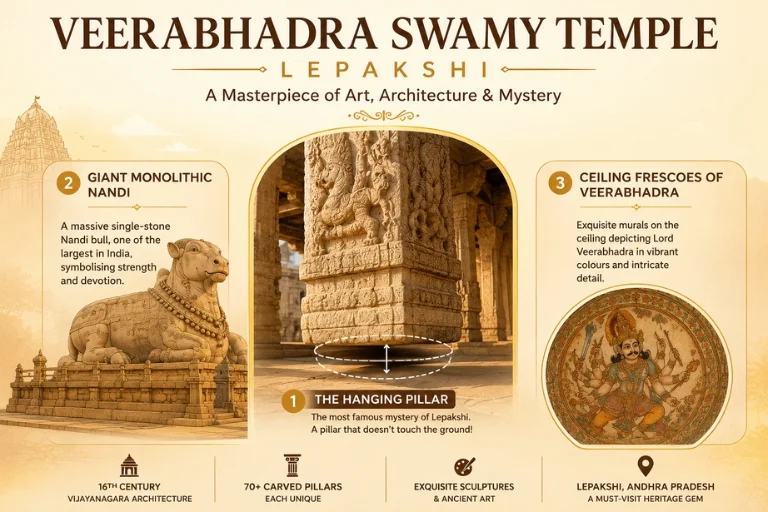
Among the temple’s 70 carved pillars, one doesn’t touch the ground at all — it hangs, suspended just slightly above its base, and generations of visitors have slid objects underneath to prove it isn’t resting on anything. Colonial-era engineers reportedly tried to move it to study the technique and inadvertently shifted it slightly, though it remains standing exactly as it has for centuries. No one has definitively explained how 16th-century builders achieved this level of precision without modern tools.
Other Highlights Inside the Veerabhadra Temple
Beyond the hanging pillar, the Veerabhadra temple complex holds several other remarkable features. A massive monolithic Nandi bull, carved from a single granite block, sits just outside the main complex and is among the largest of its kind in India. Inside, the ceiling above the main shrine features a giant fresco of Veerabhadra himself, considered one of the largest surviving murals from the Vijayanagara period. There’s also an unfinished kalyana mandapam (marriage hall) with intricately carved pillars, believed to have been left incomplete after the sudden fall of the Vijayanagara Empire.
Best Time to Visit
The temple is open year-round, but the most comfortable months to visit are between October and February, when daytime temperatures stay mild. Summers in this part of Andhra Pradesh can get intensely hot, so an early morning visit is generally recommended regardless of season.
How to Reach
The nearest airport is in Bengaluru, roughly a 3-hour drive away, while Hindupur serves as the closest railway station, about 15 km from the temple. Most visitors combine a trip here with a broader South India temple circuit. For travelers who enjoy pairing ancient temple architecture with high-altitude pilgrimage routes, Explore Hills’ Kedarnath Yatra offers a very different but equally compelling temple experience in the Himalayas, and the Char Dham Yatra covers four of Uttarakhand’s most sacred shrines in a single journey.
For official heritage information and conservation details on this site, you can refer to the Archaeological Survey of India, the Government of India body responsible for protecting monuments like this one.
Conclusion
The Veerabhadra Swamy Temple isn’t just another stop on a South India temple trail — it’s a place where 16th-century builders left behind a puzzle that’s never fully been solved. Between the hanging pillar, the giant fresco, and the sheer scale of the carved Nandi outside, it’s a site that rewards slow, unhurried exploration rather than a quick walkthrough.
Frequently Asked Question’s
What is special about the Veerabhadra Swamy Temple?
The temple is best known for its hanging pillar, which appears suspended without touching the ground, along with a massive monolithic Nandi bull and a giant ceiling fresco.
Where is the Sri Veerabhadra Swamy Temple located?
It is located in Lepakshi, Anantapur district, Andhra Pradesh, about 120 km from Bengaluru.
Which deity is worshipped at the Veerabhadra temple?
The temple is primarily dedicated to Veerabhadra, the fierce form of Lord Shiva, though the complex also includes shrines to Vishnu and Durga.
How old is the Veerabhadra Swamy Temple?
The temple dates back to the 16th century, built during the reign of the Vijayanagara Empire.