

Table of Contents
Deep in the Garhwal Himalayas of Uttarakhand lies one of India’s most profound pilgrimage circuits — the Panch Kedar. Woven from mythology, devotion, and breathtaking mountain geography, this journey connects five ancient Shiva temples scattered across remote valleys, alpine meadows, and high-altitude ridgelines. For pilgrims and trekkers alike, completing this yatra is considered one of the most spiritually significant and physically rewarding experiences the Himalayas have to offer.
If you’re planning to take on this circuit, our own Panch Kedar Trek package covers the full route in detail, but before you set out, here’s everything worth knowing about the history, legend, and temples that make up this sacred journey.
What Is Panch Kedar?
The word “Panch” means five, and “Kedar” is another name for Lord Shiva, so Panch Kedar literally translates to the “Five Kedars.” It refers to five ancient Shiva temples located across the Garhwal region — Kedarnath, Tungnath, Rudranath, Madhyamaheshwar, and Kalpeshwar. Together, these five temples are believed to represent different anatomical forms of Lord Shiva, and visiting all of them is considered one of the most sacred pilgrimages a devotee can undertake.
Unlike temples clustered close together, these shrines are spread across remote, high-altitude terrain, most of them accessible only by trekking through forested trails, alpine meadows, and mountain villages. This combination of mythology and geography is what makes the journey feel less like a conventional pilgrimage and more like an immersive Himalayan expedition.
The Legend Behind Panch Kedar
The story behind these sacred temples is rooted in the Mahabharata. After the Kurukshetra war, the Pandavas were burdened with guilt for killing their own kin, including respected elders and teachers. Seeking forgiveness, they set out to find Lord Shiva to seek his blessings and atone for their sins.
Displeased with the Pandavas and reluctant to grant an easy pardon, Shiva is said to have taken the form of a bull (Nandi) and hidden himself in the Garhwal Himalayas to avoid them. As the Pandavas pursued him, Bhima — the second of the five brothers, known for his immense strength — recognised the disguised bull and attempted to hold it back. In the struggle that followed, the bull’s body is believed to have split into five parts, each reappearing in a different location across the mountains.
According to legend, Shiva’s hump appeared at Kedarnath, his arms manifested at Tungnath, his face emerged at Rudranath, his navel surfaced at Madhyamaheshwar, and his hair appeared at Kalpeshwar. At each of these five sites, the Pandavas are believed to have built temples to worship Shiva in these unique forms, giving rise to what we now know as the five Kedars.
The Five Temples
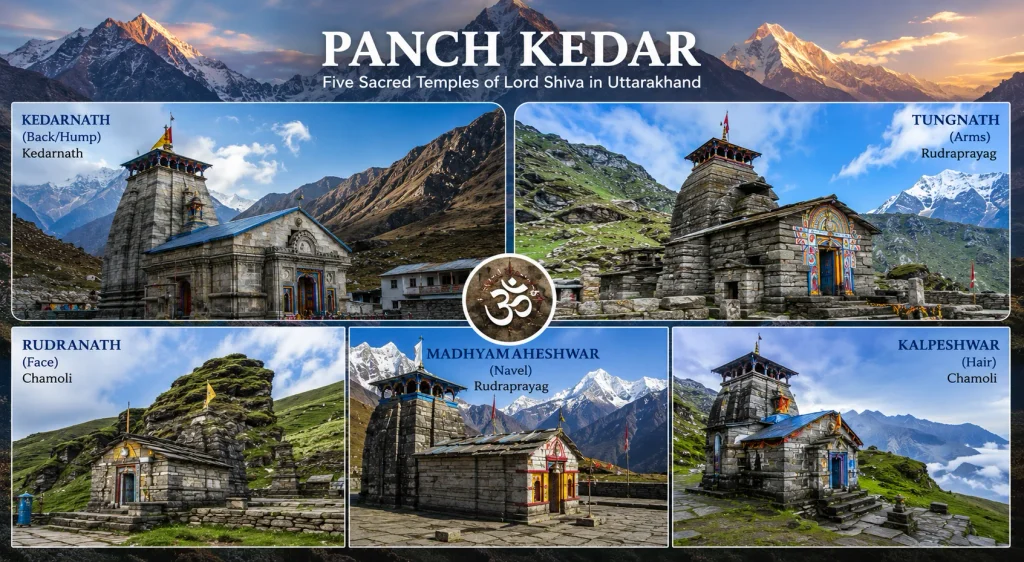
1. Kedarnath (3,583 m) The most important and most visited of the five, Kedarnath is also one of the twelve Jyotirlingas of Lord Shiva. Located in the Rudraprayag district, this temple sees lakhs of pilgrims every year and traditionally marks the starting point of the yatra.
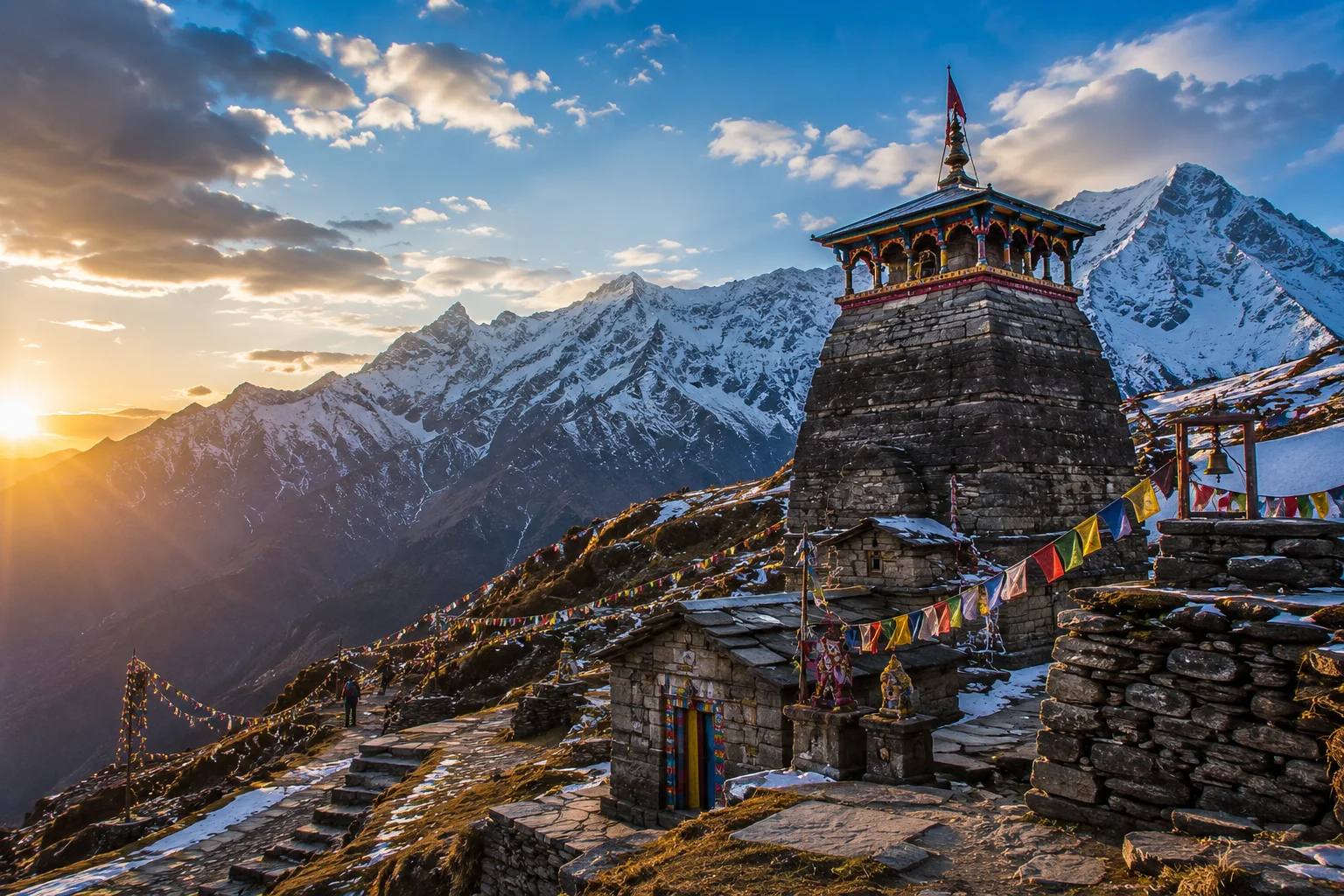
2. Tungnath (3,680 m) Tungnath holds the distinction of being the highest Shiva temple in the world and the third stop in the circuit. Despite its high altitude, it’s reachable via a relatively short 4 km trek from Chopta, making it one of the more accessible temples on the route. It represents the arms of Lord Shiva.
3. Rudranath (2,286 m) Considered one of the most challenging treks in the circuit, Rudranath is a natural rock temple set amid dense forest and alpine terrain, reached via a roughly 20 km trek from Sagar village. It represents Shiva’s face and is surrounded by sacred kunds, including Surya Kund, Chandra Kund, and Manas Kund.
4. Madhyamaheshwar (3,490 m) Representing Shiva’s navel, Madhyamaheshwar sits in a picturesque valley framed by snow-capped peaks like Chaukhamba. The trek here typically begins from Ransi village and spans around 16-18 km through lush meadows, dense forest, and remote mountain hamlets like Gaundhar and Bantoli.
5. Kalpeshwar (2,200 m) Located in the scenic Urgam Valley, Kalpeshwar is unique among the five for being the only one accessible throughout the year, since the others close for winter between roughly December and April. It represents Shiva’s matted hair (jata) and is a natural cave temple.
Panch Kedar Yatra: Route and Order
While there’s no strict rule dictating the sequence, pilgrims traditionally begin this yatra with Kedarnath, followed by Tungnath, Rudranath, Madhyamaheshwar, and finally Kalpeshwar. This order isn’t just a tradition — it also makes practical sense from a trekking and logistics standpoint, as the route roughly follows a geographical progression through the region.
The complete circuit involves well over 100 km of trekking across varying altitudes and terrain, making it a demanding but deeply rewarding journey. Most pilgrims and trekkers spread the yatra across 10 to 14 days, depending on the pace and whether they combine it with additional stops like Chopta or the Chandrashila summit.
For travellers who want a taste of this circuit without committing to the full journey, our Chopta Tungnath Chandrashila Trek is a popular shorter alternative that covers one of the most scenic and accessible temples in the circuit along with a stunning summit trek.
Best Time for Panch Kedar Yatra
The ideal window for the Panch Kedar yatra is between May and June, and again from September to October, avoiding the monsoon months when trails can become slippery and landslide-prone. Kedarnath, Tungnath, Rudranath, and Madhyamaheshwar all close for winter, generally reopening around late April or May, while Kalpeshwar remains open year-round.
Panch Kedar Yatra: Key Points to Know
- Total distance: Over 100 km of cumulative trekking across all five temples
- Difficulty level: Ranges from easy (Tungnath) to challenging (Rudranath)
- Best base towns: Ukhimath, Guptkashi, and Chopta serve as common starting points for different legs of the journey
- Physical preparation: Given the altitude and trekking distances involved, basic fitness and acclimatisation are strongly recommended
- Permits: Local permits and registration may be required at certain points, especially for Kedarnath, so it’s best to check current requirements before departure
For official yatra guidelines, registration details, and travel advisories, you can refer to the Uttarakhand Tourism Department, the state government’s official tourism portal.
Frequently Asked Questions’s
What are the five Panch Kedar temples?
The five Panch Kedar temples are Kedarnath, Tungnath, Rudranath, Madhyamaheshwar, and Kalpeshwar, all located in the Garhwal Himalayas of Uttarakhand.
What is the legend behind Panch Kedar?
According to the Mahabharata, Lord Shiva took the form of a bull to avoid the Pandavas, and when Bhima tried to hold him back, the bull’s body split into five parts that reappeared at five different locations — now worshipped as the Panch Kedar temples.
In what order should the Panch Kedar yatra be done?
While there’s no fixed rule, the traditional order is Kedarnath, followed by Tungnath, Rudranath, Madhyamaheshwar, and finally Kalpeshwar.
Which is the highest temple among the 5 temples?
Tungnath, at approximately 3,680 metres, is the highest of the five temples and is also known as the highest Shiva temple in the world.
Which Panch Kedar temple remains open all year?
Kalpeshwar is the only temple accessible throughout the year, while the other four close for winter.