

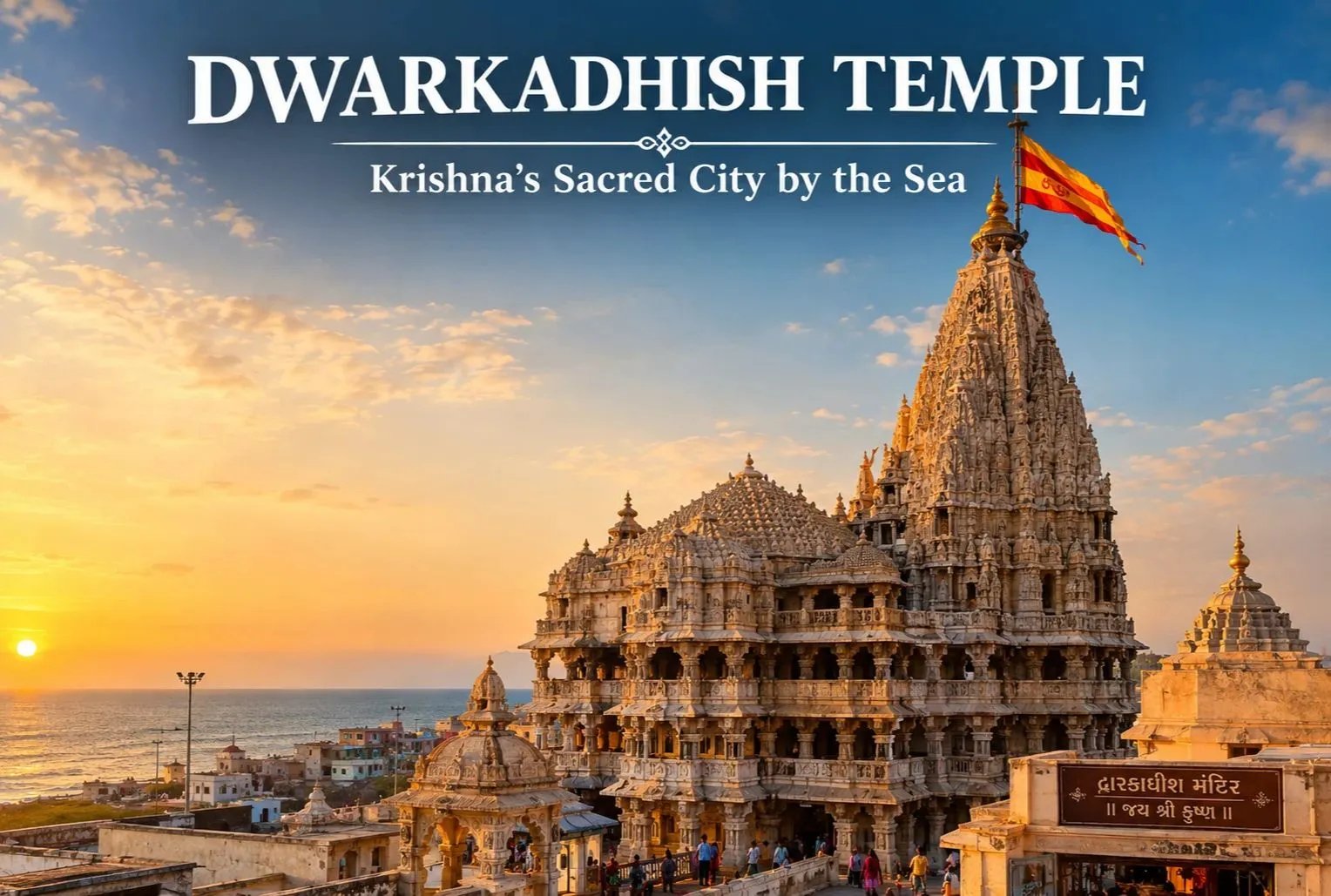
Dwarka, in Gujarat, is a place where faith lives in scriptures: felt in the heart, heard in the temple bells. Here resides the heart of Dwarka, the Jagat Mandir, the Dwarkadhish temple. Dwarkadhish Temple is dedicated to one of the most beloved and widely worshipped deities in Hinduism, Krishna, respected by millions of devotees for his teachings, compassion, wisdom, and divine presence. Dwarkadhish means, the lord of Dwarka, Krishna being the lord of dwarka and a temple dedicated to him explains everything to us. Dwarka, the legendary capital that lies under the water in Arabian sea, was established by Lord Krishna, after he left Mathura.
It is believed that when lord Krishna was departing the world, the dwarka city submerged beneath the sea. The ancient town beside Dwarka however remains above the water on the Gujarat coast and is the most famous pilgrim site among the devotees. For pilgrims planning a broader Krishna and Char Dham circuit across India, Explore Hills’ Char Dham Yatra covers four of Uttarakhand’s most significant Himalayan shrines as a separate but equally revered pilgrimage.
Table of Contents
DWARKADHISH TEMPLE: The Architecture
The architectural form of the temple reflects the essence of centuries of faith, religious belief and architectural activity. The temple was built and developed over a period of time rather than being constructed in a single phase. The temple is built on the basic principle but crucially, it is developed to meet the traditional expectations of devotees. The temple has Grabhagrah, the heart of temple where sits our deity, lord Krishna. Pilgrims have to go through Moksha Dwar and Swarg Dwar which are the gates of the temple.
The gates are followed by Mandapas. Mandapas are the halls and gathering spaces where religious activities are held. Pilgrims have to pass through these Mandapas to get to the Grabhgrah where lord Dwarkadhish waits to meet his beloved devotees.
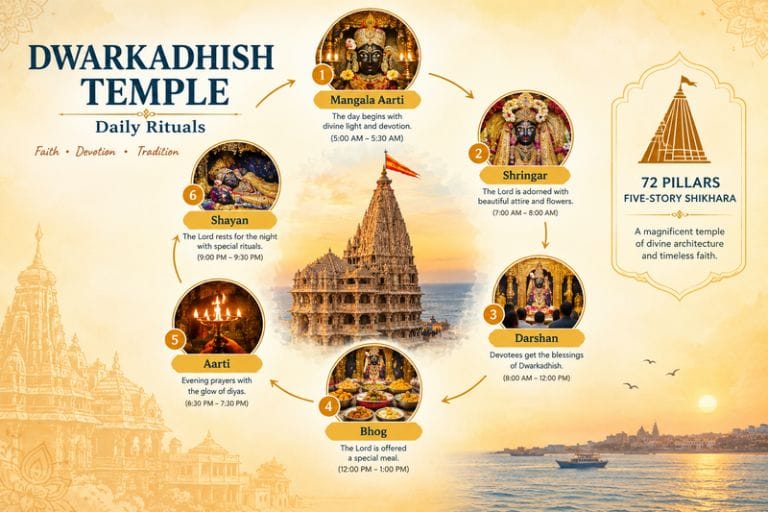
Then comes the shikhara towering the Grabhgrah, it is the architectural element of the temple that marks the inner shrine. The five story shrine is supported by 72 pillars that contribute to the temple’s symmetry, rhythm of the temple.
The Dwarkadhish flag which flies high above the temple towering shikhara, is not just a decorative piece but has a symbolic role in traditions of the temple. The flag not only represents the devotion and divine presence but also defines the victory of dharma.
RELIGIOUS TRADITIONS AND DAILY WORSHIP RITUALS
In dwarkadhish temple, lord Krishna, the king of Dwarka is worshipped. Krishna in dwarkadhish temple is worshipped as a ruler, a protector and a respected king who loved his people.
Krishna is dressed and decorated differently every day and is offered flowers, sweet, offerings and aarti. Clothing, ornaments, flowers, and other offerings can vary according to the particular festival.
The daily ritual of the Dwarkadhish temple traditionally is:
- Mangala Aarti.
- Shringar.
- Darshan.
- Bhog.
- Aarti.
- Shayan.
Mangala Aarti is the early morning worship puja that marks the beginning of the day. Here pujari ji performs a ceremonial offering of lamp which is always accompanied by prayers and devotional singings. In the mangala aarti devotees gather to get the first glimpse of lord Krishna. Mangala Aarti usually takes two hours from aarti to darshan, estimating the timing to be from 6:30am to 8am. After mangala aarti comes Shringar where lord krishan is decorated with beautiful clothing and ornaments which captures the heart of devotees. Pilgrims interested in another major Krishna-linked shrine in North India can also explore Explore Hills’ Yatra Packages collection covering several regional pilgrimage routes.
FESTIVALS CELEBRATED IN DWARKADHISH
Festivals are an important part of life, they bring joy to our lives. Dwarkadhish being the temple dedicated to Krishna, all festivals that include Krishna are celebrated with joy here.
Festivals that are celebrated here are Janmashtami, which is observed as the birthday of lord Krishna. In Janmashtami, the temple is decorated and lord Krishna is also dressed in beautiful dresses and ornaments. At midnight the real celebration begins as it is the time associated with Krishna’s birth. Special prayers and offerings are done, the atmosphere of the temple is pure and devotional.
Then comes Holi which is traditionally marked with Krishna playing in Vrindawan and Braj. People play with flowers and colors. Artists are called to perform an act which is dedicated to lord Krishna. Diwali is also one of the festivals that is celebrated in Dwarkadhish temple. Diwali is said to be the festival of lights. The temple is illuminated with lights and pilgrims visit dwarkadhish and seek blessings from lord Krishna.
Sharad Purnima is an autumn full moon festival. Sharad Purnima is celebrated as it is associated with the Raas leela of Krishna with gopis of vrindawan. Other festivals related to lord Vishnu, lord Krishna and Vaishnava are celebrated in Dwarkadhish as a contribution to their respect.
HOW TO REACH DWARKADHISH
Dwarkadhish is located in Dwarka, Devbhumi Dwarka district, Gujarat which is on the Gomti creek at the western tip of Gujarat in the ancient coastal city of Dwarka in India. The pilgrims can reach dwarkadhish to seek blessings by airways, roadways and railways.
The nearest airport is in Porbandar and Jamnagar which are 95 and 145km away from Dwarka respectively. For official current travel advisories and temple visiting guidelines, pilgrims can refer to the Gujarat Tourism Department, the official state government tourism body.
BEST TIME TO VISIT DWARKADHISH TEMPLE
Dwarkadhish temple is a holy place and the best time to visit lord Krishna is throughout the year. But, for comfortable sightseeing and pilgrimage, it is from November to February.
As July to September is observed to be monsoon hence it may hinder the beautiful sightseeing for the pilgrims. Whereas March to June is summers, which makes the climate hot, therefore during summers pilgrims prefer early morning and evening for exploring the place.
For accommodation, pilgrims have wide options from dharamshala to hotels, whereas food options, they can expect a wide variety of vegetarian restaurants and food vendors. Food options like Gujarati thali, khichdi, roti, sabzi, and farsan are always available for pilgrims.
CONCLUSION
Dwarkadhish temple is one for the Char Dhams of India. It is a magnificent temple with great history connected to spirituality. Whether you want to explore history and architecture, or simply want to experience the peaceful atmosphere of a sacred coastal town, Dwarka has something memorable to offer. Take your time, walk through the streets and its sacred shrine and witness the beautiful morning and evening aarti. Travelers whose pilgrimage circuit includes the Himalayan Char Dham as well can explore Explore Hills’ Kedarnath Yatra, one of the most significant Shiva shrines in the Uttarakhand pilgrimage circuit.
Frequently Asked Questions
Where is Dwarkadhish Temple located?
Dwarka, the legendary capital that lies under the water in Arabian sea, the ancient town beside Dwarka however remains above the water on the Gujarat coast and is the most famous pilgrim site among the devotees. Dwarkadhish is located in Dwarka, Devbhumi Dwarka district, Gujarat which is on the Gomti creek at the western tip of Gujarat in the ancient coastal city of Dwarka in India.
Who built Dwarkadhish Temple?
The Dwarkadhish temple was built by the great grandson of lord Krishna, Vajranabh, over Krishna’s residential palace.
Who is Kuldevi of Dwarkadhish?
The kuldevi of Dwarkadhish, who is called the family goddess of lord Krishna and Yaduvansh lineage is Harsiddhi Mata.
Who ruled Dwarka after Krishna died?
Krishna never ruled Dwarka; he was not the ruler, he was the guardian of administration and protector of the city. Krishna’s maternal grandfather was the ruler of Dwarka, and after the death of Krishna, his great-grandson, Vajranabh, ruled the Yaduvansh. Vajranabh was the king of surviving yaduvansh.
Who found Dwarka underwater?
Dwarka lies underwater in the Arabian Sea, which was excavated in 1983 and 1990 by marine archaeologist Dr. S.R. Rao and the Marine Archaeology Unit of the National Institute of Oceanography (NIO).
Is Lord Krishna’s family still alive?
Lord Krishna’s family, the only survivor of the submergence of Dwarka, was Vajra, whom Arjuna placed on the throne. Lord Krishna’s immediate family and the clan perished at the end of the Dvapara Yuga. The end of the clan was due to mutual infighting and the curse of Gandhari.