

Table of Contents
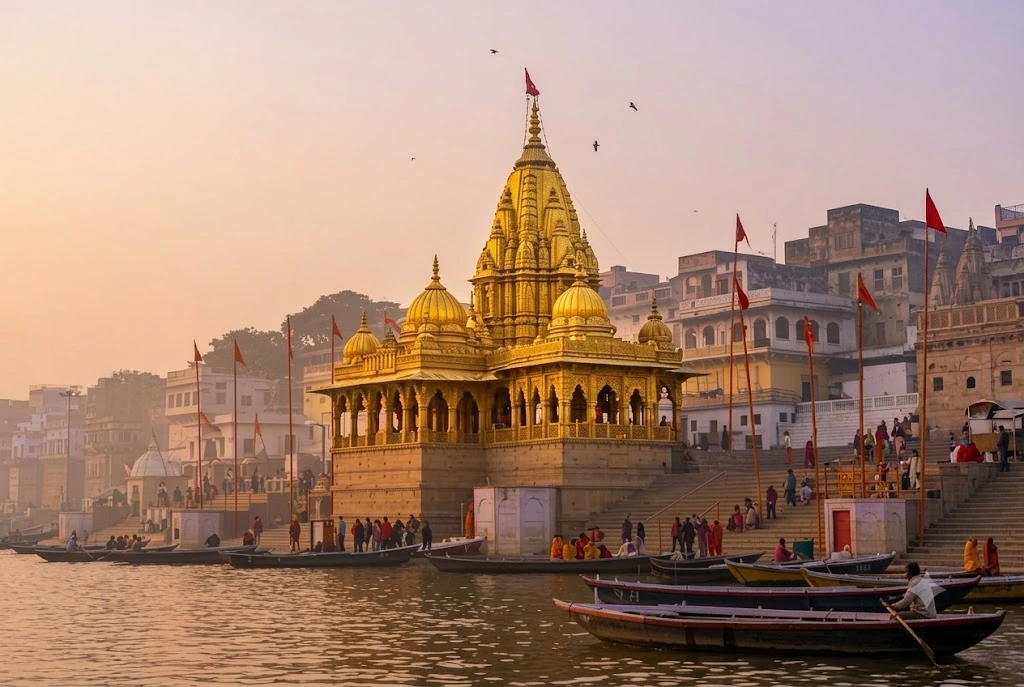
Most ancient temples in India have one construction date worth remembering. Kashi Vishwanath Temple has nearly a dozen. Built, destroyed, rebuilt, destroyed again, and rebuilt once more across eight centuries, the Kashi Vishwanath Temple standing in Varanasi today is less a single structure than the final chapter of a very long argument between devotion and destruction — one that devotion kept winning.
A Timeline of Destruction and Rebirth
Rather than tell this story in flowing prose, it’s worth laying out the Kashi Vishwanath temple story exactly as it happened, because the sheer repetition is the point:
- 1194 CE: The original Adi Vishveshwar Temple is destroyed by Qutb-ud-din Aibak, general of Muhammad Ghori, following the defeat of the Raja of Kannauj.
- 1230 CE: A Gujarati merchant rebuilds the temple during the reign of Sultan Iltutmish of the Slave dynasty.
- 1447–1517 CE: The rebuilt temple is destroyed again, during the rule of either Hussain Shah Sharqi or Sikandar Lodhi, accounts vary.
- 1585 CE: Raja Man Singh I and Raja Todar Mal, both serving under Emperor Akbar, rebuild the temple during a period of relative religious tolerance.
- 1669 CE: Emperor Aurangzeb orders the temple demolished and the Gyanvapi Mosque constructed on the site. According to tradition, the Jyotirlinga itself was hidden in the adjoining well to protect it from destruction.
- 1742 CE: Maratha ruler Malhar Rao Holkar plans to demolish the mosque and reconstruct the temple, though the plan never materialises in his lifetime.
- 1780 CE: Malhar Rao’s daughter-in-law, Maharani Ahilyabai Holkar, builds the current temple structure on a site adjacent to the mosque, using her own personal funds.
- 1835 CE: Maharaja Ranjit Singh of the Sikh Empire donates roughly 800 kilograms to a full tonne of gold to plate the temple’s spire and domes.
- 2021 CE: The Kashi Vishwanath Dham Corridor, a 400-metre walkway connecting the temple directly to the Ganga, is inaugurated by Prime Minister Narendra Modi.
Nine distinct turning points, spanning over 800 years. Few temples anywhere in the world carry a documented history this turbulent, or this consistently resilient — and that history is what makes the Kashi Vishwanath Temple we see today so remarkable.
The Legend Behind the Jyotirlinga
Kashi Vishwanath is counted among the twelve Jyotirlingas, the self-manifested forms of Lord Shiva considered the most sacred sites of Shiva worship in Hinduism. Varanasi itself, known in scripture as Kashi, holds a unique place in this tradition: according to belief, Shiva personally resides in and protects the city, and dying within its boundaries is considered a direct path to moksha, liberation from the cycle of rebirth.
This belief is central to why the Kashi Vishwanath Temple has been rebuilt so many times rather than abandoned after each destruction. For devotees, the sanctity of the site itself was never in question — only the structure standing on it, which could always be rebuilt again. The Skanda Purana references the sanctity of this ground, placing its spiritual importance well before any of the structures recorded in the timeline above were ever built, which is part of why repeated demolition never succeeded in erasing its pull on pilgrims.
What the Temple Looks Like Today
Walk toward the temple complex now and the first thing that registers is scale — not of the shrine itself, which remains relatively compact, but of the corridor and plaza surrounding it. The sanctum sits at the heart of a cluster of smaller shrines, dedicated to deities including Kaal Bhairav, Dandapani, Avimukteshwar, Vishnu, and Vinayaka, each with its own small but devoted following among regular visitors.
The main shrine itself follows a relatively simple layout by the standards of India’s grandest temples: a sanctum housing the Jyotirlinga, approached through a narrow mandapa, with the three golden shikharas rising above. What the structure lacks in architectural flamboyance compared to, say, the temples of Khajuraho or Konark, it makes up for in continuous ritual intensity — this is a temple built for daily use at enormous scale, not for admiration from a distance.
Ahilyabai Holkar: The Queen Who Rebuilt It
If one figure deserves individual credit for the temple as it exists today, it’s Ahilyabai Holkar, the Maratha queen of Indore who ruled for roughly three decades in the late 18th century. Using an estimated sixteen crore rupees of her personal inheritance, she sponsored temple construction and restoration across India — from Kedarnath and Vishnupad in the north to Rameswaram and Somnath in the south.
Her 1780 reconstruction of the Kashi Vishwanath Temple, built deliberately adjacent to the Gyanvapi Mosque on the original site, remains the structure pilgrims visit today. It stands as one of the most significant acts of heritage restoration in Indian history, carried out more than a century after Aurangzeb’s demolition, and it’s a detail worth remembering whenever this temple’s history comes up.
The Golden Domes and the Modern Corridor
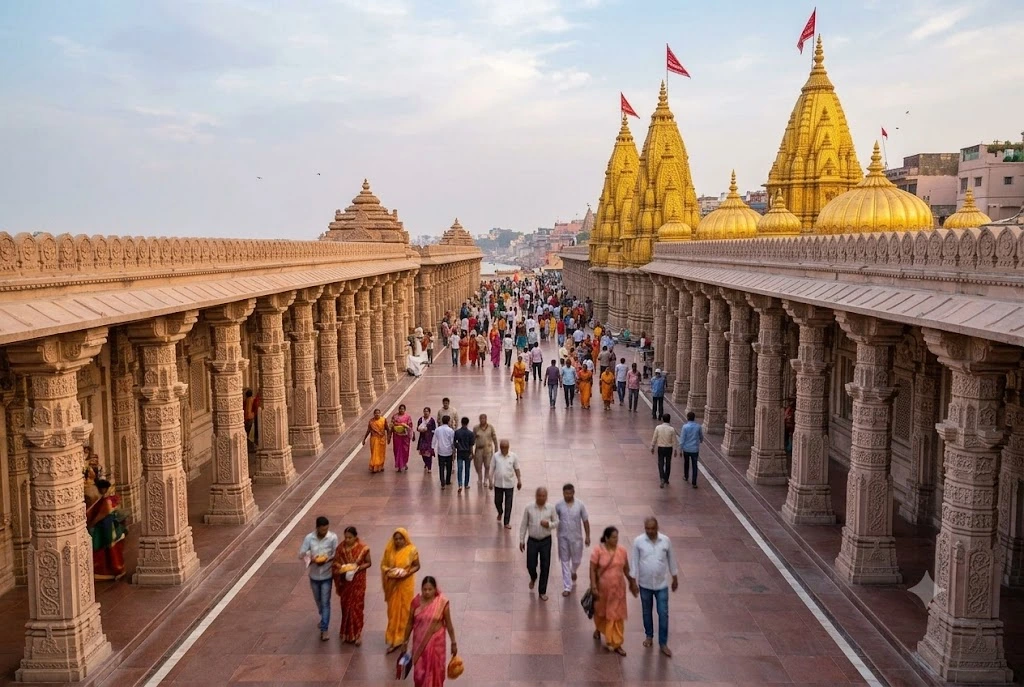
For over a century after Ahilyabai’s reconstruction, the Kashi Vishwanath Temple remained a relatively modest structure. That changed in 1835, when Maharaja Ranjit Singh of Punjab’s Sikh Empire donated a substantial quantity of gold, by most accounts around 800 kilograms, to plate the temple’s shikharas. The resulting golden domes remain the Kashi Vishwanath Temple’s most recognisable visual signature, visible from the Ganga and from much of surrounding Varanasi.
The most recent transformation came in December 2021, with the inauguration of the Kashi Vishwanath Dham Corridor, a sprawling redevelopment spanning roughly five lakh square feet. The corridor created a direct, dignified walkway linking the Kashi Vishwanath Temple to the ghats of the Ganga, replacing the narrow, congested lanes pilgrims previously had to navigate. Visitor numbers rose dramatically following its completion, transforming the daily experience of darshan for millions of pilgrims each year.
Visiting Shri Kashi Vishwanath Temple Today
The Shri Kashi Vishwanath Temple follows an extensive daily schedule built around several aartis. The temple typically opens around 2:30 to 3:00 AM for the Mangala Aarti, with general darshan available through the morning and again in the afternoon and evening, before the Shayan Aarti closes the day around 10:30 PM. Exact windows vary slightly depending on the source and season, so it’s worth checking current timings before you travel.
Several darshan options exist for Kashi Vishwanath Temple pilgrims, ranging from free general darshan to paid Sugam Darshan passes offering faster access, which can be booked through the temple trust’s official channels. Early morning visits, particularly between 4:00 and 7:00 AM on weekdays, tend to offer the shortest queues, while Mondays, the month of Shravan, and Maha Shivratri see the heaviest crowds of the year.
The temple is managed today by the Shri Kashi Vishwanath Temple Trust, established by the Government of Uttar Pradesh, which oversees both daily operations and the broader corridor complex.
Getting to Varanasi
Varanasi is well connected by air, rail, and road, making the Kashi Vishwanath Temple one of the more accessible major pilgrimage sites in India. Lal Bahadur Shastri International Airport sits roughly 26 km from the city centre, with regular domestic flights from Delhi, Mumbai, and other major cities. Varanasi Junction, also known as Varanasi Cantonment, is the main railway station, connected to nearly every corner of the country given the city’s importance as a pilgrimage hub.
From the station or airport, the temple itself sits close to the ghats in the old city, within walking distance of Dashashwamedh Ghat, where the nightly Ganga Aarti draws large crowds of its own. Many pilgrims combine a temple visit with a sunrise boat ride on the Ganga, timing their darshan around the river’s own daily rhythm of bathing, prayer, and cremation rites that have continued along these banks for centuries.
For travellers interested in other major Jyotirlinga pilgrimages, our Kedarnath Yatra package covers another of the twelve sacred Shiva shrines, high in the Himalayas, while our Panch Kedar Trek explores the wider mythology connecting Shiva worship across Uttarakhand’s mountain temples.
For official darshan booking, current timings, and verified updates, refer to the Shri Kashi Vishwanath Temple Trust’s official website.
Frequently Asked Question’s
Who built the Kashi Vishwanath Temple?
The present structure was built in 1780 by Maharani Ahilyabai Holkar of Indore, though the site has been rebuilt multiple times across history, with earlier reconstructions by Raja Man Singh I and Raja Todar Mal in the 16th century.
Why was the Kashi Vishwanath Temple destroyed by Aurangzeb?
In 1669, Emperor Aurangzeb ordered the temple demolished and had the Gyanvapi Mosque constructed on the site, as part of a broader policy of temple destruction during his reign.
What is special about the temple’s golden domes?
In 1835, Maharaja Ranjit Singh of the Sikh Empire donated a substantial quantity of gold to plate the temple’s spire and domes, giving the temple its recognisable golden appearance today.
What is the Kashi Vishwanath Corridor?
Inaugurated in December 2021, it’s a redevelopment project connecting the temple directly to the Ganga via a 400-metre walkway, significantly easing pilgrim access and increasing visitor numbers.
What are the temple’s darshan timings?
The temple generally opens around 2:30 to 3:00 AM for Mangala Aarti and remains open in sessions until around 10:30 PM to 11:00 PM, though timings can shift slightly, so it’s best to confirm before visiting.