

Table of Contents
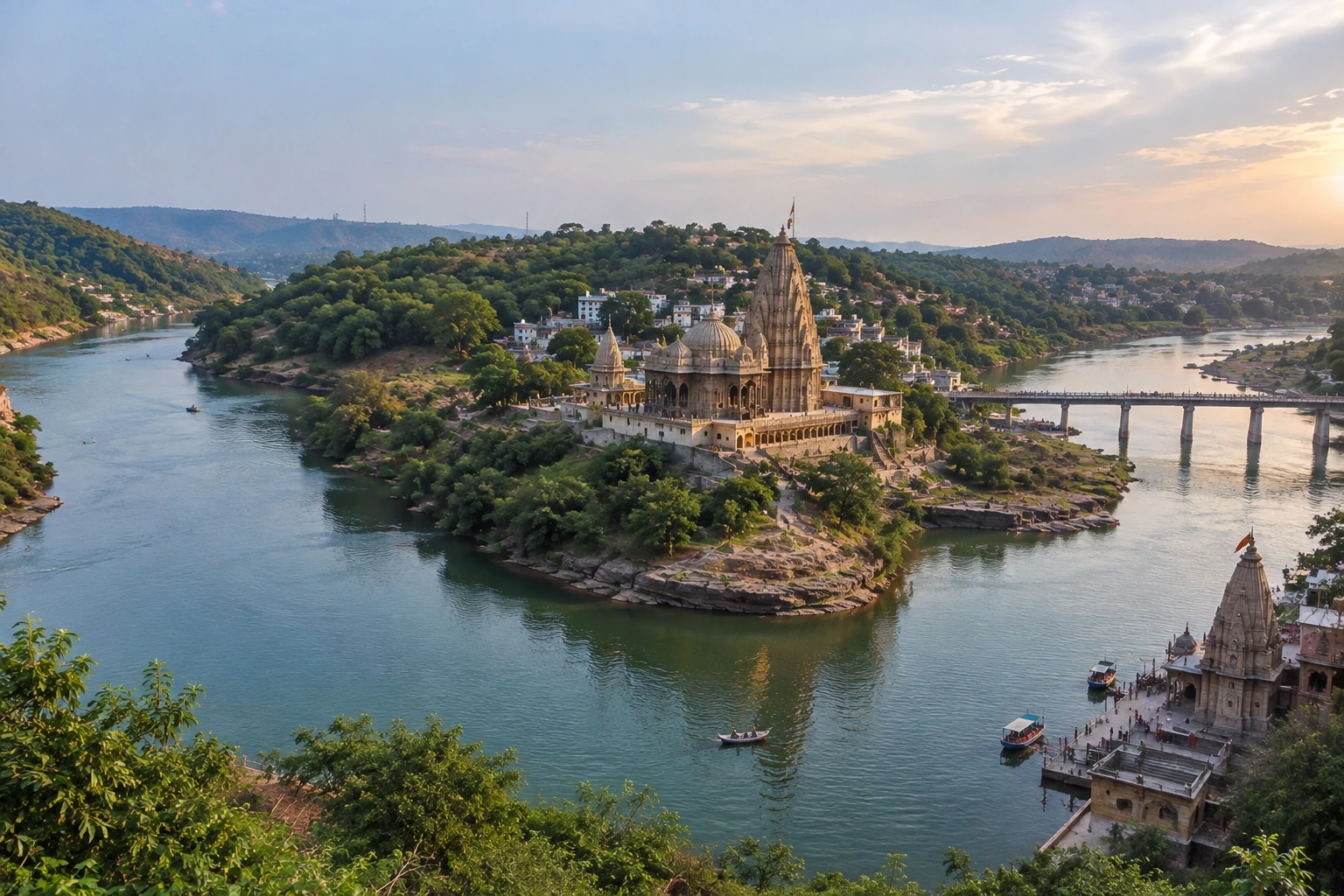
Somewhere between the Vindhya and Satpura ranges, the Narmada River splits in two, wraps itself around a rocky hill, and rejoins downstream. Seen from above, the island it leaves behind looks uncannily like the sacred syllable Om. That island, known as Mandhata or Shivpuri, is home to Omkareshwar, the fourth of India’s twelve Jyotirlingas and one of the most layered pilgrimage sites in Madhya Pradesh. It is a place where mythology, medieval architecture, and the philosophy of Adi Shankaracharya all overlap on a single stretch of riverbank.
This guide draws together the geography, legends, history, and practical details you need, whether you are planning a pilgrimage or a weekend trip from Indore.
Where Is Omkareshwar Temple?
Travellers often ask where is Omkareshwar Temple, since the town and the island are easy to confuse with nearby Maheshwar and Ujjain. The temple stands on Mandhata Island in the Narmada River, in the Khandwa district of western Madhya Pradesh. The nearest major city is Indore, roughly 77 km away by road, or about two and a half hours of driving. Ujjain, home to the Mahakaleshwar Jyotirlinga, lies further north, around three and a half hours away.
The island is formed by two hills separated by a valley, with the Narmada dividing into two channels around it. The Kaveri, a small tributary, joins the main river here, and the confluence is treated as a sacred bathing spot in its own right. The Om shape is visible on maps and aerial images, and it is the source of the place’s name.
Shri Omkareshwar Jyotirlinga Temple: A Shrine in Two Parts
The Shri Omkareshwar Jyotirlinga Temple is counted as the fourth among the twelve Jyotirlingas, the self-manifested “lingams of light” sacred to Lord Shiva. What makes it unusual is that the Jyotirlinga is traditionally understood as being divided between two shrines. One stands on the island itself. The other, called Mamleshwar or Amareshwar, sits on the southern bank of the river on the mainland. Pilgrims are expected to worship at both to complete the darshan, and the traditional route begins at the island shrine before continuing to Mamleshwar.
Inside the sanctum, the lingam is installed on the ground floor and is partly immersed in water. Unusually, it does not sit directly beneath the main spire but slightly to one side, a detail that surprises many first-time visitors.
Legends of the Island
Several stories explain why this hill became sacred. One of the best known concerns King Mandhata of the Ikshvaku dynasty, the same royal line as Lord Rama. He is said to have performed severe penance here to please Shiva, and the hill still carries his name.
A second legend involves the Vindhya mountain. After the sage Narada remarked that Mount Meru was far taller, Vindhya grew distressed and vowed to rise higher. He made a lingam of clay on this island and worshipped it with great devotion. Pleased, Shiva appeared as a Jyotirlinga and granted him a boon. A third account says the Devas, defeated in battle by the Danavas, prayed to Shiva here, and he emerged as Omkareshwar to defeat the demons.
History and Architecture
The present structures date largely to the Paramara dynasty, the dominant Rajput power of the Malwa region between the 9th and early 14th centuries. Later, the Maratha rulers, including the Holkars, supported the temple and helped renew it.
The main temple has five levels, each housing a different form of Shiva. From the ground upward, these are Omkareshwar, Mahakaleshwar, Siddhanath, Gupteshwar, and a flag-bearing deity at the top. Carved pillars, small subsidiary shrines, and shrines to Panchamukhi Ganesha and Annapurna add to the complex. The nearby Siddhanath Temple is one of the older stone structures on the island and is worth visiting for its detailed carving.
Adi Shankaracharya and Ekatma Dham
The island holds special meaning in Advaita Vedanta. Tradition says the young Shankaracharya, having travelled on foot from Kerala, met his teacher Govindapada in a cave here and received instruction. To honour this, the Madhya Pradesh government built Ekatma Dham on Mandhata Hill.
Its centrepiece is the Statue of Oneness, a 108-foot multi-metal figure of Shankaracharya as a boy of about twelve, standing on a 54-foot pedestal. It was unveiled on 21 September 2023 and faces the Narmada. It lies around four kilometres from the main temple, and visiting it is free.
Other Places on the Island
Beyond the main shrines, several stops reward a slower visit:
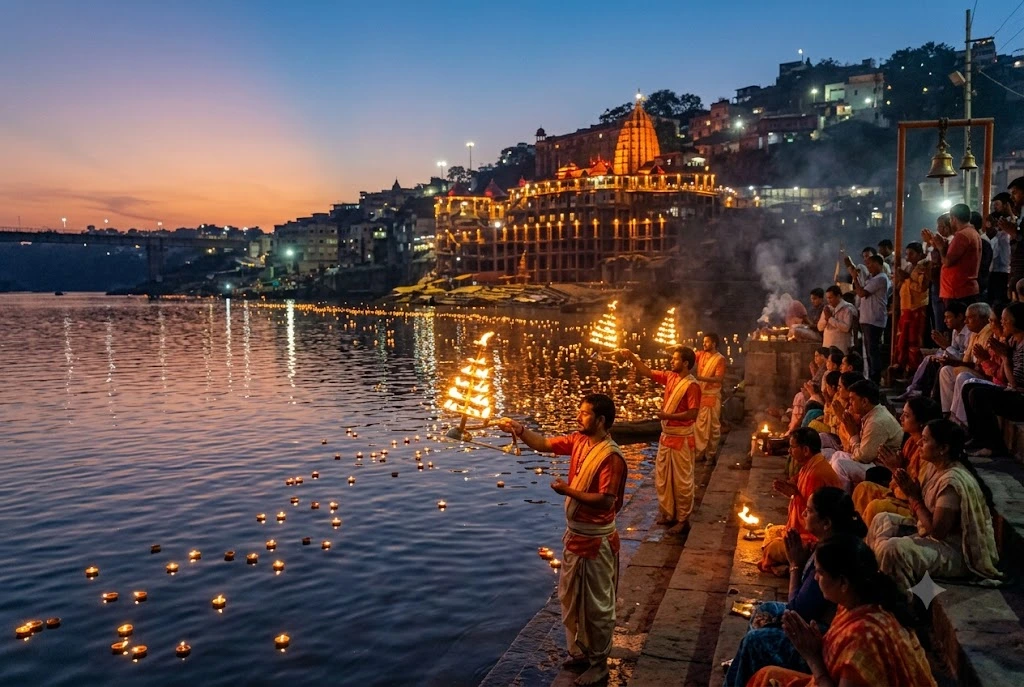
- Kotitirtha Ghat: the main bathing ghat, and the site of the evening Narmada aarti
- Gauri Somnath Temple: a carved shrine holding a large black lingam
- Rin Mukteshwar and Patali Hanuman: smaller shrines along the parikrama route
- Boat ride: a short trip on the river gives the best view of the temples and the confluence
- Suspension bridges: good for sunset views over the ghats
The island also marks the traditional starting point of the Narmada Parikrama, the long circumambulation of the river that devout pilgrims complete on foot over months.
A Note on the Dam
The landscape has changed within living memory. The Omkareshwar Dam was commissioned in 2007, roughly four kilometres downstream, and it raised water levels around the island. The project remains debated locally because of its effect on riverbank settlements and ghats, and visitors will notice the higher water compared with older photographs.
Planning Your Visit
- Darshan timings at Omkareshwar Temple: roughly 5 AM to 10 PM, with breaks between sessions. Exact hours shift on festival days, so confirm at the temple counter
- Entry: general darshan is free; a priority Shighra Darshan pass costs ₹300 per person
- Waiting time: around one to two hours on weekdays, and three to five hours on weekends, Mondays, and festival days
- Best season: October to March. Sawan (July–August) and Mahashivratri are spiritually vibrant but very crowded
- By road: about 77 km from Indore, with buses and taxis available
- By rail: Omkareshwar Road (Mortakka) is the nearest station, about 12 km away
- By air: Devi Ahilyabai Holkar Airport in Indore is the closest
A standard itinerary pairs one day in Ujjain with one day here. For a wider Shiva circuit, our Kedarnath Yatra covers another of the twelve Jyotirlingas high in the Himalayas, while our Char Dham Yatra package offers a broader pilgrimage across Uttarakhand.
For official information on the Ekatma Dham complex and visiting details, see Madhya Pradesh Tourism.
Frequently Asked Question’s
Which Jyotirlinga is Omkareshwar?
It is the fourth of the twelve Jyotirlingas of Lord Shiva.
Why is the island called Omkareshwar?
Its two hills and the split Narmada create a shape resembling the sacred syllable Om.
Are there really two Jyotirlinga shrines?
Yes. The Jyotirlinga is worshipped at the island temple and at Mamleshwar on the southern bank.
How far is it from Indore?
Around 77 km by road, a drive of roughly two and a half hours.
What is the best time to visit?
October to March offers the most comfortable weather for darshan, boat rides, and the parikrama.