



Most Jyotirlinga journeys end at a temple gate. At Bhimashankar, the journey starts in the forest. The temple sits high in the Sahyadri hills, often wrapped in mist during the monsoon, and many pilgrims remember the drive and the greenery as much as the darshan. This guide covers the Bhimashankar Mandir Jyotirlinga, its legend, timings, distances to other Maharashtra shrines, and the practical details you need before you go.
Table of Contents
Where Is Bhimashankar Maharashtra?
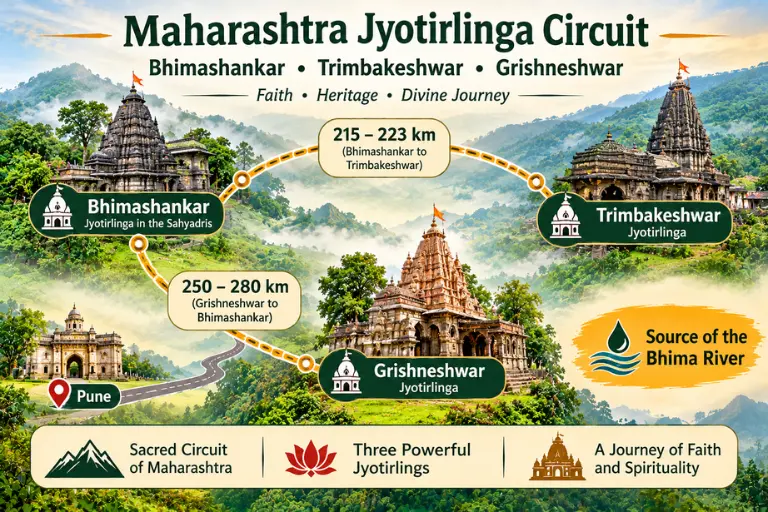
Bhimashankar Maharashtra is in Khed taluka of Pune district, deep in the Sahyadri Ghats. One listing places it at about 3,500 feet above sea level, around 125 km from Pune and 240 km from Mumbai, while others give about 110 km from Pune, so the figure depends on the route. The temple is also the source of the Bhima river, which flows southeast and joins the Krishna river near Raichur.
Bhimashankar Mandir Jyotirlinga Story
The Bhimashankar Mandir Jyotirlinga story comes from the Shiva Purana tradition. According to tradition, Shiva destroyed the demon Bhima here and stayed on as the Jyotirlinga, and the Bhima River rises nearby. Another telling of the legend links the Jyotirlinga to Bhima, the son of Kumbhakarna. Like most Jyotirlinga stories, this is devotional tradition, and versions differ. A few traditions place a Bhimashankar in other regions, but the Maharashtra shrine is the one most widely visited and recognised.
The Temple and Its Architecture
The Bhimashankar Mandir is built in the Nagara-Hemadpanti style, with dark stone, deep carvings, and a single-stone Nandi at the entrance. Its origins are traditionally traced to around the 13th century, though some sources say the 12th century. The sabhamandap and the shikhara were improved in the 18th century by Nana Phadnavis, the Peshwa-era statesman. The result is a modest but graceful temple that combines older and newer sections.
Bhimashankar Mandir Timings
Bhimashankar Mandir timings are listed differently by different sources. One guide gives darshan from 4:30 AM to 9:30 PM with free entry, while another lists 6:00 AM to 6:00 PM. Hours can change on Mondays, during Shravan, and on Maha Shivaratri. Early arrival usually means shorter queues, and please confirm the current schedule with the temple trust or locally before you travel.
Bhimashankar to Trimbakeshwar Distance and Grishneshwar to Bhimashankar Distance
Many pilgrims plan a circuit of three Maharashtra Jyotirlingas: Bhimashankar, Trimbakeshwar near Nashik, and Grishneshwar near Ellora. The Bhimashankar to Trimbakeshwar distance is about 215 km by road to 223 km, roughly 3.5 to 5 hours depending on traffic. The Grishneshwar to Bhimashankar distance is longer, about 250 km by one common route to 280 km, usually a 6 to 7 hour drive. Road distances differ slightly between route planners, so check a live map before you finalise your plan.
| Route | Approximate road distance |
|---|---|
| Pune to Bhimashankar | 110 to 125 km |
| Mumbai to Bhimashankar | about 200 to 240 km |
| Bhimashankar to Trimbakeshwar | about 215 to 223 km |
| Grishneshwar to Bhimashankar | about 250 to 280 km |
The Forest Around the Temple
The temple sits in a forested hill area, and many visitors combine darshan with the trek and wildlife sanctuary around it. Stay on marked paths, avoid plastic, and keep your distance from wildlife. If you plan a forest walk, start early and carry water.
Best Time to Visit
Avoid Shravan Mondays and Maha Shivaratri if you want a peaceful darshan. Guides differ on the season: one says summer or post-monsoon are good times, while another lists June to August, when the forest is greenest. In general, post-monsoon to winter (October to February) is comfortable, while the monsoon is beautiful but can make roads slippery and visibility poor.
How to Reach Bhimashankar
By train: Pune Railway Station is the nearest major station, about 111 km away, with onward travel by taxi or bus.
By air: The nearest airport is Pune International Airport.
By road: One route runs from Pune via Khed (Rajgurunagar) and Manchar, and state buses run from Pune daily, taking several hours.
Extending Your Pilgrimage
If this visit has you thinking about another Jyotirlinga, Explore Hills’ Kedarnath Yatra covers the Himalayan Jyotirlinga in Uttarakhand, and the Panch Kedar Trek links five Shiva shrines for trekkers.
For official visitor information, you can refer to Incredible India’s page on Bhimashankar Temple, the Government of India’s tourism portal.
What to Keep in Mind Before Visiting
- Dress modestly and remove footwear before entering the temple
- Expect long queues on Mondays, during Shravan, and on Maha Shivaratri
- Carry rain protection in the monsoon and drive carefully on ghat roads
- Carry cash and keep valuables secure in crowds
Conclusion
Bhimashankar combines a temple of long tradition with a forest setting that few Jyotirlingas can match. Check the current timings, plan your drive from Pune or Mumbai, and, if you are joining the Maharashtra circuit, use the distances above to pace your days.
Frequently Asked Questions
Where is Bhimashankar Maharashtra located?
It is in Khed taluka of Pune district, in the Sahyadri hills, about 110 to 125 km from Pune.
What are the Bhimashankar Mandir timings?
Listings vary, from about 4:30 AM to 9:30 PM in one guide to 6:00 AM to 6:00 PM in another, so please confirm locally before you travel.
What is the Bhimashankar Jyotirlinga story?
According to tradition, Shiva destroyed the demon Bhima here and stayed on as the Jyotirlinga, and the Bhima river is said to rise nearby.
What is the Bhimashankar to Trimbakeshwar distance?
It is about 215 to 223 km by road, usually 3.5 to 5 hours depending on traffic.
What is the Grishneshwar to Bhimashankar Mandir distance?
It is about 250 to 280 km by road, usually 6 to 7 hours.
When is the best time to visit the Bhimashankar Mandir?
October to February is comfortable, while the monsoon is green but slippery, and Shravan Mondays and Maha Shivaratri are very crowded.
What is the nearest railway station to Bhimashankar?
Pune Railway Station is the nearest major station, about 110 km away.