

Table of Contents
On the quiet banks of the Gomati River, in a valley overshadowed by the more famous peaks of Kumaon, stands a temple that most travellers rush past on their way to Kausani. That’s a shame, because Baijnath Temple holds one of the richest concentrations of history, mythology, and stone artistry in all of Uttarakhand — and it rewards anyone willing to slow down long enough to notice.
This isn’t your typical single-shrine pilgrimage stop. It’s an entire complex, a former royal capital, and, according to legend, the very spot where Shiva and Parvati were married. Let’s walk through what makes Baijnath Temple worth the detour.
At a Glance: Baijnath Temple
- Dedicated to: Vaidyanath, a form of Lord Shiva known as “Lord of Physicians”
- Location: Baijnath town, Bageshwar district, Uttarakhand
- Elevation: Approximately 1,125 metres (3,691 feet)
- Number of shrines: 17 to 18 temples within the complex
- Built by: The Katyuri dynasty
- Architectural style: Nagara
- Protected by: Archaeological Survey of India
The Marriage of Shiva and Parvati
Every great temple has a story, and Baijnath Temple’s is tied directly into one of Hinduism’s most celebrated divine unions. According to local tradition, this is the exact spot where Lord Shiva and Goddess Parvati were married, at the confluence of the Gomati and Garur Ganga rivers. That single detail explains why the site carries such deep emotional weight for pilgrims — this isn’t simply a place to worship Shiva, but a place tied to his most personal moment.
The name itself reflects this connection. “Vaidyanath,” the form of Shiva enshrined here, translates roughly to “Lord of Physicians,” a title that adds a layer of healing symbolism to the site’s already rich mythology.
Baijnath Temple History: A Katyuri Capital
Understanding Baijnath Temple history means understanding the Katyuri dynasty, the rulers who shaped much of Kumaon’s early medieval landscape. Baijnath, once known as Kartikeyapura, served as the capital of the Katyuri kingdom, which governed large parts of present-day Uttarakhand — and at times, stretched into Himachal Pradesh — between roughly the 7th and 13th centuries.
Most sources place the construction of the main Baijnath Temple complex around 1150 CE, credited to a Katyuri king, with some traditions specifically naming King Jaichand. Interestingly, local legend adds a more poetic layer to this history: some accounts credit a Brahmin woman with commissioning the original temple, while others claim the entire complex was built by the Katyuri kings in a single night. Whichever version you prefer, the consistent thread is the deep religious devotion the Katyuris held for Shiva, expressed through architecture across the entire region.
The approach to the temple itself carries its own story — a flight of stone steps leading up from the riverside, said to have been constructed on the orders of a Katyuri queen, still forms the traditional pilgrim’s path to the complex today.
Inside the Complex: Stone, Sculpture, and Sacred Geometry
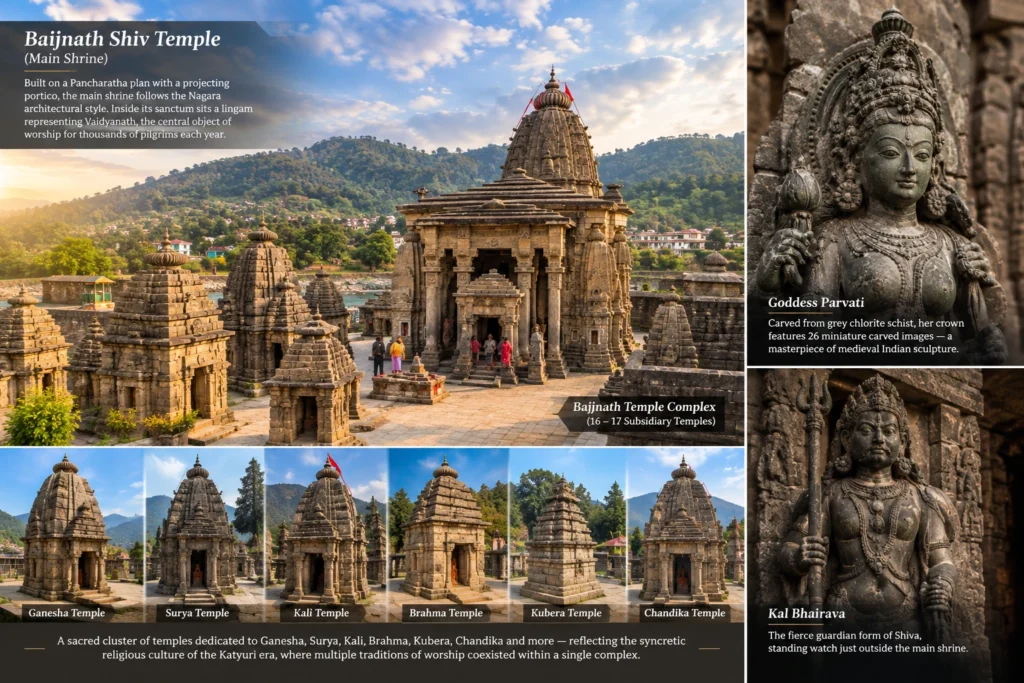
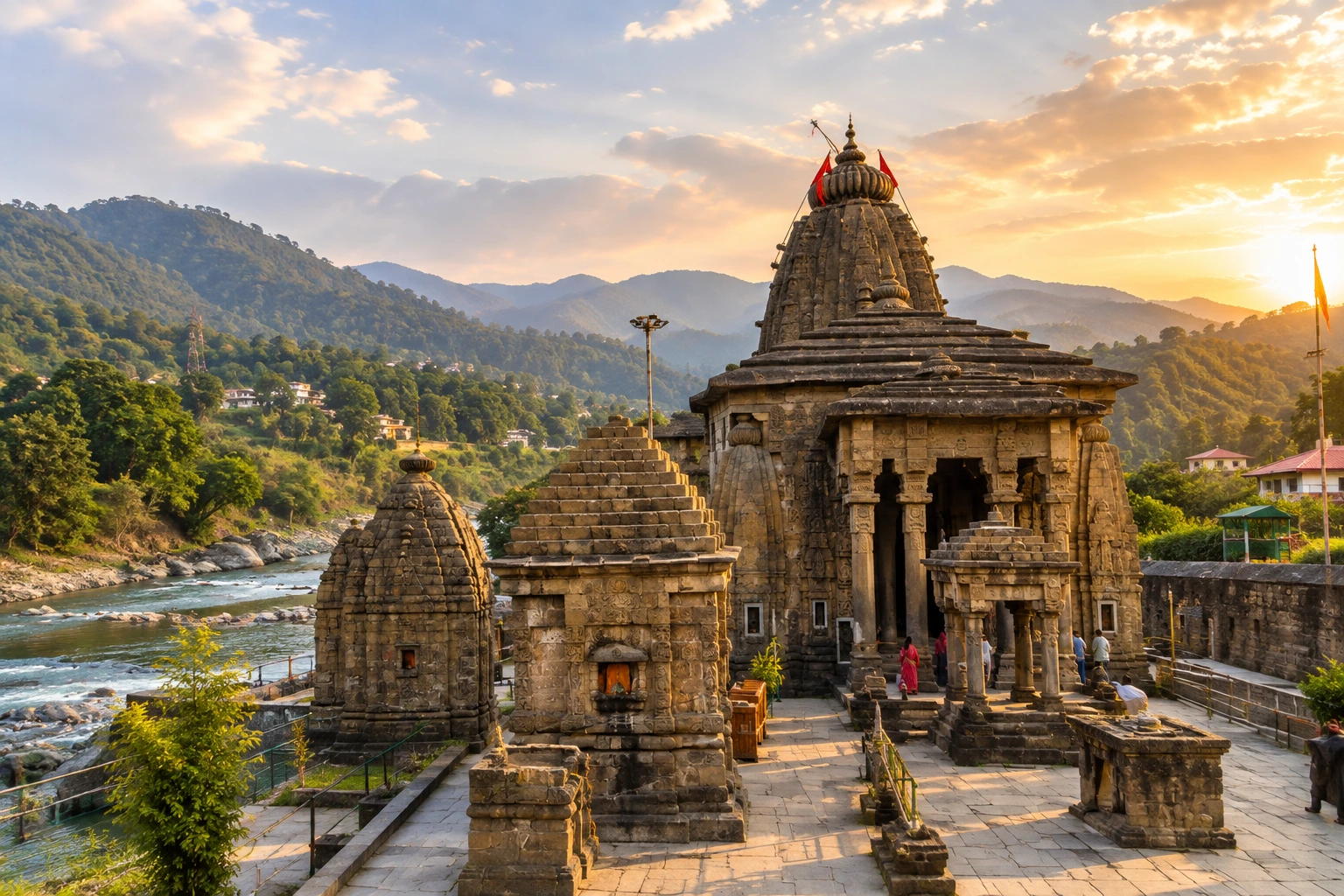
The heart of the site is the Baijnath Shiv Temple, the main shrine of the Baijnath Temple complex, built on a Pancharatha plan with a projecting portico, following the Nagara architectural style that defines the site. Inside its sanctum sits a lingam representing Vaidyanath, the central object of worship for the thousands of pilgrims who visit each year.
Surrounding this main shrine are 16 to 17 subsidiary temples within the Baijnath Temple complex, forming a dense cluster of stone shikharas dedicated to a wide range of deities — Ganesha, Surya, Kali, Brahma, Kubera, and Chandika among them. This variety reflects the syncretic religious culture of the Katyuri era, when multiple traditions of worship coexisted within a single sacred complex.
Two sculptures stand out even among this crowded field of artistry. The first is a striking image of Goddess Parvati, carved from grey chlorite schist, crowned with a headpiece featuring 26 miniature carved images — widely regarded as one of the finest examples of medieval Indian stone sculpture. The second is a life-size figure of Kal Bhairava, the fierce guardian form of Shiva, standing watch just outside the main shrine.
A Living Heritage Site
Unlike some ancient temples that have faded into ruin, Baijnath Temple remains an active place of worship, drawing devotees for Shivratri and other major festivals throughout the year. It has been recognised by the Archaeological Survey of India as a Monument of National Importance, and forms part of the government’s Shiva Heritage Circuit initiative across the Kumaon region, connecting it with other significant Shiva sites nearby.
What makes this site particularly appealing for travellers is its accessibility. Unlike Himalayan shrines that demand strenuous treks to reach, this temple sits right beside the road, offering the same spiritual and historical richness without any physical exertion required — making it a comfortable stop for pilgrims of every age.
Getting There
Baijnath Temple sits roughly 16 km from Kausani and 22 km from Bageshwar, at the junction of the Bageshwar–Gwaldam and Almora–Gopeshwar roads, making it an easy addition to any Kumaon itinerary. The nearest railway station is Kathgodam, while Pantnagar serves as the closest airport, both well connected to major cities.
For travellers looking to combine this stop with a larger Himalayan pilgrimage circuit, our Kedarnath Yatra package offers a deeper dive into Uttarakhand’s Shiva heritage, from ancient temple towns to high-altitude shrines.
For official heritage details and verified travel information, you can refer to Incredible India, the Government of India’s official tourism portal.
Frequently Asked Question’s
What is Baijnath Temple famous for?
Baijnath Temple is famous for being one of Kumaon’s most significant Shiva shrines, believed to mark the spot where Shiva and Parvati were married, and for its cluster of 17 to 18 ancient stone temples built by the Katyuri dynasty.
What is the history behind Baijnath Temple?
Baijnath Temple history traces back to around 1150 CE, when the complex was built under Katyuri patronage in what was then their capital, Kartikeyapura. Some local legends also credit a Brahmin woman or claim the temple was built by the Katyuri kings in a single night.
What is the significance of the Baijnath Shiv Temple?
The Baijnath Shiv Temple is the main shrine of the complex, dedicated to Vaidyanath, a form of Lord Shiva known as the “Lord of Physicians.” It houses a sacred lingam and remains the spiritual centre of the entire site.
Is Baijnath Temple difficult to visit?
No, unlike high-altitude shrines such as Kedarnath, Baijnath Temple is easily accessible by road, requiring no trekking or physical exertion, making it suitable for pilgrims of all ages.
How many temples are there in the Baijnath Temple complex?
The complex consists of 17 to 18 temples in total, with the main Vaidyanath shrine surrounded by subsidiary temples dedicated to deities including Ganesha, Surya, Kali, Brahma, Kubera, and Chandika.