

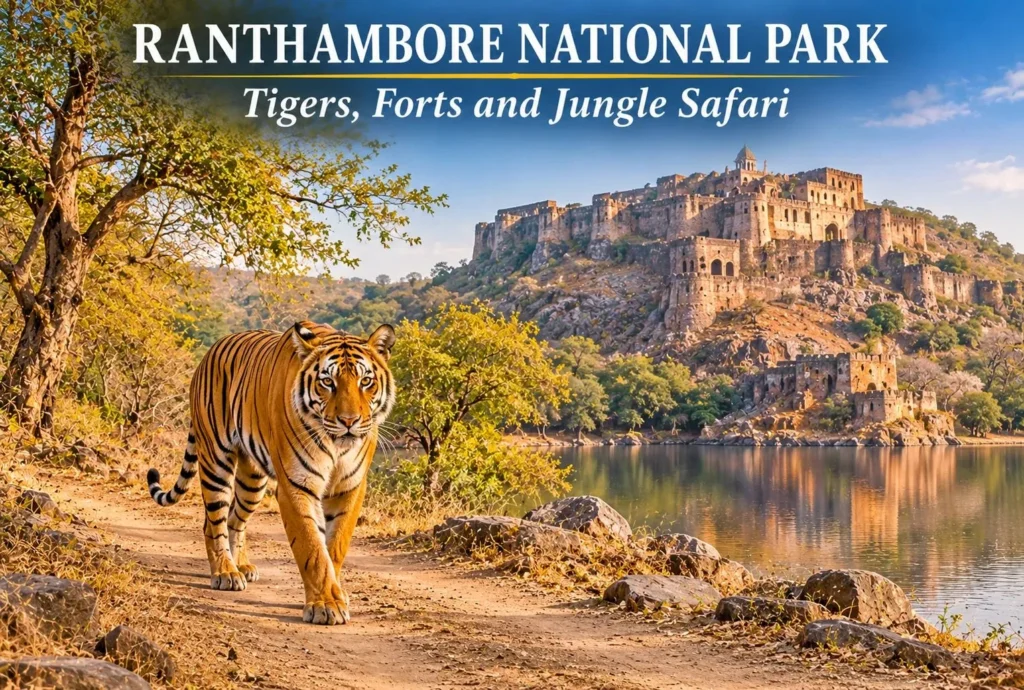
From the beautiful landscape to the rough terrain forests, the atmosphere of Ranthambore National Park is a perfect blend of nature and history, where you will find beautiful lakes as well as historic forts that present the unique experience to wildlife lovers and photographers. To know more about Ranthambore, have a look at this guide that will briefly introduce the history, where is ranthambore national park, best time to visit, and jungle safari of the park to you.
Table of Contents
About Ranthambore National Park
Situated in the Sawai Madhopur district of Rajasthan, the Ranthambore National Park is known as one of the best wildlife destinations and tiger reserves in India. It is home to around 75 to 80 tigers, which can be spotted in the wild. Inside the park there are a large number of species of wild cats, antelope, birds, reptiles, etc.
The Ranthambore Tiger Reserve is spread over the span of around 1530 sq. km, including the protected area and forests. While the park covers about 280 sq. km of area where the safaris happen. In 2022, a total of 69 tigers are recorded here, which was only 10 in 2001.
Brief History of the Park
Get through the fascinating history of the park:
- Established in 1955: Sawai Madhopur Game Sanctuary was established in the name of the district where it is located, the Sawai Madhopur district of Rajasthan.
- Joined Project Tiger in 1873: The sanctuary became one of the tiger reserves by joining Project Tiger to save the tiger population.
- Wildlife sanctuary to National Park: The forest area of the sanctuary was declared a national park to protect the forests and wildlife in 1974.
Today, the Ranthambore is widely known for its protective land of over 280 sq. km, including the protected area and forests.
Things to Do in Ranthambore National Park
There is more here than safaris. If you have two or three days, try this list.
- Take a jungle safari— if you want to see tigers, leopards, and other wild animals, witness a jungle safari once. Here a guide and driver will take you on a ride-along forest and track the animals through their footprints.
- Visit Kachida Valley— This valley is famous for animals like panthers, sloth bears, and birds. You can reach here by Jeep safari only.
- Go Bird Watching— More than 200 species of birds can be spotted in the park. Mostly near water bodies like Padam Talao Lake and Malik Lake.
- Step into Museam— Learn about the diverse wildlife and culture of Rajasthan and witness the glimpse of Bengal tigers.
- Admire the Ranthambore Fort— Built in the 10th century, this historical fort is part of the Hill Forts of Rajasthan, a UNESCO World Heritage Site. Inside the fort there are red-stone temples of Ganesh, Shiva, and Ramji.
Wildlife You Can Spot
Tigers get the most attention, but they are only one part of the story. Here are what else live in Ranthambore National Park:
- Bengal tigers— Famous for their orange coats, black stripes, and powerful presence, makes them the most popular tourist attraction of Ranthambore.
- Leopard— A big cat with yellow skin and black spots on it, also known as an apex predator, and is also found here.
- Sloth Bear— A shaggy, insectivorous mammal known for tearing open termite mounds with its claws.
- Deer and antelope— Sanbar, chital, nilgai, chinkara, etc.
- Birds— Different species of birds can be spotted here, like painted stork and Indian eagle-owl, and crested serpent-eagle.
There are many other animal species that you will see inside the park; some may be commonly found in nature while some are rarely seen everywhere.
Bengal Tigers—Pride of Ranthambore
Bengal Tigers are Indian subcontinent species of tigers that are distributed to other nations like Nepal, Bhutan, and Bangladesh from India. The name Bengal comes from West Bengal, the state of India. These tigers are only found on the Indian subcontinent and are one of the biggest wild cats alive.
Bengal tigers are the most famous animal found in the Ranthambore National Park, which makes them tourists’ favorite animal of the park. It is a home of around 70 to 80 Bengal tigers. Some famous tigers of Ranthambore are Machli, Dollar, Tina Two, and Sundari.
How to Reach Ranthambore
By Train
- Take a train from Delhi, Mumbai and Jaipur and reach Sawai Madhopur railway station.
- The railway station is around 15 km away from Ranthambore.
By Air
- Jaipur International Airport is the closest airport with a drive of 160 km from the the Sawai Madhopur district.
- Taxis and buses are available at the airport gate which can take you to Sawai Madhopur.
By Road
- Government buses and private buses run daily from Jaipur
- The road is well connected with nearby big cities like Delhi and Jaipur.
Best Time to Visit
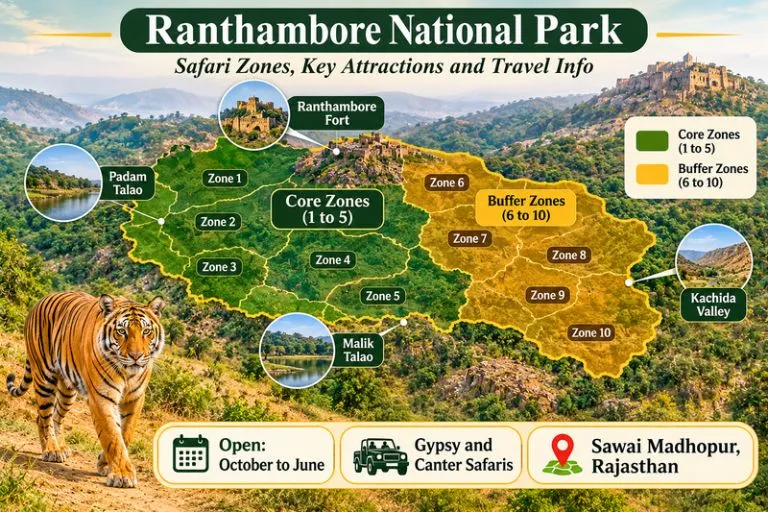
The park is opened for all tourists from the month of October to June and remains closed in the months of July, August, and September during monsoon season.
| Season | Months | Weather and Conditions | Best for |
|---|---|---|---|
| Summer | April – June | Hot weather with high temperatures and sunny days | High chances of spotting tigers near water bodies |
| Winter | October – January | Cold winds, better safari conditions | Comfortable jungle safari experience |
| Spring | February – March | Warm weather | Wildlife Enthusiasts |
Plan Jungle Safari: Timings and Booking
The Safari in Ranthambore National Park is divided into 10 zones, out of which zones 1 to 5 are core zones and zones 6 to 10 are buffer zones.
Jungle safaris can be done through two types of vehicles that are:
- Gypsy (jeep): An open four-wheeler, with a seating capacity of 6 people including the driver, is flexible and best for family.
- Canter: An open truck that has a higher seating capacity than a gypsy is less costly per person but is noisier.
The safari runs in two shifts:
- The first shift starts in the morning at around 6am.
- Afternoon shift starts at 2 pm.
The timings can change with the season.
Complete your booking for safaris through the official Rajasthan Forest Department portal. So check the Rajasthan Forest Department’s Ranthambhore Tiger Reserve page for official updates. Carry your photo ID on the day, check the rules, and plan accordingly.
For official visitor information on Rajasthan, including links to the forest department’s booking system, you can refer to Rajasthan Tourism, the state government’s official tourism body.
Where to Stay: Ranthambore National Park Resort
Ranthambore offers a variety of accommodation options for tourists, including luxury hotels, budget-friendly hotels, and hotels closest to nature.
Types of Stays Near Ranthambore
Luxury Hotels and Resorts
- Offers premium rooms with luxury services like a swimming pool, multicuisine restaurants, and a spa parlor.
- Best for long holiday vacations with close proximity to nature.
Mid-range
- Provides big rooms with basic facilities included, like restaurants, room service, and laundry facilities.
- Best if you want to stay more in Ranthambore to explore other places near Ranthambore.
Low budget
- You will get decent rooms with basic facilities like a washroom, water, and some food also.
- Good for solo travelers and budget tours.
Travel Tips
- Book your safari early, and check your safari zone in the ticket.
- Carry only permitted essentials inside with you.
- Do not touch the animal and try to become cool; this can be dangerous.
- Listen to your guide and respect them.
- Wear good-quality shoes rather than fancy sneakers and heels.
- Don’t limit yourself to watching tigers only; explore other things also, like lakes, birds, forts, grasslands, etc.
If you enjoy open landscapes and wild places, our guide to the Rann of Kutch is another good read.
If you would like to continue your nature travel in the Himalayas after the Rajasthan plains, Explore Hills’ Uttarakhand Tour Package brings together several regional highlights in one itinerary.
Conclusion
If you ever dream of exploring the wildlife once in a lifetime, Ranthambore can be a great option and the best place where you will get through the beautiful landscape and will experience the wildlife closely. Whether you are wildlife enthusiasts or admirers of history, the Ranthambore will make you fall in love with nature. More than exploring the wildlife, the important thing is to protect it.
For a forest walk with birdlife of a different kind, Explore Hills’ Chopta Tungnath Chandrashila Trek passes through rhododendron and pine forest in the Garhwal Himalayas.
Frequently Asked Questions
How many days are required to explore Ranthambore?
If you are planning for a jungle safari, bird watching, and exploring Ranthambore forts, then a minimum time of 2 to 3 days is enough.
Is there any stay inside the Ranthambore National Park?
No, Ranthambore doesn’t provide accommodation to tourists inside the park, but there are plenty of resorts and hotels near the park where you can stay.
What is Ranthambore National Park famous for?
Ranthambore is famous for its rich population of Bengal tigers, for which tourists from all over the world come here for jungle safaris to see tigers in the wild.
What is the best time to visit Ranthambore?
The best time to visit Ranthambore is the months of April to June, when there is a high chance of spotting tigers in the wild. Tigers can be seen near water bodies during the summer season. But spotting a tiger is not guaranteed.