
Explore Hills
Checkout +91-9456580306

Explore Hills Blog

Travel guides, trekking tips, destinations, yatra guides and useful travel information from ExploreHills.

Explore by Category

The City Palace: Silver Urns, Peacock Gates and a Royal Home Still Lived In

The City Palace

Some palaces are museums that happen to have been palaces. The City Palace in Jaipur is something rarer: a working royal residence, a museum and a ceremonial centre all at once, with a flag on its roof that still tells the city whether the Maharaja is at home. It sits at the centre of the walled Pink City, a short walk from Hawa Mahal and Jantar Mantar, and it holds a handful of details so unusual that they have become the stories every guide repeats.

This article walks through the famous ones: who built the palace, why its gates are linked to the seasons, how two silver jars travelled to England, and what the building looks like today. It also covers practical points such as City Palace timings, tickets and the best hours to avoid crowds.

The City Palace Jaipur at a Glance

The City Palace Jaipur is the old royal seat of the Kachwaha dynasty, built as the heart of the new capital that Maharaja Sawai Jai Singh II founded in 1727. Work began in the late 1720s and the main core was completed by around 1732, though the palace kept growing for the next two centuries as later rulers added courtyards, halls and gateways. That long, layered construction explains why the complex blends Rajput, Mughal and, in later wings, European influences rather than following one style.

Today the City Palace remains one of the most visited monuments in Rajasthan, and the royal family still hosts ceremonies and private events in its courtyards, so parts of it may close at short notice and it is worth checking before you go.

Jai Singh was both a warrior and a scientist, and he planned Jaipur on an orderly grid, which was unusual for Indian cities of the period. The tradition credits Vidyadhar Bhattacharya, a Bengali architect, with designing the city layout, and later work on the palace is associated with Sir Samuel Swinton Jacob, a British engineer who shaped many Rajasthani buildings. Together, their work gave the City Palace a formal geometry that older Rajput forts rarely had.

One quick note on names: this is the palace in Jaipur. Udaipur has its own, separate City Palace on Lake Pichola, so make sure you search for the right City Palace before you plan your trip.

The Four Gates of Pritam Niwas Chowk
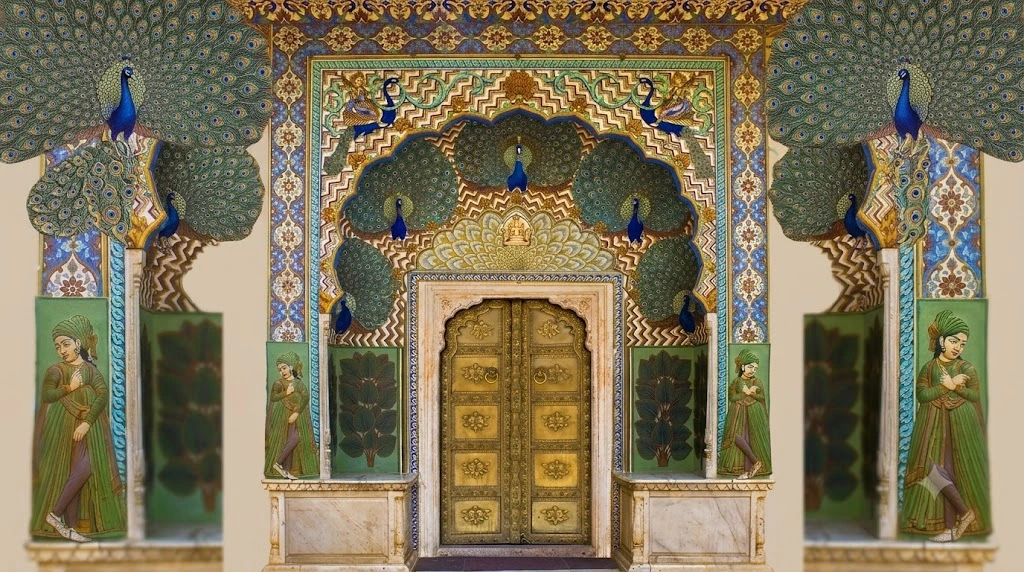
If one corner of the complex has become famous, it is Pritam Niwas Chowk, the inner courtyard that leads to Chandra Mahal. Four small, ornate doors stand around it, each linked to a season and a Hindu deity, and they are among the most photographed doorways in India.

The Peacock Gate, with its fanned blue and green birds, represents autumn and Lord Vishnu. The Lotus Gate stands for summer and Lord Shiva. The Rose Gate represents winter and the Goddess Devi, and the fourth, for spring, is associated with Ganesha and is described in different sources as the Green Gate or the Leheriya Gate, named after the wave-like pattern of its design. Each door is made of brass and carved in fine detail, so do not touch the surface, as visitors are asked to keep a respectful distance.

The Peacock Gate is the one that appears on every City Palace postcard. If you want a clean photograph without crowds, go first thing when the doors open.

The Silver Urns That Went to England

The most famous object in the complex is not a jewel or a sword but a pair of large silver jars. Two enormous urns stand in the Diwan-i-Khas, the hall of private audience, and they are recorded by Guinness World Records as the largest sterling silver objects in the world. Each weighs about 345 kilograms when empty.

They were made for a journey. When Maharaja Sawai Madho Singh II was invited to the coronation of Edward VII in London in 1902, he refused to drink anything but Ganga water, which he considered pure, and ordered silver vessels large enough to carry it by ship for the whole trip. Local silversmiths made them from silver coins. They are sometimes called the Gangajalis, a name that comes from the holy water they carried.

The story is repeated so often it has become part of the City Palace’s identity, and since the urns are on display today, you can see them yourself.

Chandra Mahal and the Flag on the Roof

Dominating the complex is Chandra Mahal, a seven-storey “Moon Palace” with mirrors, murals and open balconies. The ground floor and some upper rooms are open to visitors as part of the museum, while the upper storeys remain the home of the present royal family. The top floor, Mukut Mahal, has the best views over the old city.

A small flag fluttering on that rooftop carries a message. When the Maharaja is in residence, the flag flies, and when he is away, it is lowered. In an era when most palaces have become hotels or archives, that single flag says that the City Palace is still a home first and a monument second.

Mubarak Mahal and the Museum Collections

Near the first courtyard stands Mubarak Mahal, a reception hall built in the late nineteenth century by Madho Singh II for visiting dignitaries. Its facade blends Islamic, Rajput and European details, and today it houses displays of royal textiles and costumes.

The wider museum is named after Maharaja Sawai Man Singh II and holds a surprisingly broad range of objects. The Diwan-i-Aam area has miniature paintings, old manuscripts and embroidered carpets. The Sileh Khana, or armoury, shows swords, shields and firearms, while the carriage hall preserves old palanquins and a Victorian-era carriage said to have been a gift from the Prince of Wales in 1876.

That same year, Maharaja Ram Singh had the city painted pink to welcome the prince, because pink signified hospitality, and the colour has remained a rule for buildings in the old city ever since.

City Palace Timings, Tickets and Entry

Most sources give the City Palace timings as 9:30 AM to 5:00 PM daily, which is the schedule you should plan around. Ticket prices have changed several times, and listings quote roughly 200 rupees for Indian visitors and 700 rupees for foreign tourists, with a separate fee for cameras, so check the counter on the day. A premium “Royal Splendour” ticket, which includes access to the upper levels of Chandra Mahal and a private guide, was listed at around 3,500 rupees in 2024.

Photography at the City Palace is generally allowed in courtyards with a camera fee, but it is not allowed inside the museum galleries. Tripods are not permitted. I could not confirm a regular night schedule, so check with the ticket office if you hope to visit after dark.

When to Go and How to Plan

Come at opening time or in the late afternoon, when groups thin out and the light on the courtyards is softer. October to March is the best season, while May to July can be very hot. The nearest metro stop is Badi Chaupar, and the old city’s lanes are best handled on foot.

Plan about two to three hours at the City Palace. Jantar Mantar, which stands beside the palace, is a UNESCO World Heritage Site with 19 astronomical instruments built between 1728 and 1734, including the world’s largest stone sundial, although the City Palace itself is not on the UNESCO list. Hawa Mahal and Jantar Mantar both have their own entrances, so many visitors combine all three in a single morning, and our Hawa Mahal guide covers the pink facade in detail. If you are travelling further across Rajasthan, our Mehrangarh Fort guide takes you to Jodhpur’s great hill fort. For official context on the Pink City, see the Incredible India page on Jaipur, the Government of India’s tourism portal.

Frequently Asked Question’s

  1. Who built the City Palace in Jaipur?

    Maharaja Sawai Jai Singh II began the palace after founding Jaipur in 1727, with the core completed around 1732 and later rulers adding more wings.

  2. What are the City Palace timings?

    Most listings give 9:30 AM to 5:00 PM daily, though you should confirm at the ticket counter on the day of your visit.

  3. What is the City Palace famous for?

    It is famous for the Peacock Gate in Pritam Niwas Chowk, the giant silver urns recorded by Guinness, and Chandra Mahal, where the royal family still lives.

  4. Is the City Palace still a royal residence?

    Yes. Part of Chandra Mahal is the home of the present royal family, and a flag on the roof signals when the Maharaja is in residence.

  5. Where is the City Palace located?

    It stands in the heart of Jaipur’s Old City, beside Hawa Mahal and Jantar Mantar, close to Badi Chaupar metro station.

  6. How much time do you need at the City Palace?

    Plan around two to three hours to see the courtyards, Chandra Mahal and the museum galleries without rushing.

What lingers after a visit is how much of the City Palace is still alive. The urns can be inspected, the doors can be photographed, and the flag can be checked from the courtyard. Few palaces in India let you stand inside a home that is still being lived in, and that mix of history and daily life is the real reason to come.
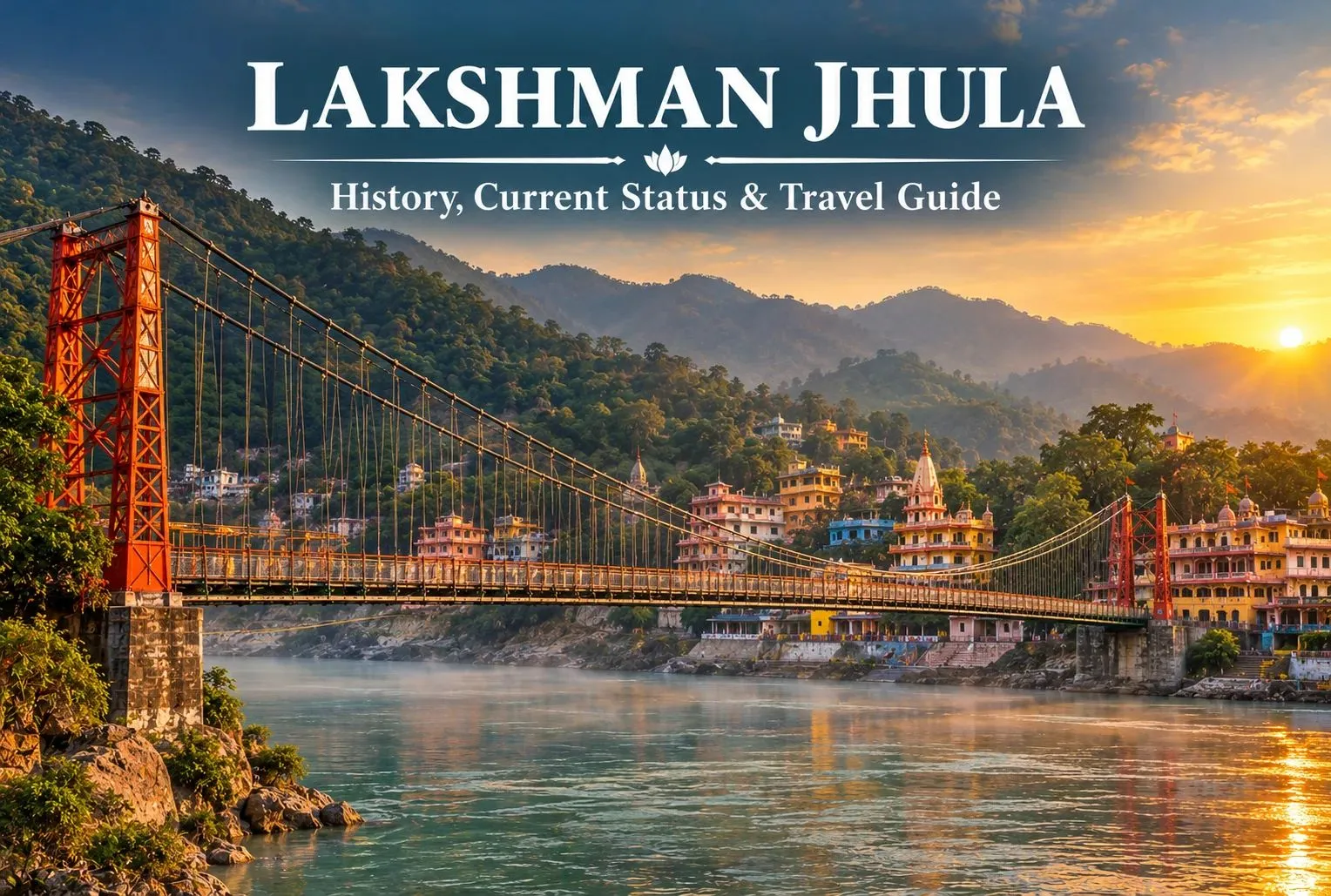
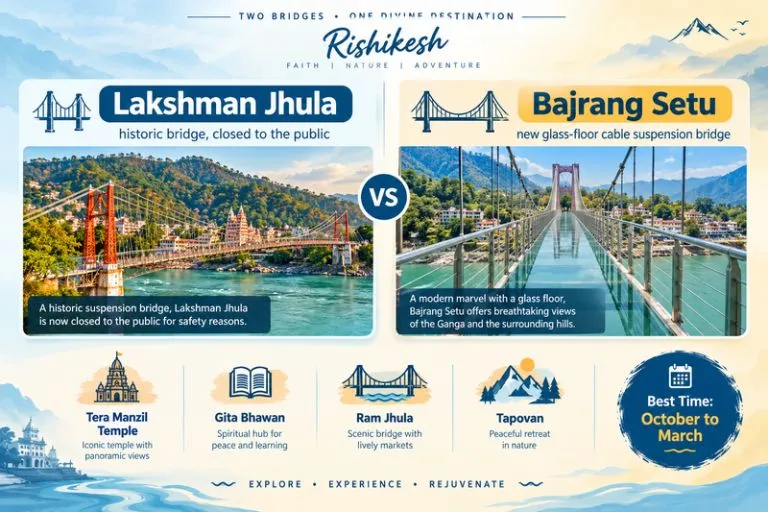
Lakshman Jhula Rishikesh: History, Current Status & Travel Guide

lakshman jhula

What Is Lakshman Jhula?

Lakshman Jhula is a well-known landmark of Rishikesh, Uttarakhand, popular for its religious as well as historical significance and breathtaking views of the Ganga River. The old bridge is no longer accessible to the public but travelers can visit temples, ashrams, cafés, and shops located in the area. The newly constructed Bajrang Setu brings the design some contemporary twist.

History and Religious Significance

  • Local tradition holds that Lord Lakshman, who is younger brother of Lord Rama from the Ramayana story, used jute ropes to cross the River Ganga at this point. The existing iron suspension bridge was constructed during the 20th century.
  • Uttarakhand Tourism indicates that the construction of the bridge took place in 1939 and its length is about 137 metres. Thus, the Lakshman Jhula can be regarded as an engineering landmark and a spiritual one as well, situated in Rishikesh.

Neighborhood of the Lakshman Jhula has become a busy area including:

  • Hindu temples and shrines.
  • Ashrams and Yoga centres.
  • Ghat of the River Ganga.
  • Small stores and markets.
  • Coffee shops and restaurants.
  • Guesthouses and hotels.
  • Viewpoints of the River Ganga.

The Lakshman Jhula area is convenient for tourists interested in spiritual life, photography, architecture and culture of Rishikesh.

Two Bridges - One Divine Destination

Bajrang Setu: The New Bridge Near Lakshman Jhula

  • In connection with the closure of the Lakshman Jhula bridge, there is a necessity of constructing a new bridge in this part of Rishikesh. The new bridge Bajrang Setu has been constructed in close proximity to Lakshman Jhula.
  • According to the news from 2026 about Bajrang Setu, it is a cable suspension bridge with glass floor sections. It has been opened for visitors in 2026 and allows viewing the Ganga River from above.

They will not visit the old bridge, but instead:

  1. Visit the historic part of Lakshman Jhula.
  2. Take photos of the historic bridge from specific viewpoints.
  3. Visit the nearby temples and riverside places.
  4. Cross the new bridge if necessary.
  5. Move on to Tapovan and further.

There might be some restrictions concerning the glass parts of the Bajrang Setu. Travellers should know the latest information about this attraction.

Things to See Near Lakshman Jhula

1. Tera Manzil Temple

  • Tera Manzil Temple, also called Trayambakeshwar Temple, is one of the recognized temples around Lakshman Jhula.
  • This multi-story place is notable for many temples near the Ganga River and can be regarded as an interesting place for those who want to observe Hindu architecture while walking around.

2. Ganga Riverside

  • Ganga River is very important for Rishikesh’s identity and at the same time the riverside of Lakshman Jhula is a good place for taking photos, strolling around and looking at religious ceremonies.
  • In the morning, the atmosphere is special, while in the evening the ghats, shops, and temples become busier.
  • However, it is essential to be careful near the river due to high waves and sudden changes of water levels.

3. Gita Bhawan

  • Gita Bhawan is one of the places located near Lakshman Jhula that serves as a center of cultural and religious activities.

Best Time to Visit Lakshman Jhula

The best time to visit Lakshman Jhula and nearby places in Rishikesh is determined by the type of experience you want.

  • The months of October through March: These are generally good months to enjoy sightseeing as well as walking and shopping in the markets and temples. These months are especially suitable for those who want to combine their visit to Rishikesh with other places in Uttarakhand.
  • The months of April through June: These months can be hot and crowded, especially during the day; however, it is possible to do some sightseeing. When visiting during this time of the year, it is imperative that you be hydrated, and plan any outdoor activities according to the weather conditions.
  • The months of July through September: These months will see heavy rains in Uttarakhand, sometimes causing severe changes to river conditions. Rain may therefore limit tourists’ ability to participate in some outdoor activities.

For current weather forecasts and rainfall alerts before you travel, you can refer to the India Meteorological Department, the Government of India’s official weather agency.

How to Reach Lakshman Jhula

Rishikesh can be accessed through various transportation means such that it is easily connected via road transport such as buses, taxis and through personal vehicles. The nearest railway station for traveling to Rishikesh would be the Rishikesh railway station and Haridwar. It is also accessible via Jolly Grant Airport that is located 20 km away from Rishikesh. Transportations for travel within the city include the use of local taxis, auto-rickshaws and bikes.

Travelers who want to combine Rishikesh with other parts of the state can explore Explore Hills’ Uttarakhand Tour Package for a wider itinerary.

Lakshman Jhula Travel Tips for Visitors

A bit of forethought can help a lot while visiting the region.

  • Ensure that the bridges are open before coming. Don’t think that the conditions will be the same as those seen in the old pictures or books. The historic Lakshman Jhula bridge is at present closed to public access.
  • Choose comfortable shoes. This region has markets, temples, lanes and river walks. Wearing comfortable shoes can come in handy while visiting the places.
  • Respect the holy sites. Most of the places near Lakshman Jhula are active religious sites. It is recommended to dress accordingly and follow the instructions of the locals while taking pictures.
  • Take precautions near Ganga. Although the Ganges River may look quite calm in certain spots, there might be fast currents in some areas. Don’t enter into the restricted zones.
  • Visit during the early morning hours. One can visit the region in the early hours of the morning to enjoy the peaceful ambiance and also to get good pictures.

Why Is Lakshman Jhula Important to Rishikesh?

Known for its cultural, historical, and religious importance, Lakshman Jhula is one of the most visited landmarks in Rishikesh. While traffic is now prohibited on the old bridge, it is possible to visit different temples, ashrams, riverside places, markets, and restaurants in the vicinity.

Conclusion

Despite the fact that the old bridge is currently out of bounds for general usage, Lakshman Jhula continues to serve as a major landmark for Rishikesh. The historical significance of the bridge, along with its surroundings that include the Himalayas, the River Ganga and temples, make this an important inclusion while planning a trip to Rishikesh.

The best strategy for a trip to this place in 2026 would be to plan the trip keeping Laxman Jhula in mind as a landmark rather than considering it to be a bridge. The neighborhood surrounding this bridge and other places like Bajrang Setu or Ram Jhula may be considered for river crossings, as the case may be.

This is an easy entry point for any person visiting Uttarakhand. Since Rishikesh is also the starting point for many Himalayan pilgrimages, Explore Hills’ Kedarnath Yatra is a natural next step for travelers who want to go deeper into the mountains.

Frequently Asked Questions

Is Lakshman Jhula open in 2026?

The original Lakshman Jhula continues to be closed to public use. Tourists can still explore the local neighborhood and see the historic bridge. There is also a new bridge called Bajrang Setu located near Lakshman Jhula, which allows modern-day pedestrians to cross the river. Operating conditions of Bajrang Setu may apply.

Why is Lakshman Jhula famous?

The most common reason for the popularity of Lakshman Jhula is the historic suspension bridge itself, religious significance in connection with Lord Lakshmana and the Ramayana as well as its location above the Ganga River in Rishikesh.

What has taken the place of Laxman Jhula?

Near the historic Laxman Jhula, there is a new bridge called Bajrang Setu that offers modern river crossing. Bajrang Setu has a glass floor and offers tourists a completely new bridge experience.

What places can I visit around Lakshman Jhula?

The local attractions include Tera Manzil Temple, Gita Bhavan, Ram Jhula, the riverside of Ganga, the Tapovan area attractions as well as the Beatles Ashram. Neer Garh Waterfall and other Rishikesh attractions can also be visited as part of a larger itinerary.

Jagdish Temple: Udaipur’s Black-Stone Jagannath and the 32 Marble Steps

Jagdish Temple

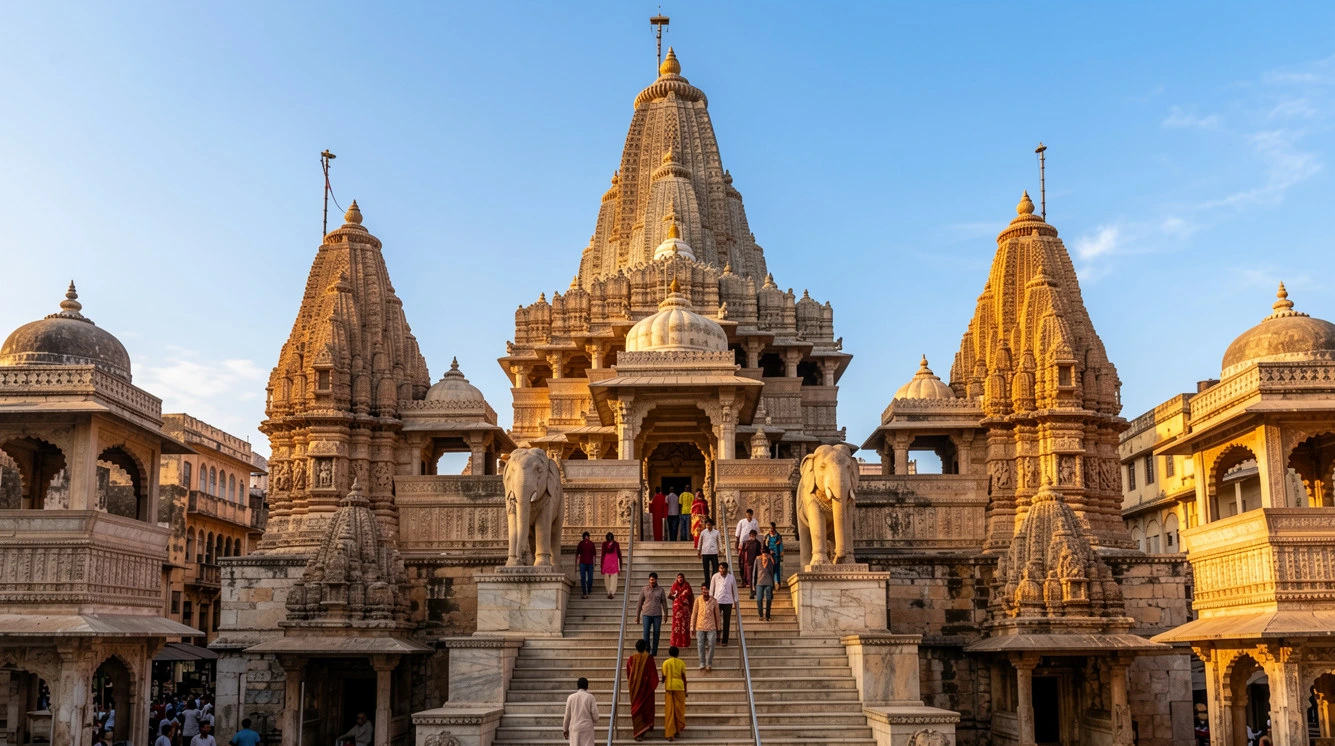
Walk up from the lanes of Udaipur’s old city, past stalls of silver jewellery and miniature paintings, and the street suddenly lifts into a flight of white marble steps guarded by two stone elephants. At the top stands a spire so densely carved that it looks less like a building and more like a sculpture. This is Jagdish Temple, a seventeenth-century shrine that has been in continuous worship since the day it opened, and one of the most photographed religious sites in Rajasthan.

Most visitors treat Jagdish Temple as a quick stop between the City Palace and Lake Pichola. That is a shame, because the temple carries a story of royal devotion, a dream, a Mughal-era battle and a distinctive building style. This guide covers where it stands, who built it, what to look for on the carvings, and how to plan around the daily schedule.

Where Jagdish Temple Stands

Jagdish Temple sits in the heart of Udaipur’s old city, just outside the royal palace complex and a short walk from the City Palace. That position is deliberate. Jagdish Temple was built by the Mewar rulers as a royal place of worship, close enough to the palace to be reached on foot during festivals, yet open to the public from the start. Lake Pichola lies a few minutes away in one direction, and the busy bazaar streets run in the other, which makes the temple easy to combine with a day of old-city sightseeing.

The nearest airport is Maharana Pratap Airport, about 22 kilometres from the city, and Udaipur City railway station is the closest rail link. From either, an auto-rickshaw or taxi can drop you near the bottom of the steps, since the lanes around the temple are narrow and best covered on foot.

Jagdish Temple Udaipur History: A Dream and a King

The tradition most often repeated about Jagdish Temple Udaipur history begins with a dream. According to one account, Maharana Jagat Singh I was directed in a dream to build a shrine to Lord Vishnu at this exact spot, and he began work soon after. Jagat Singh ruled Mewar in the mid-seventeenth century, a period of relative stability, and his reign left Udaipur with several lasting buildings.

Jagdish Temple was completed in 1651, though a board at the site gives 1652, which is a small difference you will see mentioned in different sources. The cost is recorded as roughly 1.5 million rupees, an enormous sum for the time. Originally called the temple of Jagannath Rai, it is now known by the shorter name Jagdish-ji, a form of Jagadish, meaning “Lord of the Universe.”

Its worship has continued without a break since. Few temples of this age in Rajasthan can say as much, because many were damaged, closed or rebuilt during the turbulent decades that followed.

The Defence of 1680

The site also has a battle story. A painting and a board inside the complex describe how the temple was defended during a Mughal advance on Mewar around 1680. The account credits Naruji Barhat, a Charan warrior, and twenty companions with holding the temple against the attackers, at the cost of their lives. Historians differ on the details, and the board represents local memory rather than a detailed chronicle, but the event is part of how the temple is remembered in Udaipur. Visitors can still see the painting that commemorates it.

A Temple Built in the Māru-Gurjara Style

Architecture is where Jagdish Temple really stands apart. It follows the Māru-Gurjara tradition, also described as Indo-Aryan, a style found in the Maru and Gujarat regions and known for tall towers, elaborate pillared halls and layered sculpture.

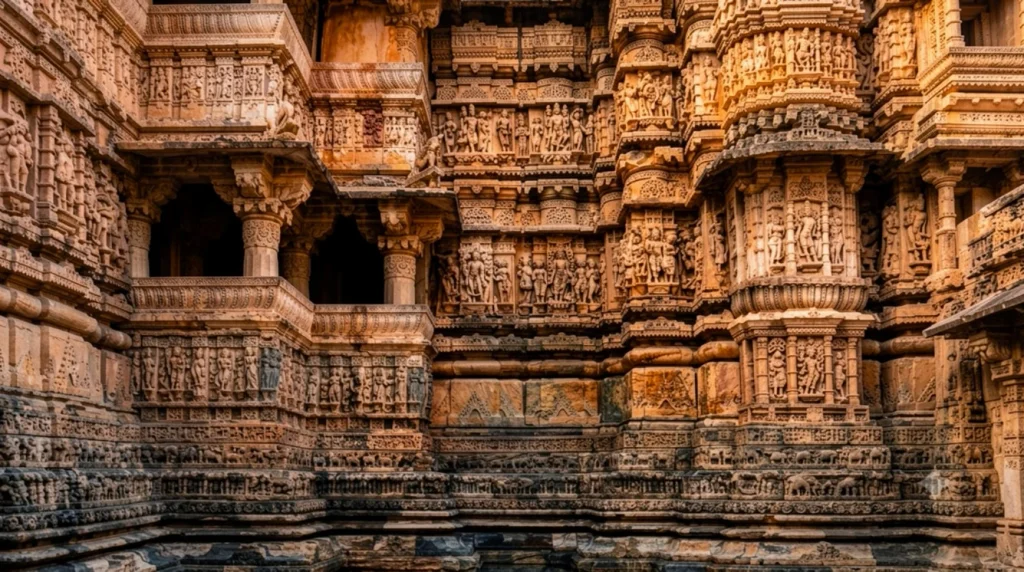
The temple rises on a high terrace, with a double-storey hall in front of a sanctum topped by a spire about 79 feet high. It is crowned by a tower that, from below, looks like several storeys, though a few of those levels are purely decorative. Every wall is covered with hand-carved figures: elephants in procession, dancers, musicians and divine figures, including an instrument that resembles a rudra veena. Once you start looking, the carving keeps revealing new detail, so give yourself time at the foot of the steps before climbing. The overall effect, designed to be read from below as you climb, is of a sacred mountain rising out of the street.

Climbing the 32 Steps

The approach itself is part of the experience. Thirty-two marble steps lead up to the main entrance, flanked by two large stone elephants, and at the top, facing the sanctum, stands a brass image of Garuda, the eagle-mount of Vishnu. Garuda always faces the god he serves, which is why he is positioned here, gazing at the main idol in the inner chamber.

Many travellers sit on the steps of Jagdish Temple in the evening, because the view over the old city rooftops and the sound of temple bells gives the place a quiet atmosphere compared with the busy street below.

Inside: The Black-Stone Jagannath

Inside the sanctum stands the central idol, a four-armed figure carved from a single piece of black stone. It is a form of Vishnu worshipped here as Jagannath, though local tradition also links it to Krishna. The dark stone and the jewelled decoration used on festival days give the image a striking presence, especially under the glow of oil lamps.

Four smaller shrines stand around the main one, dedicated to Ganesha, Surya, Shakti and Shiva, following the pancha-ayatana pattern in which several deities are honoured around a principal one. Those shrines are quieter than the main sanctum and worth a short stop. At Jagdish Temple, as in most Vaishnava temples, the day is organised around a cycle of rituals and aarti, which visitors can watch from the hall in front of the sanctum.

If this style of worship interests you, our Jagannath Temple guide covers the great Puri temple that gives this form of Vishnu its name.

Festivals at the Temple

Jagdish Temple’s busiest period comes during major festivals. The annual Rath Yatra is its most notable event, when the deity is taken out in procession through the old city. Janmashtami, Diwali and Holi also bring special prayers, music and decoration, and crowds grow considerably on those days. Visiting during a festival is rewarding but busy, so come early and expect a longer wait.

Jagdish Temple Timings and Visiting Tips

According to the Government of India’s tourism portal, the Jagdish Temple timings are 4:30 AM to 1:00 PM and 5:00 PM to 8:00 PM, with a midday closure. Other travel listings give slightly different hours, so it is sensible to confirm at the gate, especially during festivals, when schedules often change.

A few practical points:

  • Entry is generally free, though it is customary to leave a small offering.
  • Dress modestly and remove footwear before climbing the steps, since you will walk barefoot on marble that gets hot by midday in summer.
  • Photography inside the sanctum is usually restricted, and professional equipment is generally not allowed. Ask before you shoot.
  • Early morning and evening are the best times, with softer light and fewer tour groups.
  • October to March is the most comfortable season, while April to June can be very hot.

What to See Nearby

Few places are as well placed as Jagdish Temple Udaipur for a full day of sightseeing. The City Palace is next door, Bagore Ki Haveli is a short walk away and hosts evening cultural shows, and Lake Pichola offers boat rides with views of the Lake Palace. Saheliyon Ki Bari, a garden built for the royal ladies, is a little further out. If your trip continues across Rajasthan, our Chittorgarh Fort guide covers the great Mewar fortress that preceded Udaipur as the kingdom’s capital.

For verified visitor details, see the Incredible India page on Jagdish Temple, the Government of India’s official tourism portal.

Frequently Asked Question’s

  1. Who built Jagdish Temple?

    Maharana Jagat Singh I of Mewar built it, completing the temple in 1651, though a board at the site gives 1652.

  2. Where is Jagdish Temple located?

    It stands in the old city of Udaipur, Rajasthan, just outside the City Palace complex and a few minutes’ walk from Lake Pichola.

  3. Which deity is worshipped at Jagdish Temple?

    The main idol is Jagannath, a four-armed form of Vishnu carved from a single piece of black stone.

  4. How many steps lead up to Jagdish Temple?

    There are 32 marble steps, flanked by two stone elephants, leading to the entrance and the brass Garuda image.

  5. What are the Jagdish Temple timings?

    Official tourism listings give 4:30 AM to 1:00 PM and 5:00 PM to 8:00 PM, though it is wise to confirm locally during festivals.

  6. What architectural style is Jagdish Temple?

    It is built in the Māru-Gurjara, or Indo-Aryan, style, with a tall carved spire, pillared halls and richly sculpted walls.

What makes Jagdish Temple memorable is not one detail but the layering: a king’s dream, a black-stone god, a wall of carved elephants and a daily rhythm of bells that has barely changed in centuries. Give it an hour at either end of the day and you will see why Udaipur’s residents still treat it as the heart of the old city.

Thiruchendur Murugan Temple: The Seashore Abode of Lord Murugan

Thiruchendur Murugan Temple

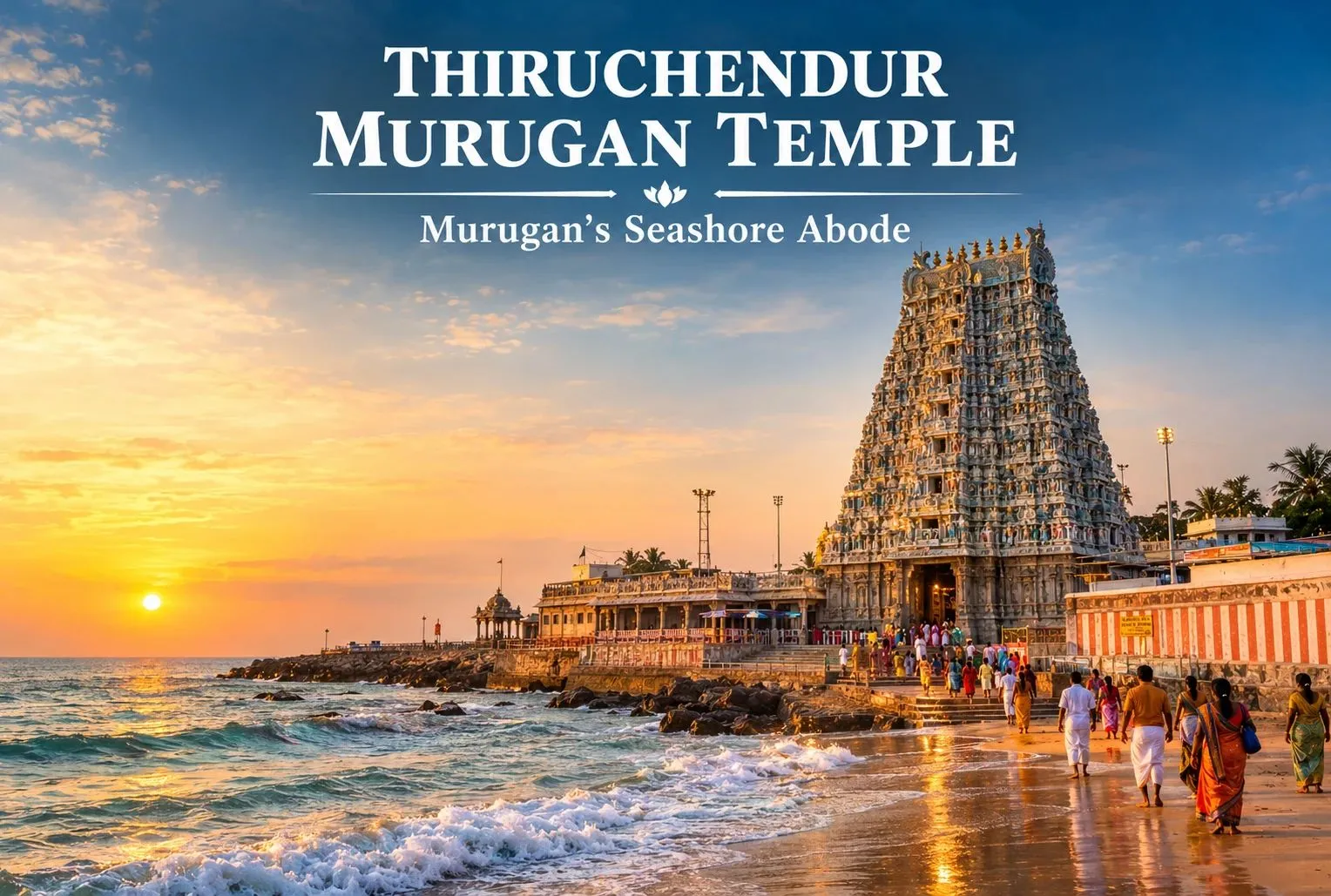
Most of Lord Murugan’s famous abodes stand on hilltops. The Thiruchendur Murugan Temple stands where land meets the Bay of Bengal’s waves, and that coastal setting is a large part of what makes it unusual.

What Is the Thiruchendur Murugan Temple?

The temple is also called the Arulmigu Subramaniya Swamy Temple. It is in Thiruchendur, in Thoothukudi district, Tamil Nadu, and is maintained by the Hindu Religious and Charitable Endowments Department of the Government of Tamil Nadu. It belongs to the Six Abodes of Murugan (Arupadai Veedu), a set of foremost sacred temples dedicated to Murugan. Unlike the others, Tiruchendur is the only one of the six on the seashore, while the rest stand on hilltops.

Thiruchendur Murugan Temple - Key Facts & Highlights

Thiruchendur Murugan Temple History and Legend

Thiruchendur Murugan temple history is told mainly through mythology. The story holds that Murugan killed Tarakasura and Simhamukha and then faced Surapadma in the final battle at Tiruchendur. Devotees see the temple as the place where that victory restored order, and the coastal setting is often read as a symbol of Murugan’s battle against evil.

The exact age of the present structure and the sequence of rebuilding are harder to pin down than the legend. If you want specifics, the temple office or a local scholar is a better source than general guides. One recent milestone is well reported: the temple’s maha kumbhabhishekam took place in July 2025, drawing lakhs of devotees. It had last been performed 16 years earlier.

Skanda Sashti and Soorasamharam

The festival that brings the largest crowds is Skanda Sashti, which marks Murugan’s victory over Surapadman. It is usually observed in October or November, and the dates shift each year with the calendar. If you want a quiet darshan, avoid this period. If you want the festival atmosphere, book accommodation well ahead.

Thiruchendur Murugan Temple Timings

Thiruchendur Murugan temple timings include early-morning poojas, daytime darshan, and evening rituals, and the exact schedule can change. Recent reports say the temple has introduced cut-off times for entering the evening darshan queues to manage heavy crowds, and these may be revised on festival days and special occasions. Because of that, please check the temple’s official announcements or the HR&CE portal before you travel, especially if you plan to arrive in the evening.

Some practical points about a typical visit:

  • Arrive early in the day for shorter queues and cooler weather
  • Weekends, school holidays, and festival days draw far larger crowds
  • Special darshan and pooja tickets are usually handled through the HR&CE system, so check the official site for current options

Best Time to Visit

October to March is generally the most comfortable window for the Tamil Nadu coast, with milder temperatures. Summers are hot and humid, and the northeast monsoon can bring heavy rain in the late-year months. Many pilgrims choose their dates around Skanda Sashti or the Tamil month festivals.

How to Reach the Thiruchendur Murugan Temple

By Train

Tiruchendur railway station is about 1 km from the temple, and Tuticorin (Thoothukudi) station is about 40 km away. oneindia

By Air

The nearest airports are generally Thoothukudi and Madurai, with onward travel by road. Flight schedules change, so check current connections and distances on a live map.

By Road

Tiruchendur is connected by road to major towns in southern Tamil Nadu, and buses and taxis run regularly from nearby cities.

Extending Your Pilgrimage

If you are planning a longer spiritual trip beyond Tamil Nadu, Explore Hills’ Yatra Packages collection brings several pilgrimage routes together, and the Kedarnath Tungnath Badrinath Yatra covers a wider Himalayan circuit for travelers who want to add a mountain pilgrimage.

For official information on temple services, bookings, and announcements, you can refer to the Tamil Nadu Hindu Religious and Charitable Endowments Department, the state government body that administers the temple.

What to Keep in Mind Before Visiting

  • Follow the temple’s dress code, which is usually traditional and modest
  • Keep an eye on official announcements for special-day schedules
  • Be careful near the sea if you plan to bathe, and follow local instructions
  • Carry cash and keep valuables secure in the crowds

Conclusion

The Thiruchendur Murugan Temple combines a powerful legend with a rare coastal setting. Check the latest darshan timings, plan around Skanda Sashti if crowds worry you, and give yourself enough time for a calm visit.

Frequently Asked Questions

Where is the Thiruchendur Murugan Temple located?

It is in Thiruchendur, Thoothukudi district, Tamil Nadu.

What are the Thiruchendur Murugan temple timings?

Timings include morning and evening poojas, but they can change on festival days, and the temple has introduced evening queue cut-offs. Please check the official announcements before you go.

What is Thiruchendur Murugan temple history in brief?

It is linked to the legend of Murugan’s final battle with Surapadma, and it is one of the six sacred abodes of Murugan. Murugan faced Surapadma in the final battle at Tiruchendur.

Why is the Thiruchendur Murugan Temple special?

It is the only one of the six Arupadai Veedu temples on the seashore.

What is the nearest railway station to the temple?

Tiruchendur railway station is about 1 km away.

When is the best time to visit the Thiruchendur Murugan Temple?

October to March is comfortable for most visitors, while Skanda Sashti brings the biggest crowds.

Baidyanath Temple: The Jyotirlinga at the Heart of Deoghar

Baidyanath Temple

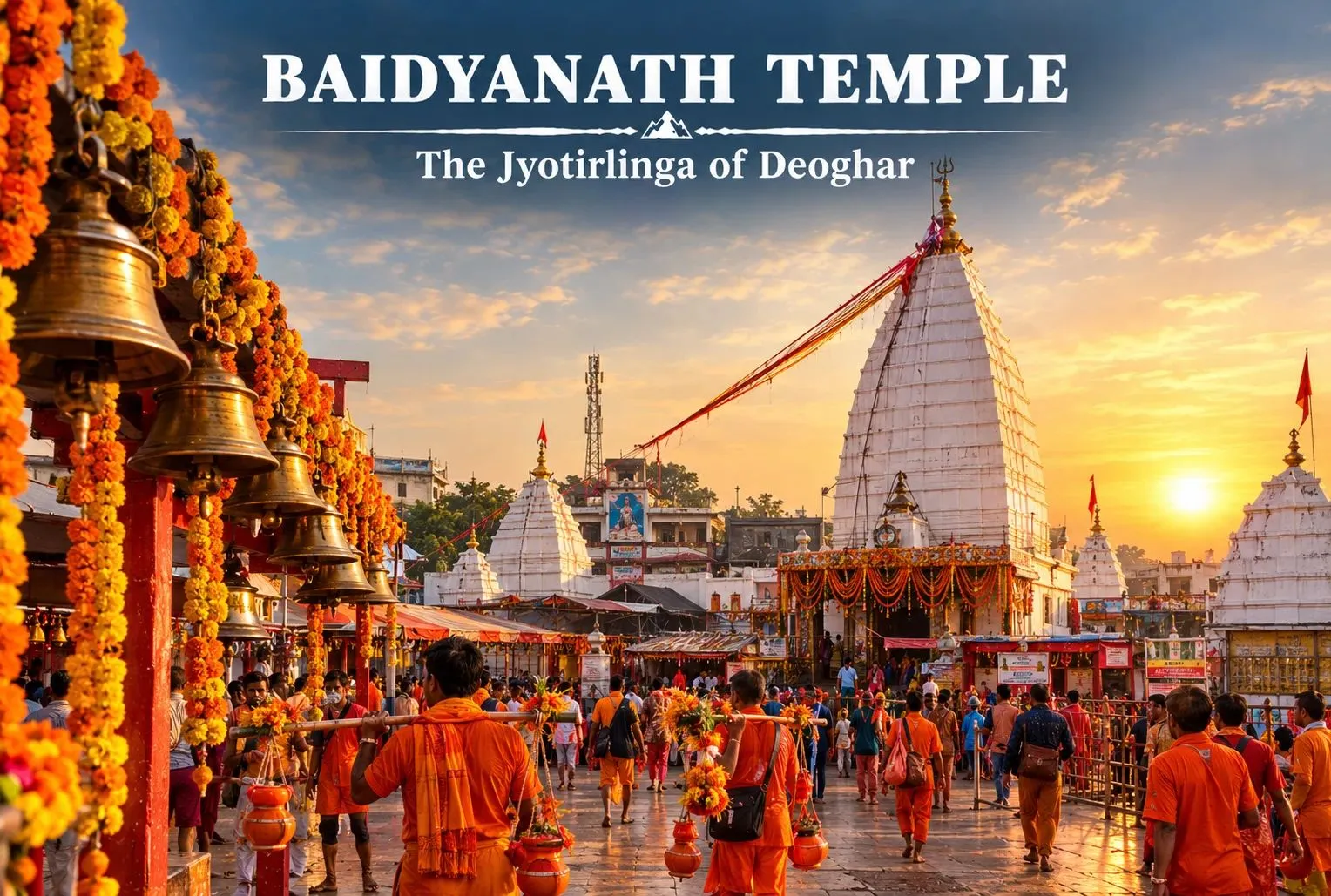
Every monsoon, a river of saffron-clad pilgrims walks across eastern India with water carried from the Ganga. Their destination is the Baidyanath Temple in Deoghar, Jharkhand, one of the most visited Shiva shrines in the country and a stop on many Jyotirlinga circuits.

What Is the Baidyanath Jyotirlinga Temple?

The Baidyanath Jyotirlinga temple, also called Baidyanath Dham or Baba Dham, is part of a complex of 22 temples in Deoghar, and the main Baidyanath shrine is the tallest of them at 72 feet, housing one of the twelve revered Jyotirlingas. Deoghar sits roughly 243 km from the state capital Ranchi. Devotees also know the shrine as Kamana Linga, the one believed to grant wishes.

Baidyanath Temple History and the Ravana Legend

Baidyanath temple history is anchored in tradition more than in a single dated record. The best-known account says Ravana was carrying Shiva toward Sri Lanka on the condition that he would not stop, but he halted here, and the Lord remained rooted at this spot. That legend is the usual explanation for the shrine’s origin and its name. Exact construction dates and the sequence of later rebuilding are less firmly documented, so a temple guide or the local trust is the best source for specifics.

Baidyanath Temple - Shravan Pilgrimage

A Note on Other Vaidyanath Claims

The Vaidyanath Jyotirlinga name is claimed by more than one temple. Tradition-based accounts also point to Parli Vaijnath in Maharashtra and, in some versions, a temple in Himachal Pradesh. Devotees sincerely follow each tradition, and this guide covers the Deoghar shrine, which Jharkhand’s tourism authority presents as the Jyotirlinga site.

What to See at Baidyanath Dham

  • The main shrine: The central Jyotirlinga, where jal abhishek is offered.
  • The wider complex: Smaller temples dedicated to other deities, within the same walled area.
  • Naulakha Mandir: A well-known temple nearby, often visited on the same day.
  • Basukinath: The pilgrimage is considered complete with a visit to Basukinath, almost 43 km from Deoghar.

Shravani Mela and the Kanwar Yatra

The busiest season is Shravan. Countless devotees walk about 100 km from Ajgaibinath (Sultanganj) to offer holy water to Baba Baidyanath. The mela runs from July to August and draws millions of devotees. If you want a calmer darshan, plan outside this period, and expect long queues and crowd controls if you travel during it.

Timings

Shiva temples usually have early-morning openings, aarti at fixed times, and a break, and the schedule changes during Shravan and festivals. Please confirm current timings with the temple management or local sources before you travel.

Best Time to Visit

October to March is the most comfortable for sightseeing in this part of Jharkhand. Summers are hot, and Shravan is spiritually special but very crowded.

How to Reach Baidyanath Temple

By Air

Deoghar has its own domestic airport, Baba Baidyanath Airport. Flight availability changes, so check current schedules.

By Train

Baidyanathdham railway station is about 1.5 km from the temple area, and Jasidih Junction is about 7.7 km away.

By Road

The nearest bus stand in Deoghar is about 2 km from the temple. Regular buses and taxis connect Deoghar with nearby cities in Jharkhand, Bihar, and West Bengal.

Extending Your Shiva Pilgrimage

If you are building a longer Shiva circuit, Explore Hills’ Kedarnath Tungnath Tour covers two of the Himalayas’ most important Shiva shrines, and the Kalpeshwar Rudranath Trek adds two more Panch Kedar shrines for trekkers.

For official visitor information on the shrine and how to reach it, you can refer to Jharkhand Tourism, the state government’s official tourism portal.

What to Keep in Mind Before Visiting

  • Dress modestly and remove footwear before entering the temple complex
  • Expect long queues in Shravan and on Mondays
  • Be cautious of touts and carry only the offerings you need
  • Carry cash, as card use can be limited near temple shops

Conclusion

The Baidyanath Temple pairs a deep legend with one of India’s most visible pilgrim traditions. Whether you come for the Jyotirlinga, the Ravana story, or the Shravan walk from Sultanganj, planning your dates and checking local details will make the visit smoother.

Frequently Asked Questions

Where is Baidyanath Temple located?

It is in Deoghar, Jharkhand, about 243 km from the state capital Ranchi.

Is Baidyanath Jyotirlinga Temple one of the twelve Jyotirlingas?

Jharkhand’s tourism authority describes it as housing one of the twelve revered Jyotirlingas. Other temples also claim the Vaidyanath name in their own traditions.

What is Baidyanath temple history in brief?

Tradition links the shrine to the Ravana legend, in which Shiva stayed rooted here after Ravana stopped on his journey. Exact construction dates are less firmly documented.

What is the best time to visit Baidyanath Temple?

October to March is comfortable for sightseeing, while Shravan, usually July to August, is the festival season with very large crowds.

What is the nearest railway station to Baidyanath Temple?

Baidyanathdham station is about 1.5 km away, and Jasidih Junction is about 7.7 km away.

Why do devotees visit Basukinath after Baidyanath Temple?

The pilgrimage is deemed complete with homage paid at Basukinath.

Hawa Mahal: The Pink Palace Where Jaipur’s Royal Women Watched the World Unseen

Hawa Mahal

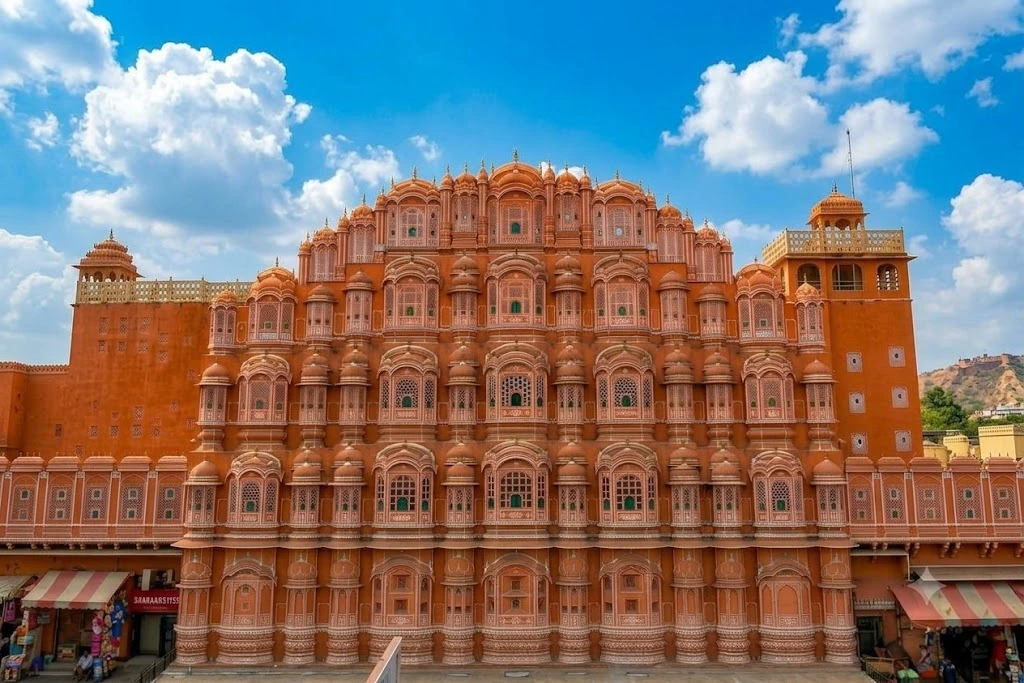
Stand on the busy road outside Jaipur’s City Palace and look up, and you will see one of the strangest buildings in India. It is only a few rooms deep, yet its front rises five storeys in a pyramid of pink sandstone, pierced by hundreds of tiny windows that glow like a honeycomb in the sun. This is Hawa Mahal, the “Palace of Winds,” and almost everything about it was designed around a single idea: letting people look out without letting anyone look in.

Most visitors tick it off in ten minutes from the pavement, which is a pity, because the story behind the facade is better than the photograph. This guide covers where Hawa Mahal stands, who built it and why, what the windows actually do, how to plan your visit around the official hours, and what the building looks like after dark.

Where Is Hawa Mahal Located

Travellers often ask where is Hawa Mahal located, and the answer is the heart of the Old City. The palace stands on Badi Chaupar in Jaipur, Rajasthan, at the edge of the City Palace complex, along the main road that runs through the walled “Pink City.” Jaipur Junction railway station is about 5.5 kilometres away, roughly twenty minutes by taxi or auto-rickshaw, and Jaipur International Airport is a little further out on the southern side of town.

One detail catches almost everyone out. The grand street face is not the entrance. There is no door on the front, and visitors enter through a gateway at the back, passing through a courtyard before reaching the building. Hawa Mahal Jaipur looks like a freestanding monument from the road, but it was built as a part of the royal women’s quarters, the zenana, which explains why the approach is tucked behind the City Palace side.

Who Built Hawa Mahal and Who Designed It

If you are wondering who built Hawa Mahal, the credit goes to Maharaja Sawai Pratap Singh, who completed it in 1799. He was a grandson of Sawai Jai Singh II, the astronomer-king who founded Jaipur in 1727. The designer was Lal Chand Ustad, an architect-craftsman whose name appears on the official tourism listing for the palace.

Pratap Singh was a poet and a devotee of Krishna, and the top of the building is popularly said to resemble Krishna’s crown, a comparison the Government of India’s tourism portal repeats. Historians also note that he took inspiration from the Khetri Mahal in Rajasthan’s Shekhawati region, whose latticed upper storeys served a similar purpose. In other words, the idea was not entirely new, but the scale and the street-facing drama were.

Hawa Mahal History and Purpose

The real Hawa Mahal history is a story about privacy. Rajput royal women of the period observed purdah, which meant they could not appear in public view, yet the city below was full of festivals, processions and markets they would otherwise miss. The solution was to build an extension of the zenana facing the main street, with a screen of tiny windows through which the women could watch Jaipur’s life unseen. A famous latticed grill known as the Aakash Patal Jali is said to have been designed so they could look down on the bustling Johari Bazaar area.

The architecture mixes two traditions. Rajput elements such as domed canopies and lotus motifs sit alongside Mughal-influenced arches and stone inlay, a blend common across 18th-century Rajasthan. The result is a building that feels both fortress and filigree, something heavy and delicate at once.

The palace did not escape time. By the late 20th century the structure had suffered from decades of neglect, and a major renovation followed in 2006 after a gap of roughly fifty years. Today Hawa Mahal is maintained by the state’s archaeology and museums department and ranks among the most photographed monuments in Rajasthan.

953 Windows and a Natural Air Conditioner

The number every guidebook quotes is 953, and it is correct: that is how many small windows, or jharokhas, cover the facade. Each is framed with carved sandstone and many are closed with fine latticework, arranged in tiers so that the whole front looks like a beehive.

The windows were not purely decorative. The latticed openings let air move through the building, and because narrow openings speed up airflow, the interior stays noticeably cooler on hot days, which is why the palace earned its name. In a city where summer highs near 44 degrees Celsius are common, a passive cooling system built in 1799 is a quiet bit of engineering.

The building is made of red and pink sandstone, which suits Jaipur’s famous colour scheme. The city was painted pink in the 19th century to welcome a royal visitor, and the shade stuck, with later rules requiring buildings to follow the same palette.

Inside the Building, Floor by Floor

Few visitors realise there is real space behind the facade. The palace has five storeys, each named for a function or a feature. The first floor, Sharad Mandir, is known for coloured glasswork, and the second is Ratan Mandir. Above it come Vichitra Mandir, Prakash Mandir and, at the top, Hawa Mandir, where the wind actually flows through the openings.

Inside, there are no staircases between the upper levels. Instead, gentle ramps lead to the higher floors, a design commonly explained as easier for royal ladies in heavy dress and palanquins. A small museum in the courtyard displays archaeological finds and Rajasthani miniature paintings, and from the top-floor balconies you look across the rooftops of the Old City toward the Jantar Mantar observatory and the City Palace.

Hawa Mahal in Night: What the Facade Looks Like After Dark

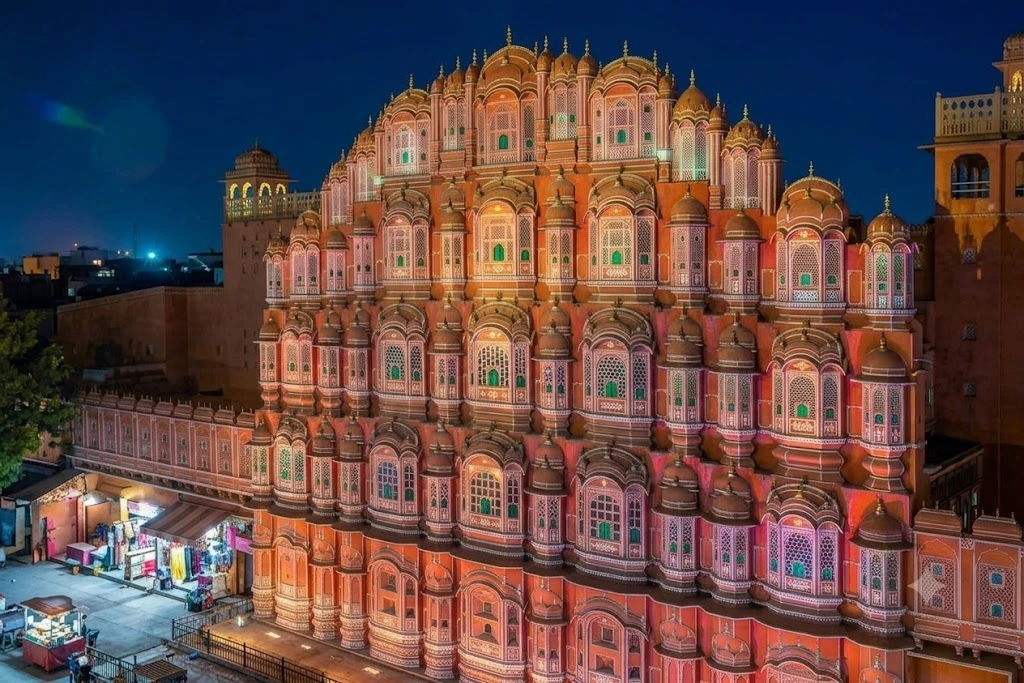
Ask anyone who has seen Hawa Mahal in night light and they usually say the same thing: it looks like a different building. In the evening the facade is lit warmly, and the carved windows turn into hundreds of small glowing frames against a darkening sky. Because the palace is an exterior-led monument, you do not need to be inside to enjoy this. The best viewing points are on the pavement across the road and from the rooftop cafes opposite, where you can sit with a cup of tea and watch the colour change from pink to gold.

Keep in mind that the monument itself closes in the late afternoon, so the night view is from outside only. I could not confirm exact illumination hours from an official source, so check at the time of your visit. The streets around it stay busy until late, which makes the area lively, if crowded.

Hawa Mahal Timings and Entry

According to the Government of India’s tourism listing, the Hawa Mahal timings are 9:00 AM to 4:30 PM. The doors open early, and the best light for photographing the facade comes in the morning, when the sun hits the pink sandstone directly. By early afternoon the front face goes into shade, and the colours look flatter.

The entry fee is modest and differs for Indian and foreign visitors, with commercial listings quoting slightly different figures, so it is safest to check the ticket counter or the Rajasthan government’s channels for the current rate. Allow roughly 45 minutes to an hour for the interior, longer if you want to read the museum displays.

Best Time to Visit and Practical Tips

October to March is the most comfortable season, with cool mornings and clear skies. Summer (April to June) is very hot, and midday visits can be uncomfortable. The monsoon brings green hills and fewer crowds, though some days are damp.

A few small tips make a Hawa Mahal visit easier:

  • Arrive at opening time, when the line is short and the light is best for photographs.
  • Wear comfortable shoes, since the ramps and courtyards involve some walking.
  • Combine the visit with the nearby City Palace and Jantar Mantar, both within walking distance.
  • If you are touring other Rajasthan forts, our Mehrangarh Fort guide covers Jodhpur’s great hill fort, and our Chittorgarh Fort guide covers the largest fort in India.
  • For verified details on the monument, see the Incredible India page on Hawa Mahal, the Government of India’s official tourism portal.

Frequently Asked Question’s

  1. Where is Hawa Mahal located?

    Hawa Mahal stands on Badi Chaupar in the Old City of Jaipur, Rajasthan, at the edge of the City Palace complex, with the entrance at the back rather than the street front.

  2. Who built Hawa Mahal?

    Maharaja Sawai Pratap Singh built it in 1799, and Lal Chand Ustad designed it.

  3. Why was Hawa Mahal built?

    It was built so the royal women of the zenana could watch festivals and street life without being seen, in keeping with the purdah tradition of the time.

  4. How many windows does Hawa Mahal have?

    The facade has 953 small windows, called jharokhas, many with carved latticework that lets air circulate.

  5. What are the Hawa Mahal timings?

    Official tourism listings give the timings as 9:00 AM to 4:30 PM, though it is wise to confirm before you travel, especially around festivals.

  6. Can you go inside Hawa Mahal?

    Yes. Visitors enter through the rear gateway and can climb ramps to the upper floors, which have small balconies and a museum in the courtyard.

What stays with you about Hawa Mahal is its contradiction. It was built to hide the people inside, and today it is one of the most looked-at buildings in India. Take the time to go in, climb to the top, and watch the old city through the same small windows the women once used. The view is the point.

Deviramma Temple: Trekking in the Midst of the Clouds

Deviramma Temple

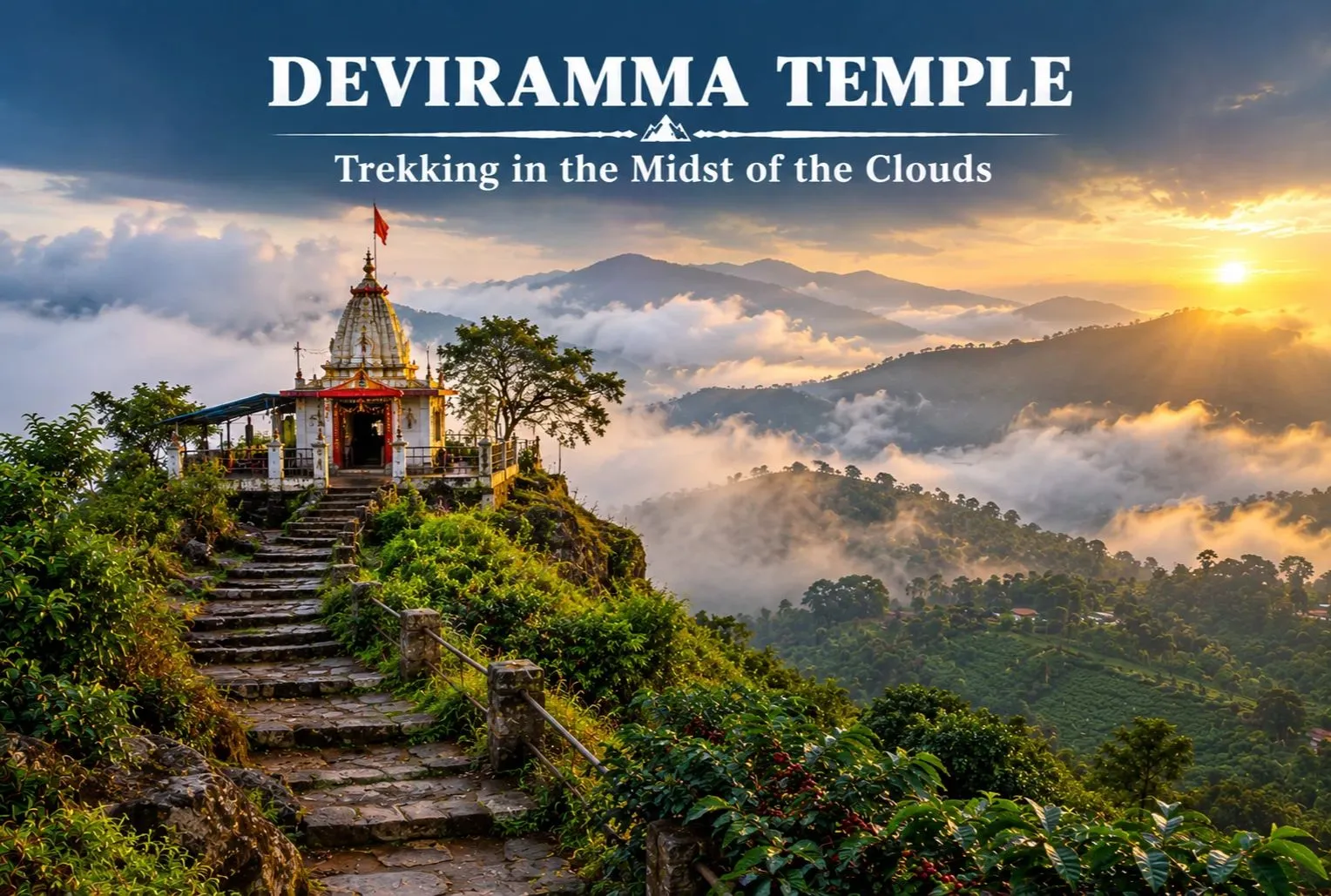
The Deviramma temple is the hill top shrine, that can be visited during the time of Diwali/ Deepawali on Naraka Chaturdasi. Naraka Chaturdasi is the first day of Diwali when devotees climb the hill to seek blessings from Goddess Deviramma. The main deity of the temple is reputed to be the manifestation of the respected Goddess, Ma Durga or Chamundeshwari. The temple is the blend of nature, spirituality and adventure. The main temple is located in Chandra Drona hill range near Chikkamagalur which is in Karnataka, Western Ghats. Every year, the temple witnesses hundreds of trekkers and devotees who climb the hill to visit the Goddess.

The Origin of the Temple

The devotees in the locality regards the Deviramma Betta as an ancient temple. According to the temple’s information domain created by the government of Karnataka, the Sri Deviramma Temple is located in Mallenahalli, Chikkamagaluru, and the information provided by the priests leads to its establishment in the 13th century. According to the source mentioned above, it is also revealed that no inscription or historical reference marking the origin of the temple has been found. As a result, the accurate date of the temple’s construction and the names of people who made it are unknown.

Worship of Goddess Deviramma has been held important for generations in this area. Many stories can be heard in the community. The location and their way of worship depend on the yearly festivals. It is important that we distinguish between the historical facts and religious ideas when writing about the temple’s history. In this manner, the guests will become familiar with the religion and culture.

Deviramma Temple - Two Temples One Divine Blessings

Mythological Story of Goddess Deviramma

The mythology of Goddess Deviramma is closely associated with Goddess Durga and Chamundeshwari. The deity of Deviramma Betta represents divine feminine power, courage and protection against evil. According to mythological beliefs, Goddess Chamundeshwari fought a fierce battle with an Asur, Mahishasura. He used to perform severe penance to please Lord Brahma. Mahishasura was granted a boon from Lord Brahma that no man or god should be able to kill him, underestimating the power of Ma Durga.

Mahishasura after being granted the boon he became arrogant and attacked heaven and defeated the gods. The Gods to defeat Mahishasura, combined their powers and manifested the divine, courageous and fearless form of Ma Durga. As boon didn’t include protection from woman, Ma Durga defeated Mahishasura and was named Mahishasuramardini which mean the slayer of Mahishasura. This victory is now celebrated as Navratri and Vijayadashami. This incident is connected to Goddess Deviramma, as it is said that goddess travelled to the hills to calm her fierce form.

Trekking in Belur/Chikkamagaluru

Depending on your approach, the Deviramma Betta hiking distance is roughly 8 to 9 kilometers, which is one single trip from the base near Belur or Chikmagalur. With its steep climbs, stone steps, and picturesque vistas of the verdant valleys, the trail is somewhat difficult. The walk in Deviramma Betta is an amazing experience one can have, as it passes through lush forests and coffee farms. If you enjoy hilltop temple treks, Explore Hills’ Chopta Tungnath Trek is a well-loved Himalayan counterpart that ends at a mountain shrine.

Safety tips for trekking in Deviramma Betta

  • Athletic and well-gripped trekking kick.
  • small snacks and plenty of water, at least 2 L per person.
  • Observe the official schedule and route guidelines.
  • Trekking at night is strictly prohibited.

For official guidance on forest-area access and trekking rules in Karnataka, you can refer to the Karnataka Forest Department, the state government body that manages these protected areas.

Best Time to Visit Deviramma Temple

Deviramma Betta can be visited throughout the year, but the best time to visit the temple is during Diwali on Naraka Chaturdashi. The hilltop shrine is traditionally open for the annual Darshan on Naraka Chaturdashi, but for the base temple, devotees can visit anytime of the year which is suitable and preferred by the forest department. For safety of people and conservation of the area, the forest department often only permits hiking during this period.

  • October to February: With cooler temperatures and ideal circumstances for sightseeing, this time of year is generally good for visiting the Chikkamagaluru region.
  • The best time to witness the temple’s traditional ceremonies and yearly pilgrimage is around Deepavali.
  • The monsoon season, which runs from June to September, brings with it an abundance of vegetation, but it can also make steep trekking routes hazardous due to heavy rain.

Trekkers who prefer a short, easy weekend climb at other times of the year can also look at Explore Hills’ Nag Tibba Trek.

Frequently Asked Questions

How many days does Deviramma Temple open?

There are two different temples, one is the hill top shrine and the other is the base temple or foothill temple. The hill top shrine is named as Deviramma Betta and the foothill temple is named as Mallenahalli/Bindiga. You can visit Mallenahalli/Bindiga throughout the year, whereas Deviramma Betta can be visited once a year, which is Naraka Chaturdashi during Deepavali.

How far is the trek to Deviramma Temple?

The trek to Deviramma Betta located in Chandra Drona hill range near Chikkamagalur which is in Karnataka, is approximately 8 to 9 km one way. The round trip of the temple is 16-18km. The ascent time is approximately 4hours and descent time is 2hours depending you the speed respectively.

Who is the deity in Deviramma Betta?

The Goddess of Deviramma Betta is closely associated with Ma Durga and Ma Chamundeshwari. The mythological incidents are said to be interconnected as said that the deity travelled to the hills to calm her fierce form.

What is the religious belief and rituals local follow in Deviramma Betta?

The deity, Goddess Deviramma, is thought by the temple’s residents to protect the region from the elements. In keeping with the customs, devotees ascend the hill barefoot each year during the Deviramma Yatre, reciting hymns and bringing offerings to create a vibrant and spiritual atmosphere around the temple.

Does the Deviramma Temple hike require registration in advance?

The conditions of registration can change, particularly during Diwali as it’s the time where Deviramma betta opens for annual Darshan. Before departing, confirm the most recent directives from the local government.

Is photography prohibited in Deviramma Temple?

Deviramma Betta is an ancient temple just like some other ancient temple there might be restrictions for the photography, therefore asking temple authorities for permission is best options. This way you are not violating the temple rules.

Koteshwar Mahadev Temple: Three Shiva Shrines Behind One Name

Koteshwar Mahadev Temple

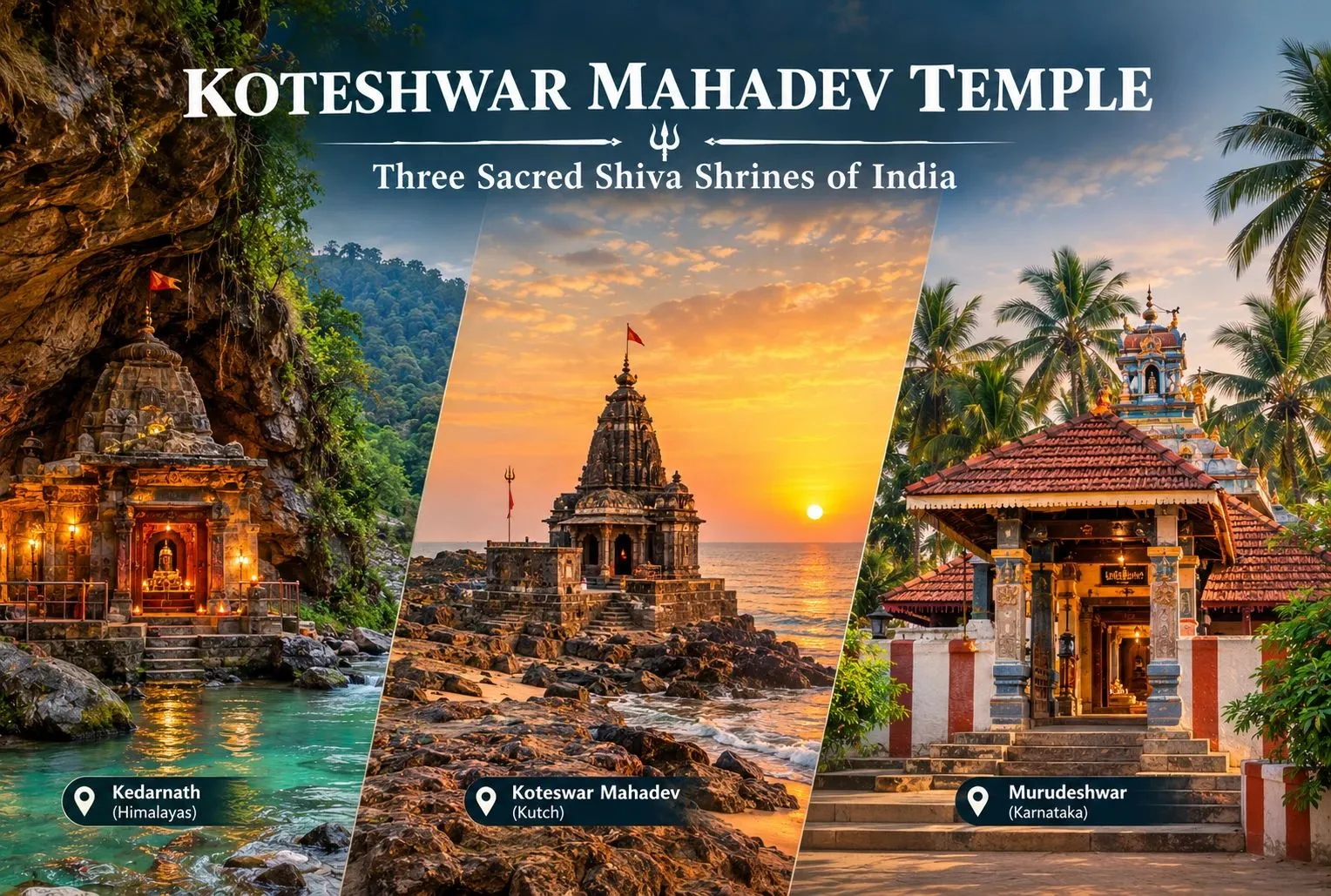
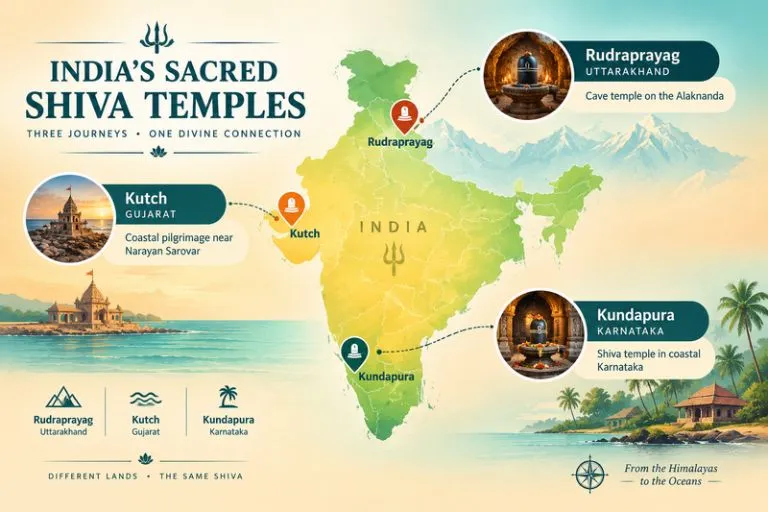
Search for the Koteshwar Mahadev Temple and you will find results from three different corners of India. The name is shared by several Shiva shrines, each with its own setting, legend, and travel route. This guide separates them so you can plan the right visit.

What Does Koteshwar Mean?

“Koteshwar” is commonly read as a name of Shiva linked to “koti,” often understood as a crore, though explanations vary from place to place. Because many regions use the name, a Koteshwar temple in one state can be unrelated to another by history, region, and tradition. The three below are among the most searched.

Koteshwar Mahadev Temple - India's Sacred Shiva Temples

Baba Koteshwar Mahadev Temple, Rudraprayag (Uttarakhand)

Baba Koteshwar Mahadev temple in Rudraprayag district is a cave shrine beside the Alaknanda river, a few kilometres from Rudraprayag town on the highway toward Srinagar. Devotees worship natural rock formations inside the cave as Shivlingas. Local tradition says Shiva meditated here before moving on toward Kedarnath, and that the Pandavas sought his blessing at this spot. This is devotional tradition rather than documented history.

The temple sits on the route that pilgrims use for Kedarnath and Badrinath, so many travelers treat it as a short stop. A brief walk down from the road leads to the cave, and most visits take under an hour.

Koteshwar Mahadev, Kutch (Gujarat)

Koteshwar Mahadev in Kutch stands near the western tip of Gujarat, close to the sea and not far from Narayan Sarovar, in Lakhpat taluka. It is one of the remote pilgrimage sites of the region, with a coastal, windswept setting that feels very different from the Himalayan version. Local tradition connects the temple to the Atmalinga story from the Ramayana, in which a linga is said to have broken or scattered into many forms. Versions differ, so treat it as local belief.

The site is roughly in the range of 100 to 150 km from Bhuj by road, which makes it a long day trip. Please confirm the distance and road conditions on a live map before you go.

Koteshwara Temple, Kundapura (Karnataka)

In coastal Karnataka, the Koteshwara temple lies in Kundapura taluk of Udupi district, a short distance from Kundapura town. It is a well-known Shiva temple in the Tulu and Kannada region, with local festivals and traditions of its own. Since this temple has a separate history from the other two, a local guide or the temple office is the best source for its legends and ritual calendar.

Quick Comparison

DetailRudraprayagKutchKundapura
StateUttarakhandGujaratKarnataka
SettingCave beside the AlaknandaCoastal, near Narayan SarovarCoastal Karnataka village
Best known forCave shrine on the Kedarnath routeRemote sea-edge pilgrimageLocal Shiva worship and festivals
Nearest big cityRishikesh and DehradunBhujKundapura and Mangaluru

Timings

Shiva temples usually open in the early morning, close for a midday break, and reopen in the evening, with aarti at fixed times. Timings differ by temple and change with festivals, so please confirm them locally before you travel.

Best Time to Visit Each Koteshwar Mahadev Temple

  • Rudraprayag: March to June and September to November. The monsoon can bring landslides on the highway.
  • Kutch: October to March is the most comfortable, since summers are very hot.
  • Kundapura: October to February, outside the heavy coastal monsoon.

How to Reach

For Rudraprayag, Jolly Grant Airport in Dehradun and Rishikesh railway station are the usual gateways, followed by a drive along the Badrinath highway. For Kutch, Bhuj has the nearest airport and railhead, with a long road journey onward. For Kundapura, Mangaluru is the main airport, and Kundapura has its own railway station on the Konkan line. Please check live maps and schedules, since I haven’t confirmed exact figures.

Planning a Wider Shiva Pilgrimage

If this guide has you thinking about a longer circuit, Explore Hills’ Panch Kedar Trek links five Shiva shrines in the Garhwal Himalayas, and the Do Dham Yatra covers two of Uttarakhand’s most important pilgrimage sites in a shorter trip.

For official travel information across India, you can refer to the Ministry of Tourism, Government of India, the national tourism authority.

What to Keep in Mind Before Visiting

  • Dress modestly and remove footwear before entering the shrine
  • Carry cash, as card use can be limited near smaller temples
  • Check road and weather conditions in monsoon, especially in Uttarakhand
  • Confirm which Koteshwar temple you are booking transport for, since the names are shared

Conclusion

The Koteshwar Mahadev Temple is really three different journeys under one name: a cave beside a Himalayan river, a remote coastal shrine in Kutch, and a Shiva temple in coastal Karnataka. Pick the one that fits your route, confirm local details, and you will find that each has its own quiet character.

Frequently Asked Questions

Where is Koteshwar Mahadev Temple located?

There are several, including one in Rudraprayag in Uttarakhand, one in Kutch in Gujarat, and one near Kundapura in Karnataka.

Which is the Baba Koteshwar Mahadev temple?

Baba Koteshwar Mahadev temple usually refers to the cave shrine beside the Alaknanda in the Rudraprayag district, Uttarakhand.

Is the Koteshwar temple in Gujarat the same as the one in Uttarakhand?

No. They are separate shrines in different regions, each with its own legends and traditions, even though they share the Koteshwar name.

What is the best time to visit Koteshwar Mahadev?

It depends on the region: March to June and September to November for Rudraprayag, and October to March for Kutch and Karnataka.

How long does a Koteshwar Mahadev Temple visit take?

The Rudraprayag cave temple usually takes under an hour, while the Kutch and Karnataka temples need more travel time to reach.

Annapurna: The Goddess of Plenty and the Treks Built Around Her

Annapurna

There is a moment on the way up to a high Himalayan basin when the clouds drop away and a wall of rock and ice appears so close that it feels like a mistake. For most people who walk the Annapurna region, that moment comes somewhere above 3,000 metres, and it explains why this corner of Nepal has pulled in trekkers, climbers and quiet wanderers for more than seventy years. The name itself carries the promise: it honours the Hindu goddess of food and nourishment, and its Sanskrit roots are usually read as “everlasting food.”

This guide covers what actually matters before you go: the real Annapurna height and the giants around it, the history of its first ascent, how the Annapurna Base Camp trek differs from the longer Annapurna Circuit trek, and how to plan permits, seasons and pacing without guesswork. If you enjoy high-altitude walking in general, our Roopkund guide covers a very different Himalayan route worth comparing.

Annapurna Height and the Peaks Around It

Start with the headline number. The Annapurna mountain, listed as Annapurna I, rises to 8,091 metres (26,545 feet), which makes it the tenth-highest peak on Earth. That figure is only part of the picture, though, because the name covers a whole massif rather than a single summit. The second summit reaches roughly 7,937 metres, the third about 7,555 metres and the fourth about 7,525 metres, with Gangapurna and Annapurna South standing close by.

Then there is Machapuchare, the “fish tail,” at 6,993 metres. It is lower than its neighbours, yet it is the peak most travellers photograph, because it stands forward of the main range above Pokhara and looks like a perfect pyramid. Machapuchare has never been officially climbed. In 1957 a British team led by Jimmy Roberts stopped about 46 metres below the top, honouring a promise made to the king of Nepal that the summit itself would remain untouched, and no permit has been issued since.

The First Eight-Thousander Ever Climbed

On 3 June 1950, Maurice Herzog and Louis Lachenal reached the summit, and the French expedition they belonged to made history: it was the first time anyone had stood on an eight-thousand-metre peak. The descent was brutal. Both men suffered severe frostbite, and the retreat through a storm turned into one of the most famous survival stories in mountaineering.

The mountain has stayed serious ever since. Its first winter ascent came on 3 February 1987, by the Polish climbers Jerzy Kukuczka and Artur Hajzer. According to figures recorded by Guinness World Records in early 2025, about 75 climbers have died from roughly 559 ascents, a fatality rate near 13 per cent, which has long been among the highest of any major peak. Most trekkers never go near that terrain, but it adds weight to the views you see from below.

A Protected Landscape, Not Just a Mountain

Every route in the region sits inside the Annapurna Conservation Area, which covers 7,629 square kilometres and is the first and largest protected area in Nepal. Official tourism material lists 102 mammal species here, including blue sheep and the endangered snow leopard, alongside 474 bird species such as the Himalayan monal and blood pheasant. Within a single walk you can pass through subtropical terraces, rhododendron forest, alpine meadow and bare glacial moraine, which is a large part of why this area feels so varied compared with other treks.

Annapurna Base Camp Trek: Into the Sanctuary

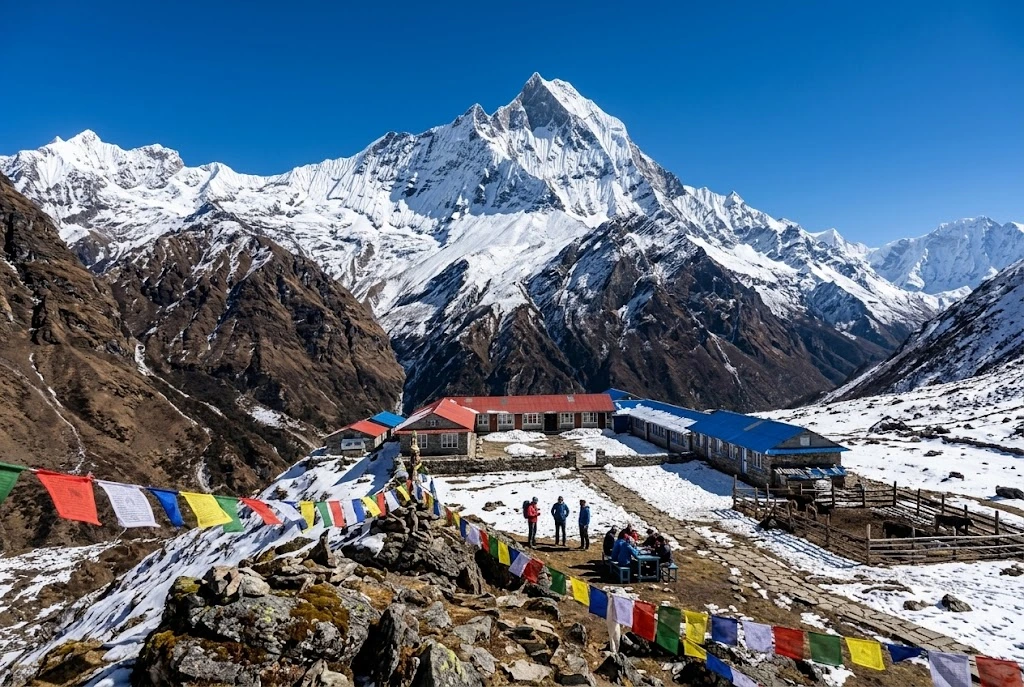
For many walkers, the Annapurna Base Camp trek is the main event. The route enters the Annapurna Sanctuary, a high glacial basin roughly 40 kilometres north of Pokhara, ringed by peaks and reachable through a single narrow gap between Hiunchuli and Machapuchare. Annapurna Base Camp itself sits at about 4,130 metres.

Most itineraries run seven to twelve days. The classic line starts near Nayapul, climbs through Ghandruk and Chhomrong, then follows the Modi Khola river up through bamboo forest, the villages of Himalaya and Deurali, and Machapuchare Base Camp at around 3,700 metres. The final stretch is the memorable one: you emerge from the gorge onto an open, snow-lined bowl where almost every direction is a peak.

The distance is not extreme, roughly 110 kilometres round trip depending on where you start, but the climbing is steady, and the sudden gain in height above Deurali is where most people feel the altitude. Allow a rest day if you can, sleep lower than you climb where possible, and treat headaches and nausea seriously rather than pushing through.

Annapurna Circuit Trek: The Long Way Round

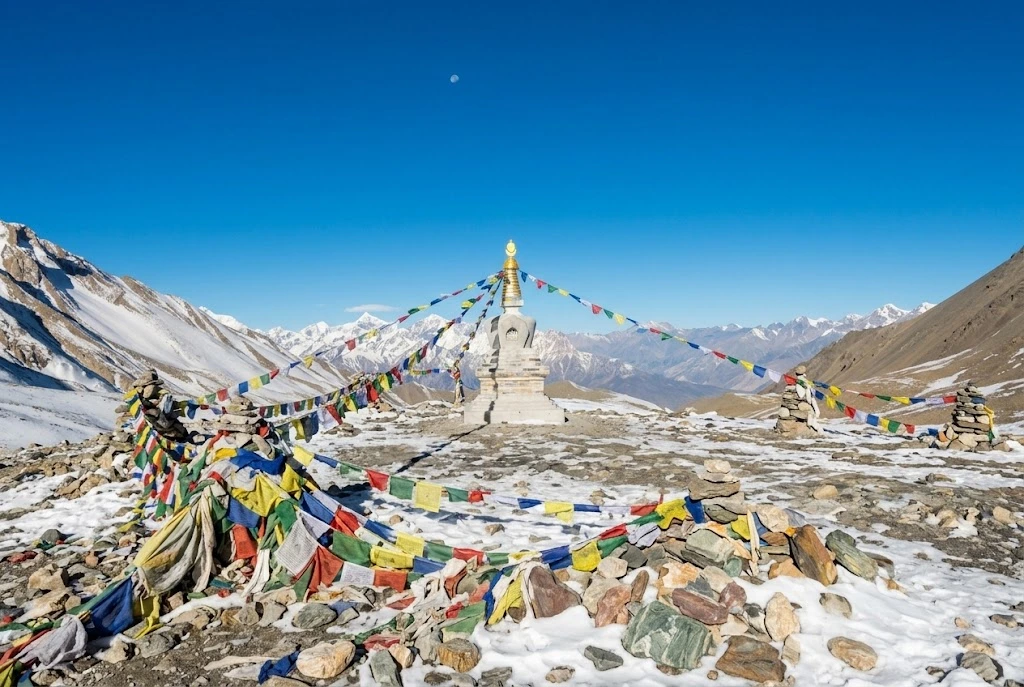
If the base camp route is a deep dive into one valley, the Annapurna Circuit trek is a journey around the entire massif. It usually takes 15 to 20 days, depending on how much of the route you cover on foot and how much by jeep, and its high point is Thorong La, at 5,416 metres, one of the highest trekking passes in the world.

The walk starts in the Marshyangdi valley near Besisahar, passes through Manang, crosses Thorong La and drops to Muktinath, a place sacred to both Hindus and Buddhists, before following the Kali Gandaki gorge south. Roads have changed this route a great deal. Reports suggest up to three-quarters of the original line has been affected by road building, and only the pass itself and the Ghorepani section lack a motor road. Many trekkers now use side trails and shorter segments instead, which keeps the Annapurna trail quiet in places and busy in others.

Choosing Your Annapurna Trail

The two big routes suit different travellers. The short comparison below is a useful starting point.

Base Camp routeCircuit route
Typical length7 to 12 days15 to 20 days
High pointAbout 4,130 m5,416 m (Thorong La)
Best forFirst Himalayan trek, limited timeExperienced trekkers, variety
Main challengeSteep climbs, cold at the basinAltitude over the pass

If you have a week and moderate fitness, the base camp walk is the safer pick. If you want scale and cultural range, from Hindu villages to Tibetan-influenced Manang, the circuit repays the extra days. A third option, the Ghorepani Poon Hill walk, gives a taste of the region in four or five days and is a good test of how your body copes with height.

Altitude, Packing and Pacing

Most problems on any Annapurna trek come from going up too fast rather than from the terrain itself. Above 3,000 metres, aim to gain no more than about 500 metres of sleeping height per day, and build in an acclimatisation day at places like Manang on the circuit or Deurali on the base camp route. Drink plenty of water, avoid alcohol until you are settled, and descend at once if a headache gets worse or you feel confused or unsteady.

Pack in layers. Days in the lower valleys can feel warm, while nights near the sanctuary or the pass fall well below freezing, so a proper down jacket, warm hat, gloves and a four-season sleeping bag (or a rented one from Pokhara) earn their weight. Broken-in boots matter more than any gadget. Trekking poles save your knees on the long stone staircases, and a headlamp is useful because teahouses switch off lights early. Travel insurance that covers high-altitude evacuation is worth arranging before you leave home, since helicopter rescue is costly.

Best Time to Go, Permits and Practical Notes

Spring (March to May) and autumn (September to November) are the two reliable windows, and official sources name both. Spring brings rhododendron bloom, while autumn offers the clearest skies after the monsoon. Winter closes Thorong La more often than not and raises avalanche risk, and the monsoon fills valleys with cloud, though the northern rain-shadow section of the circuit stays comparatively dry.

All visitors need an entry permit for the conservation area, with a fee of NPR 2,000 per foreign visitor per entry, and local permit rules have shifted in recent years, so check current requirements before you travel. Teahouses line both routes, rooms are simple, and prices climb with altitude. Carry cash, since cards are rarely accepted above the lower villages. If you are combining this trip with a longer Himalayan itinerary, our Kuari Pass guide is a good companion for another ridge-line walk. For verified area details, refer to the Nepal Tourism Board page on the conservation area, the official national tourism organisation.

Frequently Asked Question’s

  1. What is the Annapurna height?

    The main summit stands at 8,091 metres (26,545 feet), making it the tenth-highest mountain in the world, with the wider massif including several peaks above 7,000 metres.

  2. How long is the Annapurna Base Camp trek?

    Most itineraries take seven to twelve days, covering roughly 110 kilometres round trip from the Nayapul side, with the camp sitting at about 4,130 metres.

  3. How long does the Annapurna Circuit trek take?

    Usually 15 to 20 days, depending on how much walking is replaced by road transport, with Thorong La at 5,416 metres as the highest point.

  4. Who first climbed Annapurna?

    Maurice Herzog and Louis Lachenal reached the summit on 3 June 1950, the first successful ascent of any eight-thousand-metre peak.

  5. What is the best time for an Annapurna trek?

    March to May and September to November are the best seasons, offering stable weather and clearer mountain views than winter or the monsoon.

  6. Is Machapuchare part of the Annapurna region?

    Yes. At 6,993 metres it stands on the edge of the sanctuary, and it has never been officially climbed because the Nepali government does not issue permits.

What stays with people after the miles is not a statistic. It is the stillness of the sanctuary at dawn, when the first light hits the summit ridge and the whole basin turns gold. Whether you choose the shorter walk to base camp or the long loop over the pass, you are following an Annapurna trail shaped by pilgrims, traders and climbers for generations, and it is worth taking slowly enough to notice.

A Glimpse of the Chitai Golu Devta Temple

Chitai Golu Devta Temple

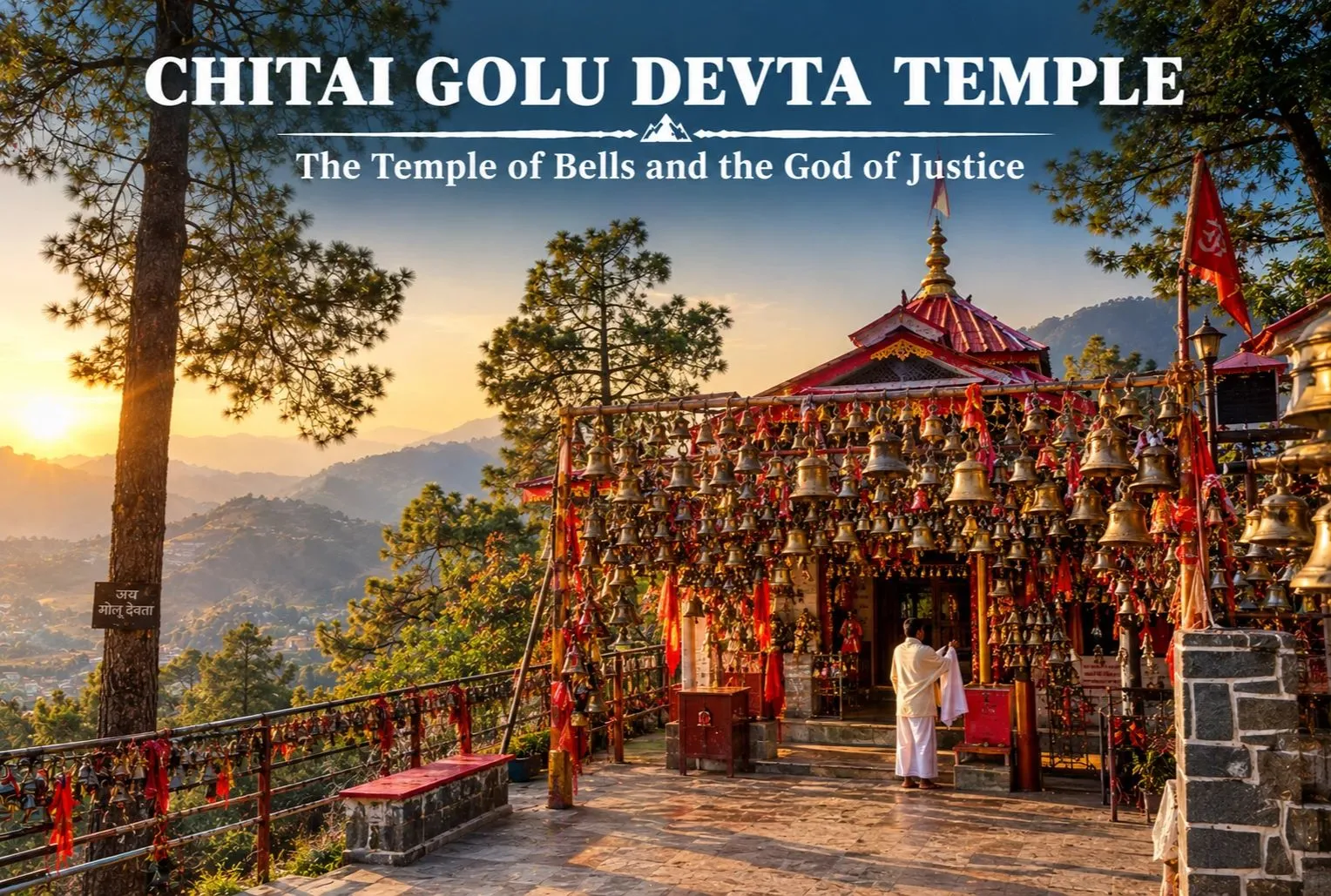
Chitai Golu Devta Temple is a sacred Hindu temple dedicated to Golu Devta, who is popularly known as Goljyu Devta. Golu Devata is a deity of the Kumaon region as well as the eastern Garhwal region of Uttarakhand. He is also referred to as the god of justice. The temple was constructed in the 12th century by a general belonging to the Chand Dynasty. The statue of Lord Golu installed in the temple is of white color. Golu Devta is seen sitting on his horse. The temple is surrounded by a thick forest of Chir pines. Golu Devta is famous as Nyaya ke Devta. He is believed to be an incarnation of Lord Shiva in the form of Gaur Bhairav.

The temple holds a great religious value and devotees offer their prayers utilizing white cloth, pagri, and white shawl. The belief of locals says any issue related to legal cases can be solved or fulfilled by writing it down on a white paper and tying it along with a bell in the temple. Every day this temple of Golu Devta is visited by thousands of pilgrims in order to get their wishes fulfilled. The temple looks extraordinary and can be easily recognized by the number of copper bells hung on its premises.

History and Origin of Chitai Golu Devta

Tales about his birth differ from place to place. One popular legend tells of King Jhal Rai and his queen, Kalinka. The story about Golu says the king, while hunting, sent his servants to look for water. The servants disturbed a woman who was praying. The woman, in a fit of anger, taunted the king that he could not separate two fighting bulls and proceeded to do so herself. The king was very impressed by this deed and he married the lady.

When this queen gave birth to a son, the other queens, who were jealous of her, replaced the boy with a silbatta (batan, stone), put him in a cage, and cast him into the river. A fisherman eventually found the child and raised him. When the boy grew up, he took a wooden horse to the river and on being questioned by the queens, he replied that if women can give birth to stone, then wooden horses can drink water. When the king heard about this, he punished the guilty queens and crowned the boy, who went on to be known as Golu devta.

Chitai Golu Devta Temple - Traditions & Faith

Chitai Golu Devta Temple Almora Uttarakhand

The Chitai Golu Devta temple is located in Chitai village, roughly 8 to 10 kilometers from Almora town on the Almora–Pithoragarh or Jageshwar Dham road (State Highway 37) in Uttarakhand.

Temple Location

● Located on the Jageshwar- Dham road, Golu Devta Temple is situated at a distance of 8.5km from Almora.

● It is Situated at the top of a hill amidst the Kumaon hills, 25km from Binsar Wildlife Sanctuary in the Chitai village. It is easily connected by motorable roads with all the nearby destinations of Uttarakhand.

● Can be easily reached via road from with all the nearby destinations of Uttarakhand.

● The nearest major Railway station is Kathgodam Railway Station which is at a distance of 89km approx. Cab/ Taxi is easily available from the station to reach Chitai Temple.

Best time to Visit Chitai Golu Devta Temple

Chitai Golu Temple timings are Monday to Sunday between 6 A.M. to 10 P.M. One can visit the temple throughout the year, however, the best time to visit the Chitai temple is March to June as it will be really enjoyable during this time with pleasant weather. July and August can be a little difficult due to the Monsoon Season. But October to May is again a good time to visit, with snowy mountains surrounding the region here.
For official travel information and advisories in this region, you can refer to the Uttarakhand Tourism Development Board, the state government’s official tourism body.

Religious and Cultural Importance of Golu Devta and the Chitai Temple

India’s social and religious environment is diverse, featuring numerous deities that are not exclusively part of the primary Brahmanical/Puranic Hindu traditions. Throughout India, individuals venerate regional deities and ancestral spirits that are tied to the particular geography and borders of their territory. In the Himalayas, particularly, the worship of such deities, and the practices related to it, have not been absorbed into the mainstream Hindu pantheon as yet. The local people believe in these gods who seem to exercise control over different territories. One of these prominent deities who has become significant over the last few years is Goludevta or Goriya Raja of Uttarakhand.

Golu Devata is seen in the form of Bhairav. Golu Devata is also worshiped as a key ancestral deity (Ista/Kula Devta) in many villages in Kumaon and Garhwal regions of Uttarakhand.

There are many temples of Golu Devata in the Kumaon region, and one of the most popular temple is the Chitai Golu Devta Temple . It is a popular belief that Golu Devata dispenses quick justice to the devotee. Many devotees file a lot of written petitions daily, which are received by the temple.

Things to Experience at the Chitai Temple

● Worshippers pin written letters, family problems, or even formal legal documents referred to as ‘Arzi’ directly to the temple walls, asking the deity to act as the ultimate judge and resolve their problems.

● Pilgrims tie brass bells around the temple grounds as a symbol of gratitude once their prayers are answered.

● Traditional offerings like white cloth, white turbans (pagri), and white shawls are frequently presented to Golu Devta by the pilgrims.

● Traditional offerings like white cloth, white turbans (pagri), and white shawls are frequently presented to Golu Devta by the pilgrims.

Conclusion

Chitai Golu Devta Temple is an important religious place in Almora, Uttarakhand, and holds a special place in the hearts of devotees. The temple is famous for its association with Golu Devta, who is worshipped as the God of Justice. The tradition of offering bells and writing petitions makes this temple different from many other temples. Along with its religious importance, the temple also gives visitors a chance to learn about the culture and traditions of the Kumaon region. Overall, Chitai Golu Devta Temple is a meaningful place to visit for anyone exploring the spiritual and cultural beauty of Uttarakhand. Travelers who enjoy temple treks in the Garhwal Himalayas can also explore at Explore Hills’ Kalpeshwar Rudranath Trek.

Frequently Asked Questions

Why are bells tied around Chitai Golu Devta Temple?

Bells are tied around the Chitai Golu Devta Temple by the devotees as a symbol of gratitude when they believe their prayers have been answered.

What is an Arzi at Chitai Golu Devta Temple?

An Arzi is a written petition or request presented by devotees to Golu Devta. People write about their problems, concerns, or wishes on paper and offer their petitions as an expression of faith in the deity’s justice.

What should devotees offer at Chitai Golu Devta Temple?

According to the tradition bells, white cloth, white turbans (pagris), and white shawls are offered by the devotees to the temple. Some visitors also submit written petitions.

Why do people write legal petitions at Chitai Golu Devta Temple?

Golu Devta is known as the God of Justice. Devotees believe they can seek his help when they have any personal or legal difficulty. Devotees write petitions to bring up their concerns to Golu Devta.