



The 12 Jyotirlingas are the holiest shrines of Lord Shiva in Hinduism, spread across eight Indian states from Gujarat’s coast to the Himalayan peaks of Uttarakhand and the southern tip of Tamil Nadu. According to Hindu tradition, each Jyotirlinga marks a site where Shiva manifested as a “jyoti,” or column of radiant light. This guide covers all 12 Jyotirlingas — their names, locations, temples, religious significance, and the practical details you need to plan a visit, including how to reach each site, the best time to go, and what a realistic Jyotirlinga Yatra route actually looks like.
Table of Contents
Key Takeaways
- There are 12 Jyotirlingas in India, located across Gujarat, Andhra Pradesh, Madhya Pradesh, Uttarakhand, Maharashtra, Uttar Pradesh, Jharkhand, and Tamil Nadu.
- A Jyotirlinga is a shrine where Shiva is worshipped in the form of a “jyoti” (light), which distinguishes these 12 temples from other Shiva temples across India.
- Kedarnath is the only Jyotirlinga in Himalayan terrain, and it closes for several months each year due to snow.
- There’s no single fixed route for a 12 Jyotirlinga Yatra. The best route depends on your starting city, available time, budget, and season of travel.
- Completing all 12 Jyotirlingas in one trip is rarely practical. Most travelers cover them in phases, moving through one regional cluster at a time.
Quick Answer
The 12 Jyotirlingas are Somnath (Gujarat), Mallikarjuna (Andhra Pradesh), Mahakaleshwar (Madhya Pradesh), Omkareshwar (Madhya Pradesh), Kedarnath (Uttarakhand), Bhimashankar (Maharashtra), Kashi Vishwanath (Uttar Pradesh), Trimbakeshwar (Maharashtra), Vaidyanath/Baidyanath (Jharkhand), Nageshwar (Gujarat), Rameshwaram (Tamil Nadu), and Grishneshwar (Maharashtra).
| No. | Jyotirlinga | Place | State | Temple |
| 1 | Somnath | Prabhas Patan | Gujarat | Somnath Temple |
| 2 | Mallikarjuna | Srisailam | Andhra Pradesh | Mallikarjuna Swamy Temple |
| 3 | Mahakaleshwar | Ujjain | Madhya Pradesh | Mahakaleshwar Temple |
| 4 | Omkareshwar | Omkareshwar | Madhya Pradesh | Omkareshwar Temple |
| 5 | Kedarnath | Kedarnath | Uttarakhand | Kedarnath Temple |
| 6 | Bhimashankar | Bhimashankar | Maharashtra | Bhimashankar Temple |
| 7 | Kashi Vishwanath | Varanasi | Uttar Pradesh | Kashi Vishwanath Temple |
| 8 | Trimbakeshwar | Trimbak, Nashik | Maharashtra | Trimbakeshwar Temple |
| 9 | Vaidyanath (Baidyanath) | Deoghar | Jharkhand | Baba Baidyanath Dham |
| 10 | Nageshwar | Near Dwarka | Gujarat | Nageshwar Jyotirlinga Temple |
| 11 | Rameshwaram | Rameswaram | Tamil Nadu | Ramanathaswamy Temple |
| 12 | Grishneshwar | Verul (Ellora) | Maharashtra | Grishneshwar Temple |
What Is a Jyotirlinga?
A Jyotirlinga is a shrine where Shiva is worshipped as a jyoti, or column of light, rather than only as a physical linga. The word combines “jyoti” (light or radiance) with “linga,” the symbol of Shiva worshipped in temples across India.
According to Hindu tradition, the 12 Jyotirlingas are associated with the manifestation of Shiva as an infinite pillar of light. The term describes a particular sacred status within Shaivite belief; it should not be taken to mean that every temple has the same origin story, consecration history, or physical form. Many Shiva temples across India house a Shiva linga, while these 12 sites are especially revered in the traditional Jyotirlinga list.
Because of this status, the 12 Jyotirlingas rank among the most visited pilgrimage sites in Hindu religious life. Together, they form one of India’s most significant pilgrimage circuits.
How Many Jyotirlingas Are There in India?
There are 12 Jyotirlingas in India, spread across eight states. They range from the Arabian Sea coastline at Somnath and Dwarka in Gujarat to the Himalayan heights of Kedarnath in Uttarakhand, and from the Ganga ghats of Varanasi to the island temple town of Rameswaram at India’s southern tip. No single state holds more than three — Maharashtra has three, while Gujarat and Madhya Pradesh have two each. The standard list of 12 names stays consistent across most traditional sources, even where regional interpretations vary on smaller details.
12 Jyotirlingas in India — Complete Guide
1. Somnath – Prabhas Patan, Gujarat

- Location & Temple: Somnath Temple stands on the coastline of Prabhas Patan in Veraval, Gujarat, facing the Arabian Sea. It’s generally listed first among the 12 Jyotirlingas.
- Religious Significance: Somnath carries deep historical weight in Shaivite tradition and appears among the most frequently referenced Jyotirlingas in Hindu scripture.
- History: The temple has been destroyed and rebuilt multiple times over the centuries, most notably following raids during the medieval period. The current structure dates to a mid-20th century reconstruction and stands as a symbol of continuity.
- Traditional Legend: According to Hindu tradition, the Moon God (Chandra) built the original temple to seek relief from a curse — which is how Somnath, “Lord of the Moon,” got its name.
- Architecture: The temple follows Chalukya architectural style, with an ornate spire visible from the sea.
- How to Reach: Somnath connects by road, rail, and air through nearby Diu Airport. Direct trains run to Somnath Railway Station from several major Gujarat cities.
- Best Time to Visit: October to March, when coastal Gujarat’s weather turns cooler and more comfortable for sightseeing.
- Nearby Places: Diu, Dwarka, and Gir National Park pair naturally with a Somnath visit.
- Travel Tip: Check current temple timings before traveling — darshan hours can shift around festivals.
For a deeper look at the temple and visiting details, see Explore Hills’Somnath Temple Guide.
2. Mallikarjuna – Srisailam, Andhra Pradesh

- Location & Temple: Mallikarjuna Swamy Temple sits on the Nallamala Hills above the Krishna River at Srisailam, Andhra Pradesh.
- Religious Significance: Srisailam is also an important centre of Shakti worship and is associated in many religious accounts with a Shakti Peetha, giving the pilgrimage significance in both Shaivite and Shakta traditions.
- History: Multiple South Indian dynasties patronized the temple complex over centuries, including the Vijayanagara rulers, who contributed to its expansion.
- Traditional Legend: Tradition associates the temple with Kartikeya, Shiva’s son, who is said to have visited this site.
- Architecture: Tall fortified walls enclose the temple complex, with intricately carved gopurams (temple towers).
- How to Reach: Srisailam is reachable by road from Hyderabad and Kurnool. The nearest major railway stations and airport sit in Hyderabad, with onward road travel required.
- Best Time to Visit: October to February, when cooler weather suits the hill terrain.
- Nearby Places: Srisailam Dam and the surrounding Nallamala forest reserve.
- Travel Tip: The ghat road to Srisailam involves long travel hours. Plan for a full day of road transit if coming from Hyderabad.
Read the full temple guide on Explore Hills:Srisailam Mallikarjuna Temple Jyotirlinga Guide.
3. Mahakaleshwar – Ujjain, Madhya Pradesh
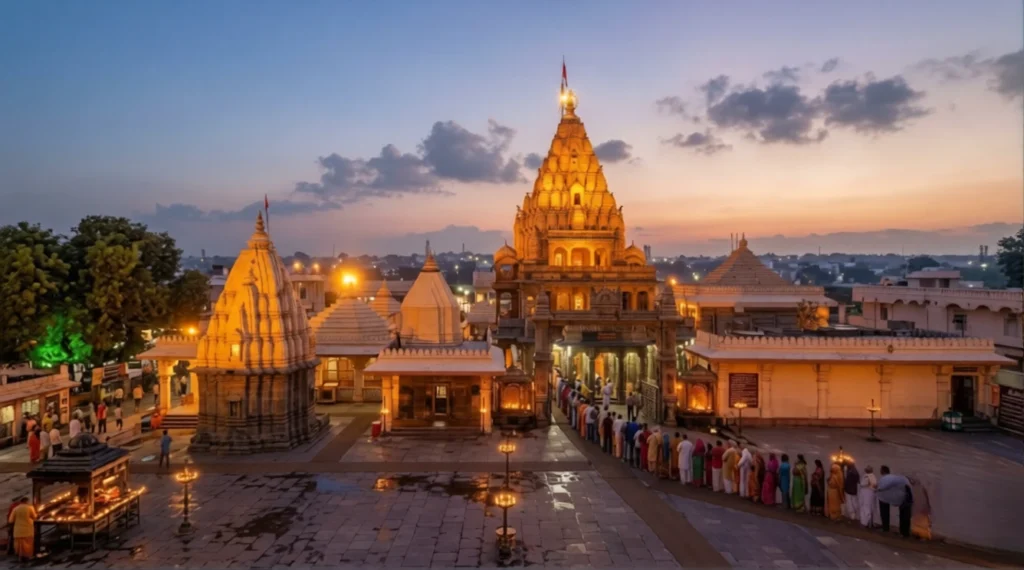
- Location & Temple: Mahakaleshwar Temple sits on the banks of the Shipra River in Ujjain, Madhya Pradesh.
- Religious Significance: This Jyotirlinga faces south, a feature unique to Mahakaleshwar among all 12 shrines, and it’s central to Ujjain’s identity as one of Hinduism’s seven sacred cities.
- History: Ujjain has served as a center of learning and astronomy for centuries, and the temple has seen multiple phases of reconstruction through history.
- Traditional Legend: The Bhasma Aarti, performed with sacred ash in the early morning, is a ritual unique to this temple, tied to local tradition around the Mahakal deity.
- Architecture: The temple follows a five-tiered structure, with the main sanctum below ground level.
- How to Reach: Ujjain has its own railway station with strong connectivity to major Indian cities. Indore Airport serves as the nearest major air hub, about an hour’s drive away.
- Best Time to Visit: October to March.
- Nearby Places: Kal Bhairav Temple and the historic ghats of Ujjain.
- Travel Tip: The early morning Bhasma Aarti typically requires advance booking. Verify current booking procedures before your visit.
For more detail, see Explore Hills’Mahakaleshwar guide.
4. Omkareshwar – Omkareshwar, Madhya Pradesh
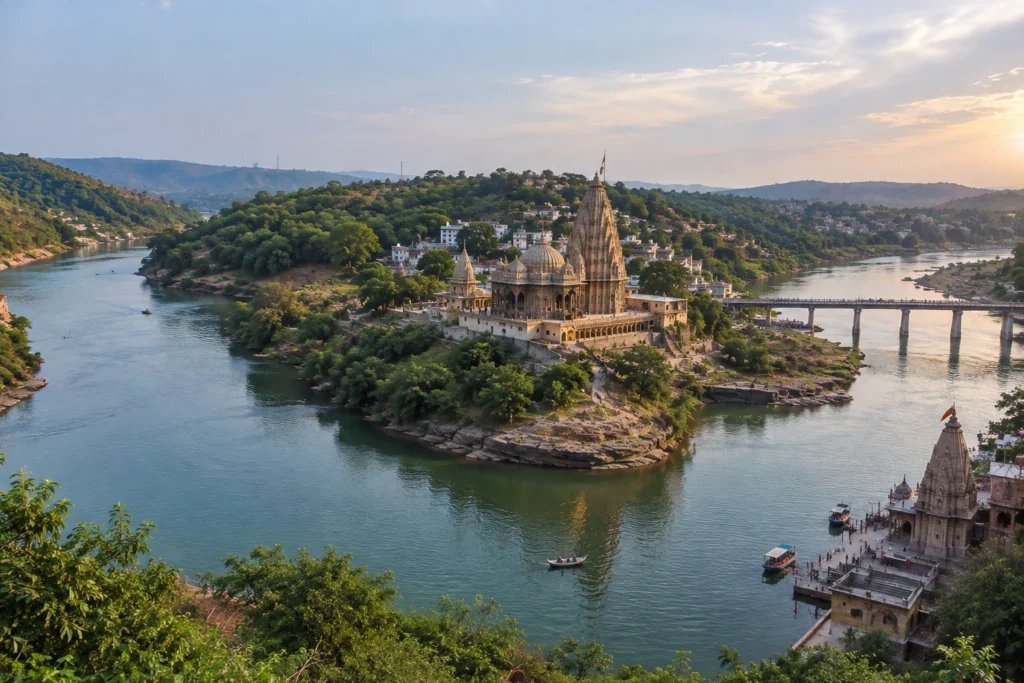
- Location & Temple: Omkareshwar Temple sits on Mandhata Island in the Narmada River, Madhya Pradesh. The island itself is said to be shaped like the Om symbol, which gives the site its name.
- Religious Significance: Omkareshwar is often visited together with Mahakaleshwar as part of a combined Madhya Pradesh Jyotirlinga circuit. Unusually, the Jyotirlinga here is traditionally understood as divided between two shrines — the island temple and Mamleshwar on the mainland’s southern bank — and pilgrims typically worship at both.
- History: The temple has long been associated with the sacred Narmada River, one of India’s most revered rivers in Hindu tradition. The present structures date largely to the Paramara dynasty, with later support from Maratha rulers including the Holkars.
- Traditional Legend: Local tradition holds that the Vindhya mountain range worshipped Shiva here to gain strength, which is said to have led to Shiva’s manifestation as a Jyotirlinga at this site.
- Architecture: A pedestrian bridge connects the mainland to Mandhata Island. The main temple has five levels, each housing a different form of Shiva.
- How to Reach: The nearest railway station is Omkareshwar Road (Mortakka), about 12 km away, with Indore serving as the nearest major airport, roughly 77 km from the site.
- Best Time to Visit: October to March.
- Nearby Places: The riverside ghats, Kotitirtha Ghat, and Ekatma Dham, home to the 108-foot Statue of Oneness honoring Adi Shankaracharya.
- Travel Tip: Combine this with Mahakaleshwar — both sites sit within a reasonable road distance of each other in Madhya Pradesh.
For the full picture, including temple timings and the Ekatma Dham complex, see Explore Hills’Omkareshwar guide.
5. Kedarnath – Kedarnath, Uttarakhand

- Location & Temple: Kedarnath Temple sits in the Garhwal Himalayas of Uttarakhand, on the bank of the Mandakini River near the Chorabari Glacier, at an elevation of roughly 3,583 meters (11,755 feet). It’s the only Jyotirlinga located in true Himalayan terrain.
- Religious Significance: Kedarnath is also one of the Char Dham and Do Dham pilgrimage sites, and one of the Panch Kedar shrines, which adds significance beyond its Jyotirlinga status.
- History: The temple’s stone structure has withstood centuries of extreme Himalayan weather, and it survived the 2013 Uttarakhand floods largely intact — something many devotees regard as significant.
- Traditional Legend: According to tradition tied to the Mahabharata, the Pandavas sought Shiva’s forgiveness here after the Kurukshetra war. Shiva is said to have taken the form of a bull and dived into the ground, with parts of his body appearing at five different Himalayan sites, together known as the Panch Kedar. Kedarnath represents his hump. For travelers wanting the complete five-shrine circuit, Explore Hills’Panch Kedar Trek covers all five.
- Architecture: Built from large grey stone slabs, the temple’s construction technique has puzzled architects given its age and high-altitude location.
- Himalayan Setting & Trek: Reaching the temple involves a trek of approximately 16 kilometers from Gaurikund. The route is a sustained uphill walk at high altitude, and actual walking time varies with fitness, weather, crowd levels, and trail conditions. Pony and palanquin services may be available during the yatra season, subject to local arrangements and official operating instructions.
- Seasonal Accessibility & Weather: Kedarnath is not accessible year-round. Kedarnath is not accessible throughout the year. The temple generally opens in spring and closes before the onset of severe winter conditions, usually around October or November. The exact opening and closing dates are announced annually and can change with the Hindu calendar and local conditions. Temperatures can be low even during the pilgrimage season, while monsoon rain may increase the risk of landslides and travel disruption. Check the current season’s dates and weather advisories before setting out.
- Preparation: The trek involves altitude gain and unpredictable weather, including rain and cold even in summer. Carry layered clothing, rainproof gear, and comfortable trekking footwear, and build in rest points along the route.
- How to Reach: Most travelers fly into Jolly Grant Airport, Dehradun, or take the train to Rishikesh or Haridwar, then travel by road to Guptakashi and Sonprayag before beginning the trek from Gaurikund. Seasonal helicopter services may operate from designated helipads, subject to weather, government directions, and availability. Use only the authorised booking channel announced for the current yatra season; do not rely on old booking dates or third-party claims. For a complete overview of the route, accommodation, and trek logistics, see Explore Hills’Kedarnath Yatra guide.
- Best Time to Visit: May–June and September–October generally offer more stable weather within the temple’s open season, while July–August brings a higher risk of landslides on mountain roads.
- Nearby Places: Gaurikund, Sonprayag, Vasuki Tal, and Tungnath all pair naturally with a Kedarnath trip. Explore Hills covers combined itineraries in theKedarnath Tungnath Tour, theKedarnath Tungnath Badrinath Yatra, and theVasuki Tal andChopta Tungnath guides.
- Travel Tip: Complete the required yatra registration before travelling and check the latest instructions, route advisories, and verification requirements on the official Uttarakhand Char Dham registration portal. Check weather and road conditions during the trip, since Himalayan conditions can change quickly.
For the full Himalayan shrine guide, see Explore Hills’Kedarnath — Sacred Himalayan Shrine Guide.
6. Bhimashankar – Bhimashankar, Maharashtra

- Location & Temple: Bhimashankar Temple sits in the Sahyadri hills near Pune, Maharashtra, within the Bhimashankar Wildlife Sanctuary.
- Religious Significance: The temple also marks the source of the Bhima River, which adds to its spiritual significance in the region.
- History: The current temple structure dates to a later period of restoration, though the site’s sacred status is considerably older.
- Traditional Legend: Tradition associates this site with Shiva’s battle against the demon Tripurasura, after which Shiva is said to have manifested here as sweat (“Bhima”), giving the site its name.
- Architecture: The temple blends Nagara-style architecture with later additions, set within dense forest surroundings.
- How to Reach: Bhimashankar is reachable by road from Pune, roughly a few hours’ drive through hill terrain.
- Best Time to Visit: October to February, outside the monsoon when hill roads can turn slippery.
- Nearby Places: The surrounding wildlife sanctuary, known for trekking trails and biodiversity.
- Travel Tip: The approach road climbs through forest terrain. Avoid night travel if you’re unfamiliar with the route.
For more detail, see Explore Hills’Bhimashankar Mandir Jyotirlinga Guide.
7. Kashi Vishwanath – Varanasi, Uttar Pradesh
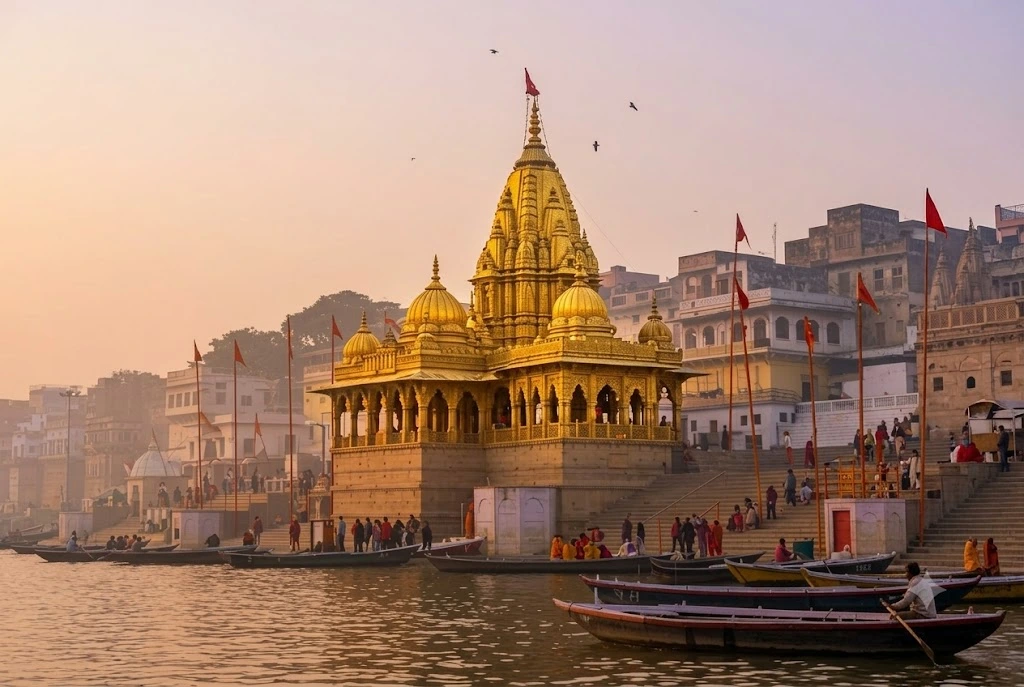
- Location & Temple: Kashi Vishwanath Temple sits on the western bank of the Ganga River in Varanasi, one of the oldest continuously inhabited cities in the world.
- Religious Significance: Varanasi, also called Kashi, ranks among Hinduism’s most sacred cities, and the temple sits at the center of the city’s religious identity.
- History: The temple has been rebuilt multiple times through history, with the current structure dating to the late 18th century. The surrounding Kashi Vishwanath Corridor underwent major redevelopment in recent years.
- Traditional Legend: Tradition holds that dying in Kashi, or visiting this temple, offers spiritual liberation (moksha).
- Architecture: The temple’s spires are gold-plated, a distinctive visual feature within the dense old-city surroundings.
- How to Reach: Varanasi has its own airport and major railway junction, with strong connectivity from across India.
- Best Time to Visit: October to March, when temperatures stay milder for walking through the ghats and old city lanes.
- Nearby Places: The Ganga ghats, Sarnath, and the evening Ganga Aarti at Dashashwamedh Ghat.
- Travel Tip: The temple area involvess narrow lanes with heavy footfall. Plan extra time for queues, especially during festivals.
For more detail, see Explore Hills’Kashi Vishwanath Temple guide.
8. Trimbakeshwar – Trimbak, Nashik, Maharashtra
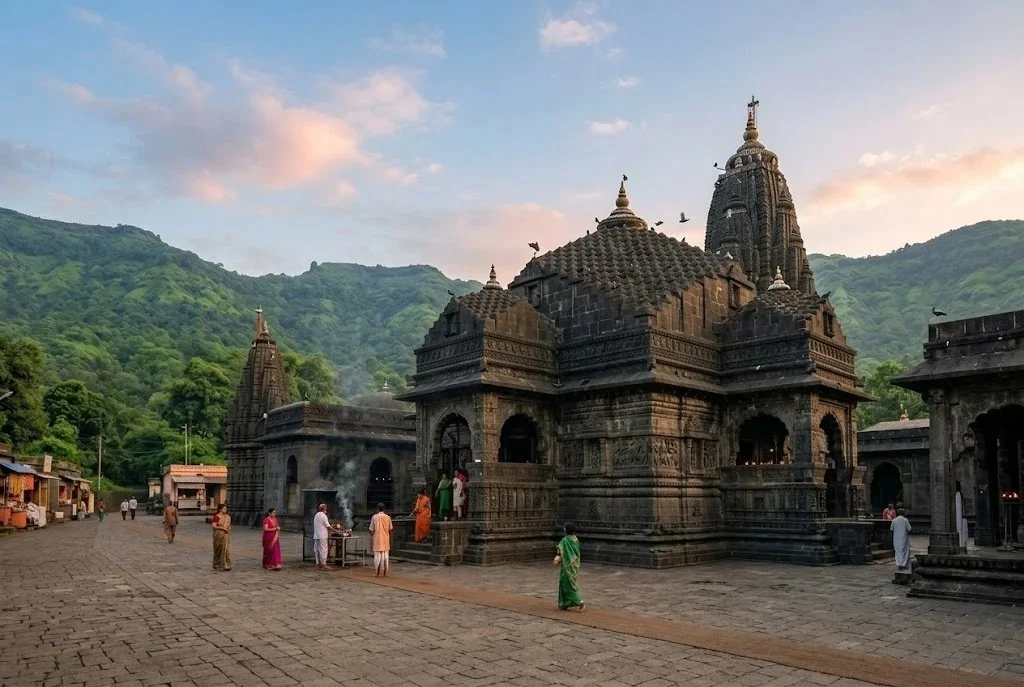
- Location & Temple: Trimbakeshwar Temple sits near Trimbak, close to Nashik, Maharashtra, at the source of the Godavari River.
- Religious Significance: The site marks the origin point of the Godavari, one of India’s major rivers, and it’s also linked to the Kumbh Mela rotation held in Nashik.
- History: The present temple structure dates to the 18th century, built under Peshwa patronage.
- Traditional Legend: Tradition describes the Jyotirlinga here as having three faces representing Brahma, Vishnu, and Shiva, reflected in the name “Trimbak” (three eyes/faces).
- Architecture: Built from black stone, in a style typical of 18th-century Maharashtra temple construction.
- How to Reach: Nashik is well connected by road, rail, and air, with Trimbak a short drive from the city.
- Best Time to Visit: October to March.
- Nearby Places: Nashik city, Anjneri Hill, and the Godavari ghats.
- Travel Tip: Photography restrictions apply inside the inner sanctum. Check current rules on arrival.
For more detail, see Explore Hills’Trimbakeshwar Temple — A Remarkable Jyotirlinga guide. For the three Maharashtra Jyotirlingas together, see theJyotirlinga in Maharashtra overview.
9. Baidyanath (Vaidyanath) — Deoghar, Jharkhand

- Location & Temple: Baba Baidyanath Dham sits in Deoghar, Jharkhand, part of a complex of 22 temples, with the main shrine standing 72 feet tall. Devotees also know it as Kamana Linga, the Jyotirlinga believed to grant wishes.
- Religious Significance: The temple draws some of the largest pilgrim crowds among India’s Jyotirlingas, particularly during the Shravan month.
- History: Regional rulers patronized the temple complex over centuries, though exact construction dates and the sequence of rebuilding are less firmly documented — a temple guide or the local trust is the best source for specifics.
- Traditional Legend: Tradition links the shrine’s origin to Ravana, who was carrying Shiva toward Sri Lanka on the condition he would not stop. He halted here, and Shiva remained rooted at this spot — giving the site its connection to healing (“Vaidya” means physician).
- Architecture: The complex includes 22 smaller temples surrounding the main Jyotirlinga shrine.
- How to Reach: Deoghar has its own domestic airport. Baidyanathdham railway station sits about 1.5 km from the temple, and Jasidih Junction is about 7.7 km away. The nearest bus stand in Deoghar is about 2 km from the temple.
- Best Time to Visit: October to February; the Shravan month (typically July–August) sees the heaviest pilgrim traffic, when devotees walk roughly 100 km from Sultanganj carrying holy water.
- Nearby Places: Naulakha Mandir and Basukinath, about 43 km away — many pilgrims consider the Baidyanath pilgrimage complete only after visiting Basukinath.
- Travel Tip: If visiting during Shravan, expect significantly longer queues and plan extra travel time.
- A Note on Other Claims: The identification of Vaidyanath is not presented uniformly in every regional tradition. Deoghar in Jharkhand is one widely followed identification, while Parli Vaijnath in Maharashtra is also associated with the name in some lists. This guide follows the Deoghar tradition for its location and travel information; visitors may encounter different regional accounts.
For more detail, see Explore Hills’Baidyanath Temple Deoghar Guide.
10. Nageshwar – Near Dwarka, Gujarat
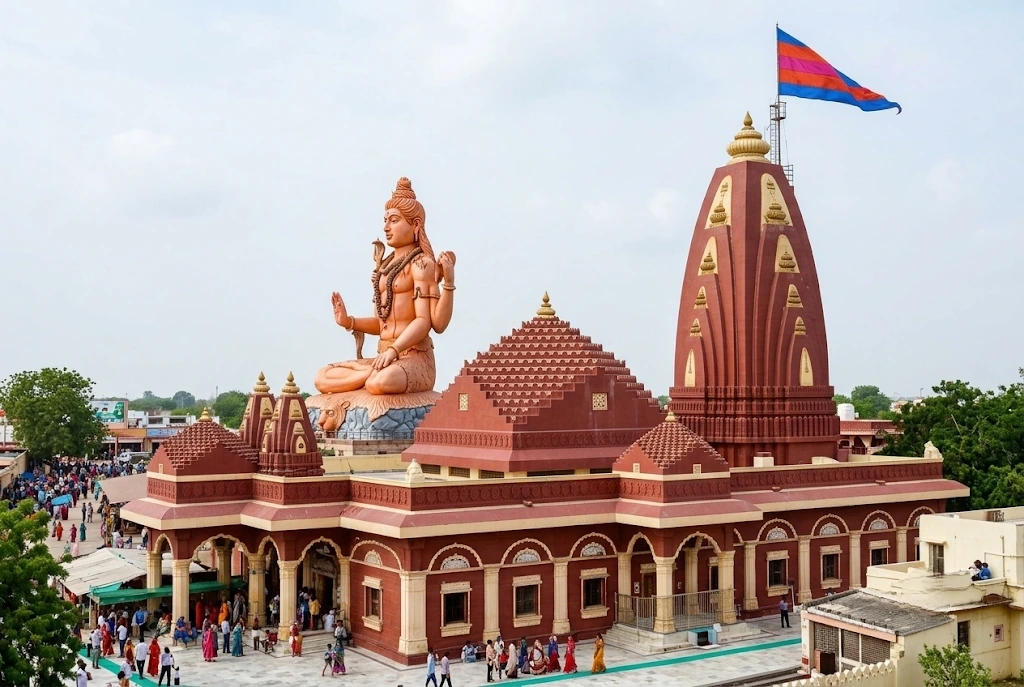
- Location & Temple: Nageshwar Jyotirlinga Temple sits near Dwarka, Gujarat, close to the Arabian Sea coast.
- Religious Significance: The temple’s proximity to Dwarka, one of the Char Dham sites associated with Lord Krishna, makes the region significant to both Shaivite and Vaishnavite traditions.
- History: Different regional traditions identify more than one site with the Nageshwar Jyotirlinga. This guide covers the well-known temple near Dwarka, Gujarat, while recognising that other identifications are also found in pilgrimage accounts.
- Traditional Legend: Tradition connects this Jyotirlinga to a story of Shiva protecting a devotee from a demon named Daruka, with “Naga” (serpent) forming part of the name.
- Architecture: A large Shiva statue, visible from a distance, stands alongside the main sanctum.
- How to Reach: Nageshwar is a short drive from Dwarka, which has its own railway station and a nearby airport in Jamnagar.
- Best Time to Visit: October to March.
- Nearby Places:Dwarkadhish Temple and the Arabian Sea coastline.
- Travel Tip: Combine this visit with Dwarka and Somnath — all three sites sit within a manageable road distance along the Gujarat coast.
For more detail, see Explore Hills’Nageshwar Jyotirlinga — Incredible Legend guide.
11. Ramanathaswamy – Rameswaram, Tamil Nadu
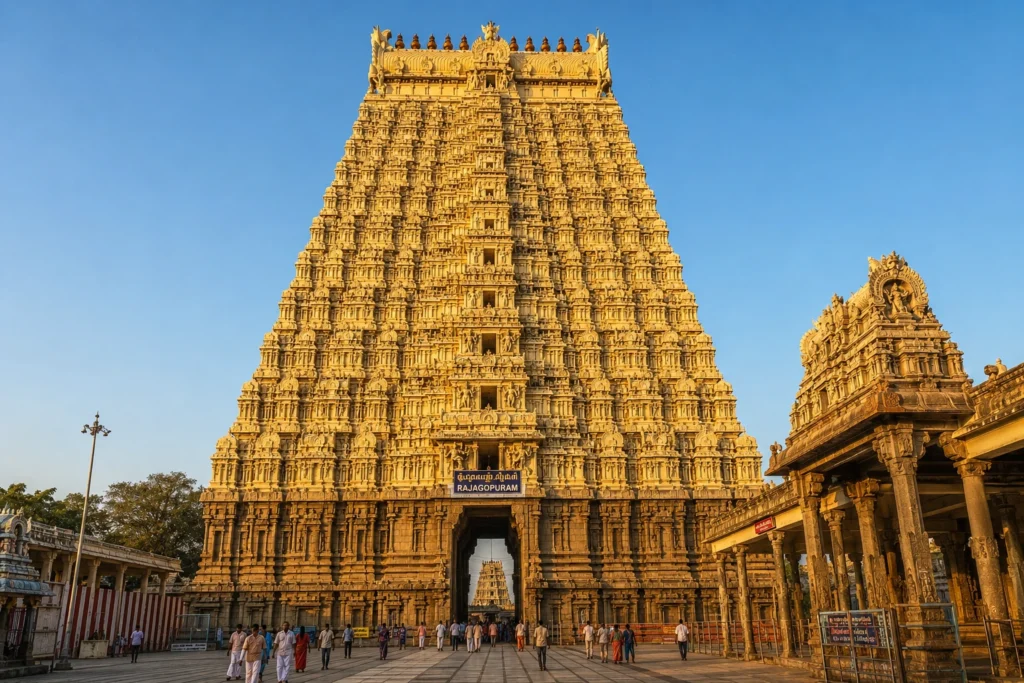
- Location & Temple: Ramanathaswamy Temple sits on Rameswaram Island in Tamil Nadu, connected to the mainland by the Pamban Bridge.
- Religious Significance: Rameswaram holds sacred status in both Shaivite tradition, as a Jyotirlinga, and in the Ramayana narrative — making it one of India’s most significant dual-tradition pilgrimage sites.
- History: The temple’s long corridors, among the longest of any Hindu temple, were constructed and expanded over several centuries by different dynasties.
- Traditional Legend: Tradition holds that Lord Rama worshipped Shiva here before his journey to Lanka, and that Sita herself installed the linga.
- Architecture: The temple is known for its pillared corridors, considered among the longest in any Hindu temple complex.
- How to Reach: Rameswaram has its own railway station, connected across the Pamban Bridge, with Madurai Airport serving as the nearest major air hub.
- Best Time to Visit: October to April, avoiding the peak heat of summer.
- Nearby Places: Dhanushkodi and the Pamban Bridge viewpoint.
- Travel Tip: The temple includes a ritual bath at 22 wells within the complex. Check current procedures and timings on arrival.
For more detail, see Explore Hills’Ramanathaswamy Temple guide.
12. Grishneshwar – Verul (Ellora), Maharashtra
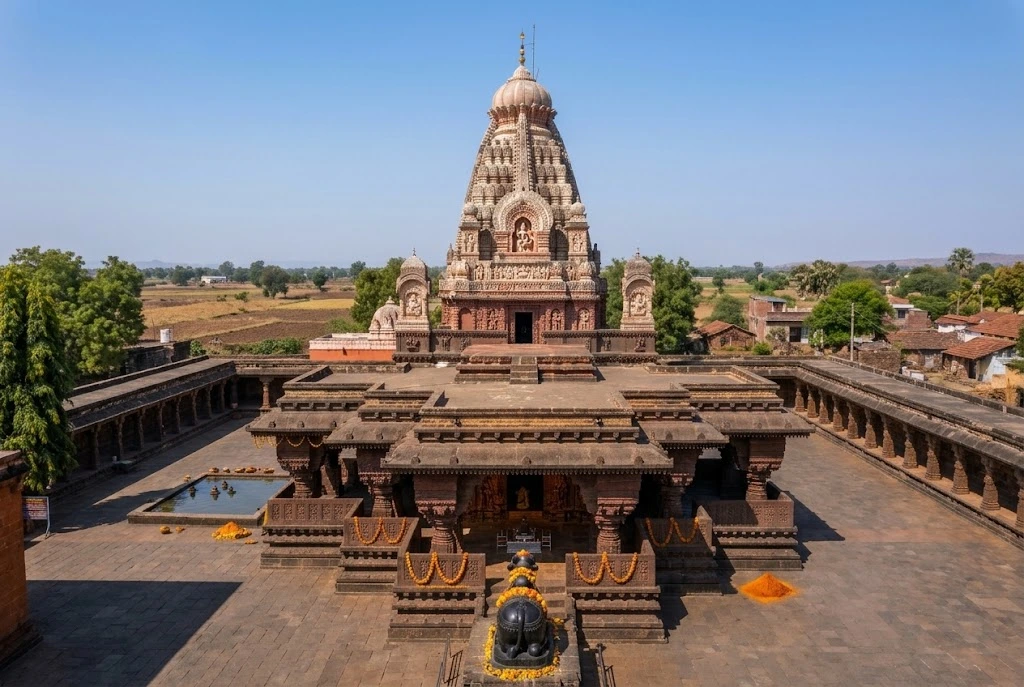
- Location & Temple: Grishneshwar Temple sits in Verul village near the Ellora Caves, Maharashtra, and is considered the last of the 12 Jyotirlingas in traditional listings.
- Religious Significance: The temple’s proximity to the UNESCO World Heritage Ellora Caves makes it a common stop for travelers combining pilgrimage with heritage sightseeing.
- History: The current structure dates to the 18th century, commissioned by Ahilyabai Holkar, who also contributed to the restoration of several other Jyotirlinga temples.
- Traditional Legend: Tradition tells of a devotee named Kusuma, whose devotion led to Shiva manifesting as a Jyotirlinga at this site after her son was restored to life.
- Architecture: Built from red volcanic rock, the temple features five tiers of sculptural work.
- How to Reach: Aurangabad is the nearest major city with rail and air connectivity, with Grishneshwar a short drive away, close to the Ellora Caves.
- Best Time to Visit: October to March.
- Nearby Places: Ellora Caves and Daulatabad Fort.
- Travel Tip: Visit the temple before or after the Ellora Caves, since both sites sit within the same short drive and pair naturally in a single day.
For more detail, see Explore Hills’Grishneshwar — The Powerful Story guide.
12 Jyotirlingas by State
| State | Jyotirlingas |
| Gujarat | Somnath, Nageshwar |
| Andhra Pradesh | Mallikarjuna |
| Madhya Pradesh | Mahakaleshwar, Omkareshwar |
| Uttarakhand | Kedarnath |
| Maharashtra | Bhimashankar, Trimbakeshwar, Grishneshwar |
| Uttar Pradesh | Kashi Vishwanath |
| Jharkhand | Vaidyanath (Baidyanath) |
| Tamil Nadu | Rameshwaram |
Maharashtra has the highest concentration, with three Jyotirlingas. Explore Hills covers all three together in the Jyotirlinga in Maharashtra guide. Gujarat and Madhya Pradesh follow with two each.
Best Time to Visit the 12 Jyotirlingas
Most of the 12 Jyotirlingas are best visited between October and March, when temperatures across central, western, and southern India turn milder for travel and temple visits.
- Gujarat, Madhya Pradesh, Maharashtra, Uttar Pradesh, Jharkhand, Andhra Pradesh: October to March offers the most comfortable travel conditions.
- Tamil Nadu (Rameshwaram): October to April generally works well, though coastal humidity stays a factor year-round.
- Uttarakhand (Kedarnath): The exception. Kedarnath follows a strict seasonal calendar tied to Himalayan weather, typically opening between late April and early May and closing around Diwali. Within that window, May–June and September–October tend to offer more stable conditions than the monsoon-affected July–August period. Always verify current opening and closing dates before planning travel, since they’re announced annually and can shift.
Avoid the peak summer months (April–June) in the plains regions of Gujarat, Madhya Pradesh, Andhra Pradesh, and Jharkhand, where daytime temperatures can make sightseeing uncomfortable.
How to Plan a 12 Jyotirlinga Yatra
Planning a Jyotirlinga Yatra starts with a few key decisions:
- Choose a starting city. Your starting point shapes your entire route. Common starting cities include Delhi, Mumbai, Ahmedabad, Hyderabad, and Chennai, depending on which regional cluster you begin with.
- Decide which regions to prioritize. Given the geographical spread, decide whether you’re covering all 12 Jyotirlingas across multiple trips or focusing on one or two regional clusters first.
- Choose your mode of transportation. Road, rail, and air each suit different clusters and budgets — covered in detail below.
- Estimate your required days. Account for travel time between regions, not just time at each temple.
- Plan accommodation. Dharamshalas (pilgrim guesthouses), budget hotels, and mid-range hotels are available near most Jyotirlinga sites. Book in advance during festival periods.
- Check temple timings in advance. Darshan hours vary by temple and can change around festivals. Verify current timings before each visit.
- Travel in the right season. Align your trip with the best time to visit for each region, particularly if Kedarnath is part of your itinerary.
- Build in a buffer. Weather delays, especially in the Himalayas, and temple queues during peak season can affect your schedule. A buffer day or two reduces stress on a multi-site itinerary.
- Consider your travel group. Families and senior citizens may need a slower pace, more rest stops, and careful planning around the Kedarnath trek.
- Set a realistic budget. Account for transportation, accommodation, food, and any guided assistance across the full trip.
For broader Himalayan pilgrimage planning, Explore Hills’ Uttarakhand Yatra guide and the Char Dham Yatra and Char Dham Yatra – The Ultimate Guide resources cover route, registration, and seasonal details that overlap with the Kedarnath leg of a Jyotirlinga journey.
12 Jyotirlinga Yatra Route
There’s no single fixed route for visiting all 12 Jyotirlingas. The best route depends on your starting city, preferred mode of transport, the season you’re traveling in, and your budget. Most travelers approach the 12 Jyotirlingas in regional phases rather than one continuous trip:
- Western cluster: Somnath and Nageshwar (Gujarat)
- Central cluster: Mahakaleshwar and Omkareshwar (Madhya Pradesh)
- Western Maharashtra cluster: Bhimashankar, Trimbakeshwar, and Grishneshwar
- Northern cluster: Kashi Vishwanath (Uttar Pradesh) and Vaidyanath (Jharkhand), often combined given their proximity in eastern-central India
- Himalayan cluster: Kedarnath (Uttarakhand), planned as its own dedicated trip given the trek and seasonal restrictions
- Southern cluster: Rameshwaram (Tamil Nadu) and Mallikarjuna (Andhra Pradesh)
Plan each cluster as a separate trip unless you have an extended travel window of several weeks.
12 Jyotirlinga Yatra by Road
Road travel offers flexibility to stop at nearby attractions and smaller shrines along the way, and it works well within regional clusters like Gujarat’s two Jyotirlingas or Maharashtra’s three. Hiring a car or joining a group tour are both common approaches. Road travel to Kedarnath only covers the portion up to Gaurikund — the final stretch to the temple itself must be completed on foot, by pony, or by helicopter where available.
Road conditions can vary significantly, especially in hill regions during monsoon. Check current road conditions before traveling, particularly for the Maharashtra and Uttarakhand clusters.
12 Jyotirlinga Yatra by Train
Most Jyotirlinga sites have direct or nearby rail connectivity. Varanasi, Ujjain, Nashik, Deoghar, and Rameswaram all have their own railway stations, making train travel a practical option for several sites. For clusters like Gujarat (Somnath–Nageshwar–Dwarka) or Madhya Pradesh (Ujjain–Omkareshwar), trains combined with short road transfers work efficiently. Kedarnath has no direct rail access — travelers typically reach Rishikesh or Dehradun by train and continue by road.
12 Jyotirlinga Yatra by Air
Flying is the fastest way to cover long distances between regional clusters. Major airports near Jyotirlinga sites include Ahmedabad and Jamnagar (for Gujarat), Indore (for Madhya Pradesh), Varanasi (for Kashi Vishwanath), Deoghar (for Vaidyanath), Madurai (for Rameshwaram), Hyderabad (for Mallikarjuna), and Aurangabad (for Grishneshwar). For Kedarnath, travelers fly into Dehradun and continue by road and foot. Seasonal helicopter services also operate on the Kedarnath route when available, subject to weather and season — see the official IRCTC Heli Yatra portal for bookings.
How Many Days Are Required for 12 Jyotirlingas?
The number of days required depends heavily on which regions you’re covering and how you’re traveling. A single regional cluster, such as Gujarat’s two Jyotirlingas or Maharashtra’s three, can typically fit into a few days including travel time. Covering all 12 Jyotirlingas requires a considerably longer commitment, generally planned across multiple separate trips rather than one continuous journey, given the distances involved and Kedarnath’s seasonal and trekking requirements. Build your itinerary around realistic travel times between regions rather than a fixed day count, since actual time needed varies by starting point, transport mode, and season.
12 Jyotirlinga Yatra Budget
Costs for a Jyotirlinga Yatra vary based on your mode of transport, choice of accommodation, season, and group size. Rather than fixed figures, which change frequently and vary by provider, budget for the following categories:
- Transportation: Flights, trains, or road travel between regions, plus local transport near each temple.
- Accommodation: Ranges from basic dharamshalas to mid-range hotels, depending on the site and season.
- Food: Local meals near temple towns, which vary by region and vendor.
- Kedarnath-specific costs: Pony, palanquin, or helicopter charges if you’re not trekking on foot, which vary seasonally and by demand.
- Guided tours or group packages: Costs vary by operator and inclusions.
- Miscellaneous: Donations, temple offerings, and contingency funds for weather delays.
Check current pricing directly with transport providers, accommodations, and temple authorities before finalizing your budget, since costs shift seasonally and year to year.
What to Carry for a Jyotirlinga Yatra
- Comfortable walking shoes, especially for temple complexes with large courtyards and the Kedarnath trek
- Modest clothing appropriate for temple visits
- A light raincoat or poncho if traveling during monsoon-affected months
- Layered clothing for Kedarnath, where temperatures can drop sharply even in summer
- A reusable water bottle and basic rehydration supplies
- A small first-aid kit, including any personal medication
- Valid identification documents, particularly if registration is required, as with Kedarnath
- A power bank, since charging access can be limited near some temple towns
- Cash in small denominations, since card acceptance can be limited near some temples
Important Tips for Visiting Jyotirlinga Temples
- Verify temple timings before each visit, since darshan hours can change seasonally and around festivals.
- Expect significant crowds during Shravan month, Maha Shivaratri, and other major Shaivite festivals. Plan extra time accordingly.
- Dress modestly; most temples have expectations around appropriate clothing for entry.
- Respect photography restrictions inside inner sanctums, which apply at several of these temples.
- Keep valuables secure in crowded temple areas.
- Stay updated on weather conditions, particularly for the Kedarnath route, where conditions can change quickly.
- Book accommodation in advance during peak pilgrimage seasons, as availability near popular temples can tighten considerably.
12 Jyotirlinga Yatra for Families and Senior Citizens
Most of the 12 Jyotirlingas are accessible to families and senior citizens without major physical demands, since they involve road or rail travel followed by walking within temple complexes. Kedarnath is the clear exception. The trek from Gaurikund involves sustained walking at altitude, and travelers with mobility concerns should consider pony, palanquin, or helicopter options where available, subject to season and availability.
For families and senior citizens planning a broader Jyotirlinga trip:
- Build in slower-paced days with fewer back-to-back temple visits.
- Choose accommodation close to temple complexes to reduce daily transit time.
- Carry any required medication and a basic first-aid kit.
- For Kedarnath specifically, consult current advisories on trek difficulty and alternative transport options before committing to the route. The Kedarnath Yatra planning resources give a realistic sense of the terrain involved.
- Avoid scheduling the Himalayan leg of the trip during the monsoon months, when road and trail conditions are least predictable.
Frequently Asked Questions
How many Jyotirlingas are there in India?
There are 12 Jyotirlingas in India, located across Gujarat, Andhra Pradesh, Madhya Pradesh, Uttarakhand, Maharashtra, Uttar Pradesh, Jharkhand, and Tamil Nadu.
Which is the first Jyotirlinga?
Somnath, located in Prabhas Patan, Gujarat, is generally listed first among the 12 Jyotirlingas in traditional sources.
Which is the last Jyotirlinga?
Grishneshwar, located near the Ellora Caves in Maharashtra, is typically listed as the twelfth and final Jyotirlinga.
Which Jyotirlinga is the hardest to reach?
Kedarnath is the most physically demanding to reach, requiring a trek of roughly 16 to 18 kilometers from Gaurikund and subject to seasonal closure during winter months.
Can all 12 Jyotirlingas be visited in one trip?
It’s possible but requires significant time and careful planning, given the distances between regions. Most travelers cover the 12 Jyotirlingas across multiple trips organized by region.
Is Kedarnath open all year?
No. Kedarnath typically opens between late April and early May and closes around Diwali in October or November due to heavy Himalayan snowfall. Exact dates are announced annually — verify before planning travel.
What is the Kedarnath closing date in 2026?
Kedarnath Temple will close for the winter season on 11 November 2026.
Planning Your Jyotirlinga Journey
Visiting the 12 Jyotirlingas means traveling across very different parts of India — coastal Gujarat, the Deccan plateau, the Gangetic plains, and the Himalayas — each with its own travel rhythm, season, and level of physical demand. The most realistic approach is to pick a regional cluster that matches your available time, then expand to other clusters on future trips rather than forcing all 12 sites into one packed itinerary.
If Kedarnath is part of your plan, treat it as its own dedicated journey rather than one stop among many. The trek, altitude, and seasonal closure window make it fundamentally different from the other 11 Jyotirlingas, and it deserves a trip planned specifically around Himalayan conditions. Related destinations like Shakti Peeth sites and the Panch Kedar circuit can extend a Himalayan pilgrimage trip for travelers with more time.
For help planning the Kedarnath portion of your Jyotirlinga journey — including trek logistics, accommodation, and combined itineraries with nearby sites like Tungnath — explore Explore Hills’ Kedarnath Yatra and Uttarakhand Yatra guides, or get in touch with the Explore Hills team to talk through your route, timing, and travel plans.