

Temples and Spiritual Places

Explore India’s famous temples, sacred destinations, pilgrimage routes, and spiritual places. Find travel guides covering temple history, religious significance, darshan timings, how to reach, nearby attractions, accommodation, and essential travel information for planning a spiritual journey.

Explore by Category

60 articles
Devbhoomi Uttarakhand
Temples and Spiritual Places

Why Uttarakhand Is Called Devbhoomi

Uttarakhand is one of the most beautiful states in North India, known for its green valleys, holy temples, and riverine landscapes. Often called Devbhoomi, which means “Land of Gods,” this state holds a special place in Indian culture and spirituality. It attracts…
October 26, 20267 min read
Jagdish Temple
Temples and Spiritual Places

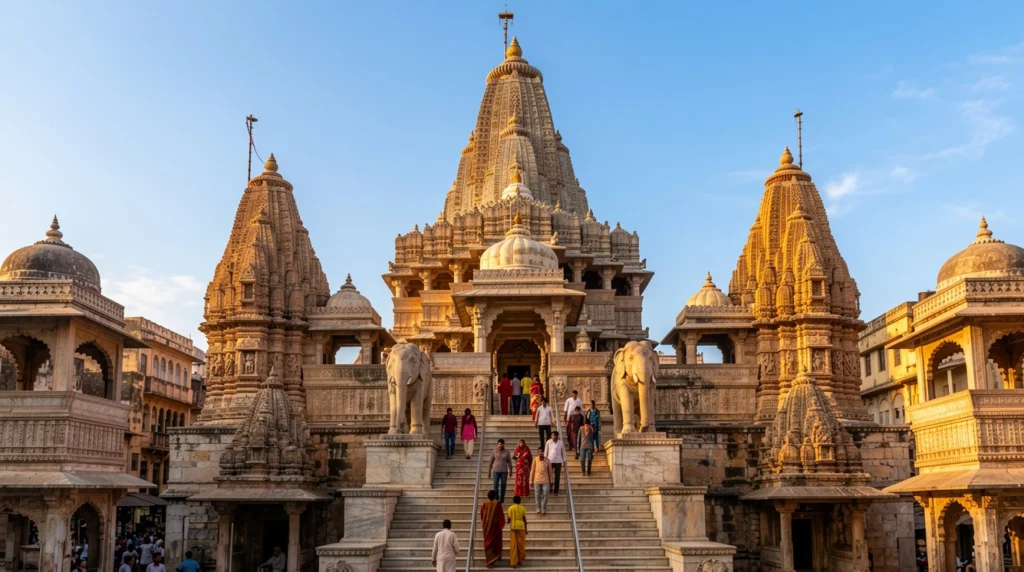
Jagdish Temple: Udaipur’s Black-Stone Jagannath and the 32 Marble Steps

Walk up from the lanes of Udaipur’s old city, past stalls of silver jewellery and miniature paintings, and the street suddenly lifts into a flight of white marble steps guarded by two stone elephants. At the top stands a spire so densely…
October 21, 20268 min read
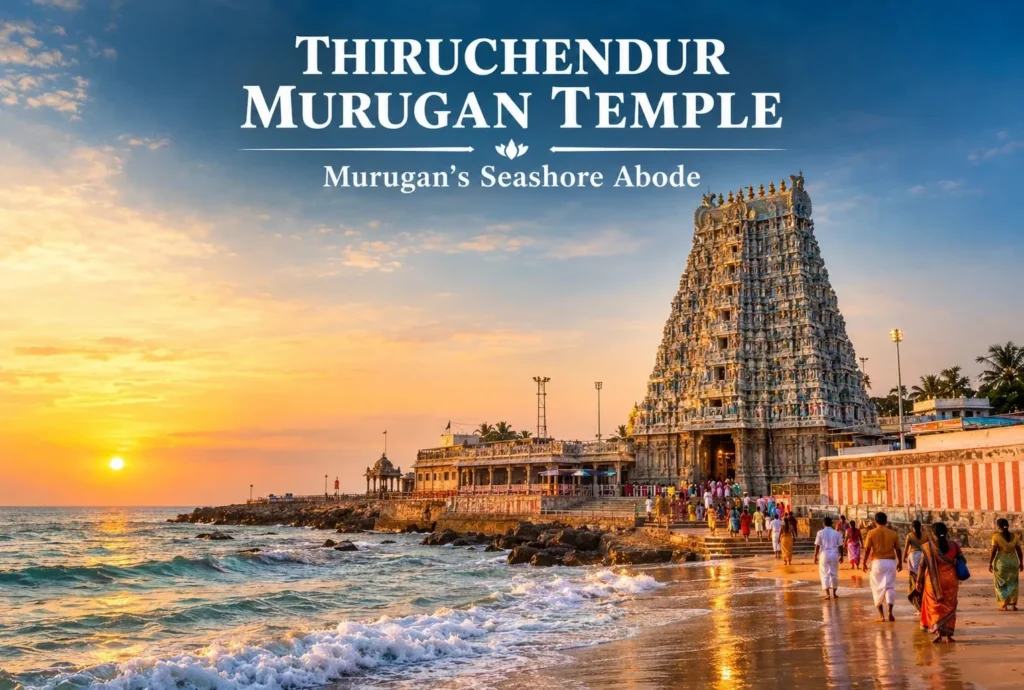
Thiruchendur Murugan Temple
Temples and Spiritual Places

Thiruchendur Murugan Temple: The Seashore Abode of Lord Murugan

Most of Lord Murugan’s famous abodes stand on hilltops. The Thiruchendur Murugan Temple stands where land meets the Bay of Bengal’s waves, and that coastal setting is a large part of what makes it unusual. What Is the Thiruchendur Murugan Temple? The…
October 21, 20265 min read
Baidyanath Temple
Temples and Spiritual Places

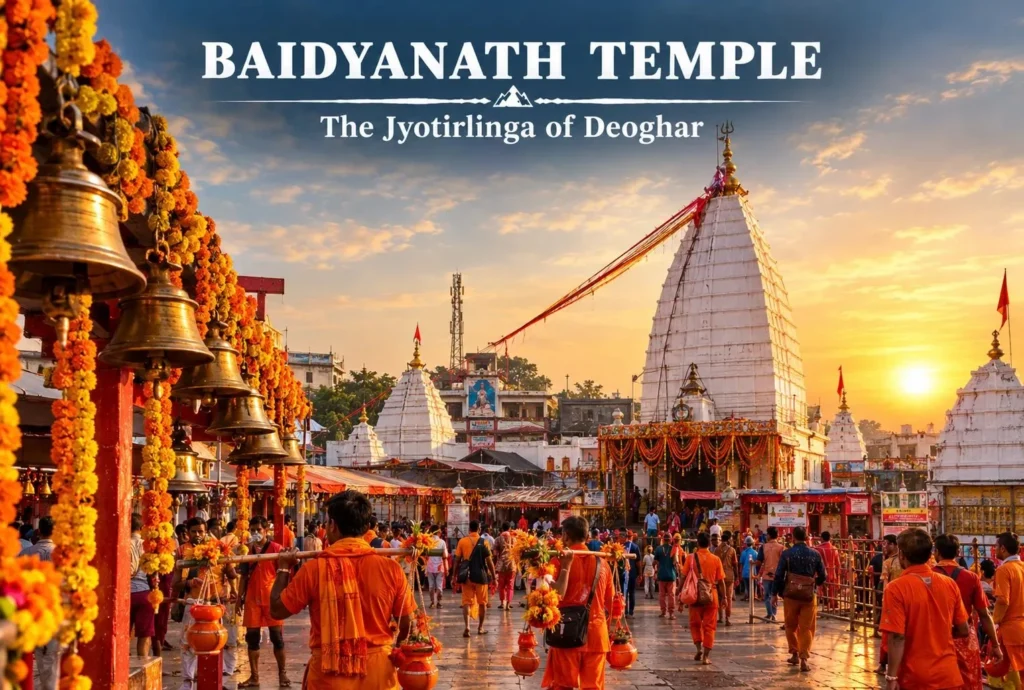
Baidyanath Temple: The Jyotirlinga at the Heart of Deoghar

Every monsoon, a river of saffron-clad pilgrims walks across eastern India with water carried from the Ganga. Their destination is the Baidyanath Temple in Deoghar, Jharkhand, one of the most visited Shiva shrines in the country and a stop on many Jyotirlinga…
October 20, 20265 min read
Deviramma Temple
Temples and Spiritual Places

Deviramma Temple: Trekking in the Midst of the Clouds

The Deviramma temple is the hill top shrine, that can be visited during the time of Diwali/ Deepawali on Naraka Chaturdasi. Naraka Chaturdasi is the first day of Diwali when devotees climb the hill to seek blessings from Goddess Deviramma. The main…
October 19, 20266 min read

Tirupati Balaji Temple: Inside the World’s Richest Place of Worship

Tirupati Balaji Temple

There’s a reason the queue at Tirupati Balaji Temple can stretch for hours and devotees still don’t flinch. This isn’t just one of India’s most visited pilgrimage sites — by most financial measures, it’s the wealthiest religious institution on the planet, pulling in roughly 24 million visitors a year to a hilltop shrine perched on the seventh peak of the Seshachalam range in Andhra Pradesh. Yet for all the numbers attached to it, what actually draws people here hasn’t changed much in over a thousand years: a quiet belief that Lord Venkateswara, the presiding deity, personally hears what’s asked of him in this particular sanctum.

This piece digs into the real Tirupati Balaji temple history, how it grew from a modest hill shrine into its current scale, the rituals that make a visit here unlike any other Hindu pilgrimage, and what you’ll actually need to know before planning a trip to Shree Tirupati Balaji Temple yourself. If you’re someone who enjoys tracing India’s major pilgrimage circuits, this one pairs naturally with our Kashi Vishwanath Temple guide, another ancient shrine shaped by centuries of royal patronage.

A History Written in Donations

Piecing together the Tirupati Balaji temple history means reading it less like a single construction story and more like a layered record of devotion from dynasty after dynasty. The earliest reference to this sacred hill appears in the Tamil epic Silappathikaram, usually dated to around the 2nd century CE, and tradition holds that an early shrine here was established under a local Thondaman king around 300 CE. For centuries after that, it remained a relatively modest hill temple rather than the sprawling complex it is today.

What changed its trajectory was a long sequence of royal patronage. The Pallava queen Samavai is recorded as making one of the earliest formal endowments, gifting jewels and land to fund temple festivals. The Chola and Pandya dynasties that followed both acted as devoted, periodic patrons, reforming and expanding the structure across several centuries. But it was the Vijayanagara Empire that transformed Tirupati Balaji Temple into something closer to its current grandeur, pouring in donations of gold and diamonds on a scale no previous dynasty had matched.

No single royal name is tied more closely to this phase of Tirupati Balaji temple history than Krishnadevaraya, the celebrated Vijayanagara emperor. He visited frequently and donated generously enough that his gifts of gold and jewels funded the gilding of the inner shrine’s roof. In a detail that still surprises first-time visitors, he went a step further in 1517, installing a statue of himself and his queens inside the temple premises — a rare instance of a ruler placing his own image so close to the sanctum of a deity he worshipped.

The Golden Roof and the Seven Hills
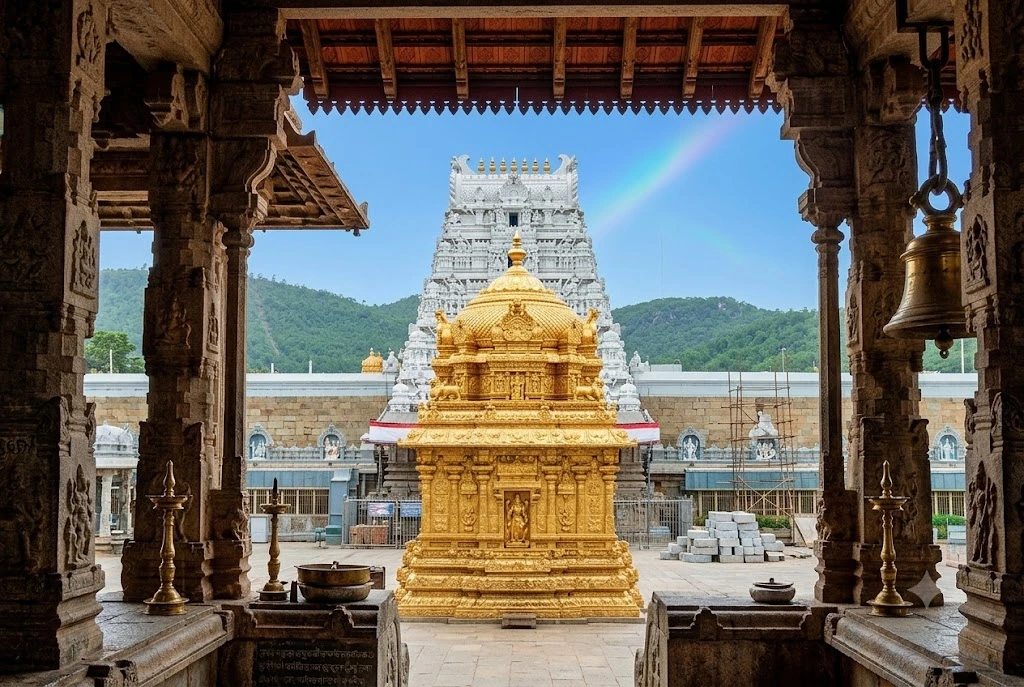
At the heart of Tirupati Balaji Temple sits the Ananda Nilayam, a three-tiered gold vimana rising directly above the inner sanctum, plated in gilt copper and crowned with a golden kalasam. It’s the single most photographed element of Shree Tirupati Balaji Temple, visible glinting in the sun long before pilgrims reach the inner courtyards, and it remains the clearest physical symbol of just how much wealth has poured into this site across centuries of continuous patronage.

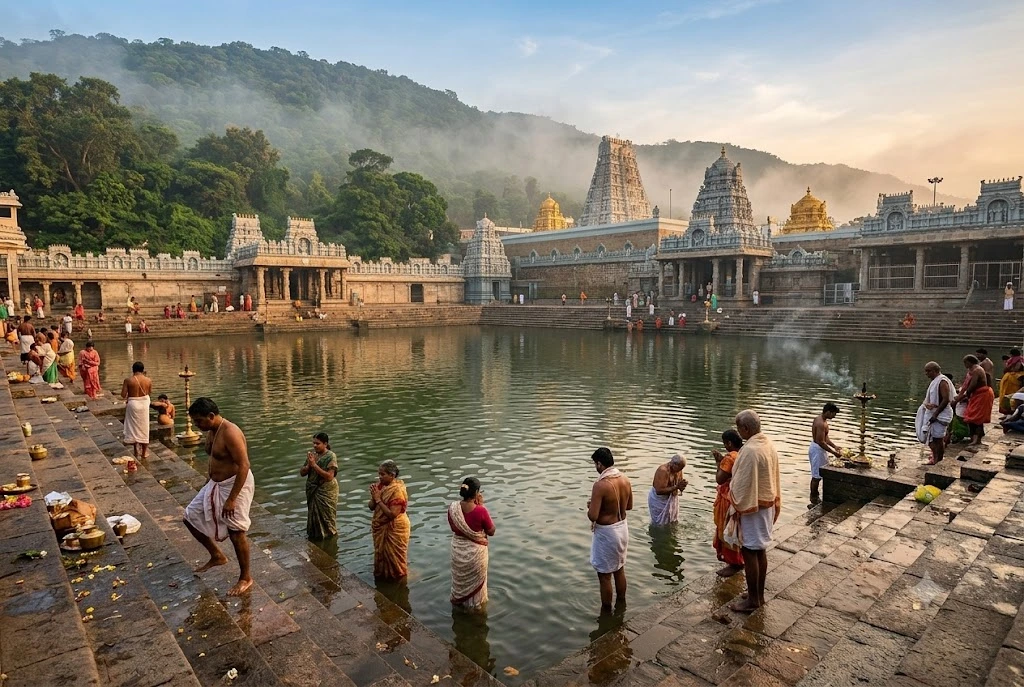
Tirupati Balaji Temple itself sits on Venkatadri, the seventh and final peak of the Seshachalam range, collectively known as the Saptagiri or Seven Hills — Vrushabhadri, Anjanadri, Neeladri, Garudadri, Seshadri, Narayanadri, and Venkatadri. Local tradition holds that these seven peaks represent the seven hoods of Adishesha, the great serpent on whom Lord Vishnu reclines, giving the entire hill range a mythological identity well beyond the temple building itself. Just below the main complex, the Swami Pushkarini tank provides the traditional ritual bathing spot for pilgrims before darshan, considered sacred in its own right rather than simply a practical water source.

The Hair That Funds a Temple

Few rituals associated with Indian temples are as instantly recognisable as the tonsuring tradition at Tirupati Balaji Temple, a practice that sets this pilgrimage apart from almost any other in the country. Devotees shave their heads as an offering, fulfilling vows made in moments of hardship or gratitude, and the scale of this practice is genuinely staggering — well over a tonne of hair is collected here daily. Far from being discarded, this hair is auctioned internationally to wig and extension manufacturers, generating a surprising but very real stream of revenue for the temple trust.

The custom traces back to the legend of Neela Devi, a Gandharva princess associated with the hill Neeladri, one of the seven peaks. Whatever its precise origin, the ritual has become one of the most visible and distinctive features of a pilgrimage here, with dedicated tonsuring halls processing thousands of devotees a day without much disruption to the broader flow of visitors.

Why This Is the Richest Temple on Earth

It’s worth pausing on just how significant the financial side of Tirupati Balaji Temple actually is, because the numbers attached to Shree Tirupati Balaji Temple aren’t exaggeration. Estimates place the temple trust’s total assets above ₹2.5 lakh crore, including vast gold reserves that have grown year over year, alongside tens of thousands of crores held in fixed deposits. Much of this wealth flows in through the hundi, the donation box pilgrims drop cash, jewellery, and gold into as part of their visit, which alone brings in well over a thousand crore rupees annually.

The Tirumala Tirupati Devasthanams, or TTD, manages this wealth and Tirupati Balaji Temple’s daily operations, channelling significant portions into charitable trusts, educational institutions, and free meal programmes for pilgrims — turning what could simply be religious wealth into a genuinely large-scale public institution.

The Laddu Everyone Talks About

No account of Tirupati Balaji Temple, or Shree Tirupati Balaji Temple as it’s formally known, feels complete without mentioning its prasadam. The Tirupati Laddu holds an official Geographical Indication tag, meaning only the TTD is legally permitted to manufacture or sell it under that name — a rare instance of a religious offering receiving the same kind of protected status usually reserved for regional foods like Darjeeling tea or Basmati rice. Pilgrims leaving the temple almost always carry a box or two home, and for many, it’s as much a part of the pilgrimage as the darshan itself.

Planning Your Visit

Reaching Shree Tirupati Balaji Temple typically means first arriving in Tirupati town at the base of the hills, with Tirupati Airport and Tirupati Railway Station both well connected to major Indian cities, before making the climb up to Tirumala by road, a journey of roughly 18 kilometres with dramatic views across the Seshachalam forests.

Darshan at the temple runs across an extended daily schedule, beginning with the pre-dawn Suprabhatam ritual that ceremonially wakes the deity, followed by free Sarva Darshan and paid Seeghra Darshan options for pilgrims wanting faster access. Because queues can run into several hours during peak season, festivals, and weekends, it’s worth checking current timings and booking darshan slots in advance through the temple trust’s official channels before you travel. Modest traditional attire is expected, and most visitors set aside a full day, if not more, to properly experience the temple, the surrounding hills, and the tonsuring halls without rushing.

Travellers building a wider South Indian temple circuit often combine this trip with our Ramanathaswamy Temple guide, another richly layered pilgrimage site further south in Tamil Nadu.

Frequently Asked Question’s

  1. What is the history of Tirupati Balaji Temple?

    Tirupati Balaji temple history traces back to around 300 CE, with early patronage from the Pallava, Chola, and Pandya dynasties, before the Vijayanagara Empire, particularly under Krishnadevaraya, transformed it into its current grand scale through extensive gold and diamond donations.

  2. Who built Tirupati Balaji Temple?

    No single ruler is credited with building the temple. It developed over centuries through continuous royal patronage, from an early Thondaman-era shrine through Pallava, Chola, Pandya, and especially Vijayanagara contributions.

  3. Why is Tirupati Balaji Temple considered the richest temple in the world?

    Its trust holds assets estimated above ₹2.5 lakh crore, including substantial gold reserves and fixed deposits, funded largely through hundi donations and the sale of devotee-offered hair, collected by the millions of pilgrims who visit annually.

  4. What is the significance of the hair-shaving ritual at Shree Tirupati Balaji Temple?

    Devotees offer their hair as a vow of gratitude or devotion, a tradition tied to the legend of Neela Devi, and the collected hair is sold internationally, generating significant revenue for the temple trust.

  5. What is special about the Tirupati Laddu?

    It holds an official Geographical Indication tag, meaning only the Tirumala Tirupati Devasthanams is legally permitted to manufacture or sell it, making it one of the few religious offerings with this protected status.

What makes Tirupati Balaji Temple genuinely remarkable isn’t just the scale of its wealth or the length of its queues — it’s that none of that seems to dilute the devotion driving it. Kings donated gold centuries ago for the same basic reason an ordinary pilgrim shaves their head today: a belief that something here is worth the effort. Few temples in the world carry quite this much history, wealth, and sheer daily human traffic, and somehow still feel personal to everyone who makes the climb.

For official darshan booking, current timings, and verified visitor information, refer to the Tirumala Tirupati Devasthanams’ official website.
Trimbakeshwar Temple: The Jyotirlinga With Three Faces

Trimbakeshwar Temple

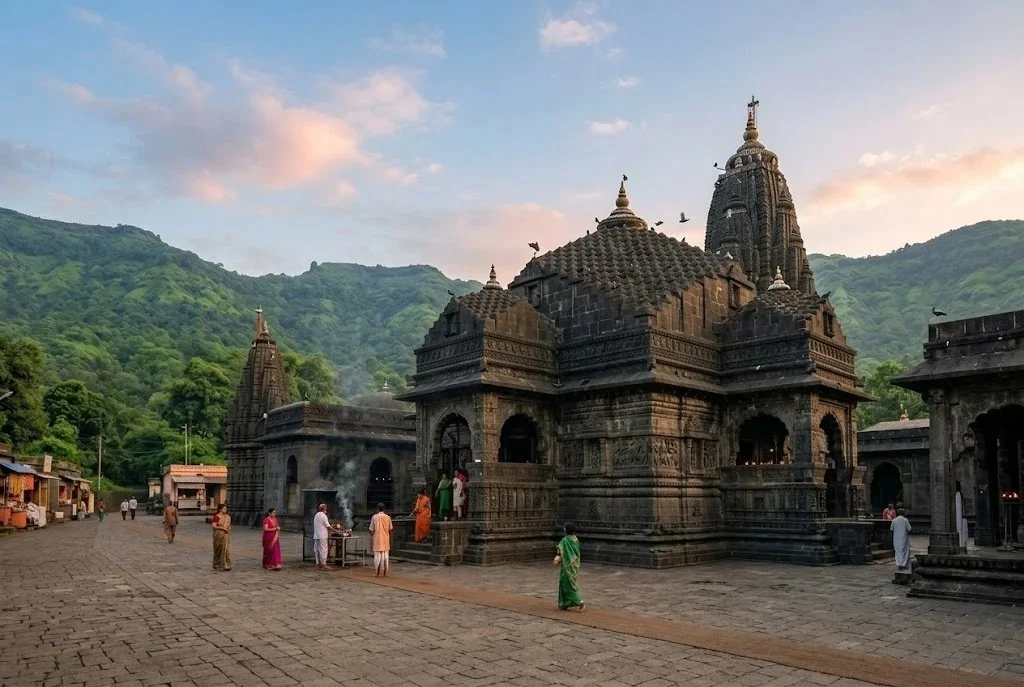
Most Shiva temples give you a single linga to focus your prayers on. Trimbakeshwar Temple, set against the Sahyadri hills just outside Nashik, gives you three faces carved into one — a detail so unusual that it’s the very reason the temple carries its name. Trimbak means “three-eyed,” and the linga inside this sanctum is believed to represent Brahma, Vishnu, and Shiva together, worn smooth over centuries by the same holy water devotees pour over it every single day.

This is one of the twelve Jyotirlingas scattered across India, and arguably one of the most layered — tied not just to Shiva worship but to the literal birthplace of the Godavari river, to a Peshwa-era architectural rebuild, and to a ritual performed nowhere else in the country. If you’re someone who enjoys tracing India’s sacred geography — much like the pilgrimage circuits covered in our Kashi Vishwanath Temple guide — this piece covers the complete Trimbakeshwar temple history, its architecture, the legends tied to the Godavari, and the practical details of Trimbakeshwar temple timings and the Nashik to Trimbakeshwar distance you’ll need to plan a visit.

Where the Godavari Begins

Before you even reach Trimbakeshwar Temple’s gates, it’s worth understanding why this particular spot in the Sahyadris became sacred in the first place. According to the legend most commonly told here, the sage Gautama performed years of severe penance on the nearby Brahmagiri hill, pleading with Lord Shiva to release the celestial Ganga to earth so that his ashram and the surrounding land could be purified. Shiva agreed, and the river that descended became the Godavari — still revered today as the “Ganga of the South” and one of India’s longest rivers.

A second version of the story credits Lord Vishnu, in his Vamana or Trivikram form, with releasing the river’s waters instead. Either way, three separate springs are said to emerge from Brahmagiri, feeding into the Godavari’s source, and the sacred tank just outside Trimbakeshwar Temple — Kusavarta Kund — is considered the river’s official starting point. Pilgrims bathe here before entering the temple, treating the ritual with the same seriousness as a dip in the Ganga itself at Varanasi or Haridwar. For travellers drawn to river-origin pilgrimages, this story pairs naturally with the one behind our Omkareshwar guide, another Jyotirlinga tied closely to a sacred river.

Trimbakeshwar Temple History

The Trimbakeshwar temple history stretches back far enough that its earliest origins are lost to legend rather than record, but the structure standing today has a documented and relatively recent past. The original shrine at this site was destroyed during the reign of the Mughal emperor Aurangzeb, part of a broader pattern of temple destruction across the empire in the 17th century. What exists now was commissioned by the Peshwa ruler Balaji Baji Rao, commonly known as Nanasaheb Peshwe, in the 18th century — making the current Trimbakeshwar Shiva Temple a product of Maratha patronage rebuilding what earlier rulers had torn down.

Built in the Hemadpanthi architectural style using black basalt stone, the temple’s construction reflects the same aesthetic language found in several other Maharashtra-era shrines from this period — heavy stone slabs, minimal mortar, and a structural solidity clearly built to last centuries rather than decades. What makes this chapter of Trimbakeshwar temple history particularly striking is the sheer level of craftsmanship invested in a reconstruction project, rather than an original build — the Peshwas clearly intended this temple to outlast the one it replaced.

The Linga That Erodes By Design

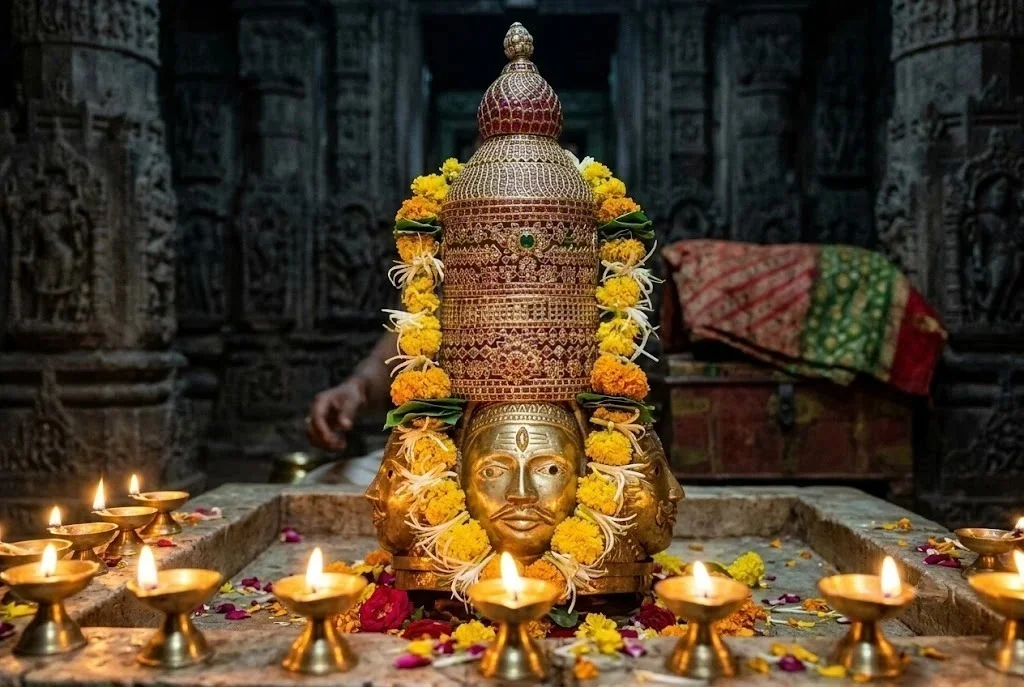
Step into Trimbakeshwar Temple’s inner sanctum and the central linga doesn’t look like most Jyotirlingas you’ll have seen elsewhere in India. Rather than a single smooth stone pillar, this one shows three distinct, barely raised faces, representing the Hindu trinity of Brahma, Vishnu, and Shiva together in a single form — a configuration unique among the twelve Jyotirlingas. Centuries of devotees pouring water, milk, and other ritual offerings directly onto the stone have gradually worn the features down, a slow erosion that temple tradition reads less as damage and more as a quiet metaphor for how even the most permanent-seeming things erode under constant human contact.

Above the linga sits a jewelled crown, reportedly dating back to the era of the Pandavas and set with diamonds and emeralds, which covers a gold mask of the three deities. It’s brought out for public display only on Monday evenings, typically between 4:00 and 5:00 PM, drawing crowds specifically timed around that single weekly window. Historically, the crown also held the legendary Nassak Diamond, looted by British forces during the Third Anglo-Maratha War in the early 19th century and now reportedly in private ownership overseas — a small but telling thread connecting Trimbakeshwar Temple to the wider story of colonial-era plunder of Indian religious artefacts.

A Ritual Performed Nowhere Else

Beyond regular Shiva worship, Trimbakeshwar Jyotirling Mandir holds a particular reputation across India for a specific set of rituals rarely, if ever, performed elsewhere: Narayan Nagbali, Kalsarpa Shanti, and Tripindi Vidhi. Narayan Nagbali in particular — a three-day ceremony believed to resolve ancestral or karmic obstacles — is said to be conducted exclusively at this temple, drawing families from across the country who travel to Trimbakeshwar Temple specifically for this purpose rather than for general darshan. Pandits at the temple also maintain genealogical records for many Hindu families, a tradition that turns a visit here into something closer to an archive consultation than a typical temple trip for some pilgrims.

This layered religious function is part of what separates Trimbakeshwar Jyotirling Mandir from many of its Jyotirlinga counterparts — it isn’t simply a stop on a pilgrimage circuit, but a destination in its own right for specific, ritually precise purposes that bring people back repeatedly throughout their lives.

The Temple Town of Trimbak

The town surrounding Trimbakeshwar Temple, also called Trimbak, sits nestled between three hills — Brahmagiri, Nilagiri, and Kalagiri — giving the whole settlement a naturally enclosed, almost amphitheatre-like feel. Beyond the main Trimbakeshwar Temple complex, the town holds smaller shrines, ghats along the Kusavarta tank, and a quiet, distinctly pilgrimage-town atmosphere that contrasts with the more commercial sprawl around some of India’s other major temple towns.

During the Nashik-Trimbakeshwar Kumbh Mela, held once every twelve years, this otherwise modest town transforms entirely, hosting one of the largest ritual bathing gatherings on Earth as part of the rotating Kumbh Mela cycle shared with Haridwar, Ujjain, and Prayagraj.

Trimbakeshwar Temple Timings

Planning around accurate Trimbakeshwar temple timings matters here more than at most temples, given how tightly the daily schedule is structured around specific rituals. Trimbakeshwar Temple generally opens for darshan around 5:30 AM and stays open, with scheduled pauses for rituals, until roughly 9:00 PM. A Rudrabhishek ceremony typically runs from 7:00 to 8:30 AM, with additional special pujas conducted around 1:00 PM and again in the late afternoon.

Because these Trimbakeshwar temple timings can shift during festivals like Mahashivratri and the Shravan month, when the temple often opens earlier and sees dramatically larger crowds, it’s worth confirming the current schedule through the temple trust before you travel. If your visit coincides with a Monday, try to time it around late afternoon to catch the brief public display of the jewelled crown.

How Far Is Trimbakeshwar From Nashik

For travellers planning the trip, the Nashik to Trimbakeshwar distance works out to roughly 28 to 30 kilometres, making it an easy half-day excursion from the city rather than a major undertaking. Regular buses and shared taxis run the route from Nashik’s central bus stands, and the drive itself cuts through pleasant Sahyadri foothill scenery, particularly scenic during and just after the monsoon.

The nearest major railway station is Nashik Road, roughly 35 to 40 kilometres away, while the closest airport is Nashik’s own Gandhinagar Airport, which connects to a handful of major Indian cities. Most visitors base themselves in Nashik itself and treat Trimbakeshwar Temple as a day trip, combining it with Nashik’s own temple circuit and its increasingly well-regarded wine country, a somewhat unexpected modern addition to this otherwise deeply traditional pilgrimage region.

Frequently Asked Question’s

What is the history of Trimbakeshwar Temple?

Trimbakeshwar temple history traces back to an original shrine destroyed during Aurangzeb’s reign, with the current structure commissioned in the 18th century by Peshwa Balaji Baji Rao (Nanasaheb Peshwe) in the Hemadpanthi style using black basalt stone.

Why is Trimbakeshwar Temple’s linga unique?

Unlike most Jyotirlingas, which feature a single stone pillar, the linga at Trimbakeshwar Shiva Temple has three distinct faces representing Brahma, Vishnu, and Shiva together, gradually worn smooth by centuries of ritual water offerings.

What are the Trimbakeshwar temple timings?

The temple is generally open for darshan from around 5:30 AM to 9:00 PM daily, with scheduled rituals through the day; timings can vary during festivals, so it’s best to confirm before visiting.

What is the Nashik to Trimbakeshwar distance?

Trimbakeshwar lies roughly 28 to 30 kilometres from Nashik city, making it an easy day trip by bus, taxi, or private vehicle.

What rituals is Trimbakeshwar Temple known for?

The temple is particularly known for Narayan Nagbali, a three-day ritual believed to be performed exclusively here, along with Kalsarpa Shanti and Tripindi Vidhi, all addressing ancestral and karmic concerns.

Is Trimbakeshwar connected to the Godavari river?

Yes, the nearby Kusavarta Kund at the foot of Brahmagiri hill is considered the origin point of the Godavari river, one of India’s longest, according to the legend of sage Gautama’s penance.

Trimbakeshwar Temple rewards the kind of visitor willing to slow down rather than rush through a single darshan. Between its three-faced linga, a crown with a diamond’s worth of colonial history attached to it, a ritual performed nowhere else in the country, and a river said to begin at its doorstep, this is a temple with far more layered meaning than its relatively modest size in photographs would suggest. For many who make the trip from Nashik, it ends up being the most memorable stop on the whole journey.

For official visitor information, rituals, and current schedules, refer to the Shri Trimbakeshwar Devasthan Trust’s official website.

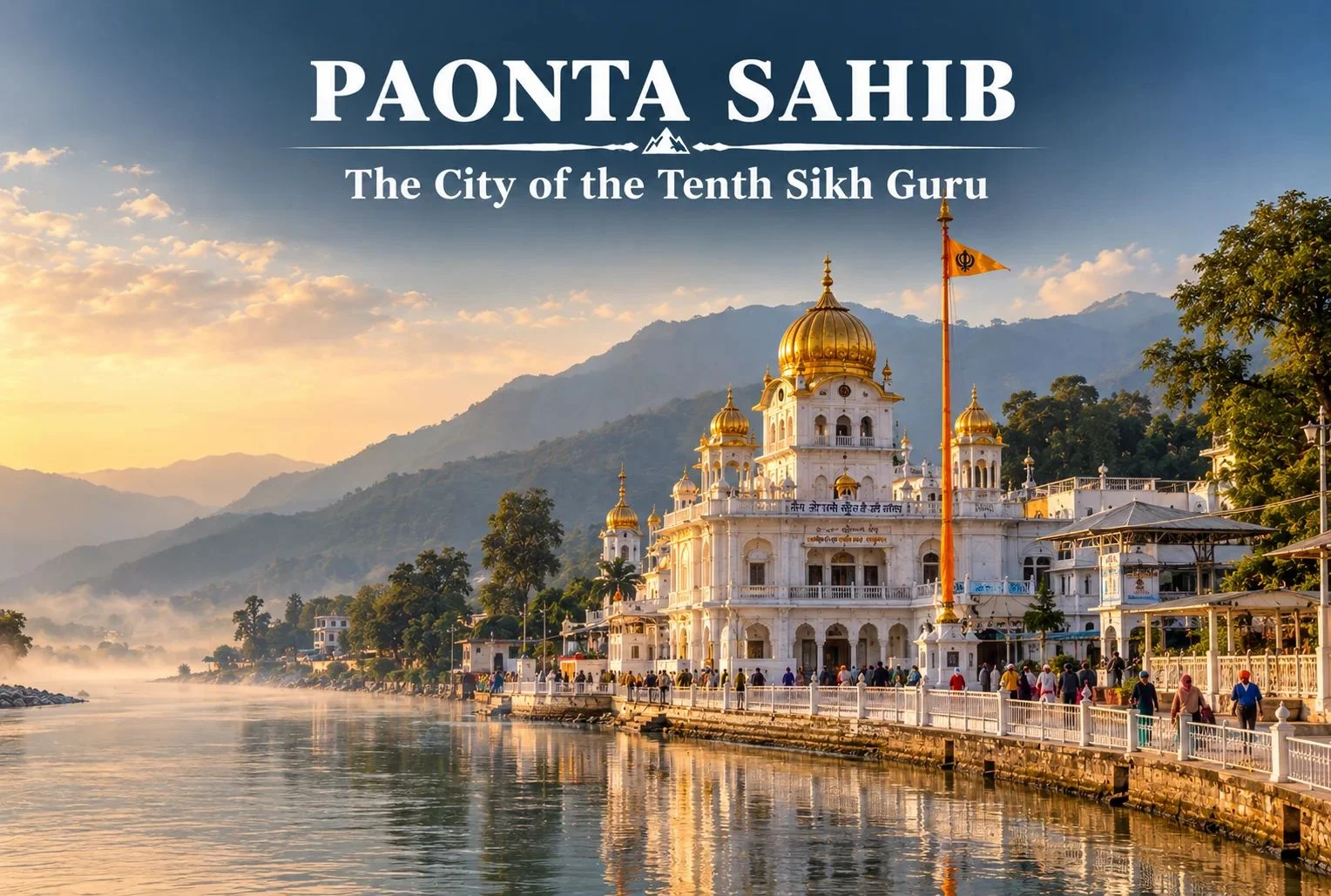
Paonta Sahib: The City Of Tenth Sikh Guru

Paonta Sahib

Himachal Pradesh is also known as “The land in the lap of the snowy Himalayas”, is one of the most famed hill stations in India. Himachal is not only famous for its snowy mesmerizing topography, Paonta Sahib the town of tenth Sikh guru, Sri Guru Gobind Singh Ji, also resides here. Paonta sahib blends the lineage sense of spirituality, natural beauty and the richness of color making it peaceful and timeless. Paonta Sahib geographically lies on the border of Uttarakhand and Himachal Pradesh. Paonta Sahib is the southern part in Himachal Pradesh of Sirmaur district. Beside Paonta sahib is the watercourse of Yamuna.

Travelers who want to continue into the nearby Uttarakhand hills can look at Explore Hills’ Chakrata Adventure Tour.

The Historic Event Of Paonta Sahib

The town was founded by the Shri Guru Govind Singh in November 1685. The original and old name of Paonta Sahib is Paontika. Paontika is derived from the Hindi word Paon (feet) and Tilak(Stable). The history of the Gurudwara is that, Guru Gobind Sing’s horse stopped by the river, Guru Gobind Singh was so captivated by the beauty of the serene picturesque, he dismounted from horse and established his foothold which eventually gave the town its unique name, Paonta Sahib. It is said that Shri Guru Gobind Singh ji came to the town and moved to this region on the royal invitation of Raja Medani Prakash of Nahan.

The period became one of the most important periods for the Sikh religion, as it has great significance of literary and spiritual activity. The battle of Bhangani in 1688 is the historical event that is remembered today when Guru Gobind Singh ji is mentioned. The battle was fought between the forces of Raja Fateh Shah and his allies with Guru Gobind Singh ji. The battle became one of the corroboration of Guru Gobind Singh’s leadership and development of Sikhi leaders. After the departure of Guru Govind Singh ji, the place continued to be remembered in his name. The history of Paontika now stands as the religious landmark which attracts devotees from all over India.

Paonta Sahib : The City Of The Tenth Sikh Guru

Architectural Features Of Paontika

Paontika reflects the blend of Indo-Islamic Sikh architectural style, which shows the influence of Mughal Era The architecture is made of white marble with gold leaf like domes.

● Local sandstone has been used as sandstone’s natural insulation properties to keep the area cool during large gatherings.

● The architecture includes the domes, arches, decorative details, and a bright exterior and Yamuna river beside it.

Walk Through Paontika

The Guru Granth Sahib ji is respected and placed in the main principal prayer hall that is Darbar Sahib.

● The Guru Granth Sahib Ji, the central and eternal spiritual scripture of Sikhism, to which Sikhs regard them as the supreme spiritual authority and the living Guru. The hall is an open space where the devotees can sit and feel the energy of spirituality through Gurbani and Kirtans.

● The other most important feature of Gurudwara is the religious flag of Sikhs, the Nishan Sahib which is displayed in the Gurudwara complex. The Nishan Sahib helps in identifying the gurudwara and also shows the faith of Sikhs.

● The complex of Gurudwara also includes the langar hall and community spaces. This space is where the visitors can eat and participate in community work regardless of their religions.

Devotees can witness the sacred river Yamuna from here. It is said that the Yamuna river’s rushing sound used to intervene in the Kavi darbar. The Guru asked Yamuna to flow quietly, so that the divine poetry and spiritual discourse can be heard with clarity. Since then the gushing sound of the river cannot be heard from Gurudwara.

Best Time to Visit Gurudwara

Gurudwara Paonta Sahib ji can be visited throughout the year. Paontika is seen being visited by devotees all year, but for better sightseeing and pilgrimage, the best time is said to be spring and autumn. For current visitor information, you can refer to the Himachal Pradesh Tourism Department, the state government’s official tourism body.

Conclusion

Paonta Sahib is a place where spirituality meets history. Gurudwara has a great significance in the history of sikhs. Gurudwara Paonta Sahib is a living evidence of sikhs leadership and military development. Gurudwara is a peaceful natural beauty which resides along the river of the sacred river Yamuna.

It is a place that serves as a spiritual gateway that will bridge the cultural heritage with nature. Since Dehradun is the nearest major city, many visitors pair this stop with Explore Hills’ Mussoorie-Rishikesh-Haridwar Trip.

Frequently asked questions

How far is Paonta Sahib from Dehradun?

Paonta Sahib is on the borders of Uttarakhand and Himachal Pradesh, which is well connected by road. Paonta Sahib is approximately 45 to 50 km from Nahan and Dehradun which makes it 1.5 to 2 hours of drive.

Is Paonta Sahib a hilly area?

Paonta Sahib is situated in the valley area. Paontika is considered as a foothill area. It is in Sirmaur district of Himachal Pradesh.

Why is Paontika famous?

Paontika is mainly famous for its history of guru Govind Singh. Shri Guru Gobind Singh ji came to the town and moved to this region on the royal invitation of Raja Medani Prakash of Nahan.

What was the original name of Paonta Sahib?

The original and old name of Paonta Sahib was Paontika. Paonta Sahib is derived from the Hindi word Paon (feet) and Tilak(Stable). Later it was named as Paonta Sahib because of its deep association with guru Govind Singh Sahib.

Which city is located nearest to the Gurudwara Paonta Sahib?

The closest city from Gurudwara . Dehradun to Paonta Sahib is roughly 50km away from Gurudwara. Dehradun is in Uttarakhand which also serves the major railway station and airport which is Jolly grant.

Shree Siddhivinayak Temple: Mumbai’s Wish-Granting Ganesha

Shree Siddhivinayak temple

Tucked into the busy junction of Prabhadevi, where Mumbai’s local trains rattle past and traffic rarely stops moving, sits a small shrine that has become one of the wealthiest and most visited temples in the country. Shree Siddhivinayak Temple wasn’t built by a king or a dynasty. It was built by an ordinary woman named Deubai Patil, who simply wanted a wish fulfilled — and the story of how that modest 1801 shrine grew into the institution it is today says a lot about how devotion spreads in this city.

If you’re someone who enjoys tracing India’s living temple traditions — the same curiosity that draws travellers to our Akshardham Temple guide — this piece digs into the real history behind Shree Siddhivinayak Temple, what makes the idol inside genuinely unusual, the Siddhivinayak temple timings you’ll need before you go, and a few details about the Siddhivinayak ganpati temple that even regular visitors often don’t know.

A Temple Born From a Childless Woman’s Prayer

The story behind this temple is quieter than most. In the late 1700s, Prabhadevi was farmland, nothing like the dense, honking neighbourhood it is today. A wealthy local woman named Deubai Patil, who had no children of her own, prayed that Lord Ganesha would grant children to any woman who came to this spot and asked sincerely. Moved by her own devotion, she commissioned a small shrine, and it was Laxman Vithu Patil, a local contractor, who actually built it. Shree Siddhivinayak Temple was consecrated on 19 November 1801 — a date that’s still recorded as the shrine’s official founding day.

What’s striking about Shree Siddhivinayak Temple’s history is how deliberately ordinary its origins were. There was no royal patronage, no grand architectural ambition at the start. It was one woman’s private hope, turned into a public place of worship, and as word spread that prayers made here seemed to be answered, the crowds simply never stopped coming.

The Idol That Breaks the Rules

Walk up to Shree Siddhivinayak Temple’s inner sanctum and you’ll notice something that long-time devotees of Ganesha temples across Maharashtra immediately clock as unusual. The idol, carved from a single block of black stone, has its trunk curving to the right rather than the left. Most Ganpati idols across India follow the left-trunk form, considered easier to appease in daily worship; a right-trunked idol is traditionally regarded as a more powerful, “Siddhi” form, requiring stricter rituals to worship correctly. It’s this feature, more than anything else, that gives Shree Siddhivinayak Temple its name — “Siddhi Vinayak,” the Ganesha who grants siddhi, or spiritual accomplishment and wish fulfilment.

The idol also carries a small third eye carved into the forehead, a detail linking it visually to Lord Shiva, and is flanked on either side by Riddhi and Siddhi, Ganesha’s two consorts representing prosperity and spiritual power respectively. The inner sanctum’s roof is plated in gold, and the temple’s wooden doors and pillars are carved with depictions of the Ashtavinayaka — the eight legendary manifestations of Ganesha worshipped across Maharashtra — which turns even a short visit into something of a visual pilgrimage in itself.

From Village Shrine to Mumbai’s Richest Trust

For nearly a century and a half, Shree Siddhivinayak Temple remained a modest neighbourhood shrine. Its transformation into the institution recognisable today happened gradually through the 20th century, as Mumbai itself exploded outward from a port town into India’s financial capital, and Prabhadevi went from farmland to prime city real estate.

Today, the Shree Siddhivinayak Ganapati Temple Trust manages the complex, governed under the Bombay Public Trusts Act and a dedicated state legislation passed in 1980. It’s widely reported as the richest temple trust in Mumbai, collecting somewhere between ₹10 and ₹15 crore annually in donations — figures that have, at various points, drawn legal scrutiny over how those funds are spent, including a Bombay High Court-appointed committee in the mid-2000s that reviewed transparency in the trust’s charitable disbursements. Security has also tightened considerably since the 2008 Mumbai terror attacks, with bulletproof enclosures now surrounding the inner sanctum and checkpoints at every entrance.

Why Tuesdays Are Different Here

If you’ve ever tried visiting on a Tuesday and found the queues stretching for blocks, there’s a reason. Tuesday is considered Lord Ganesha’s day across Hindu tradition, and at Shree Siddhivinayak Temple it’s treated almost as a second festival every single week. Shree Siddhivinayak Temple opens far earlier than usual, with special early darshan beginning around 3:15 AM, well before the general public timings kick in on other days.

This weekly surge pulls in everyone from daily commuters stopping before work to Boll ywood actors and politicians, many of whom are known to visit before a film release or a major decision, hoping the siddhivinayak ganpati temple’s reputation for removing obstacles holds up one more time. During the pandemic years, the trust introduced app-based slot booking and QR-code entry to manage crowd flow, a system that has largely stayed in place for busier days since.

Siddhivinayak Temple Timings

Planning around accurate Siddhivinayak temple timings genuinely matters here, since Shree Siddhivinayak Temple’s schedule shifts noticeably between Tuesdays and the rest of the week. On regular days, from Wednesday through Monday, Shree Siddhivinayak Temple generally opens around 6:00 AM for darshan and stays open in sessions, with the final evening aarti and closing around 9:50 PM. On Tuesdays, the schedule changes substantially — early darshan can begin as early as 3:15 AM, and the temple stays open, with brief breaks for rituals, well past midnight.

Because these siddhivinayak temple timings have shifted over the years, especially around festivals like Ganesh Chaturthi when the temple stays open for extended, almost round-the-clock hours, it’s worth checking current timings through the temple trust’s official channels before you plan a visit. Early mornings on non-Tuesday days tend to offer the shortest queues for anyone hoping to avoid the crowds.

Visiting Shree Siddhivinayak Temple

Shree Siddhivinayak Temple sits in Prabhadevi, close to Dadar, making it easy to reach by Mumbai’s suburban rail network — Dadar station is the nearest major stop, a short auto-rickshaw ride away. Chhatrapati Shivaji Maharaj International Airport lies roughly 10 kilometres away, making a visit easy to combine with other stops in the city.

Modest attire is expected inside the sanctum, and photography is generally restricted near the inner shrine, so it’s best to check current rules at the entrance. Given how central Shree Siddhivinayak Temple has become to Mumbai’s everyday rhythm — film crews, cricket teams, and newlyweds all show up here before big moments — it’s less a tourist stop than a genuine working part of the city’s life, and visiting feels like stepping briefly into that rhythm rather than observing it from outside.

Frequently Asked Question’s

  1. Who built Shree Siddhivinayak Temple?

    Shree Siddhivinayak Temple was built in 1801 by contractor Laxman Vithu Patil, commissioned by Deubai Patil, a local woman who wished for the shrine to help childless women conceive.

  2. What is the history of Shree Siddhivinayak Temple?

    Siddhivinayak temple history traces back to 19 November 1801, when the shrine was consecrated in what was then farmland in Prabhadevi. It grew from a small neighbourhood temple into one of India’s wealthiest and most visited Hindu shrines over the following two centuries.

  3. Why is the idol at Siddhivinayak Temple considered unique?

    Unlike most Ganesha idols, which have their trunk curving left, the black stone idol here has its trunk curving right, traditionally regarded as a more powerful “Siddhi” form of Ganesha, which is also where the temple gets its name.

  4. What are the Siddhivinayak temple timings?

    On regular days, Shree Siddhivinayak Temple is generally open from around 6:00 AM to 9:50 PM. On Tuesdays, considered Ganesha’s day, early darshan can begin as early as 3:15 AM, with the temple open, barring short ritual breaks, well into the night.

  5. Why are Tuesdays significant at Siddhivinayak Ganpati Temple?

    Tuesday is traditionally associated with Lord Ganesha, and Shree Siddhivinayak Temple sees significantly larger crowds and an extended, earlier schedule on this day compared to the rest of the week.

  6. Who manages Shree Siddhivinayak Temple today?

    The temple is managed by the Shree Siddhivinayak Ganapati Temple Trust, governed under the Bombay Public Trusts Act and a dedicated Maharashtra state legislation passed in 1980.

What makes Shree Siddhivinayak Temple worth understanding, beyond just its wealth or its celebrity visitors, is that none of that was the point when Deubai Patil first built it. A quiet, personal prayer from over two centuries ago somehow grew into one of the most continuously busy religious sites in India, visited daily by people hoping, much like she once did, that an honest request made here doesn’t go unanswered.

For official visitor information and current ticket or darshan details, refer to the Shree Siddhivinayak Ganapati Temple Trust’s official website.

Kashi Vishwanath Temple: Nine Lives Across Eight Centuries

Kashi Vishwanath Temple

Most ancient temples in India have one construction date worth remembering. Kashi Vishwanath Temple has nearly a dozen. Built, destroyed, rebuilt, destroyed again, and rebuilt once more across eight centuries, the Kashi Vishwanath Temple standing in Varanasi today is less a single structure than the final chapter of a very long argument between devotion and destruction — one that devotion kept winning.

A Timeline of Destruction and Rebirth

Rather than tell this story in flowing prose, it’s worth laying out the Kashi Vishwanath temple story exactly as it happened, because the sheer repetition is the point:

  • 1194 CE: The original Adi Vishveshwar Temple is destroyed by Qutb-ud-din Aibak, general of Muhammad Ghori, following the defeat of the Raja of Kannauj.
  • 1230 CE: A Gujarati merchant rebuilds the temple during the reign of Sultan Iltutmish of the Slave dynasty.
  • 1447–1517 CE: The rebuilt temple is destroyed again, during the rule of either Hussain Shah Sharqi or Sikandar Lodhi, accounts vary.
  • 1585 CE: Raja Man Singh I and Raja Todar Mal, both serving under Emperor Akbar, rebuild the temple during a period of relative religious tolerance.
  • 1669 CE: Emperor Aurangzeb orders the temple demolished and the Gyanvapi Mosque constructed on the site. According to tradition, the Jyotirlinga itself was hidden in the adjoining well to protect it from destruction.
  • 1742 CE: Maratha ruler Malhar Rao Holkar plans to demolish the mosque and reconstruct the temple, though the plan never materialises in his lifetime.
  • 1780 CE: Malhar Rao’s daughter-in-law, Maharani Ahilyabai Holkar, builds the current temple structure on a site adjacent to the mosque, using her own personal funds.
  • 1835 CE: Maharaja Ranjit Singh of the Sikh Empire donates roughly 800 kilograms to a full tonne of gold to plate the temple’s spire and domes.
  • 2021 CE: The Kashi Vishwanath Dham Corridor, a 400-metre walkway connecting the temple directly to the Ganga, is inaugurated by Prime Minister Narendra Modi.

Nine distinct turning points, spanning over 800 years. Few temples anywhere in the world carry a documented history this turbulent, or this consistently resilient — and that history is what makes the Kashi Vishwanath Temple we see today so remarkable.

The Legend Behind the Jyotirlinga

Kashi Vishwanath is counted among the twelve Jyotirlingas, the self-manifested forms of Lord Shiva considered the most sacred sites of Shiva worship in Hinduism. Varanasi itself, known in scripture as Kashi, holds a unique place in this tradition: according to belief, Shiva personally resides in and protects the city, and dying within its boundaries is considered a direct path to moksha, liberation from the cycle of rebirth.

This belief is central to why the Kashi Vishwanath Temple has been rebuilt so many times rather than abandoned after each destruction. For devotees, the sanctity of the site itself was never in question — only the structure standing on it, which could always be rebuilt again. The Skanda Purana references the sanctity of this ground, placing its spiritual importance well before any of the structures recorded in the timeline above were ever built, which is part of why repeated demolition never succeeded in erasing its pull on pilgrims.

What the Temple Looks Like Today

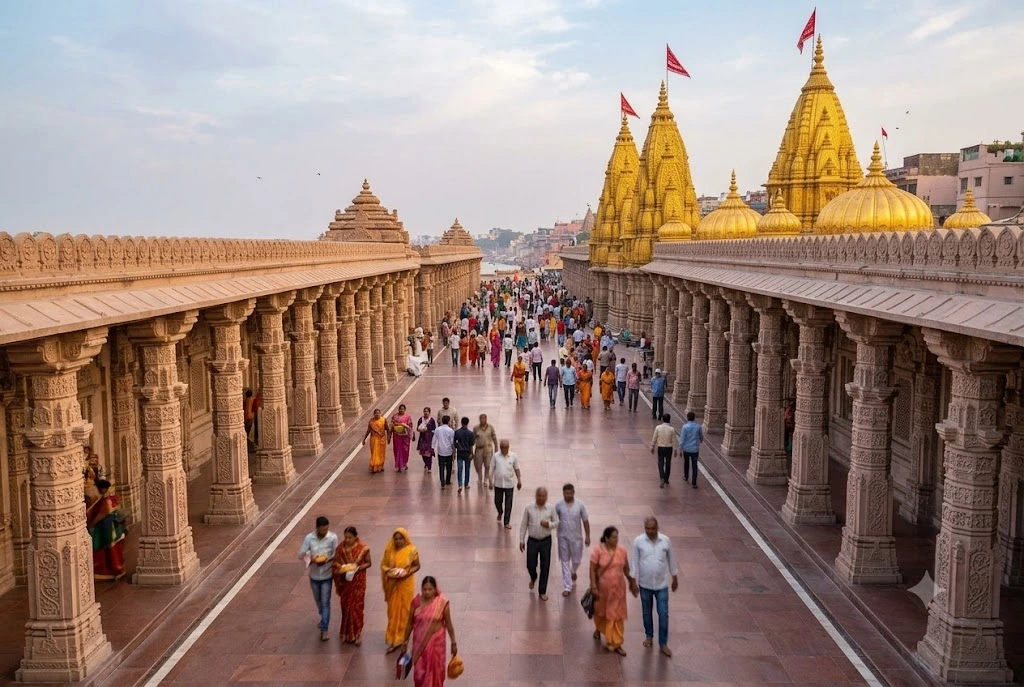
Walk toward the temple complex now and the first thing that registers is scale — not of the shrine itself, which remains relatively compact, but of the corridor and plaza surrounding it. The sanctum sits at the heart of a cluster of smaller shrines, dedicated to deities including Kaal Bhairav, Dandapani, Avimukteshwar, Vishnu, and Vinayaka, each with its own small but devoted following among regular visitors.

The main shrine itself follows a relatively simple layout by the standards of India’s grandest temples: a sanctum housing the Jyotirlinga, approached through a narrow mandapa, with the three golden shikharas rising above. What the structure lacks in architectural flamboyance compared to, say, the temples of Khajuraho or Konark, it makes up for in continuous ritual intensity — this is a temple built for daily use at enormous scale, not for admiration from a distance.

Ahilyabai Holkar: The Queen Who Rebuilt It

If one figure deserves individual credit for the temple as it exists today, it’s Ahilyabai Holkar, the Maratha queen of Indore who ruled for roughly three decades in the late 18th century. Using an estimated sixteen crore rupees of her personal inheritance, she sponsored temple construction and restoration across India — from Kedarnath and Vishnupad in the north to Rameswaram and Somnath in the south.

Her 1780 reconstruction of the Kashi Vishwanath Temple, built deliberately adjacent to the Gyanvapi Mosque on the original site, remains the structure pilgrims visit today. It stands as one of the most significant acts of heritage restoration in Indian history, carried out more than a century after Aurangzeb’s demolition, and it’s a detail worth remembering whenever this temple’s history comes up.

The Golden Domes and the Modern Corridor

For over a century after Ahilyabai’s reconstruction, the Kashi Vishwanath Temple remained a relatively modest structure. That changed in 1835, when Maharaja Ranjit Singh of Punjab’s Sikh Empire donated a substantial quantity of gold, by most accounts around 800 kilograms, to plate the temple’s shikharas. The resulting golden domes remain the Kashi Vishwanath Temple’s most recognisable visual signature, visible from the Ganga and from much of surrounding Varanasi.

The most recent transformation came in December 2021, with the inauguration of the Kashi Vishwanath Dham Corridor, a sprawling redevelopment spanning roughly five lakh square feet. The corridor created a direct, dignified walkway linking the Kashi Vishwanath Temple to the ghats of the Ganga, replacing the narrow, congested lanes pilgrims previously had to navigate. Visitor numbers rose dramatically following its completion, transforming the daily experience of darshan for millions of pilgrims each year.

Visiting Shri Kashi Vishwanath Temple Today

The Shri Kashi Vishwanath Temple follows an extensive daily schedule built around several aartis. The temple typically opens around 2:30 to 3:00 AM for the Mangala Aarti, with general darshan available through the morning and again in the afternoon and evening, before the Shayan Aarti closes the day around 10:30 PM. Exact windows vary slightly depending on the source and season, so it’s worth checking current timings before you travel.

Several darshan options exist for Kashi Vishwanath Temple pilgrims, ranging from free general darshan to paid Sugam Darshan passes offering faster access, which can be booked through the temple trust’s official channels. Early morning visits, particularly between 4:00 and 7:00 AM on weekdays, tend to offer the shortest queues, while Mondays, the month of Shravan, and Maha Shivratri see the heaviest crowds of the year.

The temple is managed today by the Shri Kashi Vishwanath Temple Trust, established by the Government of Uttar Pradesh, which oversees both daily operations and the broader corridor complex.

Getting to Varanasi

Varanasi is well connected by air, rail, and road, making the Kashi Vishwanath Temple one of the more accessible major pilgrimage sites in India. Lal Bahadur Shastri International Airport sits roughly 26 km from the city centre, with regular domestic flights from Delhi, Mumbai, and other major cities. Varanasi Junction, also known as Varanasi Cantonment, is the main railway station, connected to nearly every corner of the country given the city’s importance as a pilgrimage hub.

From the station or airport, the temple itself sits close to the ghats in the old city, within walking distance of Dashashwamedh Ghat, where the nightly Ganga Aarti draws large crowds of its own. Many pilgrims combine a temple visit with a sunrise boat ride on the Ganga, timing their darshan around the river’s own daily rhythm of bathing, prayer, and cremation rites that have continued along these banks for centuries.

For travellers interested in other major Jyotirlinga pilgrimages, our Kedarnath Yatra package covers another of the twelve sacred Shiva shrines, high in the Himalayas, while our Panch Kedar Trek explores the wider mythology connecting Shiva worship across Uttarakhand’s mountain temples.

For official darshan booking, current timings, and verified updates, refer to the Shri Kashi Vishwanath Temple Trust’s official website.

Frequently Asked Question’s

  1. Who built the Kashi Vishwanath Temple?

    The present structure was built in 1780 by Maharani Ahilyabai Holkar of Indore, though the site has been rebuilt multiple times across history, with earlier reconstructions by Raja Man Singh I and Raja Todar Mal in the 16th century.

  2. Why was the Kashi Vishwanath Temple destroyed by Aurangzeb?

    In 1669, Emperor Aurangzeb ordered the temple demolished and had the Gyanvapi Mosque constructed on the site, as part of a broader policy of temple destruction during his reign.

  3. What is special about the temple’s golden domes?

    In 1835, Maharaja Ranjit Singh of the Sikh Empire donated a substantial quantity of gold to plate the temple’s spire and domes, giving the temple its recognisable golden appearance today.

  4. What is the Kashi Vishwanath Corridor?

    Inaugurated in December 2021, it’s a redevelopment project connecting the temple directly to the Ganga via a 400-metre walkway, significantly easing pilgrim access and increasing visitor numbers.

  5. What are the temple’s darshan timings?

    The temple generally opens around 2:30 to 3:00 AM for Mangala Aarti and remains open in sessions until around 10:30 PM to 11:00 PM, though timings can shift slightly, so it’s best to confirm before visiting.

The Many Layers of Jagannath Temple

Jagannath temple

Some temples are best understood as a single story. Jagannath Temple is not one of them. Peel back its surface and you find a legend older than the structure itself, a 12th-century construction project that took generations to complete, an architectural style unique to one Indian region, and a set of daily rituals so intricate that over fifty are performed before most pilgrims have even finished their morning tea. This guide moves through those layers of Jagannath Temple one at a time — legend, history, architecture, and living practice — before covering what you’ll actually need to know for a visit.

Layer One: The Legend Before the Stone

Long before any construction began, the site of modern-day Puri already carried religious weight. According to tradition, it was King Indradyumna of Avanti who, in the mythic Satya Yuga, first established worship of Jagannath here, guided by a vision instructing him to find a sacred image washed ashore. Whether read as literal history or as devotional storytelling, this legend matters because it frames the site as sacred long before the Puri Jagannath Temple we see today was ever built — the stone structure, in this telling, is simply the latest home for a far older presence.

Layer Two: The Builders Who Shaped It

The Jagannath Temple standing in Puri today traces to the 12th century CE, constructed roughly between 1135 and 1150 under King Anantavarman Chodaganga Deva, the founding ruler of the Eastern Ganga dynasty. Epigraphic evidence and temple chronicles, collectively known as the Madala Panji, record a project that wasn’t completed within a single reign — his successor, Anangabhima Deva III, carried the work forward and is remembered for an unusual act of devotion: he formally dedicated his entire kingdom to Lord Jagannath and styled himself as the deity’s servant rather than its ruler.

This is central to understanding Jagannath Temple history — it isn’t the product of one king’s ambition, but a multi-generational undertaking shaped by political power, religious devotion, and, over the centuries, repeated rebuilding after invasions and natural damage recorded in the temple’s own chronicles.

Layer Three: A Style Found Nowhere Else

What rises from that history at Jagannath Temple is a textbook example of Kalinga architecture, a style distinct to the historic Odisha region and rarely seen with such scale elsewhere in India. The main spire climbs to roughly 65 metres (214 feet), dominating Puri’s skyline and visible from well out at sea — sailors once reportedly used it as a navigational marker.

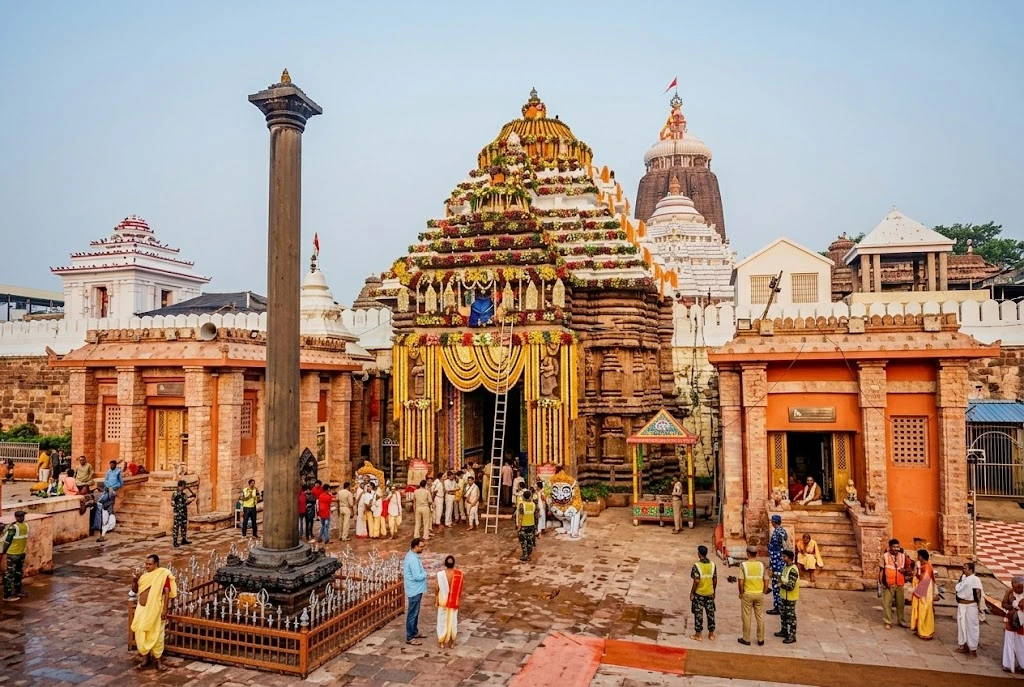
The complex follows a Pancha Deula layout, built around four connected structures: the Garbha Griha, or sanctum housing the deities; the Jagamohana, an assembly hall; the Nata Mandira, a dance hall; and the Bhoga Mandapa, where food offerings are prepared. The entire compound sits inside a 20-foot boundary wall known as the Meghanada Prachira, spanning over 400,000 square feet. At the entrance stands the Aruna Stambha, a monolithic pillar depicting Aruna, the charioteer of the sun god — originally installed at the Konark Sun Temple before being relocated here in the 18th century, quietly linking two of Odisha’s most significant monuments.

Inside, the deities themselves depart from convention. Jagannath, Balabhadra, and Subhadra are carved from neem wood rather than stone or metal, with distinctive large eyes and famously incomplete limbs — a visual signature instantly recognisable across Indian religious art.

Layer Four: A Temple That Never Stops Moving

Unlike many ancient shrines that function primarily as static monuments, Jagannath Temple runs on an almost theatrical daily schedule. More than fifty separate rituals take place over the course of a single day, from the Mangal Aarti at dawn through to the closing Pahuda rites late at night. Mahaprasad, food cooked in earthen pots and offered to the deities, is then shared with devotees regardless of caste or social status — a practice the temple treats as a core expression of its philosophy that Jagannath belongs to everyone equally.

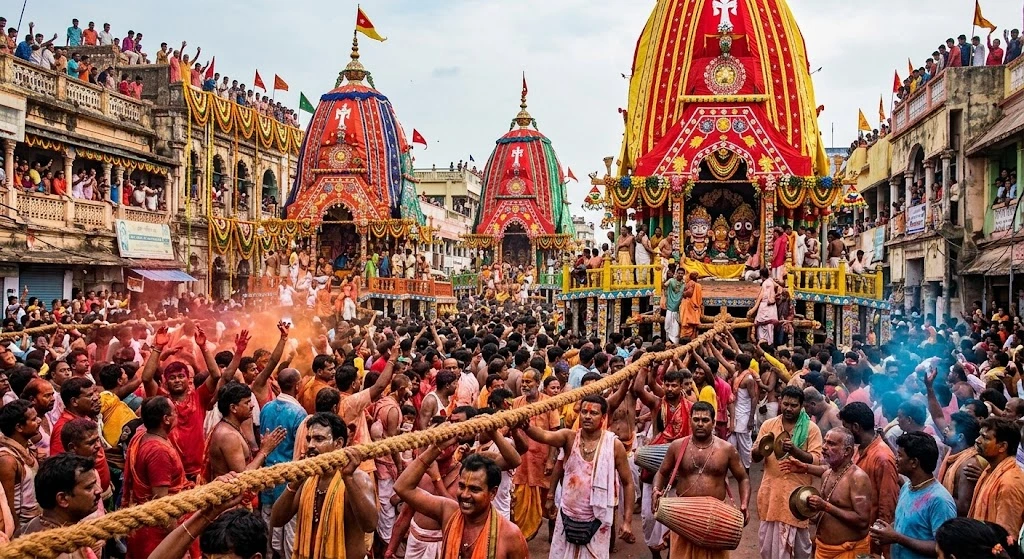
That philosophy finds its most visible expression once a year during the Ratha Yatra, the chariot festival held in the month of Ashadha, usually falling in June or July. The three deities are brought out of the sanctum and placed on massive hand-built wooden chariots, then pulled roughly three kilometres through Puri’s streets to the Gundicha Temple by thousands of devotees. For many pilgrims, witnessing or participating in this festival is the single most anticipated moment of their devotional life.

Visiting Today

The Shree Jagannath Temple follows a detailed daily schedule, generally opening around 5:00 AM with the Mangal Aarti and continuing in sessions, with breaks between rituals, until the final evening Aarti closes the day. Because exact windows shift slightly around festivals and administrative changes, it’s worth checking current Jagannath Temple timings with the temple office or official sources before planning your visit, rather than relying on any single published schedule.

One detail surprises many first-time visitors: entry to the inner temple complex has traditionally been restricted to Hindus. This is a long-standing practice maintained by the temple administration, and non-Hindu visitors are generally directed instead to the rooftop of the nearby Raghunandan Library, which offers a panoramic view of the temple from outside the walls. The one notable exception is Ratha Yatra itself, when the deities are brought out into the open streets and become visible to everyone, regardless of faith.

A few practical notes for anyone visiting: there’s no entry fee for general darshan, though mobile phones, cameras, and leather articles aren’t permitted inside. Early morning visits tend to offer shorter queues and a calmer atmosphere than the mid-morning rush.

Interestingly, Puri’s Jagannath Temple is also counted among the original Char Dham, the four sacred pilgrimage sites across India established in Hindu tradition — alongside Badrinath, Dwarka, and Rameswaram — distinct from the “Chota Char Dham” circuit within Uttarakhand that our Char Dham Yatra package covers. For travellers curious about India’s wider pilgrimage landscape, our Popular Destinations page rounds up more sacred and scenic trips across the country.

For official information on darshan timings, festival schedules, and temple guidelines, you can refer to Odisha Tourism, the state government’s official tourism portal.

Frequently Asked Question’s

  1. Who built the Jagannath Temple?

    The present structure was built by King Anantavarman Chodaganga Deva of the Eastern Ganga dynasty in the 12th century CE, and later completed by his successor, Anangabhima Deva III.

  2. What are the Jagannath Temple timings?

    The temple generally opens around 5:00 AM with Mangal Aarti and closes late at night after the final evening Aarti, though exact timings can shift around festivals, so it’s best to confirm before visiting.

  3. Can non-Hindus enter the Jagannath Temple?

    No, entry to the main temple complex is traditionally restricted to Hindus. Non-Hindu visitors can view the temple from the nearby Raghunandan Library rooftop, except during Ratha Yatra, when the deities are visible to all.

  4. What is the Jagannath Temple famous for?

    It’s best known for its unique Kalinga architecture, its neem-wood deities with distinctive features, and the annual Ratha Yatra chariot festival, one of the most significant events in the Hindu calendar.

  5. Is there an entry fee for the Puri Jagannath Temple?

    No, general darshan is free, though visitors cannot carry mobile phones, cameras, or leather items inside.

Dwarkadhish Temple: Gujarat, THE GUIDE

Dwarkadhish Temple

Dwarka, in Gujarat, is a place where faith lives in scriptures: felt in the heart, heard in the temple bells. Here resides the heart of Dwarka, the Jagat Mandir, the Dwarkadhish temple. Dwarkadhish Temple is dedicated to one of the most beloved and widely worshipped deities in Hinduism, Krishna, respected by millions of devotees for his teachings, compassion, wisdom, and divine presence. Dwarkadhish means, the lord of Dwarka, Krishna being the lord of dwarka and a temple dedicated to him explains everything to us. Dwarka, the legendary capital that lies under the water in Arabian sea, was established by Lord Krishna, after he left Mathura.

It is believed that when lord Krishna was departing the world, the dwarka city submerged beneath the sea. The ancient town beside Dwarka however remains above the water on the Gujarat coast and is the most famous pilgrim site among the devotees. For pilgrims planning a broader Krishna and Char Dham circuit across India, Explore Hills’ Char Dham Yatra covers four of Uttarakhand’s most significant Himalayan shrines as a separate but equally revered pilgrimage.

DWARKADHISH TEMPLE: The Architecture

The architectural form of the temple reflects the essence of centuries of faith, religious belief and architectural activity. The temple was built and developed over a period of time rather than being constructed in a single phase. The temple is built on the basic principle but crucially, it is developed to meet the traditional expectations of devotees. The temple has Grabhagrah, the heart of temple where sits our deity, lord Krishna. Pilgrims have to go through Moksha Dwar and Swarg Dwar which are the gates of the temple.

The gates are followed by Mandapas. Mandapas are the halls and gathering spaces where religious activities are held. Pilgrims have to pass through these Mandapas to get to the Grabhgrah where lord Dwarkadhish waits to meet his beloved devotees.

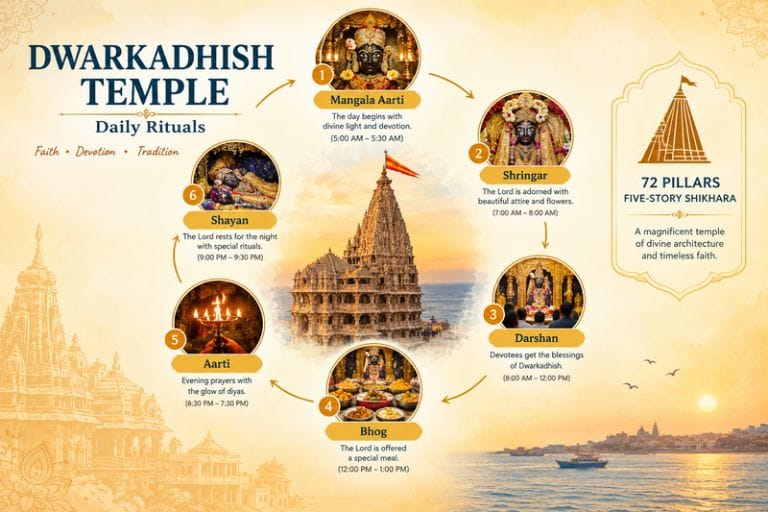
Then comes the shikhara towering the Grabhgrah, it is the architectural element of the temple that marks the inner shrine. The five story shrine is supported by 72 pillars that contribute to the temple’s symmetry, rhythm of the temple.

The Dwarkadhish flag which flies high above the temple towering shikhara, is not just a decorative piece but has a symbolic role in traditions of the temple. The flag not only represents the devotion and divine presence but also defines the victory of dharma.

Dwarkadhish Temple: Daily Rituals

RELIGIOUS TRADITIONS AND DAILY WORSHIP RITUALS

In dwarkadhish temple, lord Krishna, the king of Dwarka is worshipped. Krishna in dwarkadhish temple is worshipped as a ruler, a protector and a respected king who loved his people.

Krishna is dressed and decorated differently every day and is offered flowers, sweet, offerings and aarti. Clothing, ornaments, flowers, and other offerings can vary according to the particular festival.

The daily ritual of the Dwarkadhish temple traditionally is:

  • Mangala Aarti.
  • Shringar.
  • Darshan.
  • Bhog.
  • Aarti.
  • Shayan.

Mangala Aarti is the early morning worship puja that marks the beginning of the day. Here pujari ji performs a ceremonial offering of lamp which is always accompanied by prayers and devotional singings. In the mangala aarti devotees gather to get the first glimpse of lord Krishna. Mangala Aarti usually takes two hours from aarti to darshan, estimating the timing to be from 6:30am to 8am. After mangala aarti comes Shringar where lord krishan is decorated with beautiful clothing and ornaments which captures the heart of devotees. Pilgrims interested in another major Krishna-linked shrine in North India can also explore Explore Hills’ Yatra Packages collection covering several regional pilgrimage routes.

FESTIVALS CELEBRATED IN DWARKADHISH

Festivals are an important part of life, they bring joy to our lives. Dwarkadhish being the temple dedicated to Krishna, all festivals that include Krishna are celebrated with joy here.

Festivals that are celebrated here are Janmashtami, which is observed as the birthday of lord Krishna. In Janmashtami, the temple is decorated and lord Krishna is also dressed in beautiful dresses and ornaments. At midnight the real celebration begins as it is the time associated with Krishna’s birth. Special prayers and offerings are done, the atmosphere of the temple is pure and devotional.

Then comes Holi which is traditionally marked with Krishna playing in Vrindawan and Braj. People play with flowers and colors. Artists are called to perform an act which is dedicated to lord Krishna. Diwali is also one of the festivals that is celebrated in Dwarkadhish temple. Diwali is said to be the festival of lights. The temple is illuminated with lights and pilgrims visit dwarkadhish and seek blessings from lord Krishna.

Sharad Purnima is an autumn full moon festival. Sharad Purnima is celebrated as it is associated with the Raas leela of Krishna with gopis of vrindawan. Other festivals related to lord Vishnu, lord Krishna and Vaishnava are celebrated in Dwarkadhish as a contribution to their respect.

HOW TO REACH DWARKADHISH

Dwarkadhish is located in Dwarka, Devbhumi Dwarka district, Gujarat which is on the Gomti creek at the western tip of Gujarat in the ancient coastal city of Dwarka in India. The pilgrims can reach dwarkadhish to seek blessings by airways, roadways and railways.

The nearest airport is in Porbandar and Jamnagar which are 95 and 145km away from Dwarka respectively. For official current travel advisories and temple visiting guidelines, pilgrims can refer to the Gujarat Tourism Department, the official state government tourism body.

BEST TIME TO VISIT DWARKADHISH TEMPLE

Dwarkadhish temple is a holy place and the best time to visit lord Krishna is throughout the year. But, for comfortable sightseeing and pilgrimage, it is from November to February.

As July to September is observed to be monsoon hence it may hinder the beautiful sightseeing for the pilgrims. Whereas March to June is summers, which makes the climate hot, therefore during summers pilgrims prefer early morning and evening for exploring the place.

For accommodation, pilgrims have wide options from dharamshala to hotels, whereas food options, they can expect a wide variety of vegetarian restaurants and food vendors. Food options like Gujarati thali, khichdi, roti, sabzi, and farsan are always available for pilgrims.

CONCLUSION

Dwarkadhish temple is one for the Char Dhams of India. It is a magnificent temple with great history connected to spirituality. Whether you want to explore history and architecture, or simply want to experience the peaceful atmosphere of a sacred coastal town, Dwarka has something memorable to offer. Take your time, walk through the streets and its sacred shrine and witness the beautiful morning and evening aarti. Travelers whose pilgrimage circuit includes the Himalayan Char Dham as well can explore Explore Hills’ Kedarnath Yatra, one of the most significant Shiva shrines in the Uttarakhand pilgrimage circuit.

Frequently Asked Questions

Where is Dwarkadhish Temple located?

Dwarka, the legendary capital that lies under the water in Arabian sea, the ancient town beside Dwarka however remains above the water on the Gujarat coast and is the most famous pilgrim site among the devotees. Dwarkadhish is located in Dwarka, Devbhumi Dwarka district, Gujarat which is on the Gomti creek at the western tip of Gujarat in the ancient coastal city of Dwarka in India.

Who built Dwarkadhish Temple?

The Dwarkadhish temple was built by the great grandson of lord Krishna, Vajranabh, over Krishna’s residential palace.

Who is Kuldevi of Dwarkadhish?

The kuldevi of Dwarkadhish, who is called the family goddess of lord Krishna and Yaduvansh lineage is Harsiddhi Mata.

Who ruled Dwarka after Krishna died?

Krishna never ruled Dwarka; he was not the ruler, he was the guardian of administration and protector of the city. Krishna’s maternal grandfather was the ruler of Dwarka, and after the death of Krishna, his great-grandson, Vajranabh, ruled the Yaduvansh. Vajranabh was the king of surviving yaduvansh.

Who found Dwarka underwater?

Dwarka lies underwater in the Arabian Sea, which was excavated in 1983 and 1990 by marine archaeologist Dr. S.R. Rao and the Marine Archaeology Unit of the National Institute of Oceanography (NIO).

Is Lord Krishna’s family still alive?

Lord Krishna’s family, the only survivor of the submergence of Dwarka, was Vajra, whom Arjuna placed on the throne. Lord Krishna’s immediate family and the clan perished at the end of the Dvapara Yuga. The end of the clan was due to mutual infighting and the curse of Gandhari.


Omkareshwar: The Om-Shaped Island Where the Narmada Meets Shiva

Omkareshwar

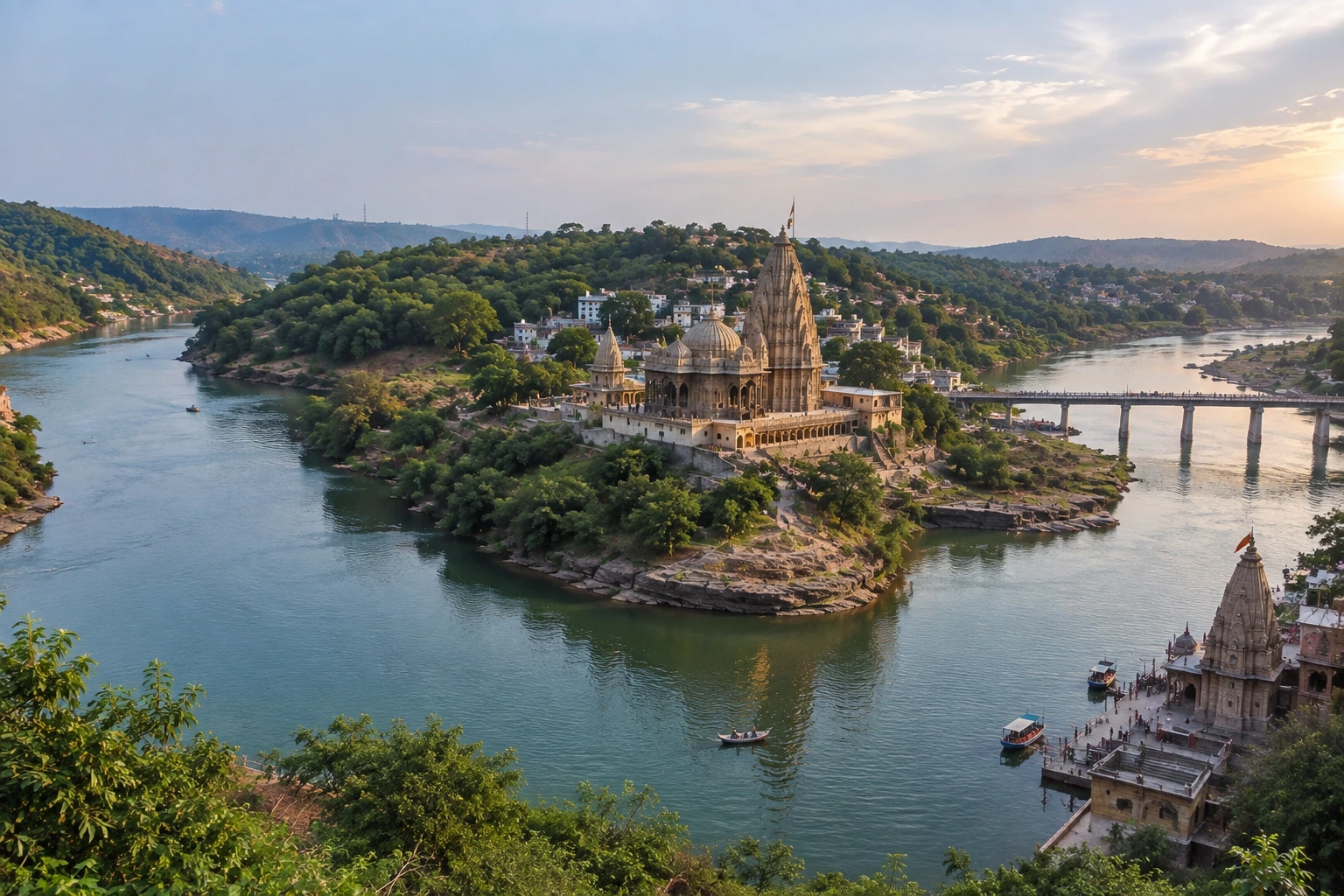
Somewhere between the Vindhya and Satpura ranges, the Narmada River splits in two, wraps itself around a rocky hill, and rejoins downstream. Seen from above, the island it leaves behind looks uncannily like the sacred syllable Om. That island, known as Mandhata or Shivpuri, is home to Omkareshwar, the fourth of India’s twelve Jyotirlingas and one of the most layered pilgrimage sites in Madhya Pradesh. It is a place where mythology, medieval architecture, and the philosophy of Adi Shankaracharya all overlap on a single stretch of riverbank.

This guide draws together the geography, legends, history, and practical details you need, whether you are planning a pilgrimage or a weekend trip from Indore.

Where Is Omkareshwar Temple?

Travellers often ask where is Omkareshwar Temple, since the town and the island are easy to confuse with nearby Maheshwar and Ujjain. The temple stands on Mandhata Island in the Narmada River, in the Khandwa district of western Madhya Pradesh. The nearest major city is Indore, roughly 77 km away by road, or about two and a half hours of driving. Ujjain, home to the Mahakaleshwar Jyotirlinga, lies further north, around three and a half hours away.

The island is formed by two hills separated by a valley, with the Narmada dividing into two channels around it. The Kaveri, a small tributary, joins the main river here, and the confluence is treated as a sacred bathing spot in its own right. The Om shape is visible on maps and aerial images, and it is the source of the place’s name.

Shri Omkareshwar Jyotirlinga Temple: A Shrine in Two Parts

The Shri Omkareshwar Jyotirlinga Temple is counted as the fourth among the twelve Jyotirlingas, the self-manifested “lingams of light” sacred to Lord Shiva. What makes it unusual is that the Jyotirlinga is traditionally understood as being divided between two shrines. One stands on the island itself. The other, called Mamleshwar or Amareshwar, sits on the southern bank of the river on the mainland. Pilgrims are expected to worship at both to complete the darshan, and the traditional route begins at the island shrine before continuing to Mamleshwar.

Inside the sanctum, the lingam is installed on the ground floor and is partly immersed in water. Unusually, it does not sit directly beneath the main spire but slightly to one side, a detail that surprises many first-time visitors.

Legends of the Island

Several stories explain why this hill became sacred. One of the best known concerns King Mandhata of the Ikshvaku dynasty, the same royal line as Lord Rama. He is said to have performed severe penance here to please Shiva, and the hill still carries his name.

A second legend involves the Vindhya mountain. After the sage Narada remarked that Mount Meru was far taller, Vindhya grew distressed and vowed to rise higher. He made a lingam of clay on this island and worshipped it with great devotion. Pleased, Shiva appeared as a Jyotirlinga and granted him a boon. A third account says the Devas, defeated in battle by the Danavas, prayed to Shiva here, and he emerged as Omkareshwar to defeat the demons.

History and Architecture

The present structures date largely to the Paramara dynasty, the dominant Rajput power of the Malwa region between the 9th and early 14th centuries. Later, the Maratha rulers, including the Holkars, supported the temple and helped renew it.

The main temple has five levels, each housing a different form of Shiva. From the ground upward, these are Omkareshwar, Mahakaleshwar, Siddhanath, Gupteshwar, and a flag-bearing deity at the top. Carved pillars, small subsidiary shrines, and shrines to Panchamukhi Ganesha and Annapurna add to the complex. The nearby Siddhanath Temple is one of the older stone structures on the island and is worth visiting for its detailed carving.

Adi Shankaracharya and Ekatma Dham

The island holds special meaning in Advaita Vedanta. Tradition says the young Shankaracharya, having travelled on foot from Kerala, met his teacher Govindapada in a cave here and received instruction. To honour this, the Madhya Pradesh government built Ekatma Dham on Mandhata Hill.

Its centrepiece is the Statue of Oneness, a 108-foot multi-metal figure of Shankaracharya as a boy of about twelve, standing on a 54-foot pedestal. It was unveiled on 21 September 2023 and faces the Narmada. It lies around four kilometres from the main temple, and visiting it is free.

Other Places on the Island

Beyond the main shrines, several stops reward a slower visit:

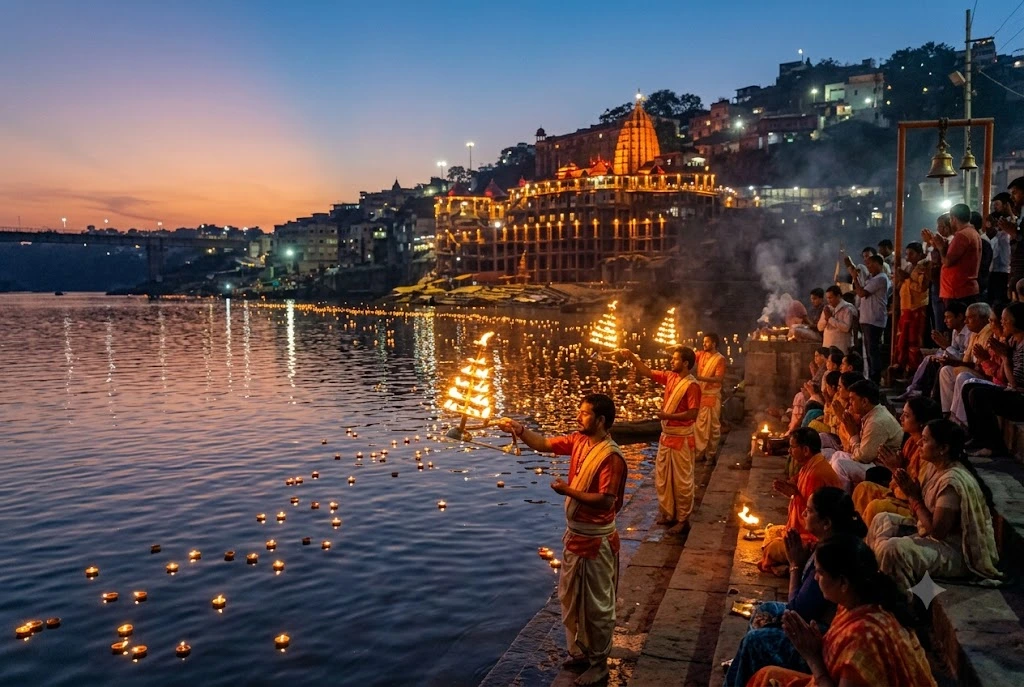
  • Kotitirtha Ghat: the main bathing ghat, and the site of the evening Narmada aarti
  • Gauri Somnath Temple: a carved shrine holding a large black lingam
  • Rin Mukteshwar and Patali Hanuman: smaller shrines along the parikrama route
  • Boat ride: a short trip on the river gives the best view of the temples and the confluence
  • Suspension bridges: good for sunset views over the ghats

The island also marks the traditional starting point of the Narmada Parikrama, the long circumambulation of the river that devout pilgrims complete on foot over months.

A Note on the Dam

The landscape has changed within living memory. The Omkareshwar Dam was commissioned in 2007, roughly four kilometres downstream, and it raised water levels around the island. The project remains debated locally because of its effect on riverbank settlements and ghats, and visitors will notice the higher water compared with older photographs.

Planning Your Visit

  • Darshan timings at Omkareshwar Temple: roughly 5 AM to 10 PM, with breaks between sessions. Exact hours shift on festival days, so confirm at the temple counter
  • Entry: general darshan is free; a priority Shighra Darshan pass costs ₹300 per person
  • Waiting time: around one to two hours on weekdays, and three to five hours on weekends, Mondays, and festival days
  • Best season: October to March. Sawan (July–August) and Mahashivratri are spiritually vibrant but very crowded
  • By road: about 77 km from Indore, with buses and taxis available
  • By rail: Omkareshwar Road (Mortakka) is the nearest station, about 12 km away
  • By air: Devi Ahilyabai Holkar Airport in Indore is the closest

A standard itinerary pairs one day in Ujjain with one day here. For a wider Shiva circuit, our Kedarnath Yatra covers another of the twelve Jyotirlingas high in the Himalayas, while our Char Dham Yatra package offers a broader pilgrimage across Uttarakhand.

For official information on the Ekatma Dham complex and visiting details, see Madhya Pradesh Tourism.

Frequently Asked Question’s

  1. Which Jyotirlinga is Omkareshwar?

    It is the fourth of the twelve Jyotirlingas of Lord Shiva.

  2. Why is the island called Omkareshwar?

    Its two hills and the split Narmada create a shape resembling the sacred syllable Om.

  3. Are there really two Jyotirlinga shrines?

    Yes. The Jyotirlinga is worshipped at the island temple and at Mamleshwar on the southern bank.

  4. How far is it from Indore?

    Around 77 km by road, a drive of roughly two and a half hours.

  5. What is the best time to visit?

    October to March offers the most comfortable weather for darshan, boat rides, and the parikrama.

Khatu Shyam Ji Temple: The Rajasthan Shrine That Draws Millions

Khatu Shyam Ji Temple

Few pilgrimage sites in North India pull in the sheer volume of devotees this temple does, especially during its annual fair, when the small town around it swells into one of the busiest religious gatherings in Rajasthan. This is Khatu Shyam Ji Temple, and its story is as compelling as the crowds it draws.

What Is Khatu Shyam Ji Temple?

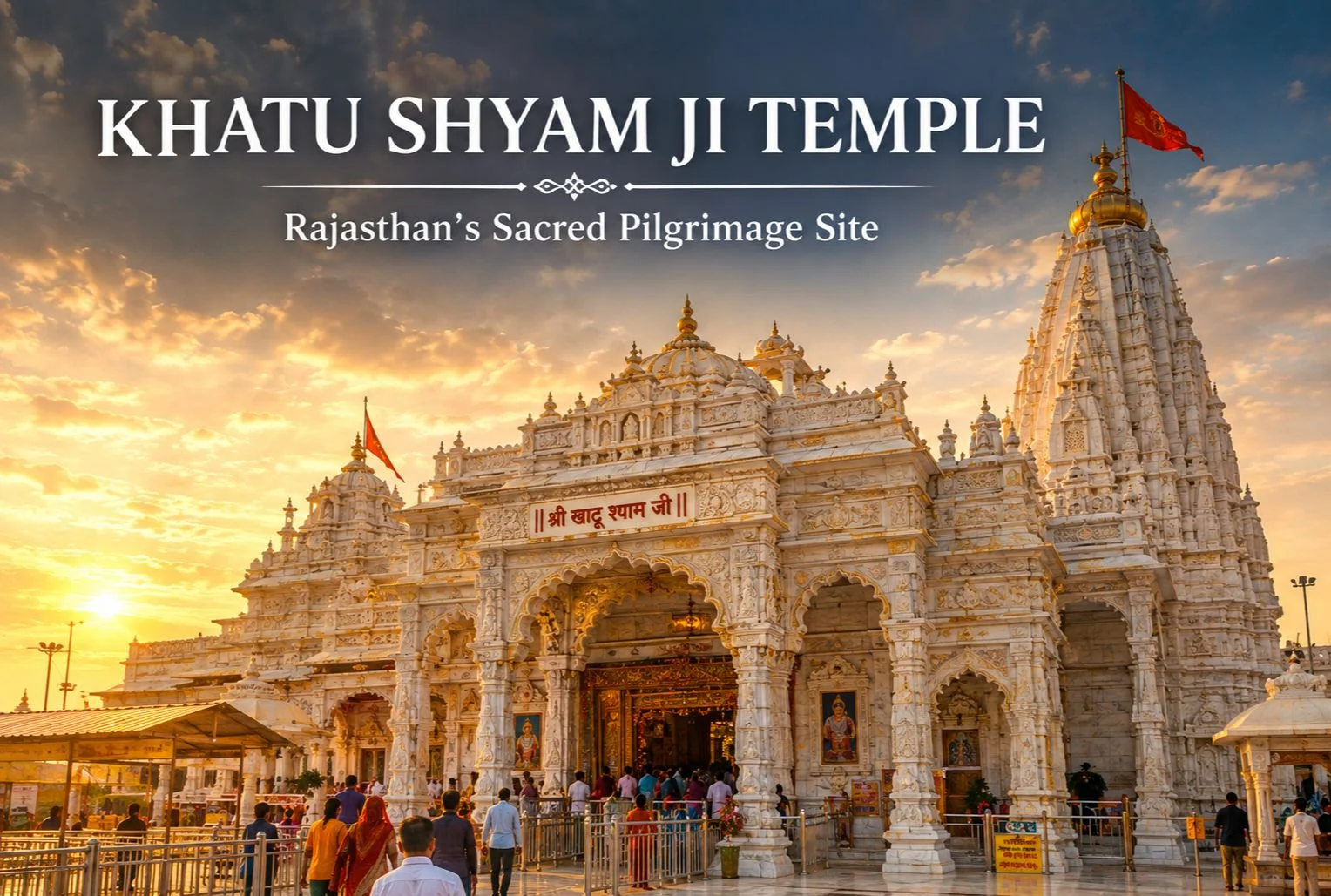
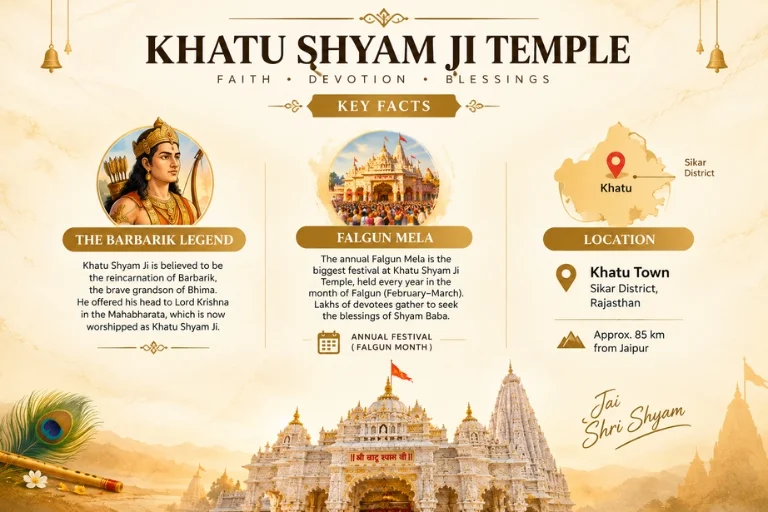
Khatu Shyam Ji Temple is located in the town of Khatu, in Sikar district, Rajasthan, dedicated to Khatu Shyam Baba, worshipped as a form of Lord Krishna. The temple’s popularity has grown enormously over recent decades, drawing pilgrims not just from Rajasthan but from across North India, particularly during major festival periods.

Khatu Shyam Ji Temple - History

The Legend Behind Khatu Shyam Baba Temple

The story behind Khatu Shyam Baba Temple traces back to the Mahabharata and the warrior Barbarik, grandson of Bhima. According to legend, Barbarik possessed extraordinary combat skills and vowed to fight on the side of the weaker army in the Kurukshetra war. To test his resolve and prevent the war from ending too quickly, Lord Krishna asked for his head as alms (shirdaan), which Barbarik gave willingly. Pleased by this sacrifice, Krishna granted him a boon that he would be worshipped in the Kali Yuga under the name Shyam, which is how the deity came to be known as Khatu Shyam Baba, with Khatu being the town where his head is believed to be enshrined.

Khatu Shyam Temple: Architecture and Significance

The Khatu Shyam temple structure reflects Rajasthani temple architecture, with a prominent shikhara and detailed marble work throughout the complex. The main sanctum houses the deity’s image, and the temple complex includes additional structures like Shyam Kunj, considered significant for devotees performing specific rituals during their visit.

Khatu Shyam Temple Timings

Khatu Shyam temple timings generally follow a structured daily schedule, though visitors should confirm details locally given how much footfall the temple sees, especially during peak season.

Time SlotApproximate Hours
Morning darshan (Mangala Aarti)4:30 AM – 12:00 PM
Afternoon break12:00 PM – 4:00 PM
Evening darshan and Aarti4:00 PM – 10:00 PM

These timings can shift significantly during the Falgun Mela and other major festival periods, so confirming the current schedule with temple management or an official source shortly before traveling is strongly recommended.

The Falgun Mela: Khatu’s Biggest Event

The Falgun Mela, held annually around the Hindu month of Falgun (typically February-March), is when the temple sees its highest footfall of the year, with lakhs of devotees arriving over several days. Roads leading into Khatu get significantly congested during this period, and planning around it—either to join the festivities or to avoid the crowds entirely—makes a real difference to the visit experience.

Best Time to Visit

Outside the Falgun Mela, the temple sees steady but more manageable crowds year-round, with weekdays generally quieter than weekends. Winter months (October to February) offer more comfortable travel weather for the Rajasthan region overall, avoiding the intense summer heat that builds up by April and May.

How to Reach Khatu

By Air

The nearest airport is Jaipur International Airport, roughly 80 km from Khatu.

By Train

Ringas Railway Station is the nearest railhead, roughly 17 km from the temple, well-connected to Jaipur and other major Rajasthan cities.

By Road

Khatu is well-connected by road from Jaipur, Sikar, and Ringas, with regular bus and taxi services available, particularly during the Falgun Mela when additional transport options are arranged.

Extending Your Pilgrimage

For travelers whose pilgrimage plans extend beyond Rajasthan into the Himalayas, Explore Hills’ Kedarnath Yatra covers one of India’s most significant mountain pilgrimages, and the Char Dham Yatra bundles four of Uttarakhand’s most sacred shrines into a single extended journey for those planning a broader multi-region pilgrimage circuit.

For official visitor information and travel advisories for the Sikar district and Falgun Mela arrangements, you can refer to the Rajasthan Tourism Department, the official state government tourism body.

What to Keep in Mind Before Visiting

  • Dress modestly, with shoulders and knees covered
  • Expect long queues during peak hours and especially during the Falgun Mela
  • Footwear isn’t permitted inside the temple sanctum
  • Carry cash for offerings, as card acceptance is inconsistent in smaller shops around the temple town

Conclusion

Khatu Shyam Ji Temple isn’t just a regional pilgrimage stop—it’s become one of the most visited Krishna-related shrines in North India, driven by a legend that resonates deeply with devotees. Whether you visit during the intensity of the Falgun Mela or on a quieter weekday, it’s a temple that leaves a strong impression on nearly everyone who makes the trip.

Frequently Asked Questions

What is Khatu Shyam Ji Temple famous for?

It is famous as the shrine of Khatu Shyam Baba, associated with the Mahabharata warrior Barbarik, and is one of North India’s most visited pilgrimage sites.

What are the current Khatu Shyam temple timings?

The temple generally follows morning and evening darshan slots, though timings can shift significantly during the Falgun Mela, so confirming locally before travel is advised.

What is the legend behind Khatu Shyam Baba Temple?

According to the Mahabharata, warrior Barbarik offered his head to Lord Krishna as alms and was granted a boon to be worshipped as Shyam in the Kali Yuga.

When is the best time to visit Khatu Shyam Temple?

Winter months (October to February) offer comfortable weather, though many devotees specifically plan around the Falgun Mela in February-March for the festival experience.

How do I reach Khatu Shyam Ji Temple?

The nearest railway station is Ringas, roughly 17 km away, and the nearest airport is Jaipur International Airport, about 80 km from Khatu.

Jyotirlinga in Maharashtra: Names, Locations & Travel Guide

Jyotirlinga in Maharashtra

Quick answer: Maharashtra is home to three universally recognized Jyotirlingas—Trimbakeshwar (Nashik), Bhimashankar (Pune district), and Grishneshwar (near Ellora, Chhatrapati Sambhajinagar). Two more sites, Parli Vaijnath (Beed) and Aundha Nagnath (Hingoli), are also worshipped as Jyotirlingas by local tradition, though these two identities are contested by similarly named shrines in other states. Depending on which tradition you follow, Maharashtra claims either 3 or 5 of the 12 Jyotirlingas.

If you’ve searched for the jyotirlinga in Maharashtra, you’ve probably run into two different answers — some sources say three, others say five. That inconsistency isn’t a mistake on anyone’s part. It comes down to genuine, long-standing disagreement within Hindu tradition about the exact location of two of the twelve Jyotirlingas, and Maharashtra happens to sit at the center of both disputes.

This guide sorts out which Jyotirlingas in Maharashtra are undisputed, which are debated, and why. You’ll also find the exact distance from Mumbai and Pune to each shrine, what to expect when you visit, and how to sequence a multi-temple yatra without wasting days on backtracking.

What Is a Jyotirlinga, and Why Does Maharashtra Have So Many?

A Jyotirlinga is a shrine where Lord Shiva is worshipped in the form of a “linga of light.” According to Hindu tradition, there are twelve such sites across India, each believed to mark a place where Shiva manifested in a radiant, self-formed pillar of light. The Shiva Purana lists all twelve, and pilgrims consider visiting them collectively — the Dwadash Jyotirlinga Yatra — one of the most significant spiritual journeys in Shaivism.

Maharashtra’s concentration of Jyotirlingas isn’t accidental. The state has one of the longest and most continuous traditions of Shiva worship in India, tied closely to the Godavari river basin, the Sahyadri hill temples, and centuries of temple patronage under regional dynasties. Three of the twelve Jyotirlingas fall within Maharashtra’s borders without dispute, and the state is also home to two more shrines that are locally worshipped as Jyotirlingas, even though their canonical status is debated elsewhere in the country.

The Five Sacred Abodes Maharashtra Jyotirlinga

How Many Jyotirlinga Are There in Maharashtra?

This is the most commonly asked question about the topic, so it deserves a direct answer before anything else.

Three Jyotirlingas in Maharashtra are undisputed:

  1. Trimbakeshwar (Nashik)
  2. Bhimashankar (Pune district)
  3. Grishneshwar (near Ellora, Chhatrapati Sambhajinagar)

Two additional sites are worshipped as Jyotirlingas in Maharashtra, but their identity is contested:

  1. Parli Vaijnath (Beed district) — worshipped locally as the Vaidyanath Jyotirlinga, a title also claimed by the Baidyanath Dham temple in Deoghar, Jharkhand.
  2. Aundha Nagnath (Hingoli district) — worshipped locally as the Nageshwar Jyotirlinga, a title also claimed by the Nageshwar Temple near Dwarka, Gujarat.

So if someone asks how many Jyotirlinga are in Maharashtra, the honest answer depends on which regional tradition you follow. Pilgrims from Maharashtra generally count all five as part of their state’s sacred geography, while pan-India tradition and most Sanskrit textual sources recognize only Trimbakeshwar, Bhimashankar, and Grishneshwar without dispute. Both positions are held sincerely by different communities, and neither is presented here as more correct than the other — this guide simply flags where the disagreement exists so you can plan with accurate expectations.

What Are the Names of the Jyotirlinga in Maharashtra?

Here’s a quick-reference table covering all five, including the three undisputed sites and the two locally claimed ones.

Jyotirlinga NameDistrict / CityNearest Major CityApprox. Distance from MumbaiApprox. Distance from PuneStatus
TrimbakeshwarNashikNashik (28 km)~180 km~225 kmUndisputed
BhimashankarPune districtPune (110 km)~225 km~110 kmUndisputed
GrishneshwarChhatrapati Sambhajinagar (Aurangabad)Aurangabad (30 km)~350 km~235 kmUndisputed
Parli VaijnathBeedParli town~450 km~340 kmLocally worshipped; identity contested
Aundha NagnathHingoliHingoli town~600 km~440 kmLocally worshipped; identity contested

These figures are approximate road distances and can vary depending on your exact starting point and route. Always confirm the current distance and driving time using a live maps service before you finalize your itinerary, especially for the longer legs to Beed and Hingoli.

Trimbakeshwar: The Jyotirlinga at the Source of the Godavari

Trimbakeshwar sits about 28 km from Nashik city, right at the base of the Brahmagiri hills — the traditional source of the Godavari river, one of India’s most sacred waterways. The temple’s linga is unusual among Jyotirlingas: it has three small faces representing Brahma, Vishnu, and Shiva, which is where the “Trimbak” (three-eyed) name comes from.

The current structure was built in the 18th century under Peshwa Nanasaheb, replacing an older temple on the same site, and its black stone carving is considered some of the finest Peshwa-era temple architecture in Maharashtra. Trimbakeshwar is also where the Kumbh Mela is held every twelve years, alternating with Nashik’s Ramkund ghats, which tells you how central this site is to the region’s religious calendar.

If you’re combining this with a Nashik trip, plan for a half-day visit including the temple and Brahmagiri hill, which has a short trek to its base for those who want a wider view of the valley.

Bhimashankar: A Jyotirlinga Inside a Wildlife Sanctuary

Bhimashankar is roughly 110 km from Pune, tucked into the Sahyadri range inside the Bhimashankar Wildlife Sanctuary — a detail that sets it apart from every other Jyotirlinga on this list. You’re not just visiting a temple here; you’re driving through dense forest that’s home to the Malabar giant squirrel, among other species protected under the sanctuary’s conservation status.

According to tradition, this is where Shiva took the form of Bhima to defeat the demon Tripurasura, and the river Bhima is said to originate near the temple. The current temple structure dates to the 18th century, built in a style that blends Nagara and later architectural influences, with detailed carvings on its sabha mandap (assembly hall).

Because Bhimashankar sits inside a protected forest, plan your visit for daylight hours, and check ahead if you intend to combine the temple visit with any nature trail inside the sanctuary.

Grishneshwar: The Jyotirlinga Next to the Ellora Caves

Grishneshwar is the most conveniently located Jyotirlinga on this list for travelers already planning a heritage trip, since it sits barely a kilometer from the Ellora Caves — a UNESCO World Heritage Site and one of India’s most significant rock-cut temple complexes. The Kailasa Temple at Ellora, carved entirely from a single rock face, is one of the standout monuments in that complex and is well worth pairing with your Grishneshwar visit on the same day.

The temple you see today was rebuilt in the 18th century by Ahilyabai Holkar, the Maratha queen responsible for restoring several major Hindu temples across India after earlier periods of destruction. Its five-tiered shikhara (spire) is built from red volcanic rock, distinct from the stone used at most other Jyotirlingas on this list.

Because Grishneshwar and Ellora sit so close together, most travelers treat this as a single day trip from Chhatrapati Sambhajinagar (Aurangabad), roughly 30 km away.

Parli Vaijnath: Maharashtra’s Contested Vaidyanath Jyotirlinga

Parli Vaijnath, in Beed district, is worshipped by many Maharashtrian pilgrims as the Vaidyanath Jyotirlinga — the shrine associated with Shiva in his form as the “Lord of Physicians.” The dispute here isn’t about whether Parli Vaijnath is a significant, ancient Shiva temple — it clearly is — but about whether it, or the Baidyanath Dham temple in Deoghar, Jharkhand, holds the original Vaidyanath Jyotirlinga status described in the Shiva Purana. Both temples have long, independently documented pilgrimage traditions, and travelers from Maharashtra typically visit Parli Vaijnath as part of their state’s Jyotirlinga circuit regardless of the broader debate.

The temple itself, rebuilt by Ahilyabai Holkar like Grishneshwar, sits on a small hillock in Parli town and is known for its finely carved black stone mandap.

Aundha Nagnath: Maharashtra’s Contested Nageshwar Jyotirlinga

Aundha Nagnath, in Hingoli district, is the more remote of the two contested sites and sees noticeably fewer pilgrims than the other four temples on this list, partly because of the longer drive from both Mumbai and Pune. Local tradition identifies this as the Nageshwar Jyotirlinga, a title more widely associated with the Nageshwar Temple near Dwarka in Gujarat. As with Parli Vaijnath, this is a case of two long-standing regional traditions claiming the same identity rather than one temple being more “authentic” than the other.

The temple’s carved stone architecture is considered historically significant in its own right, with inscriptions and structural elements dating back several centuries, independent of the Jyotirlinga naming dispute.

What’s the Best Way to Plan a Jyotirlinga Yatra Across Maharashtra?

Trying to cover all five sites in one trip is possible, but only if you accept a fair amount of driving — the distance between Bhimashankar and Aundha Nagnath alone is close to 500 km. Here’s a more realistic way to break it up:

  • If you have 2–3 days: Cover Trimbakeshwar and Grishneshwar together via Nashik and Aurangabad, adding the Ellora Caves to the same trip.
  • If you have 3–4 days and are based in Pune: Combine Bhimashankar with Trimbakeshwar, since both are reachable from Pune within a half-day drive of each other via Nashik.
  • If you want all five sites: Budget 7–8 days minimum, sequencing Trimbakeshwar → Bhimashankar → Grishneshwar → Parli Vaijnath → Aundha Nagnath (or the reverse) to avoid unnecessary backtracking across the state.

Most of these temples get busy on Mondays, since the day is traditionally associated with Shiva worship, and during the month of Shravan (typically falling between July and August), when queues can extend well beyond an hour. If your schedule allows flexibility, visiting on a weekday outside Shravan makes for a noticeably calmer experience at each shrine.

Quick Facts Table: Maharashtra Jyotirlinga at a Glance

DetailInformation
Total Jyotirlingas in India12
Undisputed Jyotirlingas in Maharashtra3 (Trimbakeshwar, Bhimashankar, Grishneshwar)
Additional locally worshipped sites2 (Parli Vaijnath, Aundha Nagnath)
Nearest major cities for a baseNashik, Pune, Chhatrapati Sambhajinagar (Aurangabad)
Busiest periodShravan month (typically July–August) and Mondays
Nearby heritage siteEllora Caves (adjacent to Grishneshwar)

What Should You Carry for a Temple Visit Like This?

Each of these temples follows standard Hindu temple etiquette, so a few basics will keep your visit smooth:

  • Modest clothing that covers shoulders and knees
  • A change of clothes if you plan to bathe in the temple kund before darshan, as is customary at several of these sites
  • Cash in small denominations for offerings and local transport, since card acceptance is inconsistent in smaller temple towns like Parli and Aundha
  • Comfortable, easy-to-remove footwear, since shoes aren’t permitted inside the temple premises
  • A basic first-aid kit if you’re combining the Bhimashankar visit with any walking inside the wildlife sanctuary

According to the Maharashtra Tourism Development Corporation, visitors should also confirm current darshan timings directly with each temple trust before traveling, since hours can shift around major festivals.

Planning Beyond Maharashtra’s Jyotirlinga Circuit

If this deep dive into Maharashtra’s Jyotirlinga sites has you thinking about India’s broader pilgrimage landscape, it’s worth knowing that four more of the twelve Jyotirlingas — Kashi Vishwanath, Kedarnath is separate from the Jyotirlinga at Ujjain and Omkareshwar, but the Himalayan pilgrimage circuit that includes Kedarnath remains one of the most significant Shiva-related yatras in the country. If a mountain pilgrimage interests you alongside your Maharashtra temple visits, Explore Hills’ Kedarnath Yatra and Char Dham Yatra packages cover guided travel to some of the most revered shrines in the Himalayas, with the Kedarnath shrine guide offering more detail on what to expect at the temple itself.

Whichever direction your yatra takes you next, Maharashtra’s Jyotirlinga sites are worth the drive — five ancient shrines, each with its own architecture, landscape, and story, all within a state you can cross by road in under a week.

Frequently Asked Questions

How many Jyotirlinga are there in Maharashtra?

Three Jyotirlingas in Maharashtra are undisputed — Trimbakeshwar, Bhimashankar, and Grishneshwar. Two more, Parli Vaijnath and Aundha Nagnath, are worshipped locally as Jyotirlingas, bringing the state’s total to five according to regional tradition, though their identity is contested by similarly named temples in Jharkhand and Gujarat.

What are the names of the Jyotirlinga temples in Maharashtra?

The five temples associated with Jyotirlinga worship in Maharashtra are Trimbakeshwar (Nashik), Bhimashankar (Pune district), Grishneshwar (Chhatrapati Sambhajinagar), Parli Vaijnath (Beed), and Aundha Nagnath (Hingoli).

Which Jyotirlinga is closest to Mumbai?

Trimbakeshwar, near Nashik, is the closest at approximately 180 km from Mumbai, making it feasible as a long day trip or an easy overnight visit.

Which Jyotirlinga is closest to Pune?

Bhimashankar is closest to Pune, at roughly 110 km, and is a common day-trip destination for pilgrims based in the city.

Can I visit all five Jyotirlinga sites in Maharashtra in one trip?

Yes, but it requires at least 7–8 days given the distances involved, particularly the long stretch between Bhimashankar and the more remote sites of Parli Vaijnath and Aundha Nagnath in eastern Maharashtra.

Why is there a dispute over some Jyotirlinga locations in Maharashtra?

Two of the twelve Jyotirlingas described in the Shiva Purana — Vaidyanath and Nageshwar — are each claimed by more than one temple in different states. Maharashtra’s Parli Vaijnath and Aundha Nagnath are among the temples claiming these identities, alongside temples in Jharkhand and Gujarat respectively. Both positions are held sincerely within their respective regional traditions.

Is Grishneshwar close to the Ellora Caves?

Yes, Grishneshwar is located barely a kilometer from the Ellora Caves, making it easy to combine a temple visit with a half-day or full-day exploration of the UNESCO-listed rock-cut monuments, including the Kailasa Temple.

What is the best time of year to visit the Jyotirlinga temples in Maharashtra?

Most pilgrims visit during the Shravan month, typically falling in July or August, though this is also when crowds peak. Weekdays outside this period offer a quieter, more comfortable darshan experience at all five sites.